Gab

13.1K posts

Gab banner
Gab

Gab

@GabGrowth

I write about asymmetric investments that go unnoticed, with a deep focus on emerging markets.

Singapore Katılım Ağustos 2018
589 Takip Edilen22.5K Takipçiler
Sabitlenmiş Tweet
Gab
Gab@GabGrowth·
It's been almost 16 months since I started publishing my deep dives in public and 6 months since going paid. I thought it would be a good moment to pause and express my gratitude for the community that has formed around this work. When I first started writing, there were no expectations beyond wanting to think more clearly by documenting my process, and sharing ideas with like-minded individuals. The response since then has been far more encouraging than I could have imagined. I also think it’s an appropriate time to take stock of how things have been going and provide some transparency around the performance of these deep dives so far. I've published 13 deep dives to date, 10 bullish and 3 neutral. I have no interest in being bearish or short. If I don't like a business/stock, I simply don't buy it. Of the 10 bullish picks, 9 are currently in the green while 1 is in the red. One of the green positions has been closed, while the others continue to be held. Of the 3 bearish picks, all 3 are in the red as I write. On average: - Bullish picks: +38.7% - Bearish picks: -26.7% - SPY: +12.2% over the same period I must also acknowledge that I’ve been fortunate to have started this blog in the middle of a bull market, and the performance to date is by no means a reliable indicator of long-term success. I’m sector-agnostic, and these names span e-commerce, consumer discretionary, SaaS, infrastructure and more. It's still very early and I've thoroughly enjoyed the process thus far. There will definitely be drawdowns and mistakes ahead. As always, I'll stay transparent and share both the research and the outcomes, good and bad. Thank you to everyone who has been part of the journey, in particular to paid subs who continue to place their trust in an anonymous person from a tiny country in Southeast Asia. I hope to continue rewarding that faith by producing high-quality research grounded in facts, not hyperbole. ❤️
Gab tweet media
English
9
4
121
35K
Danny cheng
Danny cheng@dannycheng2022·
When my DIU indicator (Danny’s Indicator of Unfollowers/Unsubscribers) aligns strongly with the Fear and Greed Index, I get excited. I know the market is handing us retail investors real opportunities. Every single time these two signals line up, it delivers! Thank you for the recent dips, which are perfect opportunities for us genuine, dedicated long-term investors! Today, many stocks are flashing bullish signals again, and I’ll share them at the end of my daily review.
Danny cheng tweet media
English
19
6
199
27.1K
Gab
Gab@GabGrowth·
@jakebrowatzke "$3M of deployable leverage" It looks like you've learned nothing, i'm sorry.
English
0
0
2
118
Gab
Gab@GabGrowth·
@DotyBilly @sidprabhu It's a pivot. He ran a P2E gaming channel previously covering Axie Infinity, Sandbox etc. That worked out well..
English
0
0
0
645
Gab
Gab@GabGrowth·
@MikeFritzell Always short shitcos instead of expensive goodcos
English
1
0
6
219
Gab
Gab@GabGrowth·
@mkfilko Yeah kinda weird to have $SPCX as the 3rd name tbh hahaha but this is their rationale:
Gab tweet media
English
1
0
2
347
leki ⚔️
leki ⚔️@mkfilko·
@GabGrowth That's actually really cool but I wonder what's the rationale for selecting $SPCX lol.
English
1
0
1
463
Gab
Gab@GabGrowth·
JUST IN: Singapore investors can now invest in $SE $GRAB $SPCX through the local exchange. SGX launched Singapore Depository Receipts for these 3 names and they represent the first 3 US listed stocks. Investors will be able to trade these during local trading hours in Singapore dollars.
Gab tweet media
English
5
7
107
8.4K
Gab
Gab@GabGrowth·
The items i’m discussing are certified real on Amazon and Shopee (to the best of my knowledge). ShopeeMall items are 100% authentic, with 2x refunds if found to be inauthentic. Most brands in the mall section are run by the official stores and I personally haven’t had any issues.
English
0
0
1
163
Michael Fritzell (Asian Century Stocks)
Very surprised Amazon has failed in Southeast Asia. I have nothing but good experiences dealing with it. Customers are most likely too price sensitive to buy branded products.
Michael Fritzell (Asian Century Stocks) tweet media
English
23
6
50
6.7K
Gab
Gab@GabGrowth·
@trailsad Yes agreed. I am also subscribed to email notifications and have noticed them. That said, there are many reasons for executives selling and that hasn’t stopped many stocks from continuing to climb (Zuck at $META, Gates at $MSFT come to mind) Still disappointing to see, for sure
English
0
0
2
249
Des
Des@trailsad·
@GabGrowth Agree, but i’m not a big fan of management cashing out on their shares. Don’t know how many Form 144 notifications i’ve received in the past months.
English
1
0
2
94
Gab
Gab@GabGrowth·
Fully agree with everything Amit said here on $GRAB. So far, this has been an unsuccessful investment simply because the stock is down/sideways. However, the gap between the stock and the business has never been wider. Operationally, Grab has continued to execute well. GMV has continued to grow >20%, take rates have climbed, incentive spend has been disciplined, and operating leverage is just beginning. What has affected them are all external shocks. Fuel cost spikes, the Indonesian commission cap slashing driver-side economics from 20% to 8%, and outflows to AI-related equities. The clearest proof is to look at $SE $MELI $NU $INTR stock prices in the past year. An entire cohort of high-quality EM platforms have been repriced together. Eventually, quality rises to the top. Unlike the majority of FinTwit, my investment horizon is far longer than a week, a month or a year.
amit@amitisinvesting

$GRAB This will be a long post and dive into many things including Grab's stock performance, some updated thoughts on my Grab thesis after having visited Southeast Asia last month, and new models for valuation. Let's get into it. First off, it's obvious that the stock has not performed in the way that most would like since I first initiated coverage, which was at $4.50. The stock is currently at $3.57, so it is down 20% in the 1.5 years since I laid out my thesis. I think there are many reasons for this but the common theme behind these reasons are less about the fundamentals and more about the macro. It sucks to say that because it would imply that larger forces have played a role outside of the business's execution, but I do think that has happened and unfortunately has made the investment, so far, unsuccessful. Two major macro disruptions hurt grab: the price of oil skyrocketing and the violent shift to AI stocks. On the price of oil, the company actually has weathered the storm very nicely if you look at their latest earnings, but the sentiment around companies in a region that is prone to oil price risk has been very bad. On AI, this is something that I quite frankly just didn't see coming. $UBER is an exceptional business and in my opinion undervalued, but the overhang of robotaxis has led the stock to not do much. The intensity of the AI buildout that began in early 2025 meant that capital was rotating and Grab wouldn't play a role in that infra cap-ex trade which meant it would be prone to be stuck. I can't even blame the market here, why invest in a company that is growing 25% when you can pick memory names or neoclouds growing 500%? Having said that, the fundamentals of the business have only gotten better. I know that in this market environment, if you can't get 20% ROI in a week then your stock is failure, but if we are being a bit more realistic...things take time. HOOD took time. PLTR took time. Not every name explodes because of a datacenter contract and I believe that has given some people unrealistic expectations. Regardless, an opportunity cost is an opportunity cost and if the stock price is the basis for judgement, then the investment has not fully played out yet. Thankfully, my time horizon is greater than 1.5 years. I did have calls on GRAB in addition to shares for Jan 2027 and if there is not a meaningful change over the coming months, those calls will be worth nothing. That is the game -- if you take a risk with options, you have to be ready for the downside. Second, my experience in Southeast Asia. I visited Singapore and basically used GRAB every single day, multiple times a day. My initial thesis was based on a simple idea: compounding earnings growth while consolidating market share within the region. Being able to build the superapp that can grow users would allow upsells and as margins expand, so would operating leverage, which would elevate the company's value. Nothing in my personal experience changed that thesis and if anything, actually witnessing how intense the product was in the region strengthened my conviction. In order to deal with competition in the region, Grab either has to expand or offer better deals to out compete. With 50M+ MAU, I believe they have still under penetrated the region and have a significant runway of growth to go in order to achieve these goals. Ultimately, many of the competitors in the region are burning cash and can't produce a profit. Eventually, I believe that marketshare continues to consolidate and the one left standing should be able to benefit the most. Third, valuation. So, I have updated my models and assumptions based on Q1 numbers. I believe the conservative, fair intrinsic value for the name is at $7.50 which is why I continue to own shares. Q1 2026: Revenue guidance: $4.04-4.10B (+20-22%) Adjusted EBITDA guidance: $700-720M (+40%+) Q1 revenue: $955M (+24% YoY) Q1 Adjusted EBITDA: $154M (+46% YoY) Loan book: $1.44B (+130% YoY) Financial Services approaching EBITDA breakeven Ongoing $400M accelerated share repurchase Net cash balance remains one of the strongest in internet/platform companies For 2027, I would use deliberately conservative assumptions across all three scenarios. In the bear case, Grab grows revenue by 15% to approximately $4.7 billion and reaches a 19% adjusted EBITDA margin, producing roughly $900 million of adjusted EBITDA. In the base case, revenue grows by 18% to about $4.85 billion, while the adjusted EBITDA margin expands to 22%, resulting in approximately $1.07 billion of adjusted EBITDA. In the bull case, revenue grows by 22% to around $5.0 billion and the adjusted EBITDA margin reaches 25%, generating about $1.25 billion of adjusted EBITDA. These projections assume only moderate operating leverage, even though Grab has recently been expanding profitability faster than revenue. For valuation, I would apply an 18x adjusted EBITDA multiple in the bear case, a 24x multiple in the base case, and a 28x multiple in the bull case. Grab should trade at some discount to larger global platforms because of its geographic concentration in Southeast Asia and the risks associated with emerging markets. However, that discount is partly offset by Grab’s leading regional position, improving margins, financial-services growth, strong balance sheet, advertising opportunity, and continued share repurchases. In the bear case, applying an 18x multiple to $900 million of adjusted EBITDA produces an enterprise value of approximately $16.2 billion. After adding roughly $5 billion of net cash, Grab’s equity value would be about $21.2 billion. Using approximately 4.05 billion diluted shares outstanding, that implies a value of roughly $5.25 per share, with a reasonable bear-case range of approximately $5.25 to $5.75. In the base case, applying a 24x multiple to approximately $1.07 billion of adjusted EBITDA produces an enterprise value of about $25.7 billion. Adding roughly $5 billion of net cash results in an equity value of approximately $30.7 billion. Based on approximately 4.05 billion diluted shares, the implied value is around $7.55 per share. That supports a base-case valuation range of approximately $7.50 to $8.25 per share. In the bull case, applying a 28x multiple to $1.25 billion of adjusted EBITDA results in an enterprise value of approximately $35 billion. After adding roughly $5 billion of net cash, Grab’s equity value would reach about $40 billion. Dividing that by approximately 4.05 billion diluted shares produces an implied value of roughly $9.90 per share, supporting a bull-case range of approximately $9.75 to $11.00. My preferred valuation framework therefore produces a bear case of $5.25 to $5.75 per share, a base case of $7.50 to $8.25 per share, and a bull case of $9.75 to $11.00 per share. The base case does not require aggressive assumptions. It only assumes that Grab continues growing at a healthy but moderating rate, improves margins as the business scales, and receives a valuation multiple that remains below many higher-growth global technology and marketplace companies. A valuation of $8.50 per share is also defensible without relying on an extreme bull case. One path would be for Grab to generate roughly $5 billion of revenue and achieve an adjusted EBITDA margin of 23% to 24%, producing approximately $1.15 billion of adjusted EBITDA. At a 24x multiple, that would imply an enterprise value of roughly $27.6 billion. Adding approximately $5 billion of net cash would produce an equity value of around $32.6 billion, or approximately $8.05 per share before factoring in additional share repurchases or stronger cash generation. A slightly higher EBITDA result, a modestly higher multiple, or a lower diluted share count could push the valuation into the $8.50 range. Another path to $8.50 would be a moderate valuation rerating. If Grab generates approximately $1.1 billion of adjusted EBITDA and trades at 26x adjusted EBITDA rather than 24x, its enterprise value would be approximately $28.6 billion. After adding roughly $5 billion of net cash, the equity value would be about $33.6 billion, which translates to approximately $8.30 per share using 4.05 billion diluted shares. Additional buybacks, higher net cash, or slightly stronger earnings could bring the implied value closer to $8.50 to $9.00 per share. The market may also be underestimating Grab because it is still often viewed primarily as a ride-hailing and food-delivery company. In reality, Grab is developing several potential profit engines. Mobility can continue generating strong margins and cash flow, delivery benefits from greater scale and operational efficiency, financial services could become a meaningful earnings contributor as the loan book grows, and advertising remains relatively early in its development. At the same time, artificial intelligence and automation may improve driver utilization, merchant performance, customer targeting, and corporate efficiency. In all of these scenarios, I am also not anticipating revenue growth of 30% or above. This is the wild card, given the company is expanding to Taiwan and has a host of new initiatives that they have been getting into with M&A, if they can reaccelerate to 30%+, it changes all assumptions and could further lead to a rerating. Overall, I would view approximately $7.50 as a conservative base-case intrinsic value if Grab simply executes on its current trajectory. A value closer to $8.50 is reasonable if the company delivers modest upside to current expectations, continues expanding margins, repurchases shares, and receives even a small valuation rerating from the market. So, those are my updated thoughts. Some have asked why I don't talk about the name everyday, it's simple: there isn't much to discuss. The name is stuck based on the market's lack of interest which is why I think the discount has become so intense. I continue to hold and until I feel the thesis changes dramatically, if it doesn't, then I will continue to engage in the most boring part of investing: being patient and trusting a thesis can play out.

English
5
1
143
15.7K
Gab
Gab@GabGrowth·
Perhaps their failure in the larger e-commerce business meant it didn’t make sense to continue if it couldn’t amortise the cost of fulfilment over a larger base. I’ve used Amazon for products a few times, but have always been shocked at how expensive they are and the delivery time. Oftentimes, I could find the same product on Shopee for 1/2 to 1/3 the price and 1/4 the delivery time. I only bought very specific items (usually branded sportswear) from Amazon because it wasn’t available elsewhere.
English
1
0
1
174
Gab
Gab@GabGrowth·
I’m not sure if there is an official definition, but I refer to 2.0 as platform businesses that focus on selling access to a market, prioritise network effects, with mobile and payments as accelerants. 3.0 is where platforms actively manufacture shopping intent, impulse buying and algorithms are key here. Creators become the distribution layer.
English
0
0
1
89
Gab
Gab@GabGrowth·
@MikeFritzell What kind of items were you buying on Fresh? International products? I believe Amazon Fresh’s withdrawal was due to lack of demand for everyday essentials, with their customers prioritising international goods that maybe weren’t available through RedMart, FairPrice Online, etc?
English
1
0
1
197
Gab
Gab@GabGrowth·
@mvcinvesting Watching your journey and you sticking to your principles all the way has been inspiring, congratulations on the milestone!
English
2
0
6
1.4K
MrOuzbek
MrOuzbek@ZweeiPh·
@GabGrowth @the_zack_zhu You guys are the top 0,001% of X. Every time I read your analyses, I learn something new. Thank you very much for your excellent content. Always a pleasure to see a long thread with your name in my feed. 🙇‍♂️
English
2
0
2
75
Gab
Gab@GabGrowth·
$APP Adam Foroughi gets a lot of praise and the majority of attention when people discuss AppLovin, and he deserves it. But someone that I think is overlooked, is Giovanni Ge, their newly appointed CTO. Giovanni joined the company in Nov 2022, having worked as a ML engineer at $META, and at $UBER and $BLK previously. He studied at the University of Science and Technology of China before doing his PhD in Condensed Matter and Materials Physics at SISSA in Italy. Upon joining, he led the Axon 2 model development with Basil Shikin (previous CTO). In an interview with David Senra, Adam is explicit that Giovanni led it, built the team, and runs it. He described him as fresh blood with an insanely high IQ, one of the smartest people he’s ever met, and in his words, “much smarter than I am”. That is high praise. What was more interesting, was Adam revealing what Giovanni did for the culture of the company. Adam mentioned that Giovanni came in daily grilling him with uncomfortable questions like why does this person exist, why this team, why these processes, why is this VP above someone better. Adam says he faced a choice, either address those questions or lose a talent like Giovanni. That interrogation directly triggered the ~40% headcount reduction in 2023-24 (while revenue nearly doubled) and his shift to treating culture as something to re-derive continuously rather than preserve. Adam called Giovanni an A+ player with zero tolerance for non-A players, quick to cut anyone not at the required level, willing to fire on sight. He frames this impatience as the mechanism that lets him trust the org: put A+ leaders in key roles and they self-police quality below them. Since joining, Giovanni has had a rapid rise to the top. He was a part of the engineering and technical staff when joining but quickly rose to be the company’s Chief Product and Engineering Officer from November 2025 through July 2026 and has just taken over from Basil Shikin as CTO. Adam mentioned that this was simply a case of natural succession. Just as Shikin displaced co-founder John Krystynak as CTO in 2016 because the person underneath had become better, Shikin is now shifting roles and the person who built the new technology, Giovanni, has taken the CTO role. Adam’s stated principle is that the best person must hold the role at any moment, or that person will leave and start a new company. I think this speaks a lot to the competence of Giovanni, and also the humility and clear-mindedness of Adam. The combination of Adam and Giovanni, is not a team I would want to bet against. P.S. I am working on an $APP deep dive and will be aiming to hit publish in the coming week. Find it in the usual place!
Gab tweet media
English
5
4
61
6.6K
Gab
Gab@GabGrowth·
@the_zack_zhu Cool! I’m still looking through interviews, should come across it soon!
English
1
0
2
371
Zack Zhu
Zack Zhu@the_zack_zhu·
@GabGrowth An interesting thing that I learn from an interview is that Giovanni Ge was a person that cares about work life balance before joining Meta. In Meta, he become passionate and than become a workaholic.
English
1
0
2
472
Gab
Gab@GabGrowth·
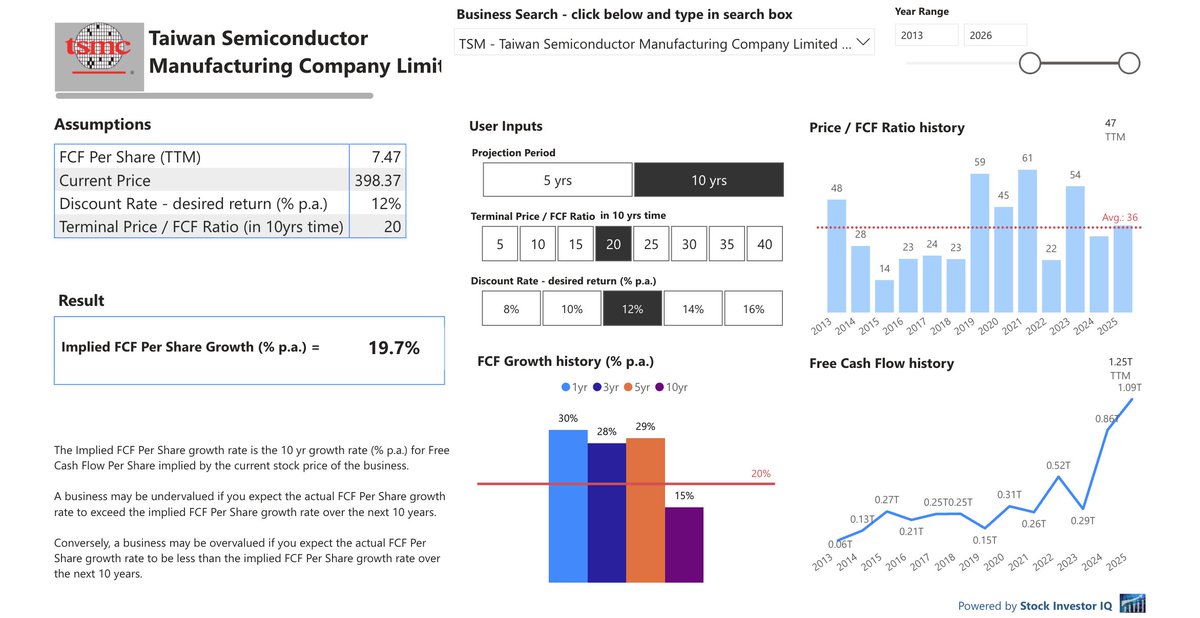
Pic shows 20x* P/FCF (!), which would imply 19.7% FCF per share growth. Here is the 25x P/FCF version:
Gab tweet media
English
0
0
5
1.3K
Gab
Gab@GabGrowth·
Recently found this neat reverse DCF calculator. Sharing my assumptions on $TSM: - 10 year period - 25x P/FCF in 10 years (average is 36) - 12% discount rate Implied FCF per share growth is 17.5%, which is above the 10 year average. I think it is priced pretty well now.
Gab tweet media
English
2
0
30
4.3K