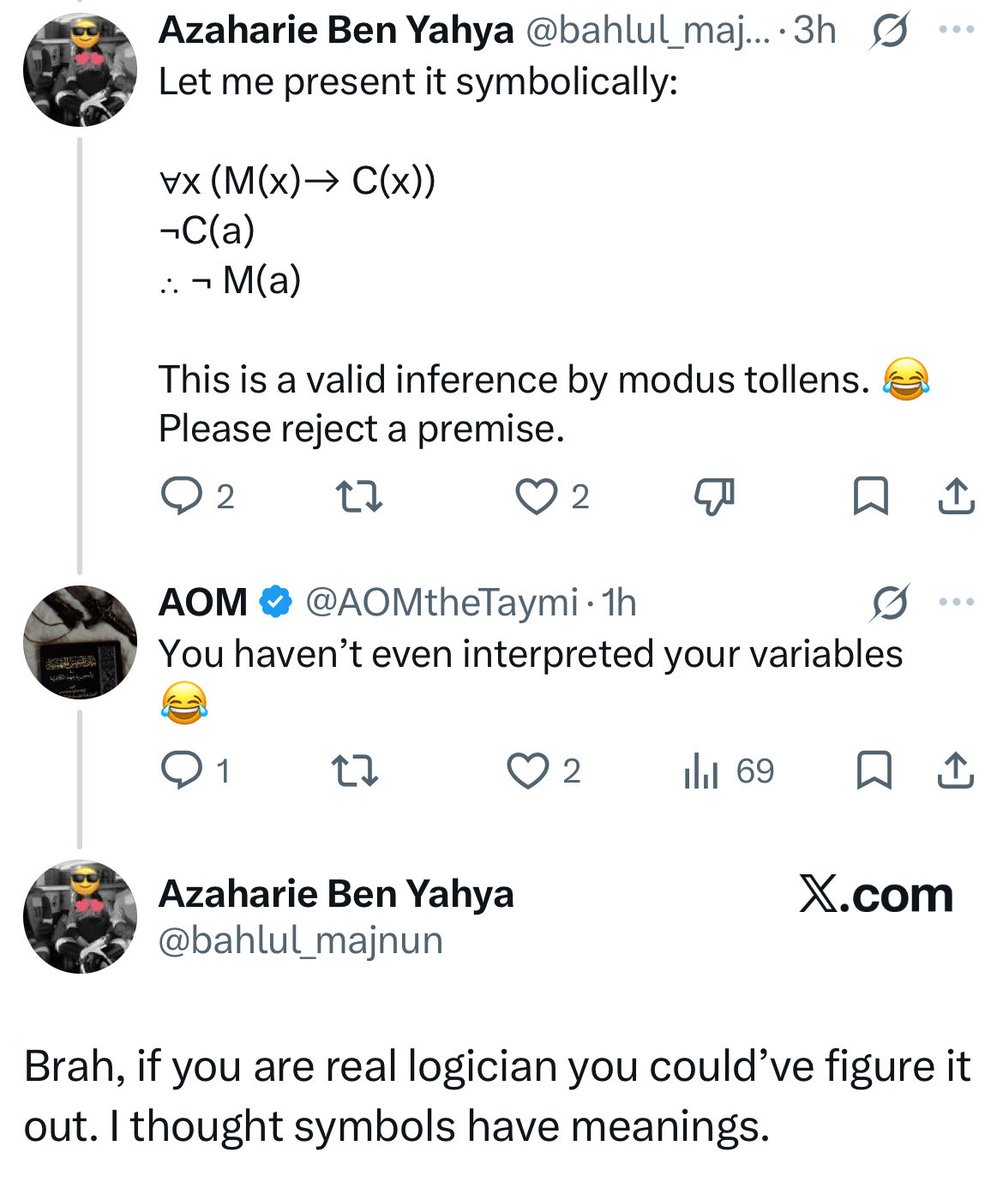
@HF63098360 @AlAbdulDhaeef @AOMtheTaymi @hashimiyy_ Ok since he is scared to engage I am just going to ask you this question are definitions truth apt?
English
ash
1K posts


The logic here is correct. However, premise 2 reflects a misunderstanding of Hawaadith and of what it means for a Haadith to subsist in a thing’s essence. Using the same line of reasoning, we actually would invert premise 2, and say: It IS the case that everything that is not devoid of Hawaadith is Haadith. The conclusion then follows inversely as well: Ash’ari Aqidah is true. (Although this is a very silly way to argue for the ‘truth’ of an Aqeedah, simply because truth would depend on many other factors.. but for this absurd posts’ sake, we will pretend truth can be detivef from this *one* point) Why is our corrected premise true? First, let us define two terms: Haadith = created. Qadeem = uncreated. These are the two categories into which all existents fall. Now, follow carefully along this lengthy set of ifs and entailments: Suppose a created thing (Haadith) subsists within an uncreated (Qadeem) being, which is an attribute for Allah: • Since it is created, it must have been brought into existence by the uncreated being. •• This necessarily entails a point at which the uncreated being did not have this Haadith subsist within Him. ••• Consequently, some of what subsists within Him would not be eternal, but would instead have come into existence after not existing. •••• Yet whatever comes into existence requires a creator and cannot bring itself into existence. Therefore, such an attribute would be created. • And if it is created, then it is not divine. •• If it is not divine, then it must be distinct from the divine essence. But whatever is distinct from Allah and created by Him cannot be understood as an attribute subsisting in His essence, and if one were to claim divinity for such a created thing, he would be attributing divinity to creation. Thus, a created thing cannot subsist in the essence of the Creator. Accordingly, if it cannot subsist within a Qadeem (uncreated) being, then all that is left of the categories of existence is created beings, so if a Haadith subsists in something, then that must itself be created. Impossible for it to be the creator. Hence, it is true that: Everything that is not devoid of Hawaadith is Haadith. This is a simplified presentation of the principle. Any objection to this argument must answer the following question: If a Haadith can subsist in the essence of Allah while Allah remains eternal, then was Allah complete before that Haadith came into existence or not? If one says no, then he is arguing for Allah being described as having attained perfection, meaning He previously was lacking it. If one says yes, then he is saying that Allah created a part of Himself that He didn’t even need. They’re both disbelief, the first ascribing imperfection to Allah which is Kufr, and the second entailing attributing divinity to a created thing which is Shirk. والسلام عليكم



@si62119640 Because change is created

Tanrı da yoktur, ruh da yoktur, hiçlik de yoktur. Şu an gerçek ve kendiliğinden oluşup bugünlere kadar gelebilmeyi başarmış dünya ve evrimin bir ürünüyüz. Evet materyalistim.


The Holy Spirit gave her that answer and you will never convince me otherwise


Where did you learn logic?? 😂 one of the conditions of luzum (conditional proposition) is there must be an intelligible connection (munāsabah) between antecedent and consequent. Otherwise arbitrary associations become possible. Like 4 (antecedent) and “evenness” (consequent). Conceiving 4 instantly yields “evenness”. There is no intelligible connection between Ash’ari aqidah being true and “everything that is not devoid of hawadith is hādith”. Therefore arbitrary associations become possible. Therefore your P1 is unjustified.

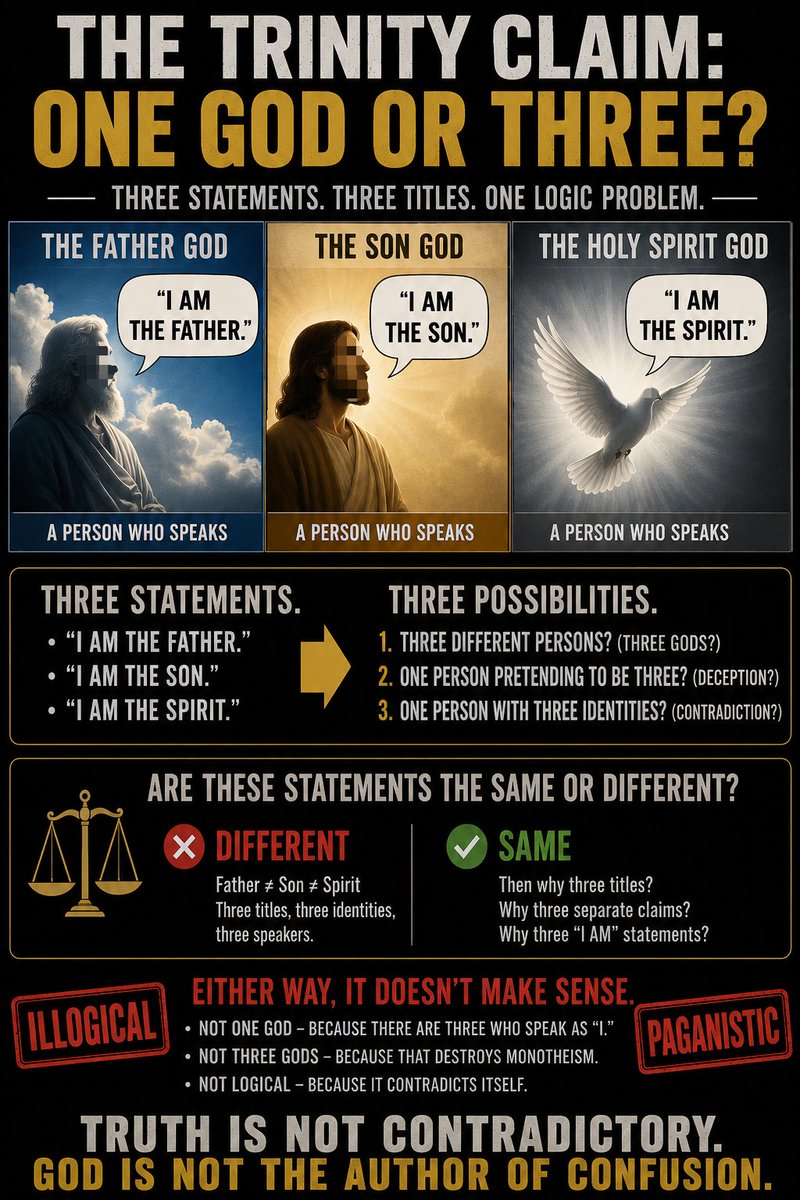

And? How does that entail 3 Gods exactly if each are divine? There’s an identity relation. Such that Jesus is identical to God and the father is identical to God. Even if they hold to them Not being identical why would multiplicity follow? There’s the aspectivalism view that Sijuwade postulates. Show me how you can argue even against the Trinity yallah Mr mutakalim you’re doing bad

I don’t know how you people felt comfortable posting this… @SapienceOrg