Ashish Bansal

2.5K posts

Ashish Bansal banner
Ashish Bansal

Ashish Bansal

@ash_bans

Machine Learning makes predictions. Artificial Intelligence takes decisions. © CEO @StarSparkAI, ex-Google/Twitch/Twitter. https://t.co/xoqOzByLne / banaras.eth

San Francisco, CA Katılım Nisan 2012
487 Takip Edilen1.3K Takipçiler
Sabitlenmiş Tweet
Ashish Bansal
Ashish Bansal@ash_bans·
Shared pre-print of my book on #NLP with @data_nerd. Carla was kind enough, took a look & wrote: "Advanced Natural Language Processing with TensorFlow 2 is a great book and it will help out tremendously for those interested in learning more, hats off!!" amzn.to/2ZoMXgE
English
2
4
25
0
JUMPERZ
JUMPERZ@jumperz·
karpathy is showing one of the simplest AI architectures that actually works.. dump research into a folder, let the model organise it into a wiki, ask questions, then file the answers back in. the real insight is the loop...every query makes the wiki better. it compounds.. now thats a second brain building itself. i think this is so good for agents if applied right instead of pulling from shared memory every session, they build a living knowledge base that stays. your coordinator is not just coordinating tasks anymore.. it is maintaining institutional knowledge so every execution adds something back to the base. the bigger implication is crazy tho. agents that own their own knowledge layer do not need infinite context windows, they need good file organisation and the ability to read their own indexes. way cheaper, way more scalable, and way more inspectable than stuffing everything into one giant prompt.
JUMPERZ tweet media
Andrej Karpathy@karpathy

LLM Knowledge Bases Something I'm finding very useful recently: using LLMs to build personal knowledge bases for various topics of research interest. In this way, a large fraction of my recent token throughput is going less into manipulating code, and more into manipulating knowledge (stored as markdown and images). The latest LLMs are quite good at it. So: Data ingest: I index source documents (articles, papers, repos, datasets, images, etc.) into a raw/ directory, then I use an LLM to incrementally "compile" a wiki, which is just a collection of .md files in a directory structure. The wiki includes summaries of all the data in raw/, backlinks, and then it categorizes data into concepts, writes articles for them, and links them all. To convert web articles into .md files I like to use the Obsidian Web Clipper extension, and then I also use a hotkey to download all the related images to local so that my LLM can easily reference them. IDE: I use Obsidian as the IDE "frontend" where I can view the raw data, the the compiled wiki, and the derived visualizations. Important to note that the LLM writes and maintains all of the data of the wiki, I rarely touch it directly. I've played with a few Obsidian plugins to render and view data in other ways (e.g. Marp for slides). Q&A: Where things get interesting is that once your wiki is big enough (e.g. mine on some recent research is ~100 articles and ~400K words), you can ask your LLM agent all kinds of complex questions against the wiki, and it will go off, research the answers, etc. I thought I had to reach for fancy RAG, but the LLM has been pretty good about auto-maintaining index files and brief summaries of all the documents and it reads all the important related data fairly easily at this ~small scale. Output: Instead of getting answers in text/terminal, I like to have it render markdown files for me, or slide shows (Marp format), or matplotlib images, all of which I then view again in Obsidian. You can imagine many other visual output formats depending on the query. Often, I end up "filing" the outputs back into the wiki to enhance it for further queries. So my own explorations and queries always "add up" in the knowledge base. Linting: I've run some LLM "health checks" over the wiki to e.g. find inconsistent data, impute missing data (with web searchers), find interesting connections for new article candidates, etc., to incrementally clean up the wiki and enhance its overall data integrity. The LLMs are quite good at suggesting further questions to ask and look into. Extra tools: I find myself developing additional tools to process the data, e.g. I vibe coded a small and naive search engine over the wiki, which I both use directly (in a web ui), but more often I want to hand it off to an LLM via CLI as a tool for larger queries. Further explorations: As the repo grows, the natural desire is to also think about synthetic data generation + finetuning to have your LLM "know" the data in its weights instead of just context windows. TLDR: raw data from a given number of sources is collected, then compiled by an LLM into a .md wiki, then operated on by various CLIs by the LLM to do Q&A and to incrementally enhance the wiki, and all of it viewable in Obsidian. You rarely ever write or edit the wiki manually, it's the domain of the LLM. I think there is room here for an incredible new product instead of a hacky collection of scripts.


English
61
298
3.5K
371.5K
Ashish Bansal
Ashish Bansal@ash_bans·
@alliekmiller @peteskomoroch Thanks for sharing. We are building AI tutors for educational outcomes. It has been impossible to connect to learning groups at @OpenAI or @AnthropicAI. We get no response at all. So I have had a bad experience trying to reach out and discuss.
English
0
0
1
42
Allie K. Miller
Allie K. Miller@alliekmiller·
Yesterday, I met with Anthropic and OpenAI and Google. (Separately, of course.) And while the conversations were largely confidential, I do want to share some aggregated reflections on the day as well as general SF takeaways. ⬇️ 1) Competitive advantage as a solo practitioner really does come from taking action and finding an area with a bit of friction and doubling down. Ex: memory management right now isn’t perfect, but allocating an hour to improving that system gives you a ton of leverage over others 2) SF continues to be the number one place for AI work. I know that’s not surprising. I would put New York at a healthy second place. SF tends to be more about crazy agent experiments for the thrill of capability and discovery and NYC tends to be more about kinda crazy agent experiments to find new ways to make money. Not saying either is better. But I met several people renting two apartments to straddle these worlds. You want the frontier of SF and enterprise insights of NYC. It’s one reason I travel between them so much. 3) All AI labs want to hear more from people. All of them. What are you using it for, what do you like, what do you hate, what do you need. Users have a TON of power on the direction of these tools. Keep testing and tweeting at them!! 4) There is very clearly a third customer cohort that is bubbling and underserved. It’s not developers…it’s not the business professional basic users…it’s builders. Everyone can build now. It’s marketing and sales folks vibe coding. It’s legal folks building complex skills. It’s a finance expert building a side project. This is a really undertapped customer base. They feel the Cursors of the world are too complex and doc summarization tools of the world are too basic. 5) Not sure if it was just sample size, but far fewer people were wearing tech gear compared to when I lived in SF. Everyone was still dressed casually, but I used to see Splunk and Optimizely and Slack and VC gear everywhere. People seem more in stealth swag now. 6) We may soon have our world model moment. 7) Speed of iteration and shipping is faster than I’ve ever seen. We see the nonstop drops from Anthropic. We see that because of scale, providers can get a much faster feedback loop of products or features that aren’t hitting. A lot of 2025 was experimentation, but ever since the OpenClaw moment over the holidays, the releases from all three labs have been more concentrated on…things that sorta look and feel like OpenClaw. 8) Small teams can pull off more than ever before. Small teams are the powerhouses of innovation right now. This means that finding new ways to share knowledge, break silos, and remove duplicate work is going to be even more important. AI agents functioning as actually teammates that support an entire system is key. 9) Build more Skills. Build better Skills. 10) Misinformation on AI tools and leaks spread FAST. I’ve seen so many fake stories on these AI labs. Your company needs to actually TEST these tools on your actual use cases to know which models and tools are best and you need to not make large-scale snap decisions based on a rumor of a rumor of a rumor. We will see more volatility. Plan for it. 11) You can feel the seriousness of this moment. Even during random conversations I had in line at a cafe. Lots of folks worried about job loss and lack of meaning. 12) Mac minis were sold out ;)
English
89
65
585
107.3K
Tech Layoff Tracker
Tech Layoff Tracker@TechLayoffLover·
Berkeley CS grad with $174k in debt just had her third offer rescinded 48 hours before start date First one was "headcount freeze due to market conditions" in March Second was "role eliminated during restructuring" in July Third was "converting to AI-augmented position requiring 2+ years experience" last week Her entire graduating class of 312 CS majors? 18 have jobs. Actual jobs. The rest are fighting over unpaid internships or applying to McDonald's management programs Talked to her advisor yesterday - department placement rate dropped from 94% in 2022 to 11% this year Professors still teaching algorithms and data structures like companies aren't just buying AI APIs and calling three offshore contractors One kid spent his entire senior year building a recommendation engine for his capstone Found out his "dream company" replaced their entire ML team with two Anthropic API calls and a contractor in Hyderabad who makes $18k annually Career center stopped posting CS job openings in September Now they just send weekly emails about "alternative career paths" and coding bootcamps for people with CS degrees The kids who got offers? All had family connections or took 60% pay cuts to work at startups that'll be dead by Q3 Everyone else is watching their $200k investment in computer science education become as useful as a journalism degree in 2010
English
115
308
1.9K
111K
Iceland Cricket
Iceland Cricket@icelandcricket·
Dear @ICC, It is with a heavy heart that we now announce our unavailability to replace Pakistan in the upcoming T20 World Cup. Regardless of whether they now withdraw, the short timescales ensure it is impossible for our squad to prepare in the professional manner necessary to compete effectively in this global cricketing spectacle. We are not like Scotland and able to turn up on a whim, with no kit sponsor. Our players are from all walks of life and cannot simply drop their occupations to fly halfway around the world to experience temperatures only normally felt in Finnish saunas. Our captain, a professional baker, needs to attend to his oven, our ship captain needs to steer his vessel, and our bankers need to go bankrupt (again). This is the harsh reality of cricket at the amateur level of the game. This news will be extremely disappointing to our fans. Despite being the most peaceful nation on Earth, we maintain an army of online followers, and are the world's 14th most followed national board on X. We were ready to give the Dutch the biggest shock they have experienced since William of Orange lost the Battle of Landen in 1693. And the Americans were looking forward to taking on Greenland, or so their orange-dyed leader thought. Our loss is likely Uganda's gain. We wish them well. Their kits cannot be missed unless you have epilepsy, in which case they are probably best avoided. The future is always ice, until it isn't. Yours sincerely, Icelandic Cricket Association
English
2.5K
6.7K
70.6K
4.8M
Erika Lee
Erika Lee@erikalee·
tiktok has a new trend where people drink hot water and stretch in the morning and call it being chinese but have u ever cried while doing math with your dad at the kitchen table and he broke your pencil in half
English
276
1.2K
19.3K
515.7K
Ashish Bansal
Ashish Bansal@ash_bans·
@dunkhippo33 At @StarsparkAI we leverage a variety of techniques to make very high gross margins in an #AI native app. But consumer business need funds to grow. So we face a catch 22 when speaking to investors even though we have amazing unit economics.
English
0
0
0
76
Elizabeth Yin 💛
Elizabeth Yin 💛@dunkhippo33·
Most AI startups will go bankrupt within 18-24 months. After reviewing hundreds of AI startups' financials at Hustle Fund, I'm seeing a sustainability crisis that nobody's talking about. The numbers are brutal. 🧵
Elizabeth Yin 💛 tweet media
English
117
117
892
213.7K
Ashish Bansal retweetledi
StarSpark.ai
StarSpark.ai@StarsparkAI·
Math education is evolving quickly, and parents are doing their best to keep up with a shifting landscape and the growing influence of AI in learning. To support parents, we partnered with @OpenStax to host a free webinar led by Meg Knapik, Educational Advisor and former Superintendent of Curriculum and Instruction in Illinois, and Ashish Bansal, CEO and Co-Founder of StarSpark.AI. They will break down how kids learn math best in today’s education environment and how families can support that learning at home. In this 45-minute session, we will cover: • The difference between school curriculum and State Standards • How Singapore and U.S. math approaches shape student success • How AI tutoring tools like StarSpark build mastery, confidence, and consistent practice 📅 December 4 at 4 PM CST / 5 PM EST 🔗 Register at the link in our bio #parentwebinar #matheducation #aiinlearning #mathhelp #mathematics #education
StarSpark.ai tweet media
English
0
1
3
158
Hubert Thieblot
Hubert Thieblot@hthieblot·
Explain your product in one sentence. Be clear about what it does. No buzzwords. If you can do that, I’ll consider investing. Hit me.
English
1.5K
88
2.1K
322.2K
Ashish Bansal retweetledi
Robert Youssef
Robert Youssef@rryssf_·
RIP fine-tuning ☠️ This new Stanford paper just killed it. It’s called 'Agentic Context Engineering (ACE)' and it proves you can make models smarter without touching a single weight. Instead of retraining, ACE evolves the context itself. The model writes, reflects, and edits its own prompt over and over until it becomes a self-improving system. Think of it like the model keeping a growing notebook of what works. Each failure becomes a strategy. Each success becomes a rule. The results are absurd: +10.6% better than GPT-4–powered agents on AppWorld. +8.6% on finance reasoning. 86.9% lower cost and latency. No labels. Just feedback. Everyone’s been obsessed with “short, clean” prompts. ACE flips that. It builds long, detailed evolving playbooks that never forget. And it works because LLMs don’t want simplicity, they want *context density. If this scales, the next generation of AI won’t be “fine-tuned.” It’ll be self-tuned. We’re entering the era of living prompts.
Robert Youssef tweet media
English
239
1.2K
7.8K
714.1K
Ashish Bansal
Ashish Bansal@ash_bans·
@hthieblot Fixing my rag pipeline in agentic math question generation flow for more reliability and diversity of questions.
English
0
0
1
21
Hubert Thieblot
Hubert Thieblot@hthieblot·
@ founders What are you building this week end?
English
460
13
542
57.5K
Ashish Bansal
Ashish Bansal@ash_bans·
IIT is a point in time. People have long careers and continue to learn and grow. My friend didn’t get selected in first attempt and got AIR83 the next year. Did he really grow a brain in one year? My humble advice - not every one who goes to IIT has it made and not everyone who didn’t go to IIT is a failure. You can replace IIT with any reputed school like Stanford, MIT etc and it will still be true. The key is a growth mindset. With that anyone can be successful eventually.
English
0
0
0
183
Deedy
Deedy@deedydas·
The new CTO of Anthropic and ex-CTO of Stripe is from PESIT. Imagine being a non-IITian, from the #83 college in the country, and having anywhere close to this career trajectory in India.
Deedy tweet media
English
259
257
4.4K
756.7K
Ashish Bansal
Ashish Bansal@ash_bans·
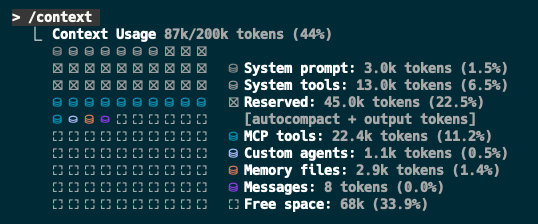
Empty Microsoft Word files and @AnthropicAI Claude Code new sessions are about the same size. @alexalbert__ if 87K of 200k is taken with context, it severely limits ability to do stuff. I have had to remove tools and context files.
Ashish Bansal tweet media
English
1
0
1
137
Josh Lu
Josh Lu@JoshLu·
Today is the day. @speedrun applications are due tonight. Excited to see what you all are building
English
36
3
219
11.2K
Ashish Bansal
Ashish Bansal@ash_bans·
@MartinGTobias @StarsparkAI is the world’s first all-in-one AI math teacher, delivering personalized, elite 1:1 instruction for every K–12 student at a global scale. Product is delivering efficacy in tests with multiple schools. Now we are working on scaling.
English
0
0
1
40
Martin Tobias (Pre-Seed VC)
Martin Tobias (Pre-Seed VC)@MartinGTobias·
Founders: time to shine… Tell me what you are building and if you are raising. Investors take note:
English
414
39
667
70K
Daniel George
Daniel George@dan7geo·
Excited to announce our new breakthrough in AI speech-to-text with TwinMind EAR-3 model. We set a new industry record outperforming Eleven Labs, Otter, Deepgram, Assembly AI, Speechmatics, OpenAI, etc. - Accuracy:  94.74% (5.26% Word Error Rate) - Speaker Labeling:  3.8% Diarization Error - Languages:  140+ (over 40 more than others) Starting today, anyone can transcribe audio files for free using @TwinMind_AI (link in comments)
English
8
9
76
31.3K
Ashish Bansal
Ashish Bansal@ash_bans·
x.com/ash_bans/statu… Sub agents are useful. The instructions take a lot of context in terms of large code bases. My sub agents focus on gut workflow, code reviews for specific languages and their corresponding coding standards, documentation agents and bootstrapping agents for starting features/enhancements and bugs. This works very well in CC.
Ashish Bansal@ash_bans

I have been using Codex as a command line coding OS. So, both depending on the use case: 1. Smarter with larger context: when building new features in an existing code base, it is important to understand the various pieces and existing impl patterns 2. Faster: for a lot of mundane tasks and workflow automation - build docker images, document updates, filing PRs, and such things. @karpathy thoughts?

English
0
0
0
99
Tibo
Tibo@thsottiaux·
What would you like us to fix in codex? What would be the biggest productivity unlock for you and your team?
English
682
34
862
240.4K
Ashish Bansal
Ashish Bansal@ash_bans·
I have been using Codex as a command line coding OS. So, both depending on the use case: 1. Smarter with larger context: when building new features in an existing code base, it is important to understand the various pieces and existing impl patterns 2. Faster: for a lot of mundane tasks and workflow automation - build docker images, document updates, filing PRs, and such things. @karpathy thoughts?
English
0
0
0
172