Sabitlenmiş Tweet

Astraia
5.6K posts
@astraiaml
AI Researcher • Friendly 🤗 • Tweets are not Financial Advise • Thank you for visiting my profile 💜





Today, we share a breakthrough on the planar unit distance problem, a famous open question first posed by Paul Erdős in 1946. For nearly 80 years, mathematicians believed the best possible solutions looked roughly like square grids. An OpenAI model has now disproved that belief, discovering an entirely new family of constructions that performs better. This marks the first time AI has autonomously solved a prominent open problem central to a field of mathematics.

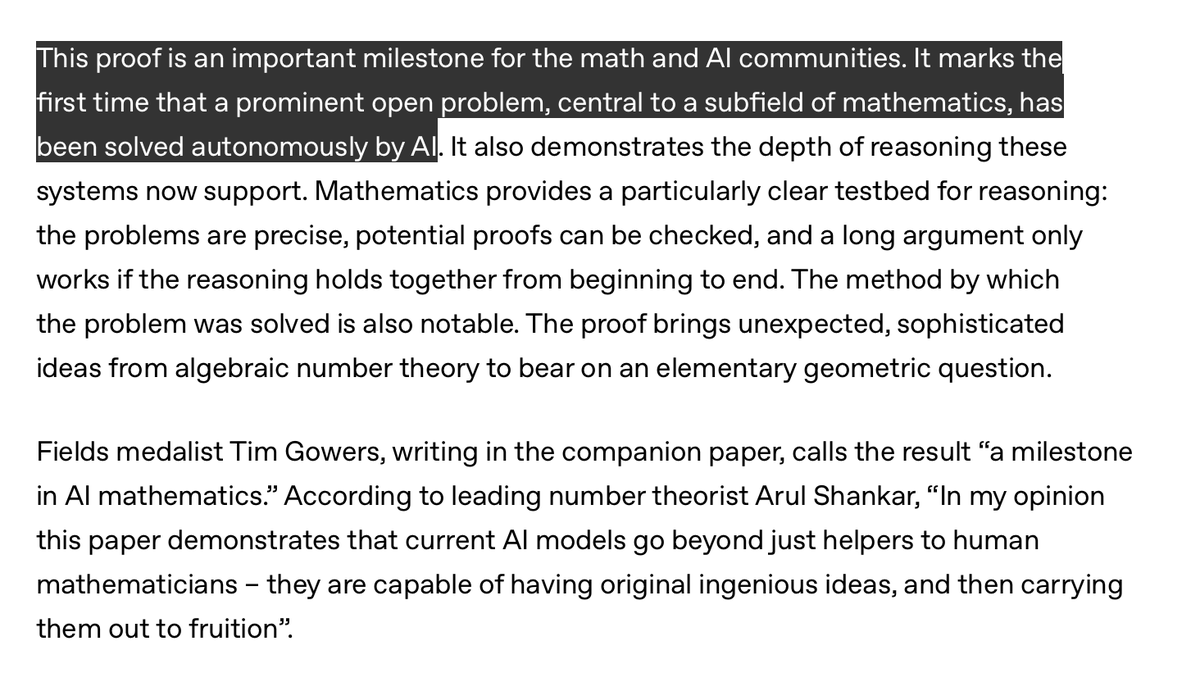
Today, we share a breakthrough on the planar unit distance problem, a famous open question first posed by Paul Erdős in 1946. For nearly 80 years, mathematicians believed the best possible solutions looked roughly like square grids. An OpenAI model has now disproved that belief, discovering an entirely new family of constructions that performs better. This marks the first time AI has autonomously solved a prominent open problem central to a field of mathematics.


Gemini 3.5 feels like the start of a new era for Gemini, we spent the last 2.5 years putting the infrastructure, products, team, etc in place (learning lots of lessons along the way). The model is the product, please keep the feedback coming!

three of the things we are most excited about: 1. AGI accelerating research 2. AGI accelerating companies 3. personal AGI accelerating everyone in achieving their goals today it was great to announce the unit distance result. yesterday it was great to announce that we are offering to invest $2M in openai credits into every YC company. now we need to increase our efforts on the third!
False. This is something most people, even many researchers, do not understand: The human mind actually DOES work in a very similar way to LLMs. It is called predictive coding, and it is the central theme of all human intelligence functions. The autoregressive nature of LLMs captures and solves for what is, in effect, a more limited representation of the very same contextual semanticity. The meaning captured in the input sequence is intended to represent context, the solution of which is the true mathematical target of backpropagation.


"It's not intelligent, it's just predicting the next word" Have the people saying this tried consistently predicting the next word themselves?