Audrey Kangara

389 posts

Audrey Kangara banner
Audrey Kangara

Audrey Kangara

@audkays

Katılım Nisan 2026
307 Takip Edilen185 Takipçiler
Audrey Kangara
Audrey Kangara@audkays·
A constitution is not a static text it is a dynamic framework designed to evolve alongside the society it governs. As articulated by the Minister of Justice, Legal and Parliamentary Affairs, Hon. Ziyambi Ziyambi, the key to its ongoing renewal is intentionally written into the document itself. (#CA3) represents this constitutional evolution in action ensuring our legal pillars remain responsive, resilient, and built for national progress. ​ #ZiyambiZiyambi#CA3 #Zimbabwe #LawReform
Audrey Kangara tweet media
English
0
0
0
1
Audrey Kangara
Audrey Kangara@audkays·
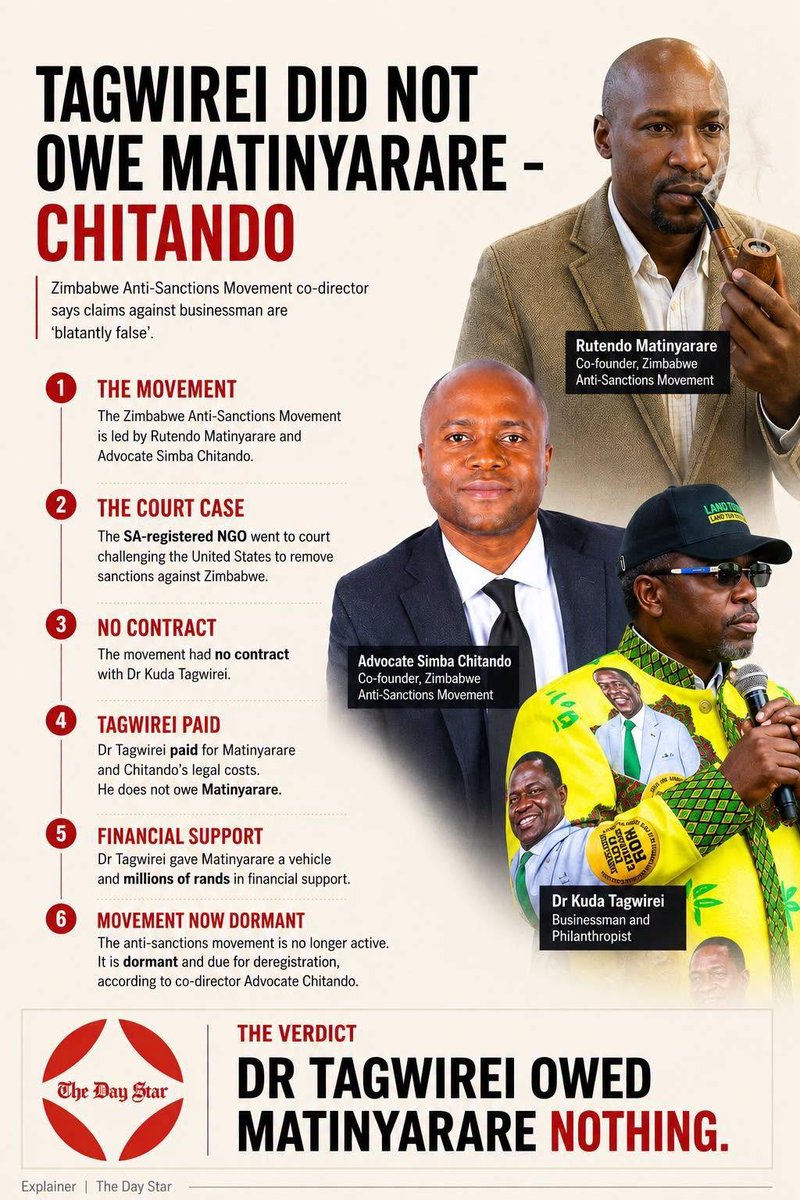
The latest revelations from Advocate Simba Chitando have added a significant new dimension to the debate surrounding Rutendo Matinyarare and Dr Kuda Tagwirei. As a co-director of the Zimbabwe Anti-Sanctions Movement and a key figure in its legal strategy, Chitando is not speaking from the sidelines. He was directly involved in the organisation's operations and finances. His account is clear: Dr Tagwirei funded the anti-sanctions campaign, covered legal and operational expenses, supported the organisation's activities, and even provided additional assistance to Matinyarare. Most importantly, Chitando states that there was no outstanding debt owed by Dr Tagwirei to Matinyarare or ZASM. If these claims are accurate, they fundamentally challenge the narrative that has dominated public discussion. The question ceases to be whether Dr Tagwirei fulfilled
Audrey Kangara tweet media
English
0
0
0
185
Dereck Goto
Dereck Goto@dereckgoto·
The video statement by Simba Chitando, co-director of the Zimbabwe Anti-Sanctions Movement (ZASM), deserves careful scrutiny - because if his assertions are accurate, they raise a far more damaging question than the one currently dominating public debate. They raise the question of whether Rutendo Matinyarare has been operating not as an activist, but as an extortionist and political communications mercenary who has now successfully collected. Chitando was not a peripheral figure. He was ZASM's legal strategist and co-director - inside the organisation, present for its decisions, party to its finances. His testimony carries weight precisely because of that proximity. Several facts emerge from his statement that cannot be easily dismissed. The Government of Zimbabwe declined to fund ZASM. That single detail collapses the foundational claim that Matinyarare was executing a state-commissioned mandate deserving state-level compensation. Anti-sanctions advocacy in Zimbabwe has never belonged to one organisation - parties, churches, diplomats, academics, traditional leaders, and ordinary citizens have all participated for years. Government had no particular reason to single out ZASM, and it did not. ZASM sought and received support from private donors, including Dr. Kuda Tagwirei, who covered organisational expenses, legal liabilities, and logistical costs. Chitando states categorically that neither ZASM nor its directors are owed anything by Tagwirei or anyone else. The organisation is effectively dormant - no longer litigating, its legal challenge withdrawn, pending deregistration in South Africa. Most significantly, Chitando reveals that additional funding and a vehicle were recently channelled through Matinyarare without his knowledge - despite his being a co-director of the same organisation. That detail is the thread that unravels everything. If previous expenses were already settled, nothing was owed, and the co-director knew nothing about the transaction, then what exactly was being compensated? Why did it require a publicised gifting spectacle rather than a quiet institutional arrangement? The gifter's own argument answers that question - and in answering it, destroys itself. The claim now being advanced is that the gift was necessary to encourage Matinyarare to cease his attacks on the highest office in the land. Set against Chitando's testimony that nothing was owed, that argument does not become an explanation. It becomes a confession. You do not pay someone to stop attacking you unless they have made it clear that continued silence carries a price. That is not gratitude. That is not recognition. That has a much simpler name: extortion. And the person who pays an extortionist does not resolve a problem. They establish a rate. Here is where Matinyarare's own well-documented habits become impossible to separate from the analysis. He is notorious for recording conversations with virtually everyone he engages - politicians, officials, businesspeople, fellow activists. In his trade, that is not due diligence. That is inventory. A man who systematically builds an archive of sensitive recorded material across years, then converts public pressure into tangible assets, has not stumbled into a business model. He has refined one. The gift confirms that the model works. Which raises the question that no one paying attention can honestly avoid: what guarantee exists that this ends here? History is unambiguous on this point. Extortion does not conclude with the first payment. It scales with proof of concept. What assurance does anyone have - the gifter, the institution, the office apparently being threatened - that the cameras will not return, that the social media pressure will not resume, that the recorded archive will not find new applications the moment a new grievance is manufactured or an old one is reframed? The answer is none. There is no assurance. There is only the next negotiation, now better informed by the knowledge of exactly what pressure yields results. What makes this particularly corrosive is that it did not have to be public. Zimbabwe has institutions - political, governmental, security - entirely capable of managing sensitive matters involving proximity to the highest office with discretion, through proper channels, without cameras and without luxury assets becoming social media content. The decision to make this spectacularly public was either a catastrophic miscalculation or a deliberate signal. Neither interpretation reflects well on the judgment of those involved. Chitando's testimony has done something that the weeks of online noise failed to do. It has stripped away the activist framing and forced a clear-eyed look at the underlying mechanics. What those mechanics reveal is a political communications mercenary who identified a pressure point, cultivated it over years, recorded everything along the way as operational collateral, applied sustained public pressure against the highest office in the land, and collected - publicly, luxuriously, and on camera. The only remaining questions are who allowed this to reach this point, whether those responsible for protecting the integrity of Zimbabwe's highest office fully understand what they have now set in motion, and whether the rate has already been noted by others watching carefully from the sidelines. Because if it has, the Matinyarare affair is not a conclusion. It is a template.
English
40
36
61
11.3K
Audrey Kangara
Audrey Kangara@audkays·
Tuesday is a pivotal day for #CA3. The Senate is set to deliberate on the remaining provisions of CA3, including proposals for a seven year electoral cycle and a parliamentary system for the election of the President. Following debate, Senators will cast a constitutional vote requiring a two-thirds majority at least 54 of the 80 Senators for the Bill to pass. The proceedings will be closely watched as they represent another important step in Zimbabwe's constitutional reform process. Whatever the outcome, the debate underscores the significance of parliamentary participation, constitutionalism, and democratic decision-making in shaping the nation's future. #CA3ZVAENDWA #Senate #ParliamentOfZimbabwe #ConstitutionalReform #ZimbabwePolitics
Audrey Kangara tweet media
English
0
0
0
7
Audrey Kangara
Audrey Kangara@audkays·
As we bid farewell to a dedicated comrade whose life was defined by service, commitment, and sacrifice. Through both challenges and triumphs, you remained steadfast in your duty to the nation and its people. Your legacy is written not only in words but in the lives you touched and the causes you championed. As we mourn your passing, we also honor your contributions and the values you stood for. Rest in peace, Cde. Your service deserves the highest recognition Hero Status. May your soul rest in eternal peace. 🕊️ #VictorMatemadanda
English
0
0
0
32
Rutendo Matinyarare
Rutendo Matinyarare@matinyarare·
𝗔𝗙𝗧𝗘𝗥 𝗢𝗨𝗥 𝗗𝗢𝗖𝗨𝗠𝗘𝗡𝗧𝗔𝗥𝗬 𝗪𝗜𝗧𝗛 𝗠𝗔𝗧𝗘𝗠𝗔𝗗𝗔𝗡𝗗𝗔, 𝗪𝗘 𝗚𝗥𝗜𝗘𝗩𝗘 𝗛𝗜𝗦 𝗣𝗔𝗦𝗦𝗜𝗡𝗚. The Ambassador was uncompromising in his call for the upholding of liberation promises to war veterans. May he rest in peace. To watch the full documentary click here: youtu.be/1OvYQ5ZzMuQ?si…
YouTube video
YouTube
English
38
23
116
129K
Audrey Kangara
Audrey Kangara@audkays·
Regardless of one's position on #CA3, every Member of Parliament had a constitutional and democratic duty to be present and participate in the process. Critical national decisions require accountability, debate, and a recorded vote. Absenteeism at such a moment raises legitimate questions about commitment to constituency representation and respect for the parliamentary mandate entrusted to elected officials.
English
0
0
0
34
Audrey Kangara
Audrey Kangara@audkays·
Insisting that CA3 is "not a done deal" overlooks the fundamental principle of constitutional democracy decisions are made through established legal and parliamentary processes, not through political slogans. Parliament, composed of representatives elected by citizens, debated, revised and ultimately approved CA3. That process was neither accidental nor illegitimate it was the constitutional mechanism through which the people's mandate is exercised. Citizens remain free to support or oppose CA3, but disagreement with an outcome does not invalidate the outcome itself. The amendment was subjected to scrutiny, amendments were made, and Parliament reached a decision. That is how democratic institutions function. The real test of democratic maturity is not whether every citizen agrees with a decision, but whether society respects the constitutional processes through which decisions are made. By that standard, CA3 has crossed a significant threshold and stands as a legitimate product of Zimbabwe's democratic institutions.
English
0
0
0
17
nelson chamisa
nelson chamisa@nelsonchamisa·
CAB3: NOT A DONE DEAL. Those claiming that CAB3 is a “done deal” are either deluding themselves or deliberately attempting to mislead. Deep down, they know that nothing without the citizens is ever final. In any society, nothing can be done for the citizens without the citizens. The citizens are the ultimate decision-makers; they alone have the authority to endorse, reject, or seal any deal. As things stand, there is no done deal. In fact, there is no deal at all. Any arrangement that lacks the consent and participation of the citizens remains incomplete and illegitimate. If there is one reality that cannot be ignored, it is this: the citizens are increasingly tired of those who oppress, disregard, and undermine their rights. The only “done deal” may well be that citizens are done with oppression and are ready to reclaim their voice, their power, and their future. #TheNew #TheCitizensMovement
English
196
182
641
46.5K
Audrey Kangara
Audrey Kangara@audkays·
#CA3 does require a referendum. The Constitution itself sets out which provisions are protected and when a referendum is necessary. CA3 follows the parliamentary route provided by the Constitution. #RuleOfLaw #TakanoAmenda
Audrey Kangara tweet media
English
0
0
0
19
Audrey Kangara
Audrey Kangara@audkays·
CA3 Clause 11 represents a significant step toward strengthening Zimbabwe's democratic institutions by establishing the Zimbabwe Electoral Delimitation Commission (ZEDC) as an independent constitutional body. By separating constituency and ward delimitation from the broader responsibilities of election administration, the amendment creates a focused and specialized institution dedicated solely to ensuring fair, transparent, and credible boundary reviews. This reform promotes efficiency, brings together technical expertise in law, governance, demography, and cartography, and enhances public confidence in the delimitation process. It also allows the Zimbabwe Electoral Commission (ZEC) to concentrate on its core mandate of conducting and managing elections. Ultimately, Clause 11 contributes to a stronger constitutional framework, clearer institutional roles, and a more inclusive democratic system that supports fair representation for all Zimbabweans as the nation advances toward Vision 2030. #CA3 #ConstitutionalReform #Vision2030 #BuildingZimbabwe #Democracy #Zimbabwe
Audrey Kangara tweet media
English
0
0
0
23
TheNewsHawks
TheNewsHawks@NewsHawksLive·
Presidential Selection and Zimbabwe’s Minority Communities By Tafadzwa Wakatama On 16 February 2026, the Constitution of Zimbabwe (Amendment No. 3) H.B.I. Bill 2026, CA3, was gazetted for a 90-day public consultation period constitutionally required before parliamentary consideration. Among its 21 amendments, the Bill proposes replacing the direct popular election of the President with selection by a joint sitting of both houses of Parliament. The government’s stated precedents are Botswana and South Africa. Among the concerns the opposition has placed before the public consultation process is the claim that parliamentary selection diminishes the voice of minority communities. In this post, I examine that claim using the Zimbabwe Electoral Commission, ZEC, polling station record for 2018, and find that it does not hold up to empirical scrutiny. Executive selection systems tend to produce their distributive consequences not through the intentions of candidates but through the rational calculus that governs where political attention, campaign investment, and eventually public resources flow. Burgess, Jedwab, Miguel, Morjaria and Padro i Miquel demonstrated this with road expenditure data across six decades of Kenyan electoral history: districts whose populations aligned with the sitting president received roughly three times the road investment of those that did not (American Economic Review, 105(6), 2015). Van de Walle’s survey of 87 African multiparty elections identifies the same logic as the defining characteristic of African presidentialism: resources follow the arithmetic that produced the executive, and that arithmetic determines which communities receive attention and which do not (Journal of Modern African Studies, 2003). Clause 3 of CA3 changes that arithmetic. Under a direct popular vote, the rational calculus of a presidential candidate concentrates attention where registered voter populations are large enough to determine the national outcome. Under Clause 3, a presidential aspirant must secure an absolute majority across both Houses. The vote of every MP carries equal weight regardless of the population of the constituency they represent. Binga district’s 69,723 voters are represented by two MPs, Binga North with 33,716 registered voters and Binga South with 36,007. Under Clause 3, each carries one vote equal in weight to the MP from Harare South, whose single constituency holds 76,425 registered voters. The community that was invisible as a district in a national popular contest holds two votes in a selection process where every vote carries equal weight. The structural incentive this produces is not that any single minority community MP becomes uniquely decisive. It is that an aspirant seeking an absolute majority cannot afford to concentrate attention narrowly. The threshold requires breadth, and that breadth is the mechanism through which historically bypassed communities enter the presidential calculus for the first time. ZEC’s 2018 polling station data establishes what the current mechanism has produced. Binga district, the geographic heartland of the Tonga community, one of Zimbabwe’s 16 constitutionally recognised language groups and a population displaced from the Zambezi River plains by the construction of Kariba Dam in the late 1950s, held 69,723 registered voters in 2018. The national electorate stood at 5,695,706. That is 1.22% of the vote in an election decided by a margin of 313,027. At maximum mobilisation, Binga’s entire registered electorate could contribute 22% of that winning margin: meaningful in a judicial recount, insufficient to determine a national popular outcome. The rational campaign calculus produced by that arithmetic is confirmed by the itinerary record. Across four consecutive presidential election cycles, 2002, 2008, 2013, and 2018, no ZANU-PF presidential candidate held a primary star rally in Binga. In each cycle, the Matabeleland North event was held in Lupane.
TheNewsHawks tweet media
English
25
88
71
5.3K
Audrey Kangara
Audrey Kangara@audkays·
@NewsHawksLive #CA3 strengthens representative democracy by ensuring that presidential elections reflect parliamentary representation, giving historically marginalised communities a stronger voice in shaping Zimbabwe's future.
English
0
0
0
17
Audrey Kangara retweetledi
Doc-T Love
Doc-T Love@doctlove2·
Under #CA3, Clause 13 improves how constitutional matters are addressed by widening the Constitutional Court’s role. When courts have the right authority to settle constitutional questions, the law becomes more predictable—leading to fewer contradictions and faster resolution of disputes that affect everyone. Support Clause 13 for justice that works. #Clause13 #Ca3
Doc-T Love tweet media
English
0
2
0
39
Audrey Kangara
Audrey Kangara@audkays·
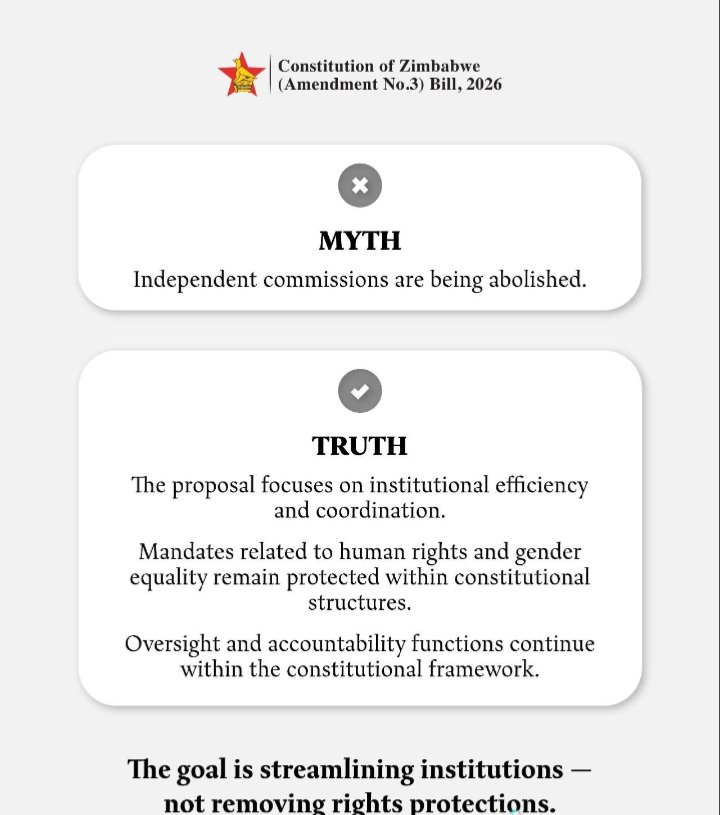
Much of the debate around #CA3 has been driven by claims that independent commissions are being abolished and constitutional safeguards weakened. A careful reading of the proposed amendment tells a different story. The objective of the Bill is not to remove rights, accountability or oversight. Rather, it seeks to improve institutional efficiency, coordination and the effective functioning of constitutional structures. The mandates relating to human rights, gender equality and public accountability remain protected within the constitutional framework, while oversight functions continue to exist through established constitutional mechanisms. Constitutional reform should be assessed on the basis of what the text actually provides, not on speculation, slogans or political narratives. Streamlining institutions is not the same as dismantling them. Improving coordination is not the same as removing protections. The real question is whether the amendment strengthens governance and improves the delivery of constitutional responsibilities. That debate should be guided by facts, law and evidence rather than fear and misinformation. #CA3 #ConstitutionalReform #FactsMatter #RuleOfLaw
Audrey Kangara tweet media
English
0
1
0
18
Audrey Kangara
Audrey Kangara@audkays·
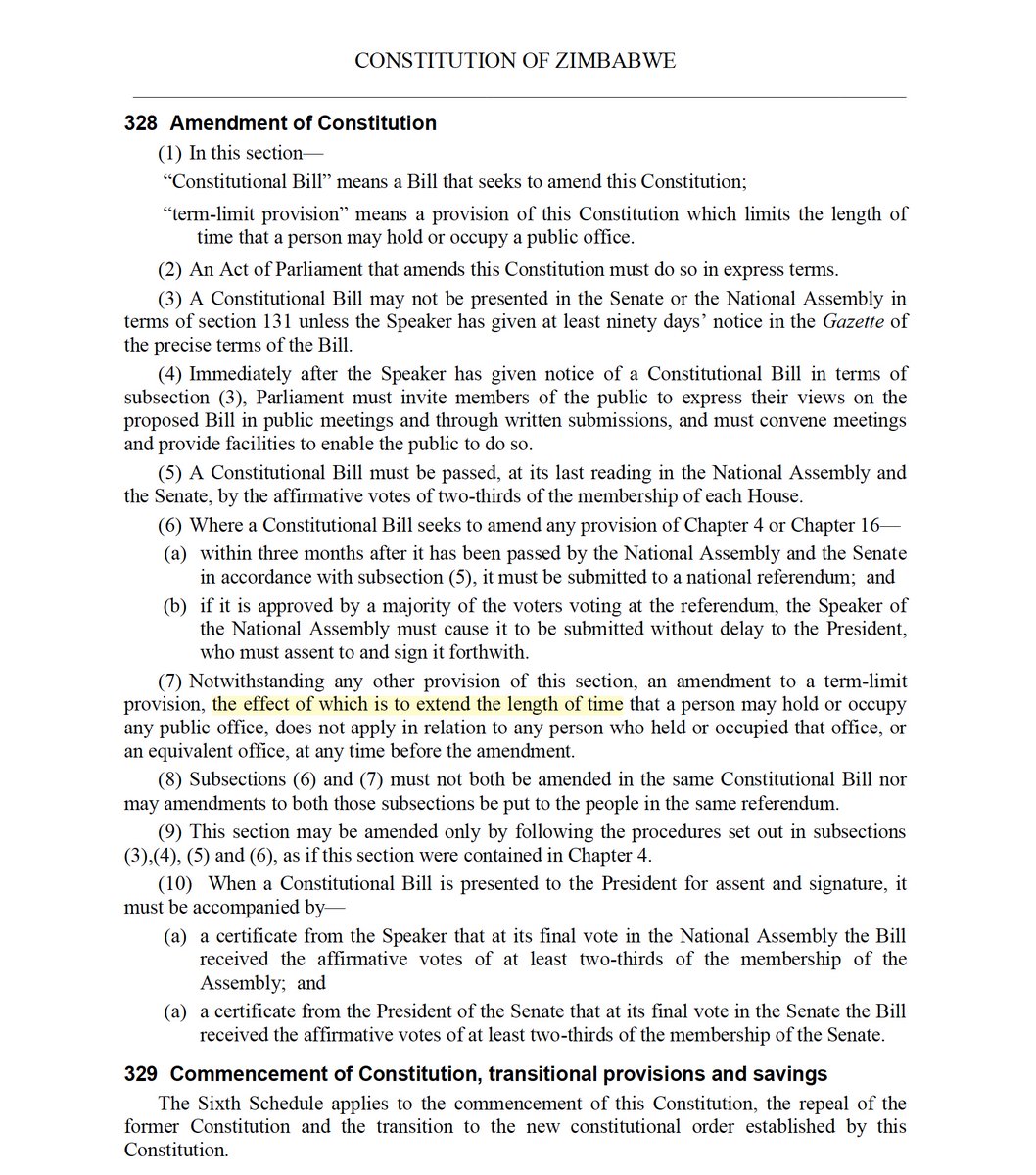
The argument sounds persuasive until you read what Section 328(7) actually protects. The Constitution does not prohibit every amendment that may have an indirect effect on time in office; it specifically targets amendments to a term-limit provision that would allow an incumbent to benefit. A term limit is the number of terms a person may serve, not the duration of each term. If the two-term limit remains intact, then the term-limit provision itself has not been extended. Conflating term length with term limits stretches Section 328(7) beyond its text and purpose. Constitutional interpretation is guided by what the Constitution says, not by hypothetical effects detached from the provision being amended. The real question is whether the amendment changes the two term cap. If it does not, then the no benefit rule is not triggered simply because opponents dislike the political outcome.
Audrey Kangara tweet media
English
0
0
0
151
Peter Ndoro
Peter Ndoro@peterndoro·
This is a fair observation, and some would say a clever legal argument. However, the Constitution appears to anticipate precisely this point by focusing on the EFFECT of an amendment rather than merely its label. If the current constitutional framework provides for two five-year terms, the maximum period a President may hold office is 10 years. If that framework is amended to two seven-year terms, the maximum period becomes 14 years. While the term limit remains "two terms", the EFFECT of the amendment is to increase the length of time a person may hold office from 10 to 14 years. That is exactly the type of benefit the Constitution's "no-benefit rule" was designed to prevent an incumbent from enjoying. The real constitutional question is not what the amendment is called, but what it allows an incumbent office-holder to DO in practice.
Peter Ndoro tweet media
Mambo Herodhi@MamboHerodhi

A vital distinction for constitutional clarity: term length dictates the duration of a single period in office, whereas term limits cap the total number of periods an individual may serve. ​Because CA3 modifies only the former, it does not necessitate a referendum.

English
15
26
64
16.7K
Audrey Kangara
Audrey Kangara@audkays·
@LynneStactia Honouring liberation heroes is important, but isolated complaints do not erase the progress made under the Second Republic. Constitutional amendments are decided by Parliament and the Constitution, not by political sentiment. #CA3
English
3
0
1
2.1K
LynneM 💕💝💎
LynneM 💕💝💎@LynneStactia·
🔹When listening to Ambassador Matemadanda express his feelings about the deteriorating situation under the Second Republic and the neglected state of the graves of those who died in Mozambique fighting for an independent Zimbabwe, one wonders: was this the reason the political establishment took him out?
English
39
75
299
60.1K
Audrey Kangara
Audrey Kangara@audkays·
Constitutional democracy is governed by law, not by the intensity of political disagreement. A referendum is required only where the Constitution expressly says so.
Audrey Kangara tweet media
English
0
1
1
24
Audrey Kangara
Audrey Kangara@audkays·
Former leaders are entitled to their opinions, but opinions cannot substitute for constitutional facts. The debate around #CA3 should be anchored in what the Constitution actually says, not in political speculation or comparisons with other countries. Constitutional amendments in Zimbabwe are governed by clear legal procedures, debated openly in Parliament, and decided through votes cast by elected representatives. Claims of manipulation, bribery, or authoritarianism require evidence, not assumptions. Zimbabwe's democratic institutions must be judged by the rule of law and due process, not by external narratives. Ultimately, the future of Zimbabwe will be determined by Zimbabweans through constitutional and democratic mechanisms, with respect for the sovereignty of the nation and the integrity of its institutions.#CA3
English
0
0
0
35
The Instigator
The Instigator@Am_Blujay·
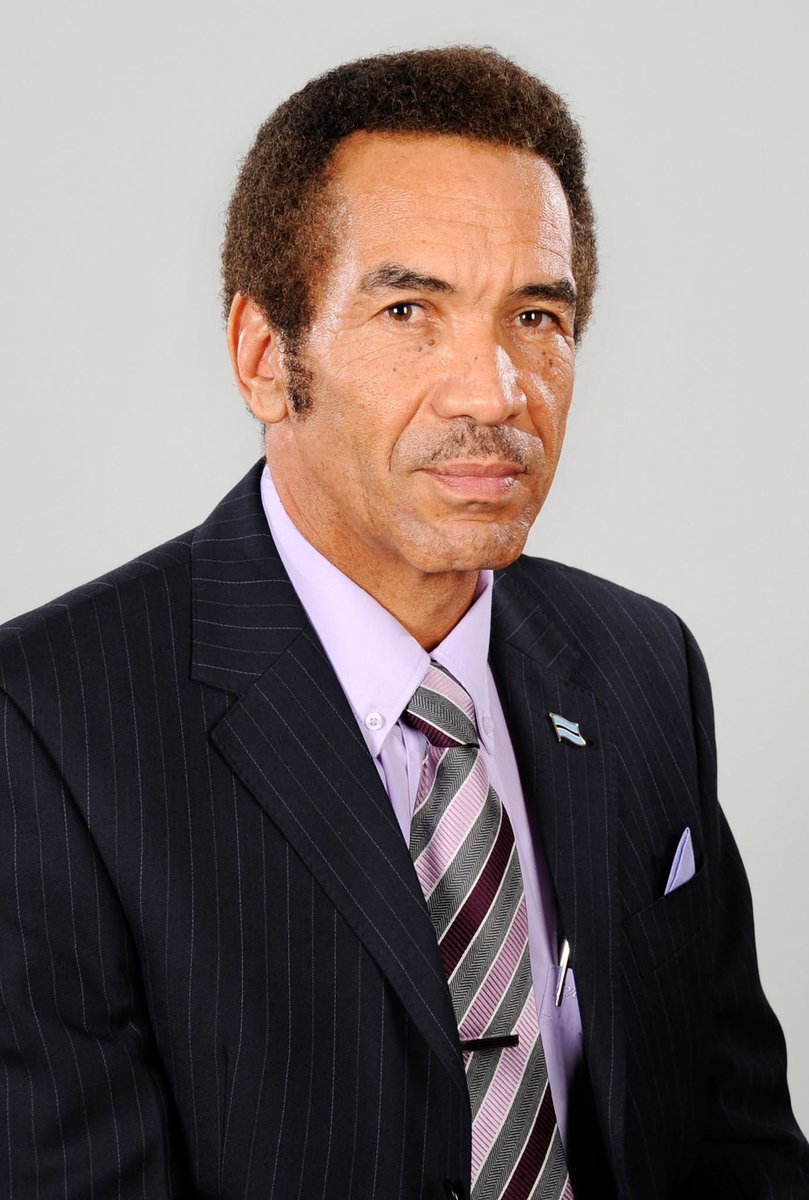
Former Botswana president Seretse Ian Khama has criticised moves in Zimbabwe to extend presidential term limits, alleging that constitutional changes are being driven by electoral manipulation and financial inducements to keep leaders in power. In a Facebook post, Khama said Zimbabwe had joined a growing list of African countries where presidents seek to prolong their rule by altering constitutions. He cited Cameroon’s Paul Biya, Uganda’s Yoweri Museveni and Rwanda’s Paul Kagame as examples. Khama also accused what he described as authoritarian regimes of relying on political assassinations, fabricated charges, detentions, kidnappings and enforced disappearances, pointing to recent incidents in Tanzania and Uganda. Referring to Zimbabwe’s history, he said the country and its people had endured oppression from the era of Gukurahundi to the present day. He recalled telling opposition politician Job Sikhala during the launch of his book Footprints in the Chains that, in his view, the only changes since the days of Rhodesia and Ian Smith were the country’s name and the identities of its leaders, adding that “oppressors come in all colours.”
The Instigator tweet media
English
57
181
532
22.5K
Audrey Kangara
Audrey Kangara@audkays·
When traditional leaders are free to participate, communities gain stronger representation, greater accountability, and a more inclusive democracy. #CA3
Audrey Kangara tweet media
English
0
1
1
12
sir_wicknell.
sir_wicknell.@wicknellchivayo·
PAPER 2...A DOUBLE REWARD 🏆🥇 Life has taught me that the people who celebrate their SMALL wins with GRATITUDE are often the same people who eventually find themselves standing before MUCH BIGGER blessings and MUCH GREATER opportunities… My brother COACH RAMBO, I didn’t think going to collect a Toyota Aqua would receive so much HYPE and support from your friends like this. I feel so HONOURED and once again I say CONGRATULATIONS to you my brother. Your level of appreciation was so touching and I genuinely feel that you deserve an IMMEDIATE UPGRADE. Please go back and see MADZIBABA CHIPAGA on Saturday morning and collect your BRAND-NEW TOYOTA FORTUNER GD6 2.4D. You will also get an extra USD5,000 for fuel. Toyota Aqua chipa mukadzi wako anga akagara pa MOTHER’S seat awane cheku fambisa and because of your level of APPRECIATION for what the world thought was small, she has also been upgraded to become a car OWNER. She will also receive cash USD 5000 kana wakuda kuroora unouya ndokubatsira ne pfuma yacho yese...🚘👏 REAL FRIENDS always celebrate your success, no matter how small !!! To all the 49 BIKERS who showed their SUPPORT and accompanied you to Enterprise Car Sales, EACH one of you will receive USD1,000 in cash as well. MAKOROKOTO MAKURU KWAMURI MOSE and may GOD continue to bless you abundantly. 🎊🎉💐🙏
Zimbabwe 🇿🇼 English
561
160
1.5K
128.3K
Audrey Kangara
Audrey Kangara@audkays·
This is not a legal argument it is a political wish dressed up as constitutional law. The Constitution is clear: not every Constitutional Amendment requires a referendum. Only amendments affecting specifically protected provisions must be put to a national vote. CA3 does not fall into that category. Repeating "referendum" a hundred times does not create a constitutional obligation where none exists. Parliament has already exercised its constitutional mandate, and the courts have affirmed the legal position. What we are witnessing is not a defence of constitutionalism, but an attempt to overturn a democratic parliamentary process because the outcome was politically inconvenient. The rule of law means accepting constitutional procedures even when they produce results you do not like. CA3 will rise or fall on the Constitution, not on slogans, threats of endless litigation, or declarations of "A luta continua." The people spoke through their elected representatives. That is democracy too. #CA3 #Vision2030
English
1
0
0
9
Doug Coltart ✊🏼🇿🇼
Why CAB3 MUST go for a referendum! In this episode, I explain how #CAB3 itself actually ADMITS that it MUST go for a referendum, @ProfJNMoyo’s FAKE definition of a "term limit provision", and why we ALL need to (in the words of Bob Marley) "Get up! Stand up! Stand up for your rights!" 🎶💪🏽🇿🇼 #NoToCAB3 WATCH the FULL EPISODE here: youtube.com/watch?v=0Lofda…
YouTube video
YouTube
English
27
40
95
5K