Aumilto Silva, MD.

46 posts

Aumilto Silva, MD. banner
Aumilto Silva, MD.

Aumilto Silva, MD.

@aumilto

Medical oncologist and clinical research focused in breast cancer. Hospital Santa Catarina Paulista.BCRI.

São Paulo, Brasil Katılım Haziran 2011
480 Takip Edilen122 Takipçiler
Aumilto Silva, MD.
Aumilto Silva, MD.@aumilto·
In this important article resistance to next-generation SERDs in ER+/HER2− metastatic breast cancer is primarily driven by loss of luminal lineage identity, leading to reduced ERα dependence and activation of alternative proliferative pathways. Heterogeneous responses: •~30–50% of patients progress early (≤2 months) •Others derive prolonged benefit (>2 years) •Resistance occurs independently of ESR1 mutation status •Stronger association with: Prior CDK4/6 inhibitor exposure and baseline low ERα activity @OncoAlert @jhaveri_komal 👉 nature.com/articles/s4146…
English
0
3
11
705
Aumilto Silva, MD.
Aumilto Silva, MD.@aumilto·
The phase III VIKTORIA-1 trial evaluated gedatolisib (pan-PI3K/mTOR inhibitor) + endocrine therapy ± CDK4/6 inhibition in HR+/HER2−, PIK3CA wild-type advanced breast cancer after progression on prior CDK4/6i + AI. • Triplet: mPFS 9.3 mo vs 2.0 mo (HR 0.24, p<0.001) • Doublet: mPFS 7.4 mo vs 2.0 mo (HR 0.33, p<0.001) → Consistent benefit across subgroups Gedatolisib-based regimens significantly improve PFS in PIK3CA-WT disease, expanding the role of PI3K pathway inhibition beyond mutation-selected populations. @oncodaily @ASCOPost 👉 ascopubs.org/doi/10.1200/JC…
English
0
1
3
299
Aumilto Silva, MD. retweetledi
Aumilto Silva, MD.
Aumilto Silva, MD.@aumilto·
Phase II (n=6): atezolizumab + SRS in TNBC brain mets showed feasibility but minimal efficacy. Median PFS: 1.3 months Median OS: 9.7 months No objective responses Despite biologic rationale, outcomes remained poor. ➡️ CNS metastases in TNBC continue to be one of the hardest settings to treat, highlighting a critical unmet need for more effective systemic + CNS-active strategies. @OncoAlert @nlinmd @antgiorda 👉 link.springer.com/article/10.100…
English
1
9
18
4.1K
Aumilto Silva, MD. retweetledi
Dr Sarah Sammons
Dr Sarah Sammons@drsarahsam·
How I think about 1st line HER2+ Metastatic Breast Cancer. Decision 1: THP versus T-DXd + P Decision 2: Maintenance based on receptor status @OncoAlert #bcsm
Dr Sarah Sammons tweet media
English
7
69
173
12.2K
Aumilto Silva, MD.
Aumilto Silva, MD.@aumilto·
A recent multicentre study in Lancet Oncology demonstrates that a multimodal deep learning model can predict Oncotype DX recurrence scores directly from H&E histopathology with high accuracy (AUC ~0.90) and consistent external validation across diverse cohorts. • AUC 0.898 for RS ≥26 • r=0.73 vs genomic score • External AUC 0.86–0.90 • HR 2.6–2.9 for recurrence endpoints Overall, this work represents a significant step toward integrating digital pathology and AI into therapeutic decision-making in breast cancer. Prospective trials are required before clinical implementation. @dviramar2 @TheLancetOncol @OncoAlert 👉 thelancet.com/journals/lanon…
English
0
24
56
7.6K
Aumilto Silva, MD.
Aumilto Silva, MD.@aumilto·
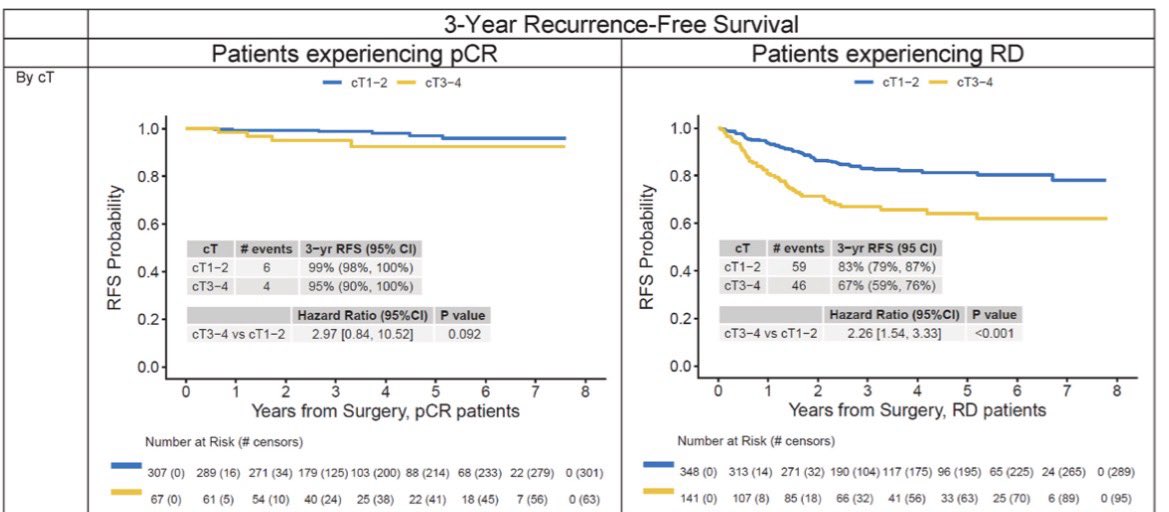
New real-world study in early HER2+ and TNBC after neoadjuvant therapy: In this study pCR remained the strongest prognostic marker. In 863 patients, 3-year RFS was 98% with pCR vs 79% with residual disease; 3-year OS was 100% vs 88%. In HER2+, 3-year RFS was 99% with pCR vs 87% with RD; in TNBC, 97% vs 72%. Baseline cT/cN/subtype predicted worse outcomes mainly in patients with residual disease. Among patients achieving pCR, baseline stage was not significantly associated with RFS or OS in this cohort. In this study pCR appears to largely mitigate the adverse effect of initial tumor burden, but residual disease still identifies a clearly higher-risk population needing escalation/novel strategies. @CCortiMD @stolaney1 @oncodaily 👉 sciencedirect.com/science/articl…
Aumilto Silva, MD. tweet media
English
4
23
57
8.7K
Aumilto Silva, MD.
Aumilto Silva, MD.@aumilto·
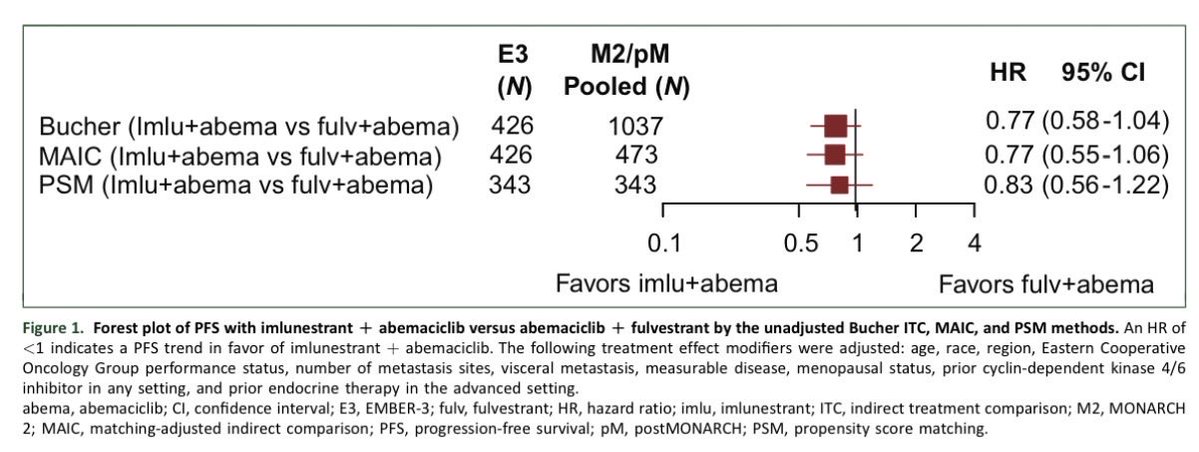
In an indirect comparison of phase III trials (EMBER-3, MONARCH 2, postMONARCH), imlunestrant + abemaciclib showed a consistent numerical PFS advantage vs fulvestrant + abemaciclib (HR ~0.77–0.83), despite no head-to-head trial. Beyond efficacy, this study highlights a key paradigm shift: → Oral SERDs overcome limitations of fulvestrant (IM delivery, suboptimal exposure) → Enable fully oral, targeted combinations → Potentially improve adherence, tolerability, and patient experience While hypothesis-generating, this analysis supports oral SERDs as a rational and potentially more effective partner to CDK4/6 inhibition, strengthening their role as the future endocrine backbone in HR+/HER2– advanced disease. @oncodaily @ESMO_Open 👉 esmoopen.com/action/showPdf…
Aumilto Silva, MD. tweet media
English
2
0
4
165
Aumilto Silva, MD.
Aumilto Silva, MD.@aumilto·
New data from the PELOPS phase II trial provide clinically relevant insights into the role of circulating tumor DNA (ctDNA) in HR+/HER2− early lobular breast cancer treated with neoadjuvant endocrine therapy (NET). In this retrospective analysis, plasma ctDNA was detected in:
• 37.5% of patients before NET
• 13.6% of patients after NET (pre-surgery) Key findings:
– Pre-NET ctDNA detection correlated with higher pathological stage and increased residual cancer burden at surgery.
– ctDNA levels were significantly higher in patients who later developed distant recurrence.
– Persistent ctDNA positivity at surgery was strongly prognostic for metastatic relapse:
• 3-year D-RFI = 22% in patients with persistent ctDNA
• 3-year D-RFI = 95–100% in patients who cleared or never had detectable ctDNA
• HR for distant recurrence with persistent ctDNA: 21.8 (P = 0.0042) Additionally, ctDNA profiling identified actionable somatic alterations (e.g., PIK3CA, AKT1, ESR1, BRCA2), suggesting real-time genomic evolution during NET. As NET use expands—particularly with CDK4/6 inhibitors—ctDNA-guided risk stratification may become a tool to treatment personalization in HR+/HER2− early breast cancer. @oncodaily 👉 esmoopen.com/article/S2059-…
English
0
0
1
68
Aumilto Silva, MD. retweetledi
Dr Sarah Sammons
Dr Sarah Sammons@drsarahsam·
This population has always been of interest and the jury is still out on how to best treat them. Physicians considered curative intent in patients with 1 lesion, HER2+ or ER+ disease. Outcomes were favorable.
Dana-Farber’s Breast Oncology Center@DFCI_BreastOnc

New 📰: Outcomes of patients with de novo #oligometastatic #BreastCancer treated with curative intent at a single institution. pubmed.ncbi.nlm.nih.gov/41501299/ @jenniferbellon2 @DrHBurstein @stolaney1 @NabihahTayob @LiorBraunstein @nlinmd @drsarahsam #DrFainaNakhlis @hthrparsons

English
1
12
35
7.3K
Aumilto Silva, MD.
Aumilto Silva, MD.@aumilto·
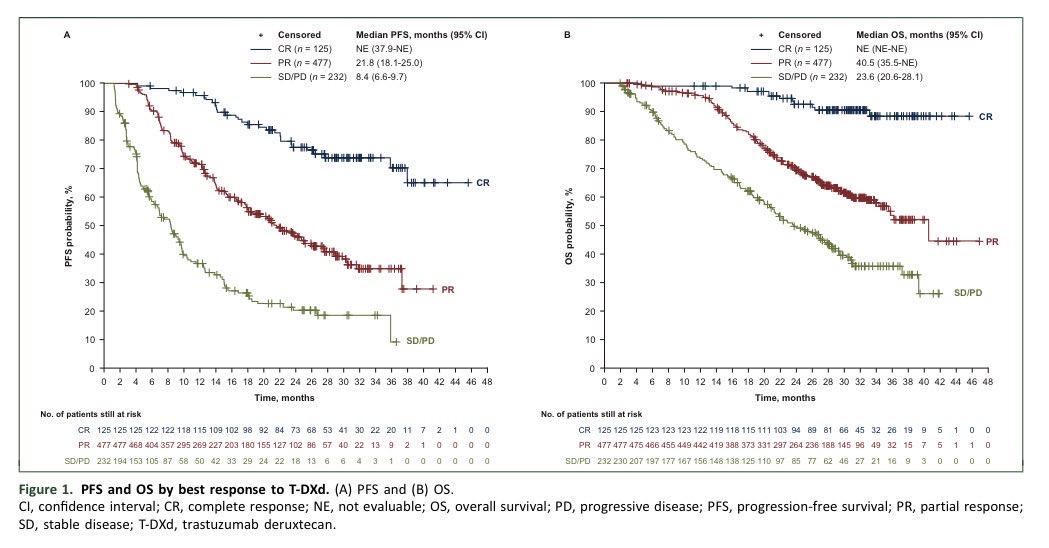
Pooled analysis of DESTINY-Breast01/02/03 (n=834) in HER2+ metastatic breast cancer treated with trastuzumab deruxtecan (T-DXd 5.4 mg/kg): CR 15%, PR 57%. Outcomes strongly tracked with depth of response—24-mo PFS 77.8% (CR) vs 46.3% (PR) vs 20.6% (SD/PD); 36-mo OS 88.6% vs 54.0% vs 35.9%. Responders had higher HER2 plasma copy number and lower ESR1 expression/mutations; ILD/pneumonitis rates were numerically lower in CR. One important takeaway is that searching for biomarkers and clinical characteristics is essential to better understand drugs clinical activity. @OncoAlert 👉 annalsofoncology.org/action/showPdf…
Aumilto Silva, MD. tweet media
English
0
5
13
1.4K
Aumilto Silva, MD.
Aumilto Silva, MD.@aumilto·
Validation of the HER2DX genomic test in first-line advanced HER2-positive breast cancer treated with trastuzumab, pertuzumab, and taxane. This real-world analysis (n = 215), baseline tumors were profiled using the HER2DX genomic assay integrating a 27-gene panel (immune, proliferation, luminal differentiation, HER2 amplicon). High ERBB2 mRNA score was associated with: •↑ rwPFS - 33.8 vs 12.5 months HR 0.50 (p < 0.001) •↑ rwOS - Not reached vs 37.1 months. HR 0.36 (p < 0.001) •↑ ORR- 84.4% vs 52.0% (p < 0.001) Patients with High ERBB2 score; < 3 metastatic sites, achieved a median rwPFS of 51.7 months. HER2DX genomic profiling provides independent prognostic information in patients with advanced HER2-positive breast cancer receiving first-line trastuzumab, pertuzumab, and taxane. Integration of ERBB2 expression, with luminal differentiation and proliferation signatures, may improve risk stratification beyond clinical variables alone. @oncodaily @Nature_NPJ 👉 nature.com/articles/s4152…
English
1
0
2
108
Aumilto Silva, MD.
Aumilto Silva, MD.@aumilto·
Now in Nature Review Clinical Oncology. Younger premenopausal women with ER-positive early breast cancer have worse outcomes not explained by age alone. This review highlights distinct genomic and immune features, the critical role of ovarian function suppression, and the integration of CDK4/6 inhibitors and molecular profiling. Treatment should be driven by tumour biology—not chronological age—to refine escalation and de-escalation strategies and improve outcomes in this population. @S_LoboMartins @LoiSher @OncoAlert 👉 nature.com/articles/s4157…
English
0
0
2
52
Aumilto Silva, MD.
Aumilto Silva, MD.@aumilto·
A recent npj Breast Cancer article highlights the growing role of dynamic biomarkers in HR+/HER2− breast cancer. Rather than relying solely on baseline features, the study shows how on-treatment changes in Ki67, genomic signatures, ctDNA, functional imaging, and even the microbiome can anticipate response or resistance and support real-time treatment adaptation. The management of Hormone Receptor-Positive/HER2-Negative Breast Cancer is shifting from static, baseline-driven prognostication toward adaptive therapeutic strategies guided by dynamic biomarkers. @nature_npj 👉 nature.com/articles/s4152…
English
0
0
2
79