Aus_Bytes

473 posts

Aus_Bytes banner
Aus_Bytes

Aus_Bytes

@aus_bytes

Dad, founder & C-level executive, building AI systems and writing about my experiences @ https://t.co/d3PPvJA7yp

Melbourne, Victoria Katılım Ocak 2015
1.1K Takip Edilen246 Takipçiler
Sabitlenmiş Tweet
Aus_Bytes
Aus_Bytes@aus_bytes·
My 10 predictions for AI in 2026: • Frontier labs will continue to shift focus shifts from models → products - models are now good enough. Products are not. • Frontier labs will remain majorly compute-constrained, but progress continues — I expect new developments in memory systems, enhanced model capabilities, and potentially new advances in recursive learning: AI supervising its own training. • Data centres - continued investment by all players into back end of 2030's and beyond. We are still early in the demand curve for tokens. • New agentic workflows will dominate — coding agents first across a range of workflows, then enterprise knowledge work. By year-end, coding agents run reliably for 24+ hours. • Frontier maths & science emerge as important new model capabilities— tasks that once required specialist ML teams become accessible to more people. • The frontier gap widens between leaders and average users — most users still use AI as chat. Frontier users will start to orchestrate advanced agent teams and automated workflows. • Job displacement becomes visible - roles blur, teams shrink, demand for 10x coders rises. • Public sentiment turns negative - as job displacement occurs, politics will follow. • Enterprise architecture gets rethought — if agents code reliably, does “buy rather than build” still make sense for enterprise? New AI native enterprise SaaS offerings will emerge to take on traditional SaaS. • Anthropic IPOs H2 2026; OpenAI announces late 2026 for 2027.
English
1
0
1
350
Aus_Bytes retweetledi
Nick
Nick@nickbaumann_·
My laptop has become a “satellite device” since I started using Codex from my phone. And my Mac mini has become the “home.” It’s clunky, but the end state feels more like how we’re going to be working in the near future: I’m currently running the Codex app on 2 devices: 1. my MacBook 2. my Mac mini My laptop isn’t reliably connected to Wi-Fi enough, so I keep a Mac mini on my desk that is always connected. When I kick off new threads from my phone, I start them on the Mac mini. When I’m working from my desk, I run them there too. The cool part is that I’ve added my MacBook and Mac mini as connected devices to each other. That means I can start and resume threads from either device. So if I’m in a meeting but want to continue a thread on my laptop that was started on my Mac mini, I can do that. I’ve also set up mutual SSH for Mac mini <> MacBook, so files are easy to access from either side. It’s not fully seamless yet, but the model works. What this means: - I have an always-on Codex that is accessible from my phone, with its own dev environment - All threads are always accessible from any of the 3 devices - I can run heartbeat threads that stay on 24/7 It’s a little makeshift today, but the shape of it feels very real to me: Codex is no longer tied to whichever computer happens to be open in front of me. It starts to feel like something I can stay connected to across whatever device I’m using.
Nick tweet media
English
91
71
1.3K
202.7K
Aus_Bytes retweetledi
geoff
geoff@GeoffreyHuntley·
GPT-5.5 w/no reasoning is now my favourite model
English
36
9
237
30.3K
Aus_Bytes
Aus_Bytes@aus_bytes·
Rate of learning growth for ASI would be a key metric. This could be constrained by compute investment, electricity, algorithmic strategies, and then geo-political / regulatory environments, to name a few; which would mean a later achiever of ASI could win if their rate of learning growth was faster over the long run. I also still have doubts that ASI will be some singular homogenous product that necessarily converges to one end solution. There could be different algorithmic principles / product features that these could be built on, that could differentiate behaviour / outputs (particularly early on), that countries, companies, people might value differently. An example here is Anthropics pre-training constitution vs OpenAI's post training methods. Not everyone might want an ASI built with it's own sense of purpose / 'good'.
English
0
0
0
55
Flowers ☾
Flowers ☾@flowersslop·
I thought ASI would be like: one lab wins, every other lab gets obliterated. But people talk like there’ll be a Claude, Codex and Gemini ASI but if ASI is ASI, how could they differ and why isnt it winner takes all? A one month ASI lead seems bigger than all humanity without it.
English
45
4
128
16.1K
Aus_Bytes
Aus_Bytes@aus_bytes·
Stay on low for any basic context reading / summarisation/coding High / xhigh for complex analysis, navigating conflicting info, pro for complex legal, deep research and planning, science and maths 5.5 instant is actually pretty incredible if you spend a day on it, once it’s verbosity is dialled in. These models are v capable with no / little reasoning
English
2
0
8
1.3K
Tyler
Tyler@rezoundous·
Am I the only one using GPT-5.5 on xhigh all the time?
English
304
9
689
77.2K
Aus_Bytes
Aus_Bytes@aus_bytes·
chatgpt-5.5 instant is really incredible. It's doing a lot of things without reasoning that 5.4 needed with reasoning. V much worth worth experimenting with - the speed + intelligence is really something.
English
0
0
0
33
Aus_Bytes retweetledi
Chris
Chris@chatgpt21·
Codex made me money without me doing anything.. Huge turning point for me today, I asked Codex to go off and make me $5. It went out, found a small open-source security/audit bounty path, made a legit PR, followed up with the maintainer, kept my payment details private - (without me asking), handled the GitHub proof/verification loop, and got the work merged. it spent about 22 hours working on multiple security audits. Today I received my first payment from that experiment: $16.88. That’s a $506.40/month run-rate if repeated daily. Not life-changing money yet, but it's deeply exciting to live out Sam Altman's vision for AI, where it will just go out and make money for you. It's awesome to start to see the beginning of that.
Chris tweet media
English
348
216
4.1K
1.6M
Aus_Bytes retweetledi
🚨 AI News | TestingCatalog
We will likely see a deeper integration between Codex and ChatGPT already very soon. > Use the ChatGPT app on your phone to keep working with Codex whenever your computer is awake. Additionally, this image from OpenAI sparked loads of speculations, including the one where OpenAI would be teasing their own mobile phone. Even though it is quite unrealistic, this would be a huge steal of attention from the Google I/O event.
🚨 AI News | TestingCatalog tweet media🚨 AI News | TestingCatalog tweet media
\\@zyrnob

how do i call x.com/sama/status/20…

English
39
48
934
134.5K
Aus_Bytes retweetledi
Peter Steinberger 🦞
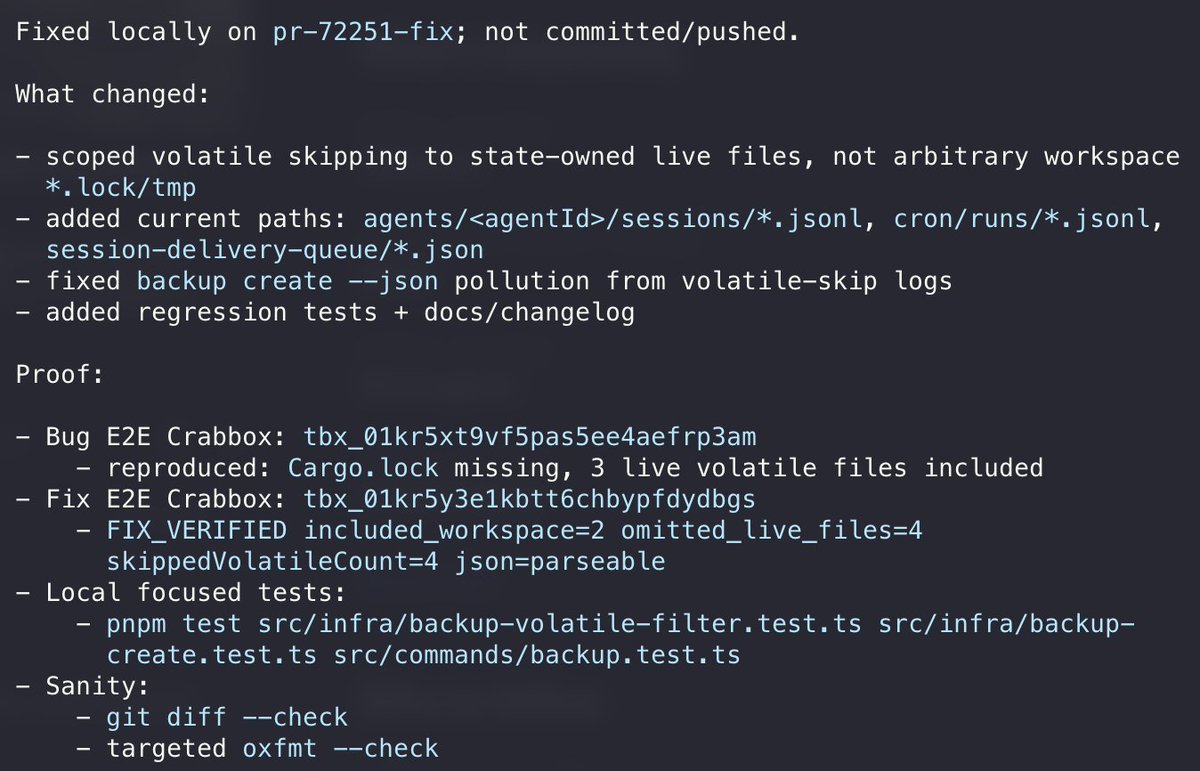
Whenever I investigate a bug, I let codex recreate the exact state in an emphemeral crabbox, verify the bug, fix it, verify the fix. No messy state because local system might be polluted, and no slowdown because I run 10 sessions in parallel. crabbox.sh
Peter Steinberger 🦞 tweet media
English
106
159
3K
317.3K
Aus_Bytes
Aus_Bytes@aus_bytes·
There’s pros and cons with all file formats I tend to run canonical markdown combined with other files that demonstrate the prototype / visual meaning. But I wonder if there’s a better way to combines the simplicity of words with readability and portability for both humans / LLMs
English
0
0
0
114
ᴅᴀɴɪᴇʟ ᴍɪᴇssʟᴇʀ 🛡️
This is really cool thinking from @trq212 here, but I think I disagree with the solution. He makes a great point about Markdown being more difficult to share and communicate ideas with, because formatting and visuals can make things super easy to understand. My problem with the approach is that, by trading editabilty for readability, we’re separating we humans even further from the creation process. I value Markdown because I value text. And I value text because I see it as one step away from thought. I believe thinking is the one thing we should be careful not to outsource, and I worry what this idea smuggles in is a major step toward making our creations opaque to humans. Not just AI's creations, but ours as well. The reason I value Paul Graham so much is because of the idea compression work that goes into writing super clean prose. It's difficult to write clearly because it requires thinking clearly. Text makes your ideas naked, and I like that. - What is the problem, exactly? - What should we do to solve it? - Why is our solution better than alternatives? I love the challenge of crystalizing this kind of critical stuff in pure text before any technology is involved. If we're not writing that text ourselves, and then editing it, it starts to feel a lot like bringing a strong robot to the gym. I worry that if we vibe-think to AI and have it spit out amazing HTML, we're instantly disconnected from the idea. Like where did the idea go? It started as vibes and got put through a woodchipper and turned into someone else's HTML. Can I see it in 4 simple bullets? Can I stare at it? Can I grapple with it. Can I tweak it? It's an idea. I need to be able to wrestle with it. Of course we can ask the AI to summarize its brilliant HTML document into four bullets, but we'll have lost through compression and expansion some percentage of the original. Maybe I'm being overly emotional here. I just feel like if you didn't put the hard thinking and writing work into the original idea, and then maintain it in a format that's easy for humans to read and edit, then you have somehow surrendered something Holy to the machines. I say this as a total AI maximalist. But I get the point he's making, and I think it's super valid. It's hard to explain or convince people of things with a giant text file. Formatting massively helps. Images massively help. Even an interface or a video or something. So we're synched on that. I just think it might be better to come at the output we both want in a different way. - MARKDOWN: Easy for humans to write, hard for humans to read. - HTML: Hard for humans to write, easy for humans to read. Maybe the solution isn't moving the first step to HTML where it becomes more opaque to both agents and humans (plus the versioning issues Thariq talked about). Maybe the solution is something crazy like document pairing: like you have the thought file and you have the presentation file(s). The proposal is to ask AI to just write HTML, right? Well why not just have a separate but linked file for that? One is for crystal-clear human creation and sync between human and AI. Simplicity, clarity, precision, and human editability. And then AI can produce whatever from that. Images, diagrams, videos, or whatever. And if you want, yes, a full HTML file that contains all of them. And that can be what you use to present or share the idea with audiences. (Plus there's the fact that some file formats are literally directories, which could be shared with lots of related content, and then there's also things like .mdx that allow for richer content in Markdown, etc.) I hate the idea of multiple files, but I think it's far preferable to losing the transparent, editable connection to the idea that you get with text. Plus, the better and cheaper AI gets, the more trivial it will be to have the core thought file plus n-number of associated versions or formats that are useful for different audiences. Basically I think it's much easier for AI to make a rich and shareable version of clean, editable thought, in the form of text, than it is for humans to stay connected with ideas as opaque HTML. And I think the human thought-to-text connection is the most important thing to preserve. Still thinking it through, however, and massive thanks to @trq212 for the push for all of us to evolve on this.
Thariq@trq212

x.com/i/article/2052…

English
74
22
298
46.2K
Aus_Bytes
Aus_Bytes@aus_bytes·
@leighjasper Incredibly poor policy proposal on so many levels. Would put the country possibly permanently behind at a fairly unstable time geopolitically.
English
0
0
3
230
Leigh Jasper
Leigh Jasper@leighjasper·
‘Blindsided’: Start-up anger grows over CGT changes afr.com/technology/bli… The government’s proposed massive doubling of capital gains tax will be a disaster for Australian innovation and venture. Tech founders and investors will leave Australia in droves. With the Aconex sale to Oracle for $1.6b, around $400m in tax was paid in Australia by the shareholders of Aconex. If I were paying double the current capital gains tax, I for one, would have stayed in Silicon Valley, rather than coming back to Australia to list Aconex on the ASX. On the sale to Oracle, I would have paid all my capital gains tax in the US, not Australia. Overtaxing capital gains in venture capital will simple force founders, entrepreneurs, execs and investors to leave Australia for lower tax countries such as the US. The whole country loses, with less investment, less innovation, less jobs, less wealth creation and ultimately less tax paid in Australia. This is what you get when you have a treasurer (and nearly 100% of the government) that has never taken the risk to start a company, or been anywhere near business in their life.
English
64
141
753
57.4K
Taiyo/AI Agent作る大学生
Taiyo/AI Agent作る大学生@taiyo_ai_gakuse·
まじで、すごいの出来たwww 自分でこの新しく出たGPT-Realtime-2を組み込んだCLIを作って、マイク設定を変えるとGoogle MeetとかZoomで自分の声が完全リアルタイム翻訳されて、日本語から英語になる。 あとで、MTGしてるデモ見せるけどマジですごいww👇
OpenAI@OpenAI

Introducing GPT-Realtime-2 in the API: our most intelligent voice model yet, bringing GPT-5-class reasoning to voice agents. Voice agents are now real-time collaborators that can listen, reason, and solve complex problems as conversations unfold. Now available in the API alongside streaming models GPT-Realtime-Translate and GPT-Realtime-Whisper — a new set of audio capabilities for the next generation of voice interfaces.

日本語
19
127
1.2K
390.8K
Aus_Bytes
Aus_Bytes@aus_bytes·
Not a one liner, but i have a prompt (wrapped in a skill) adapted from other sources / similar ideas for my workflow that is called 'ask_me_if_underspecified'. This is a long enough prompt that forces the model to assess whether I have provided a fully rounded set of thinking / thoughts before executing. It will ask me questions to further round out the work, before executing. I use this all the time when early prototyping or whe doing something where I am less sure i am covering all the bases. It's brilliant and avoids a whole lot of pain downstream.
English
1
0
2
154
Meta Alchemist
Meta Alchemist@meta_alchemist·
everybody! share your most underrated prompt in the comments ( mine is: "give me a honest verdict" for hallucinations/glazing to be minimized ) go 👇👇
English
38
7
96
4.5K
Aus_Bytes
Aus_Bytes@aus_bytes·
@_simonsmith Atlas has been my daily driver and is a great product - particularly that side bar - would be a shame to see it go. Would be great to see it as a native first class aspect of Codex app.
English
0
0
2
155
Simon Smith
Simon Smith@_simonsmith·
It will be useful for Codex to have Chrome control, but also feels like another nail in the coffin for Atlas. First, add browser inside Codex. Second, add Chrome control. Peel off Atlas use cases. Then shutter Atlas. If so, I hope there's some way to replicate the Ask Chat sidebar in Atlas. That's what I've found unique right now to Atlas, better than Gemini in Chrome.
OpenAI@OpenAI

Codex now works directly in Chrome on macOS and Windows. It’s even better at working with apps and sites in Chrome, and now works in parallel across tabs in the background without taking over your browser. To get started, install the Chrome plugin in the Codex app.

English
17
3
86
7.5K
Aus_Bytes
Aus_Bytes@aus_bytes·
A reshaping of organisations is coming. Similar to the Block announcement recently.
Brian Armstrong@brian_armstrong

This is an email I sent earlier today to all employees at Coinbase: Team, Today I’ve made the difficult decision to reduce the size of Coinbase by ~14%. I want to walk you through why we're doing this now, what it means for those affected, and how this positions us for the future. Why now Two forces are converging at the same time. We need to be front footed to respond to both. First, the market. Coinbase is well-capitalized, has diversified revenue streams, and is well-positioned to weather any storm. Crypto is also on the verge of the next wave of adoption, with stablecoins, prediction markets, tokenization, and more taking off. However, our business is still volatile from quarter to quarter. While we've managed through that cyclicality many times before and come out stronger on the other side, we’re currently in a down market and need to adjust our cost structure now so that we emerge from this period leaner, faster, and more efficient for our next phase of growth. Second, AI is changing how we work. Over the past year, I’ve watched engineers use AI to ship in days what used to take a team weeks. Non-technical teams are now shipping production code and many of our workflows are being automated. The pace of what's possible with a small, focused team has changed dramatically, and it's accelerating every day. All of this has led us to an inflection point, not just for Coinbase, but for every company. The biggest risk now is not taking action. We are adjusting early and deliberately to rebuild Coinbase to be lean, fast, and AI-native. We need to return to the speed and focus of our startup founding, with AI at our core. What this means To get there, we are not just reducing headcount and cutting costs, we’re fundamentally changing how we operate: rebuilding Coinbase as an intelligence, with humans around the edge aligning it. What does this mean in practice? - Fewer layers, faster decisions: We are flattening our org structure to 5 layers max below CEO/COO. Layers slow things down and create coordination tax. The future is small, high context teams that can move quickly. Leaders will own much more, with as many as 15+ direct reports. Fewer layers also means a leaner cost structure that is built to perform through all market cycles. - No pure managers: Every leader at Coinbase must also be a strong and active individual contributor. Managers should be like player-coaches, getting their hands dirty alongside their teams. - AI-native pods: We’ll be concentrating around AI-native talent who can manage fleets of agents to drive outsized impact. We’ll also be experimenting with reduced pod sizes, including “one person teams” with engineers, designers, and product managers all in one role. In short: AI is bringing a profound shift in how companies operate, and we’re reshaping Coinbase to lead in this new era. This is a new way of working, and we need to leverage AI across every facet of our jobs. To those who are affected I know there are real people behind these decisions — talented colleagues who have poured themselves into this company and our mission. To those of you who will be leaving: thank you. You’ve helped build Coinbase into what it is today, and I am sincerely grateful for everything you've done. All impacted team members will receive an email to their personal account in the next hour with more information, and an invitation to meet with an HRBP and a senior leader in your organization. Coinbase system access has been removed today. I know this feels sudden and harsh, but it is the only responsible choice given our duty to protect customer information. To those affected, we will be providing a comprehensive package to support you through this transition. US employees will receive a minimum of 16 weeks base pay (plus 2 weeks per year worked), their next equity vest, and 6 months of COBRA. Employees on a work visa will get extra transition support. Those outside of the US will receive similar support, based on local factors and subject to any consultation requirements. Coinbase prides itself on talent density. Our employees are among the most talented people in the world, and I have no doubt that your skills and experience will be highly sought after as you pursue your next chapters. How we move forward To the team that is staying, I know this is a difficult day. We’re saying goodbye to colleagues and friends you've been in the trenches with. But here’s what I want you to know as we move forward together: Over the past 13 years, we have weathered four crypto winters, gone public, and built the most trusted platform in our industry. We’ve made it this far by making hard decisions and by always staying focused on our mission. This time will be no different – nothing has changed about the long term outlook of our company or industry. And most importantly, our mission has never been more important for the world. Increasing economic freedom requires a new financial system, and we’re building it. The Coinbase that emerges from this will be more capable than ever to achieve our mission. Brian

English
0
0
0
19
Aus_Bytes retweetledi
Brian Armstrong
Brian Armstrong@brian_armstrong·
This is an email I sent earlier today to all employees at Coinbase: Team, Today I’ve made the difficult decision to reduce the size of Coinbase by ~14%. I want to walk you through why we're doing this now, what it means for those affected, and how this positions us for the future. Why now Two forces are converging at the same time. We need to be front footed to respond to both. First, the market. Coinbase is well-capitalized, has diversified revenue streams, and is well-positioned to weather any storm. Crypto is also on the verge of the next wave of adoption, with stablecoins, prediction markets, tokenization, and more taking off. However, our business is still volatile from quarter to quarter. While we've managed through that cyclicality many times before and come out stronger on the other side, we’re currently in a down market and need to adjust our cost structure now so that we emerge from this period leaner, faster, and more efficient for our next phase of growth. Second, AI is changing how we work. Over the past year, I’ve watched engineers use AI to ship in days what used to take a team weeks. Non-technical teams are now shipping production code and many of our workflows are being automated. The pace of what's possible with a small, focused team has changed dramatically, and it's accelerating every day. All of this has led us to an inflection point, not just for Coinbase, but for every company. The biggest risk now is not taking action. We are adjusting early and deliberately to rebuild Coinbase to be lean, fast, and AI-native. We need to return to the speed and focus of our startup founding, with AI at our core. What this means To get there, we are not just reducing headcount and cutting costs, we’re fundamentally changing how we operate: rebuilding Coinbase as an intelligence, with humans around the edge aligning it. What does this mean in practice? - Fewer layers, faster decisions: We are flattening our org structure to 5 layers max below CEO/COO. Layers slow things down and create coordination tax. The future is small, high context teams that can move quickly. Leaders will own much more, with as many as 15+ direct reports. Fewer layers also means a leaner cost structure that is built to perform through all market cycles. - No pure managers: Every leader at Coinbase must also be a strong and active individual contributor. Managers should be like player-coaches, getting their hands dirty alongside their teams. - AI-native pods: We’ll be concentrating around AI-native talent who can manage fleets of agents to drive outsized impact. We’ll also be experimenting with reduced pod sizes, including “one person teams” with engineers, designers, and product managers all in one role. In short: AI is bringing a profound shift in how companies operate, and we’re reshaping Coinbase to lead in this new era. This is a new way of working, and we need to leverage AI across every facet of our jobs. To those who are affected I know there are real people behind these decisions — talented colleagues who have poured themselves into this company and our mission. To those of you who will be leaving: thank you. You’ve helped build Coinbase into what it is today, and I am sincerely grateful for everything you've done. All impacted team members will receive an email to their personal account in the next hour with more information, and an invitation to meet with an HRBP and a senior leader in your organization. Coinbase system access has been removed today. I know this feels sudden and harsh, but it is the only responsible choice given our duty to protect customer information. To those affected, we will be providing a comprehensive package to support you through this transition. US employees will receive a minimum of 16 weeks base pay (plus 2 weeks per year worked), their next equity vest, and 6 months of COBRA. Employees on a work visa will get extra transition support. Those outside of the US will receive similar support, based on local factors and subject to any consultation requirements. Coinbase prides itself on talent density. Our employees are among the most talented people in the world, and I have no doubt that your skills and experience will be highly sought after as you pursue your next chapters. How we move forward To the team that is staying, I know this is a difficult day. We’re saying goodbye to colleagues and friends you've been in the trenches with. But here’s what I want you to know as we move forward together: Over the past 13 years, we have weathered four crypto winters, gone public, and built the most trusted platform in our industry. We’ve made it this far by making hard decisions and by always staying focused on our mission. This time will be no different – nothing has changed about the long term outlook of our company or industry. And most importantly, our mission has never been more important for the world. Increasing economic freedom requires a new financial system, and we’re building it. The Coinbase that emerges from this will be more capable than ever to achieve our mission. Brian

English
5.3K
2.4K
20K
23.4M
Aus_Bytes
Aus_Bytes@aus_bytes·
Reasoning: low -> standard engineering tasks the model is trained on (low/high is what 5.4 high/xhigh was for a lot of things) xhigh -> when tasks are more specialist requiring a lot of 'scratchpad' work in runtime Goal v Oneshot Clearly defined spec / outcome with a mostly set of standard tasks that can be verified -> /goal Iterative goal that you need to prototype / figure out -> progressive shots or one shot ______ Combine as required
English
0
0
0
233
Nick Dobos
Nick Dobos@NickADobos·
What’s the difference between GPT 5.5 low reasoning + /goal Vs GPT 5.5 xhigh reasoning + one shot Both are essentially yeeting compute at a task. But which one - is more efficient? - works better & produces better results? - finishes the task? Seems like the major difference is low would spend less time thinking between each step? And would do way more tool calls because of this?
English
62
6
545
98.7K
Aus_Bytes
Aus_Bytes@aus_bytes·
I don't think AI replaces managers. I think it replaces a lot of the middleware work we've been asking managers to do: gathering context, compressing truth, routing decisions, and turning messy reality into status packs. The future is not managerless. It is less dependent on humans pretending to be middleware. aussiebytes.com/intelligence-l…
English
0
0
0
9