

Andrew Verboncouer
13.2K posts
Andrew Verboncouer
@averbs
† Jesus • ⚭ • Dad³ Worship Leader. Partner & CEO @headwayio Design Systems, Innovation, Transformation. https://t.co/aPIZACjIDN • https://t.co/Vtv8b8TCoI
WI - HI - WI Katılım Nisan 2008
3.4K Takip Edilen4.2K Takipçiler

@averbs Thank you – we did have a few different landing page implementations but none felt quite right so we kept previous version.
You could sign up to newsletters with your Save to Instapaper email address, it will show here when logged in: instapaper.com/docs/save/email
English
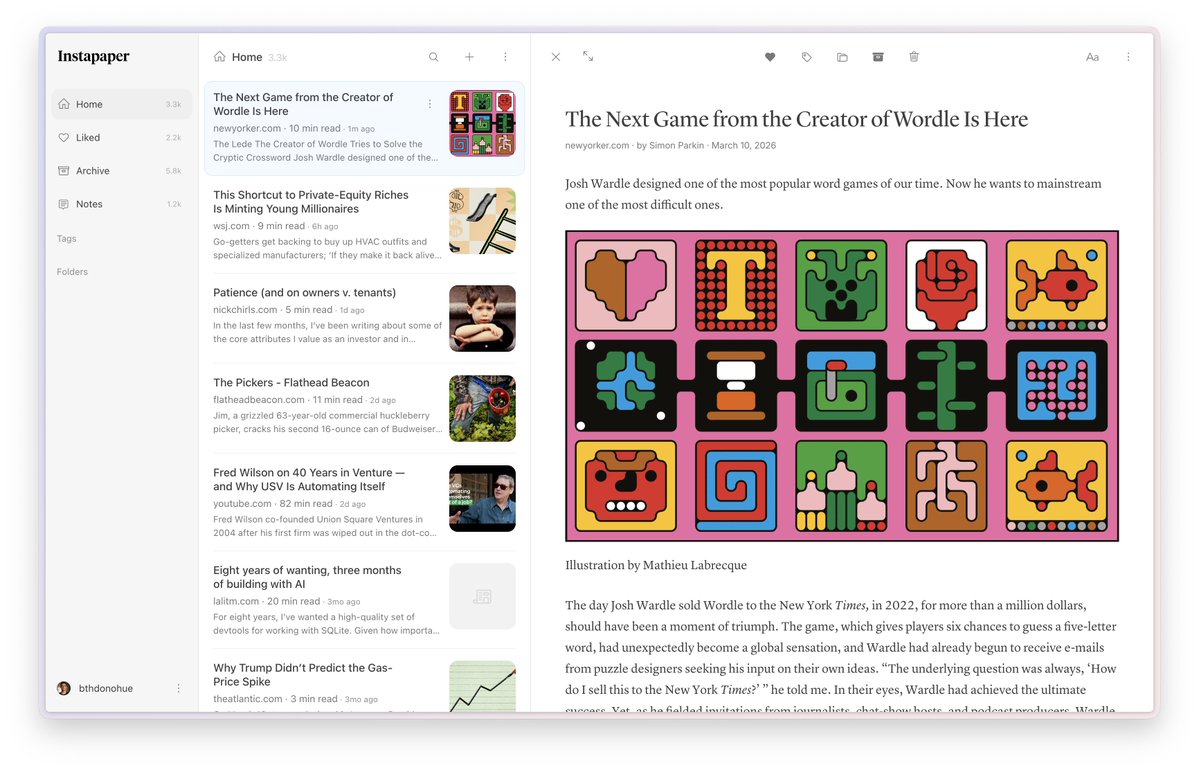
Launch day! Rewrite of instapaper.com, Instapaper 10 for iOS (Liquid Glass, many new features), and Android AI Voices.
English
The new inbox-like UI is great, I was expecting a new home page pre-log-in though!
One of the things I've been thinking about is how ruthless I am about email, and having a good newsletter reader that aggregates the feed/latest would be helpful. Is there a way to automate saves into instapaper like this?
English
@BrettErik Even if you think you're ready, just keep paddling!
English

i still firmly believe surfing is the best analogy for business:
- fundamentally about balance
- requires alignment with large, semi-predictable patterns
- rewards mental and physical fitness
- done well, makes you feel grounded/deep progress
- gives you the realization of just how small you (and your goals) are in the grand scheme of things
- best done with close friends
- reminds you of your weak areas (ESPECIALLY lack of focus)
- makes you appreciate small areas of improvement
- technical, but ultimately about the pursuit of mastery over your state
- perfect balance of fun and challenge

English

A billion people produce the most valuable dataset in the world every day – and delete it every night.
We’re recording it.
Introducing @AttentionInc
English



I am 6.5 hours into the day.
7 tasks completed.
4 b-roll clips recorded.
2 hungry mouths fed (my son and I).
1 LinkedIn post shared.
0 blockers.
Rocky Roark ✶ Brand Sprints@RockyRoark
4am wake up. 1 mile workout in. 3 tasks knocked out before 5am. Feeling pretty good this morning.
English
Enterprise software problems get diagnosed as technology problems.
A surprising number of them are staffing problems in disguise.
Large organizations bring in staffing firms to fill product and engineering gaps, and what those firms deliver is coverage: bodies in seats, headcount that satisfies higher-ups.
The team infrastructure underneath that headcount, the shared standards, training, and sense of direction, tends to arrive separately, if at all.
Without that connective tissue in place, every sprint adds a little more inconsistency.
Decisions get made in isolation, and the product changes.
By the time someone points to the output as the problem, the actual issue has been slowly getting worse for months.
But the companies that build durable software products over time treat team cohesion with the same rigor as any other design decision.
You can have the right technology and the wrong team and still end up exactly where the organizations with the wrong technology end up.
English
@paulbullard The right strategy, with the right talent is so rare.
English

@averbs 100%. When you get down to the root talents, you can see how they apply differently across contexts.
English
Skills from two seemingly unrelated fields transfer more than you’d think.
I went to school for business at Winona State, and played football there. During the time after, I was launching startups and businesses while also playing pro indoor football.
At the time, it was a lot to juggle. But looking back, the skills transferred more than I expected.
Playing at that level requires an obsessive commitment to preparation, an ability to execute under pressure, and a team-first mentality.
All of which came from football. I didn’t need to learn that from scratch at my first startup.
I’m not suggesting you need to go pro in any sport, but you probably learned a skill or two somewhere else in your life that’ll make the whole process easier.

English
We tell clients we help them build a business, not just a product.
Might sound like a positioning thing at first, but it really isn’t.
A product agency merely optimizes for the deliverable.
Design files, shipped features, a codebase that works.
We care about those things, but the question we're always working backward from is whether the product is actually moving the business.
Is it solving what it was scoped to solve?
Is the team better positioned after this engagement than before it?
That framing changes what we prioritize in discovery and always leads to a happier client-agency relationship.
English
Many product teams know their onboarding completion rate.
Almost none of them know which specific moment in that flow is where a particular type of user stops engaging.
Those are very different pieces of information, and they lead to very different conversations about what to fix.
Generic completion metrics tell you something went wrong. Event-based analytics tell you where, for whom, and under what conditions.
We call this "metered experience." The product gets instrumented well enough that you're diagnosing user behavior, not just observing it from a distance.
The teams that build this kind of instrumentation early have a fundamentally different conversation about product decisions than the ones relying on aggregate numbers.
English
@rjs Absolutely - even more important for enterprise, and becoming essential foundation for small teams.
English

Design systems are underrated now. They used to be a large-team problem. Every accelerated team that doesn’t want to look like everyone else needs one.
English
The way software teams are structured today just isn’t going to cut it anymore.
The specialist model, one person per lane, made sense when the tools required that kind of singular focus to operate effectively.
But AI is changing this.
And it’s not just about teams adding AI tools to their existing structure either.
It’s about asking a more fundamental question:
“What does a high-functioning product team actually need to look like when AI can take on the specialist execution?”
The answer I keep landing on is judgment.
The ability to evaluate an output, not just produce one.
The ability to move between disciplines without losing the thread of the business problem.
The ability to direct a tool toward the right outcome rather than accept whatever the tool generates.
I've been calling this the "specialized generalist" for a while now.
I think the teams building around this concept now are going to be in a significantly different position compared to everyone else in the next few years.
Time will tell.
English
Most agencies put an account executive between you and the people doing the work.
At Headway, the person you're talking to is the person building the product.
There are no intermediaries translating your feedback, no layers absorbing context before it reaches the team, no account manager whose job is to manage your perception of progress.
You're in the same Slack/Teams channel as the engineers and designers.
That's a structural decision we've held since the beginning.
This means fewer layers of communication and a faster feedback loop.
English




@joshpuckett So much better/efficient to combine trad deterministic methods with a dynamic personalization layer on top.
English

It’s kinda hilarious how much energy we’re all spending trying to make a magical indeterminate system actually determinate.
English