Missed paychecks. Travel disruptions. HOURS long airport security lines. Hardworking Americans are paying the price for Senate Democrats’ DHS shutdown. Stop the insanity and fund DHS.
Barb
29.5K posts

@barb2point0
I used to love this platform. Communications & Public Affairs Pro.

Missed paychecks. Travel disruptions. HOURS long airport security lines. Hardworking Americans are paying the price for Senate Democrats’ DHS shutdown. Stop the insanity and fund DHS.


President Donald J. Trump has posted to his Truth Social platform warning that if Iran fails to reopen the Strait of Hormuz within 48 hours, the US will begin targeting Iranian power plants. The message was posted at 7:44pm EST.


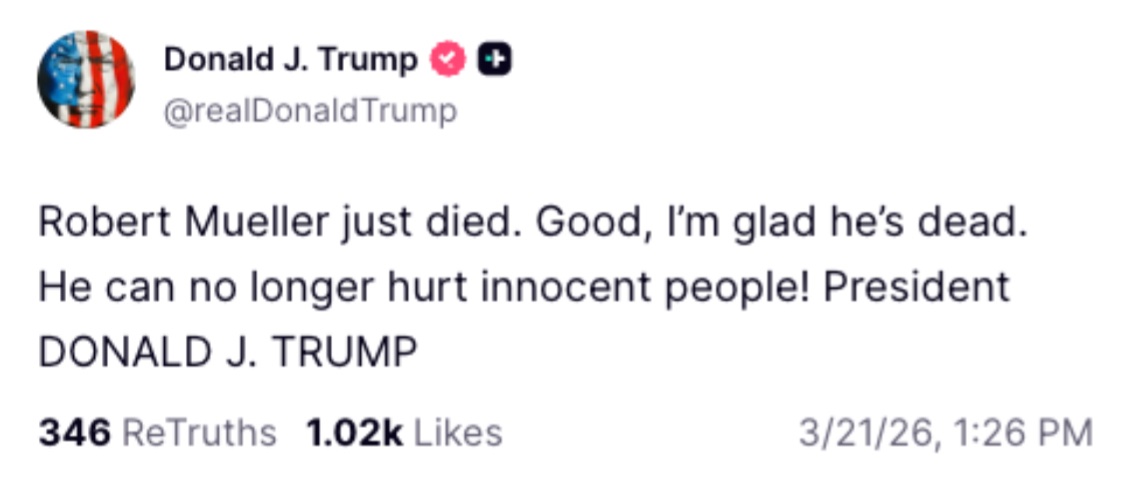
Trump: “Robert Mueller just died. Good, I’m glad he’s dead. He can no longer hurt innocent people! President DONALD J. TRUMP”

NEW: In a letter to employees, United CEO Scott Kirby says the airline is prepping for oil to hit $175/barrel & “doesn't get back down to $100/barrel until the end of 2027.” United is shaving 3% of off-peak flights - “think redeyes, Tues/Wed/Sat flying” - this spring & summer.

BREAKING: $1 trillion in value has been wiped out from US stock-market today

BREAKING: The Pentagon is preparing detailed plans for a possible U.S. ground force deployment in Iran, sources say. cbsn.ws/4bsFiCw


JUST IN: Ukraine just deployed anti-drone soldiers to Qatar, the UAE, and Saudi Arabia. The country Russia has been bombing with Iranian Shahed drones for three years is now defending Gulf states from the same Iranian Shahed drones. Read that sentence until the full geometry of this war becomes visible. Zelensky announced on 10th March that Ukrainian military teams equipped with low-cost interceptor drones and electronic warfare systems have arrived in all three Gulf states this week, with a separate team deployed to Jordan for US base protection. The deployment follows direct requests from Washington and calls from Gulf leaders, including Saudi Crown Prince MBS. The interceptors cost between $1,000 and $2,000 each. A Patriot missile costs $3 to $4 million. An Iron Dome Tamir interceptor costs $50,000 to $100,000. A Shahed drone costs $20,000 to $50,000. Ukraine’s battle-tested ramming drones, some 3D-printed and produced at rates of up to 950 per day, achieve over 60 to 70% kill rates against Shahed swarms at a thousandth of the cost of a Patriot. They are disposable. They are scalable. And they have been tested against the exact weapon system they are now deployed to counter, because Iran designed the Shahed and Russia has been launching them at Ukraine since 2022. No other country on Earth has more operational experience killing Shaheds than Ukraine. No other country can offer that expertise at this price. And no other country needs something from the United States as desperately as Ukraine needs Patriot batteries for its own survival. This is the quid pro quo nobody saw coming. Zelensky is not donating expertise. He is trading it. Ukrainian drone killers for American air defence missiles. Shahed interception capability for Patriot deliveries. The country that cannot defend its own power grid without Western systems is now defending Gulf oil infrastructure with indigenous technology cheaper than anything in the American arsenal. The leverage is extraordinary: Ukraine offers the one capability the Gulf urgently needs, at a cost the Pentagon cannot match, in exchange for the one capability Ukraine urgently needs and only Washington can provide. While the US strips THAAD and Patriot batteries from South Korea and ships them to the Gulf at enormous logistical cost, Ukraine arrives with $1,000 drones in cargo containers. While Ghalibaf mocks American escorts as PlayStation, Ukrainian teams set up electronic warfare jammers on Gulf airfields. While the White House blames a staffer for a deleted post about an escort that never happened, Ukraine delivers the capability the post falsely claimed existed. The Iran war just merged with the Russia war through the one weapon system they share: the Shahed drone. Designed in Iran. Manufactured for Russia. Launched against Ukraine for three years. Now launched against the Gulf. And intercepted in both theatres by the same Ukrainian operators using the same $1,000 technology. Iran built the drone. Russia scaled it. Ukraine learned to kill it. And now Ukraine is selling that knowledge to the countries Iran is attacking, funded by the country Russia is fighting. The circle is complete. The wars are one. Full analysis below. open.substack.com/pub/shanakaans…

Helium is the only element that escapes Earth’s atmosphere permanently. Once released, it rises through the troposphere, passes the stratosphere, and leaves the planet. It cannot be manufactured. It cannot be synthesised at industrial scale. It accumulates over billions of years in the same geological reservoirs as natural gas. And one third of the world’s supply just went offline because Iran hit the facility that extracts it. Qatar produced roughly 63 million cubic metres of helium in 2025, accounting for 30 to 36 percent of global supply from a total of approximately 190 million cubic metres. QatarEnergy’s three large helium purification plants at Ras Laffan form the world’s biggest helium production base. When LNG production stopped after Iranian drone strikes on March 2 and the subsequent missile damage on March 19, helium extraction stopped automatically because helium is recovered during natural gas liquefaction. You cannot produce helium without producing LNG. The byproduct dies with the primary product. Spot helium prices have roughly doubled since the crisis began. Industry consultants warn that prolonged disruption could push contract prices toward $2,000 per thousand cubic feet. A major industrial gas supplier has already begun assessing customers a helium surcharge. Phil Kornbluth, the most cited helium market consultant, stated the assessment directly: the world cannot compensate for the loss of a third of its helium supply. South Korea imports 64.7 percent of its helium from Qatar. SK Hynix and Samsung operate high-volume fabs producing the DRAM and high-bandwidth memory that power every AI accelerator, every data centre GPU, and every cloud computing cluster on Earth. Helium cools silicon wafers during fabrication. It serves as a carrier gas in deposition and etching tools. It enables leak detection in vacuum systems. Modern extreme ultraviolet lithography requires helium-cooled environments for precise temperature control. Without helium, the fabrication process degrades or stops. SK Hynix and Samsung hold two to three months of helium inventory. Two to three months is not a buffer. It is a countdown. If Ras Laffan remains offline beyond that window, South Korean memory production faces rationing. TSMC in Taiwan is somewhat more diversified but still uses Qatar-linked supply chains. The entire AI hardware supply chain, from HBM3E memory stacks to advanced logic chips, sits inside helium-dependent ecosystems. Beyond semiconductors, helium cools the superconducting magnets in more than 14,000 MRI machines operating worldwide. It pressurises rocket fuel tanks and purges propulsion systems in aerospace. CERN’s Large Hadron Collider depends on helium cryogenic systems. There is no substitute for helium in any of these applications at industrial scale. The United States and Qatar together account for more than 70 percent of global production. The US federal helium reserve and private suppliers offer partial relief, but global prices and spot availability are still governed by Qatar’s market share. Japan’s Iwatani has drawn on US reserves. Canada and the Rockies are seeing renewed investor interest. None of this replaces 63 million cubic metres in weeks. The war hit uranium first. Then oil. Then nitrogen. Then water. Then plastic. Then medicine. Then sulfur. Now helium. Eight layers. Each one deeper. Each one closer to the infrastructure that sustains modern civilisation. The chip that processes your data, the magnet that scans your body, and the rocket that launches your satellite all depend on an atom that leaves the planet when you lose it. open.substack.com/pub/shanakaans…