Atlantis USD ($USDA) - Official@AtlantisUSD
🌎 Why Would Financial Institutions — Such as Banks, Stablecoin Issuers, Credit Card Businesses, and Payment Gateways — Prefer to Utilize a Faster, More Secure, Quantum-Resistant Blockchain, and Which Blockchain Is Better Suited for Such Commercial Demands?👇
Financial institutions, such as banks, stablecoin issuers, credit card businesses, and payment gateways, always prioritize infrastructure that delivers security, finality efficiency, cost effectiveness, better privacy protection, settlement certainty, compliance control, regulatory compatibility, and scalability.
________________________________________
1️⃣ Security
Financial institutions manage high-value and system-critical assets including:
•deposits,
•reserves,
•securities,
•and cross-border payment flows.
With the evolution of quantum computing, traditional cryptographic systems used by many blockchains may face increased exposure to:
•key prediction risks,
•signature compromise,
•wallet attacks,
•transaction hijacking,
•and cryptographic vulnerabilities.
The potential quantum threat to Bitcoin, Ethereum, and other similar blockchains has recently become a hot topic in the Web3 space, as concerns grow around the long-term resilience of widely used cryptographic standards.
In comparison, AtlantisChain’s quantum-resistant architecture strengthens long-term protection against these risks, providing higher infrastructure security for financial systems that must remain secure for decades.
________________________________________
2️⃣ Finality Efficiency
Financial systems depend on fast and deterministic settlement outcomes.
Many existing blockchains rely on:
•probabilistic confirmation,
•mempool delays,
•and potential transaction reorganization risks.
This creates uncertainty for:
•payment settlement,
•accounting reconciliation,
•liquidity management,
•and trade execution.
In comparison, AtlantisChain provides:
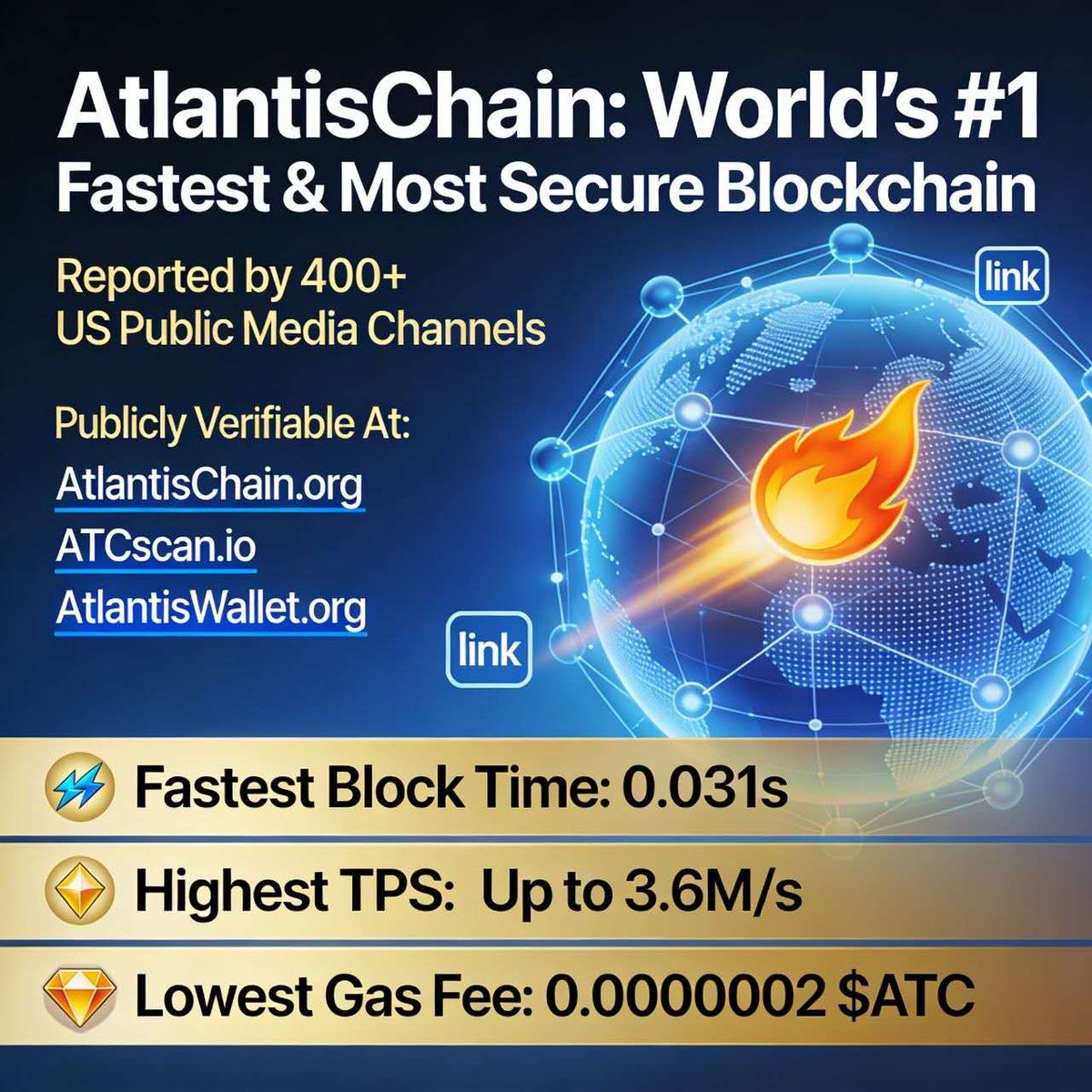
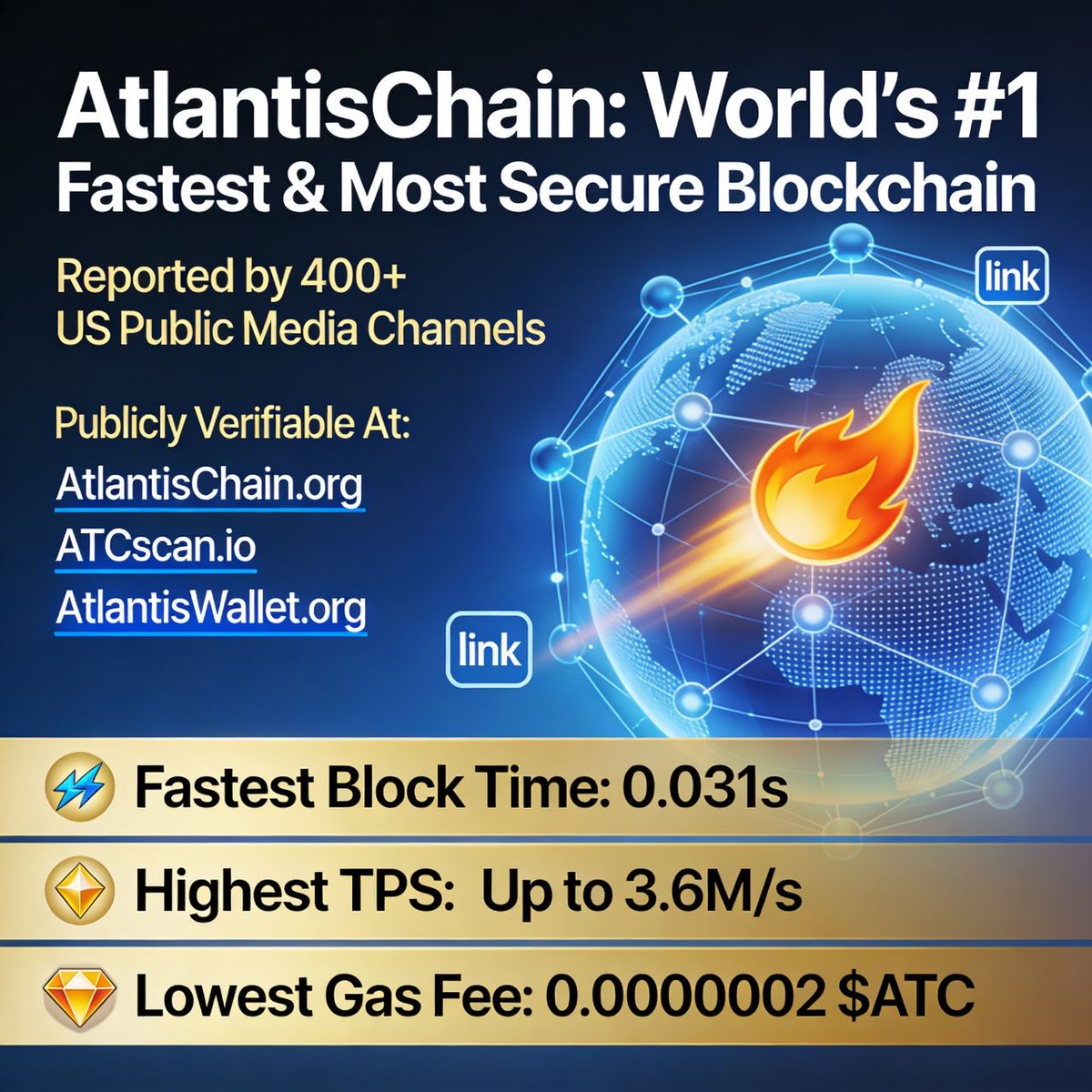
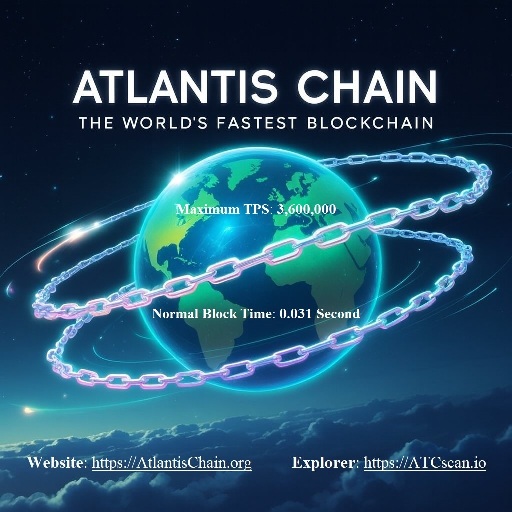
•0.031-second block time
•non-cancellable transactions
•fully final execution upon inclusion in a block
This means that once a transaction is submitted and included, it becomes final and irreversible, with settlement potentially completed in as little as 0.031 second.
This removes confirmation ambiguity, eliminates cancellation risk, and enables near-instant deterministic settlement for financial operations requiring immediate certainty.
________________________________________
3️⃣ Cost Effectiveness
Financial institutions operate at massive transaction scale, where cost stability is critical.
All other blockchains' issues on transaction expenses include:
•volatile gas fees,
•congestion-driven cost spikes,
•unpredictable settlement expenses,
•and high reconciliation overhead.
For example, on the Bitcoin and Ethereum networks, there have been instances prior to 2026 where network congestion and fee spikes resulted in users paying extremely high transaction fees—sometimes amounting to thousands or even millions of dollars in gas fees for transactions involving significantly smaller transfer values.
In comparison, AtlantisChain delivers cost efficiency by minimizing and fixing its gas fee for all transactions at: 0.0000002 ATC per transaction.
This results in:
•predictable per-transaction costs,
•stable treasury planning,
•and highly efficient financial accounting at scale.
For institutions processing millions of transactions, this leads to:
•significantly lower operational uncertainty,
•improved capital efficiency,
•and reduced total infrastructure cost.
________________________________________
4️⃣ Better Privacy Protection
Financial institutions require strong confidentiality for:
•treasury operations,
•enterprise payments,
•sensitive financial data,
•and customer protection as required by law.
Most blockchain transparency can expose:
•all active customers and their transaction details,
•trading behavior,
•payment flows,
•liquidity positions,
•and internal operations.
In comparison, AtlantisChain provides enhanced privacy protection through:
•controlled transaction visibility,
•institutional-grade confidentiality,
•and secure financial coordination.
This allows institutions to protect sensitive commercial data and customer information while still meeting regulatory obligations, and increase traceable transactions transparency.
________________________________________
5️⃣ Settlement Certainty
Financial transactions directly impact:
•accounting systems,
•asset transfers,
•revenue recognition,
•and regulatory reporting.
Most blockchains take quite long time for finality, and users may cancel a transaction during its finality process, and such uncertain settlement creates risks such as:
•transaction reversals,
•delayed confirmations,
•and inconsistent financial records.
In comparison, AtlantisChain provides:
•deterministic settlement,
•irreversible execution,
•and immediate confirmation certainty as quick as 0.031 second for any transaction.
AtlantisChain's unmatched settlement certainty reduces:
•settlement disputes,
•reconciliation costs,
•and financial reporting errors.
According to MIT’s World Currency Theory, when money changes hands, it represents a final and determinative transfer of ownership, i.e., transaction finality.
________________________________________
6️⃣ Compliance Control
Financial institutions must meet strict requirements including:
•AML monitoring,
•transaction traceability,
•audit readiness,
•and regulatory reporting.
Most blockchains don't have any legal compliance functions from their day 1 of operations, and thus always risk legal challenges from time to time.
In comparison, AtlantisChain's ATC-20 Standard supports:
•verifiable transaction history,
•structured financial records,
•systematic compliance alignment,
•anti-hack functions,
•anti-cheating functions,
•and anti-rug functions.
This improves regulatory oversight while maintaining operational efficiency.
________________________________________
7️⃣ Regulatory Compatibility
As required by law, financial institutions must ensure:
•asset backing transparency,
•transaction legitimacy,
•and audit-grade reporting.
A suitable blockchain must provide:
•verifiable and tamper-resistant transaction records that can be independently audited by institutions and regulators
•transparent transaction history that supports external compliance review, risk assessment, and forensic analysis
•consistent ledger finality that ensures a stable and reliable reference state for financial reporting and audits
According to World Currency Theory of MIT, when money changes hands, it represents a final and determinative transfer of ownership, i.e., transaction finality.
In comparison, AtlantisChain aligns with these requirements through:
•immutable transaction records,
•deterministic settlement behavior at the speed of 0.031 second per block,
•and consistent financial data structure.
________________________________________
8️⃣ Scalability
Global financial systems require:
•high transaction throughput,
•continuous settlement capability,
•and long-term scalability.
Most blockchains are not fit for any commercial use due to their low TPS and continuous congestions from day to day.
In comparison, AtlantisChain enables:
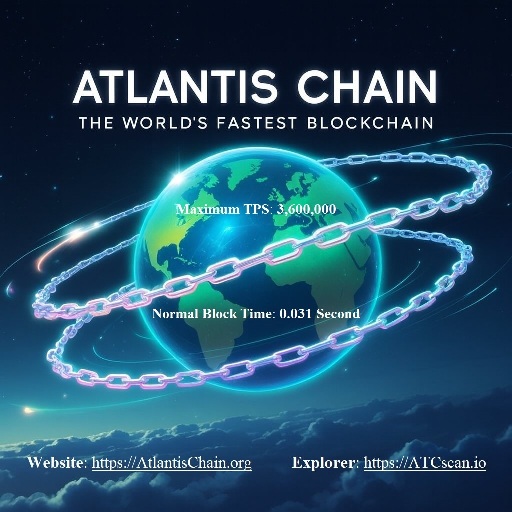
•large-scale transaction processing, capable of processing up to 3,600,000 transactions per second (TPS)
•sustained network performance with 0.031-second block time since April 2025
•and global financial expansion capability.
In addition, Atlantis Space node satellites are under development since late 2025, making it the world’s first blockchain network expanding into outer space.
AtlantisChain’s scalability is unmatched — setting a new standard and delivering a revolutionary leap for financial institutions worldwide:
•payment networks,
•stablecoin ecosystems,
•enterprise financial infrastructure,
•international trade,
•cross-border transfers.
________________________________________
9️⃣ Conclusion
Financial institutions, such as banks, stablecoin issuers, credit card businesses, and payment gateways, are increasingly seeking blockchain infrastructure that aligns with real-world financial system requirements, including security, efficiency, cost predictability, privacy protection, settlement certainty, compliance readiness, regulatory compatibility, and scalability, since late 2025 when blockchain-based business becomes lawful in the United States.
As financial markets continue to evolve toward digitized assets and global on-chain settlement systems, infrastructure selection becomes a foundational decision for long-term operational stability and economic efficiency.
Based on the factual information above and market trends, a faster, more secure, privacy-enhanced, quantum-resistant, and high-performance blockchain – such as AtlantisChain – represents a revolutionary commercial-grade infrastructure model designed to support institutional-grade financial activity, global payments, large-scale economic coordination, and billions of people’s everyday commerce.
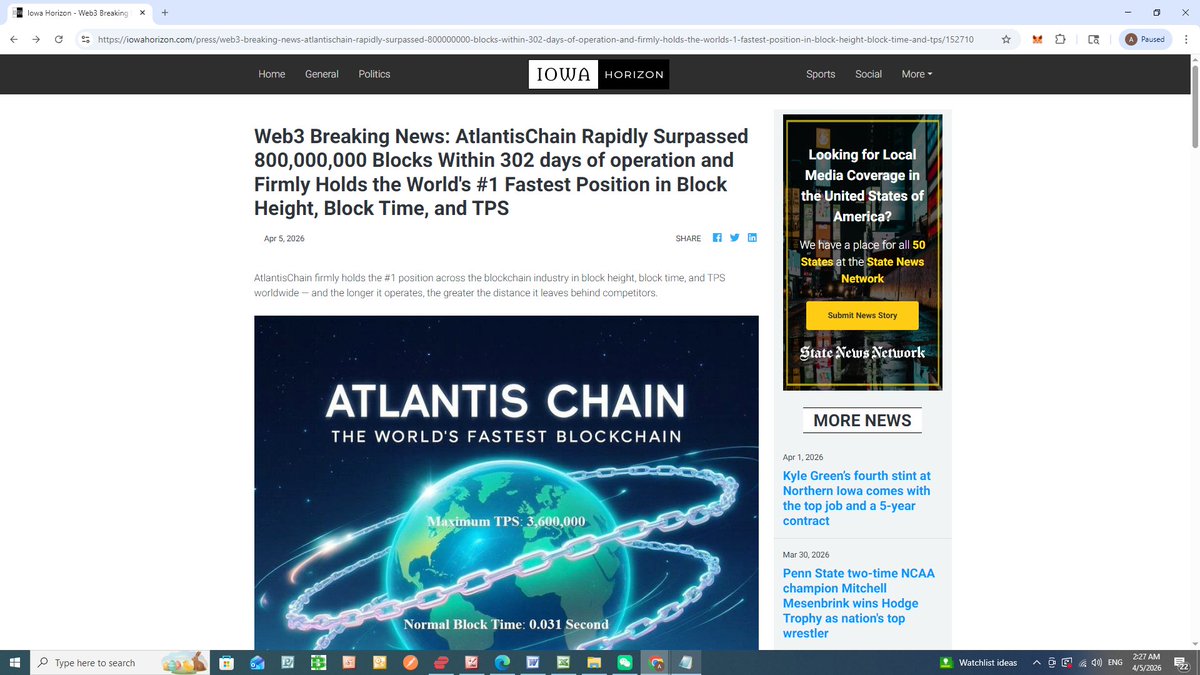
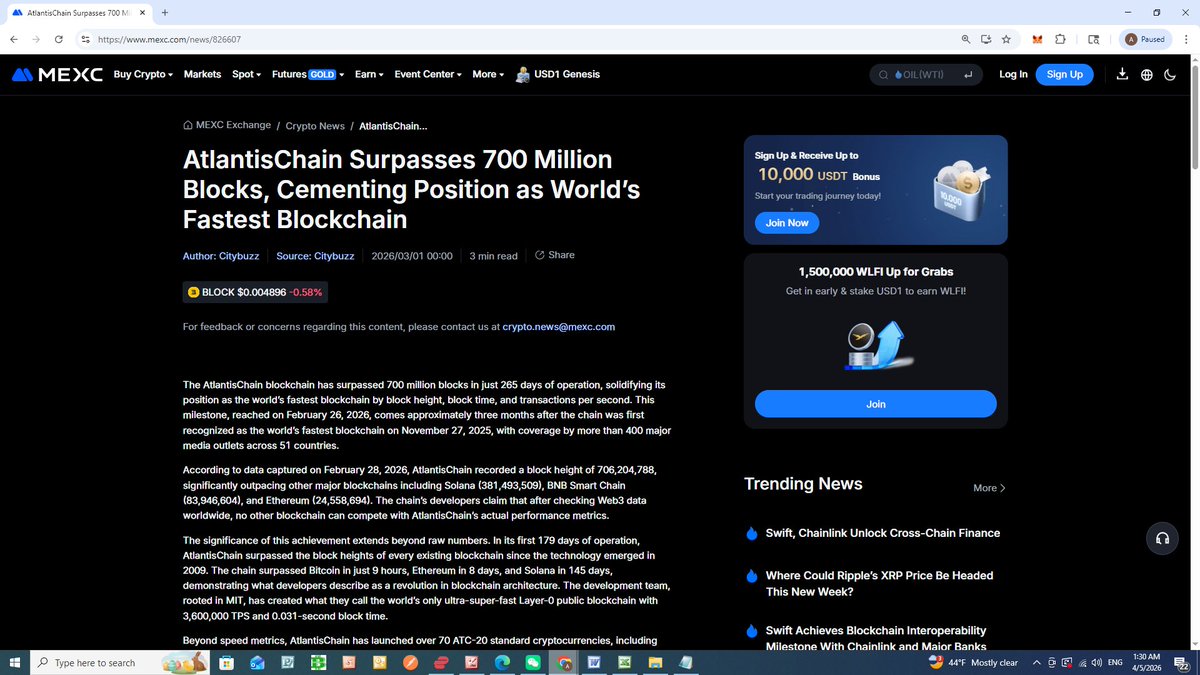
AtlantisChain has firmly maintained its position as the world’s #1 fastest and most secure blockchain since November 27, 2025 and has been extensively reported by more than 400 public news channels throughout the United States.
As of May 13, 2026, AtlantisChain’s block height has surpassed 891,500,000+ blocks, consolidating its position as the world’s #1 leading blockchain in both performance and technology.
As 2026 progresses, AtlantisChain has been ready for global users and will gain increasing adoption from both individual users and institutional participants as awareness and real-world utilization continue to expand.
Last but not least:
1)For AtlantisChain’s Featured Facts, see: x.com/AKF_Foundation…
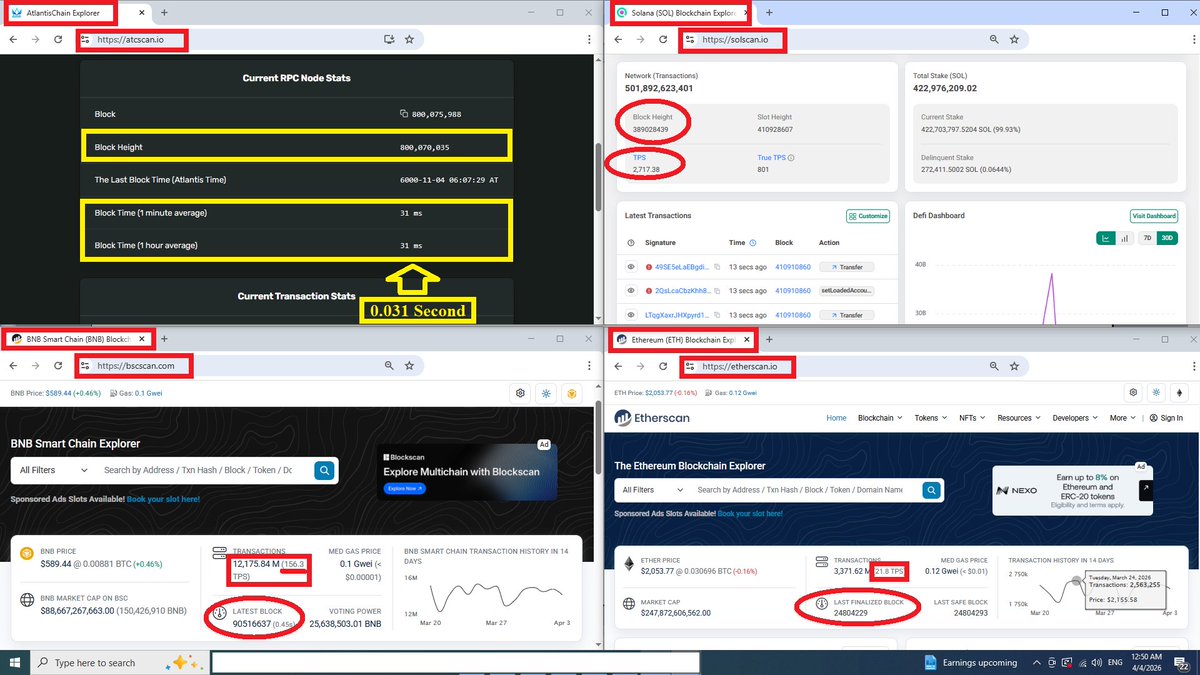
2)To verify AtlantisChain’s real performance, see: ATCscan.io
#Tokenization
#InstitutionalFinance
#Institution
#Bank
#Stablecoin
#CreditCard
#PaymentGateway
#Blockchain
#FinTech
#DeFi
#Stablecoin
#Cryptocurrency
#DigitalAssets
#Payment
#AtlantisChain
#AI
#Web3
#Web4