

Bobby DeSimone
378 posts


I’ve probably vibe coded 100+ things in the past year.
I can count how many I still use on one hand.
English
@jhleath how to secure & manage what goes in and out of the sandbox remains the challenge imho

English

100% of infra companies created over the past three years are sandbox companies, if you take “sandbox” to mean “orchestrates compute on behalf of users” — they disagree on what will be the differentiator that matters, is it:
- shared storage
- being good at GPUs
- being good at browsers
- running the sandboxes in your basement
- cool DNS+IP tricks
- triangles
- shipping SQLite around the world fast
- GTM
- cute graphic design
some of these will matter more than others, and it’s fun to not know what it will be — probably something that looks very different
BennyKok@BennyKokMusic
Calling it. All coding agent wrapper company in couple of months will start selling you cloud sandbox
English

I'll never look at a deck. I don't do decks. We don't do decks.
Just tell me.
English
can someone in legal confirm this is grounds for immediate termination?
English
Bobby DeSimone retweetledi

As agents get capable enough to act across real enterprise systems, the bottleneck isn't "can the model do the work?", it's "can we govern it?"
Run Identity = the work (scoped, expiring) × the agent's capabilities × who's behind it.
Access exists only where all three overlap.
English
@nikesharora I think this is pretty spot on... and as the ecosystem matures, I think we are going to see a very clear dividing line between what's in and out of the inherently non-deterministic harness boundary. This goes for context as much as it goes for identity, and authorization.
English

Summary:
I spent time trying to figure out this orchestration layer problem, can we design a multi model architecture in the long term. The more I dug in the more I understand that trying to build an abstracted layer is hard. As agentic activities increase and agent chaining and complex tasks get assigned to AI it will become harder to move between models.
There is a reasonable probability that 75% of the enterprises will build their implementation of the solution to their core problem around one model "stack".
Token price reduction by 90% is the solve and mobility between models from the same frontier lab!
Evals, harnesses, cache memory are the moats and I don't see models providing simple abstraction to those.
I know there are efforts to do this out there, the long term solve for orchestration if it works will need to be "Claude code" level of design genius.
Here's a chat with Fable @HamzaFodderwala had.
**Why abstraction looks easy.** Models are stateless — every API call is weights + a prompt assembled at runtime. Everything the model "knows" about you — memory, documents, history, tools — is injected into the context window by software outside the model. So in principle, all your state already lives outside the weights. The catch is what "state" includes.
**Layer 1 — Data (fully portable).** Enterprise documents, tickets, logs. Retrieved via RAG: text is chunked, embedded, stored in a vector database (Pinecone, pgvector), and relevant pieces are fetched into the prompt per query. The embedding model is separate from the LLM, so this layer is genuinely model-agnostic. Already solved.
**Layer 2 — Memory (portable in principle).** Systems like Mem0 and Zep sit between the app and the model: after each interaction they extract salient facts ("user prefers X"), store them as plain text, and inject the relevant ones into future prompts. Because the artifact is natural language, it reads into any model. Facts port.
**Layer 3 — Orchestration/routing (works, but only for shallow tasks).** Gateways like OpenRouter and LiteLLM normalize API differences and route each request to the cheapest capable model. This is the fungibility layer being furiously built. It genuinely works for one-shot, verifiable tasks — classification, extraction, summarization — which conveniently are the tasks where cheap models suffice anyway.
**Where it breaks — the non-portable state.** Four things stay behind when you switch:
- **The harness.** Prompts, tool schemas, and guardrails are tuned to one model's quirks. An agent must get every step right, so reliability compounds: a model that's 98% reliable per step completes a 50-step task about a third of the time; at 90% per step, it almost never finishes. Swapping models costs you a few points per step — the difference between an agent that works and one that doesn't.
- **The evals.** Swapping means re-testing everything and re-fixing every regression. The real switching cost isn't data migration — it's re-verification. Nobody has abstracted that.
- **Procedural memory.** Facts port; skills don't. Cached successful workflows and learned workarounds are conditional on the model that produced them.
- **Cache pricing.** Provider-specific, worth 75–90% of input costs on agentic workloads. Quiet lock-in.
**The labs' angle.** They offer hosted memory, hosted file stores, caching, fine-tuning — every one pulls state from your side onto theirs. The labs will crack memory first, but as lock-in, not portability. Nobody standardizes their own exit door. MCP is the partial exception: it standardizes tool and data access across models, but doesn't touch harness tuning or evals.
**Where 3P vendors fit.** Routers are thin-margin commodity plumbing; vector DBs and memory infra are real but small. The two structurally interesting positions: **eval platforms** (LangSmith, Braintrust) — since switching cost equals re-verification cost, whoever industrializes cross-model testing actually enables fungibility.
English
We’ve been thinking about project awareness all wrong.
we need to spend $150k in tokens to convert pomerium to rust; not for any improvement, but because apparently rewrite drama is like catnip for devs
English

cleaning up your old codex / claude code config files, skills,`agents.md` , etc feels remarkably similar to cleaning up your windows registry felt
it's wild how fast prompt engineering best practices shift, and how quickly that becomes agentic tech debt
English
Bobby DeSimone retweetledi

Love this re-imagining of America’s founding using Docs, Gmail, Calendar and more from @GoogleWorkspace. Really puts the history in version history :)
English

@dzhng It’s still very new, but my impression is you’ve inverted what fable/mythos is best at which is going deep. I find fable incrementally better at planning and great at going deep. Unfortunately doesn’t help on the token spend…
English

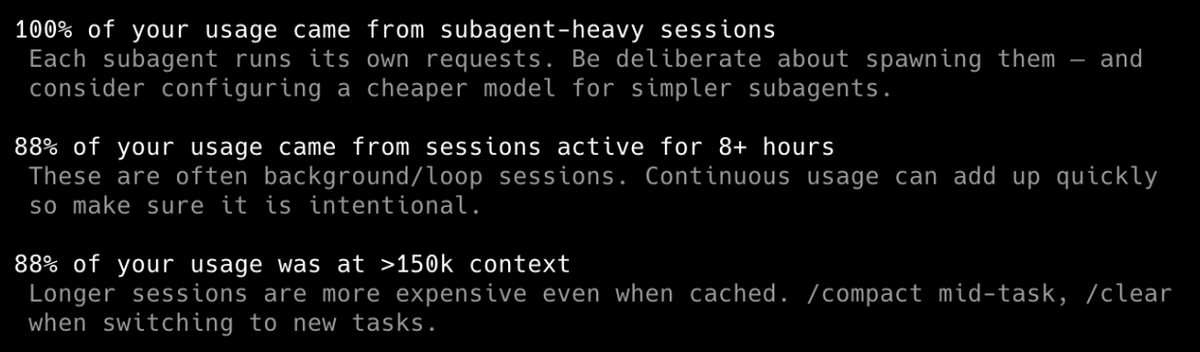
Hot tip: use Fable-5 for planning and as the general orchestrator and reviewer, and Codex as the actual implementer so you don't blow through all your fable credits in a day
I have a skill for this: github.com/dzhng/skills
It also contains my battletested skill to recursively plan and map out the lay of the land, very important to do this before you start any long loop runs.
Happy Fable day!
English
I periodically remember perplexity exists when a podcaster is contractually obligated to Google something via perplexity
English
… remember when everyone was freaking out about moltbook a place where llms were having deranged conversations with each other all day?
… and that’s just LinkedIn now & we all just accept it as the new normal
English
@homegymcoop Barrel saunas have a ton of down sides. I love Costco. And I love sauna but I would not suggest this for anyone looking to enjoy their sauna experience. Cold feet, hot head, poor ventilation, can’t lay down, just generally terrible ergonomics
English

The Costco 2-person cedar barrel sauna is the best value traditional sauna you can buy.
- Heats up quickly (small size)
- Tempered glassdoor + window
- Harvia 6.5kwh heater
- Western red cedar
- Easy to mod w/roof and wifi
- Costco return policy
All for ~$3k out the door.
English
