

Brian Summerfield
13.7K posts

Brian Summerfield
@bdsummerfield
Restoring U.S. Manufacturing | Founder @ CSS – Ops, Lean, CAPEX, Turnaround, Exit Prep | Christ-Powered. Empty the Tank.
Ohio, USA | Nationwide Katılım Eylül 2012
1.9K Takip Edilen1.8K Takipçiler
“I do get the point that a PE firm who's long-in-the-tooth on a deal is incentivized to rein in / defer spending to goose EBITDA and therefore EV - that of course happens. But cut those costs / defer that spend too aggressively, and any new buyer will see right through it and factor those dollars into their offer.”
English

Ah, the PE is bad vs. PE does no wrong debate. Surprised I'm late to this one.
I started covering PE firms when there were SIXTEEN with more than $1 bn of AUM. I also spent some years working directly in middle market private equity, and saw the way it worked from the inside as well.
To say "All PE bad!!!" is beyond ridiculous. It's now a multi-trillion-dollar asset class because an unfathomable amount of value has been created over the decades. And much of that value has accrued to pension funds, endowments, universities, and the retirement funds of people who work and live on Main Street. PE has saved companies, grown companies, enabled new products, services, and therefore jobs.
Now, on the flip side, "PE only makes money when they make a company more valuable" is demonstrably not accurate. The history of the industry is full of dividend recaps that moved money to LPs / partners but ultimately led to the business blowing up (with everything bad that entailed). That's just a fact.
On multiple arbitrage, when I was running buy-side models back in the day we would get yelled at - appropriately - if we baked in ANY multiple arbitrage to the exit. If the deal didn't work w/o multiple expansion, you wouldn't do it. I don't disagree with John - build a better business, get a better multiple - but over the long run macro has a huge impact on where multiples settle at any given point in time. That's out of our control. Plenty of mediocre deals with modest improvement in the underlying business still ended up doing well because the market (and multiples) continued to go up and to the right. Bain, McKinsey, etc. have always tried to quantify how much of overall returns has been driven by mult expansion. I don't know how accurate their numbers are, but it's certainly had a meaningfully positive impact (in the public markets as well, of course).
In terms of time horizon, I'm not sure I fully see where @HighyieldHarry is going with that one: "There’s an inherent mismatch where medium term profit maximization results in things that are actually bad for the consumer experience and ultimately the business long term." You could make the argument that ANY profit maximization can lead to the exact same result independent of time horizon - and that applies to PE, pubcos, or founder-backed businesses. I'm a small business owner, and I'm always thinking about short-term profit - because I have to. I, and most business owners regardless of size, don't really have the luxury of thinking about 20 year time horizons. We are constantly striking a balance between profitability and customer experience, and I think that applies to all businesses - large, small, public, private, PE-owned (VC-backed may be an exception and worthy of another discussion). I do get the point that a PE firm who's long-in-the-tooth on a deal is incentivized to rein in / defer spending to goose EBITDA and therefore EV - that of course happens. But cut those costs / defer that spend too aggressively, and any new buyer will see right through it and factor those dollars into their offer.
I think we can appropriately see both sides here. PE is not evil and it has added tremendous value. PE has also caused a lot of damage over the years - bad decisions, bad capital structures, bad outcomes that have negatively / severely impacted employees, lenders, investors, and other stakeholders. When trillions of dollars have been invested, of course there will be a very substantial number of deals gone bad. These deals get a ton of coverage and cause real pain to those involved - deservedly so.
Like everything else on Twitter, the world wants this to be binary. Good v bad, and no in-between. Lots of people have gotten rich from PE - including employees - and plenty have been wiped out.
I didn't enjoy my time in the industry at all - for lots of different reasons - and I'm very happy to have turned the page to running my own business. I'm not a blind advocate of PE, by any means.
But I'm also willing to give credit where credit is due, and there are many brilliant PE folks who are completely dedicated to building great businesses - and when they do, it benefits us all.
There's a reason the industry has gone from a few handfuls of billions of AUM to trillions today.
John Caple@BigJohn043
This is non-sense. PE only makes money when they make a company more valuable. Debt paydown is almost always a small portion of the return. While sometimes cost reductions make a company more valuable, generally business buyers are pretty smart. They aren't going to pay up for a business that has been stripped. They will pay up for business that show top line growth, shifts to segments with more recurring revenue, etc. Most PE investments focus on growth. The idea that PE isn't focused enough on the long term is truly wrong. Talk to anyone that has worked in a public company and there is intense focus on simply the next quarter. When they get to PE they are amazed at the focus on 3-5 years out. And BTW, even if we are going to sell in 3-5 years we also have to make investments so the next buyer has a good return in their 3-5 year hold after that. Way less short term focused. Should we focus on 10-20 years out? While this sounds good, many investments focused on those types of time horizons are just a waste of money. Who knows what the world will look like in 20 years. If an investment can't be justified over the next 5 years then most times it is just a bad investment. I am sure there are limited exceptions but I am very skeptical. The bottom line is PE only makes money if they build better businesses. Not every PE firm is successful and even the successful ones have deals that don't work. But there are also public companies and founder owned businesses that fail. The success and returns of PE suggest that overall they are building better businesses and that is good for society as a whole.
English

The move is this
Hire an ex-CEO as chief people officer (should be senior to current CEO so functions as a consigliere)
Outsource every HR function possible pay, benefits, hiring, etc.
Get an epic HR IT self serve portal
Build capabilities in front line managers normally guarded by HR
Get them a “legal on call” if they have an employment concern
Save massive dollars
Polymarket@Polymarket
JUST IN: Bolt CEO Ryan Breslow fired the company’s entire HR team because they were “creating problems that didn’t exist.”
English
Find people who are actually operators and have done it in the seats. I see too many PEs hire ex-consultant heavy folks. Nothing against consultants, brilliant people some of them, but until you done it (and have some scars) from the actual driving seats and that accountability, you won’t get the outputs expected.
English

Over the past year I have personally seen three large Private Equity firms build their value creation teams from scratch...
And then fire the lot of them and start over.
It is so hard to get it right. What's the secret?
English
@BigJohn043 Having worked across both public and PE as well as SMB, this is a very good breakdown.
English

This is non-sense.
PE only makes money when they make a company more valuable. Debt paydown is almost always a small portion of the return. While sometimes cost reductions make a company more valuable, generally business buyers are pretty smart. They aren't going to pay up for a business that has been stripped. They will pay up for business that show top line growth, shifts to segments with more recurring revenue, etc. Most PE investments focus on growth.
The idea that PE isn't focused enough on the long term is truly wrong. Talk to anyone that has worked in a public company and there is intense focus on simply the next quarter. When they get to PE they are amazed at the focus on 3-5 years out. And BTW, even if we are going to sell in 3-5 years we also have to make investments so the next buyer has a good return in their 3-5 year hold after that. Way less short term focused.
Should we focus on 10-20 years out? While this sounds good, many investments focused on those types of time horizons are just a waste of money. Who knows what the world will look like in 20 years. If an investment can't be justified over the next 5 years then most times it is just a bad investment. I am sure there are limited exceptions but I am very skeptical.
The bottom line is PE only makes money if they build better businesses. Not every PE firm is successful and even the successful ones have deals that don't work. But there are also public companies and founder owned businesses that fail.
The success and returns of PE suggest that overall they are building better businesses and that is good for society as a whole.
High Yield Harry@HighyieldHarry
Since everyone is arguing about whether Private Equity is good or evil, I want to say we shouldn’t have rosy glasses here. A decent amount of what PE does is very destructive long-term. That’s far from every deal or team though. Some of these companies grow a ton organically and create great jobs & payouts for investors and employees. But many destroy businesses LT. There’s an inherent mismatch where medium term profit maximization results in things that are actually bad for the consumer experience and ultimately the business long term. That 3-7 year exit timeline vs operating on a 20 year timeline eventually strips many businesses of what made them great for the sake of short term margin expansion. Let’s get real guys - there’s so many silly costs that get cut & expenditures that get deferred as a result of medium-term profit maximization to pump up EV. And that doesn’t even mention consolidation of critical services like healthcare. I’ve been digging into how PE consolidation impacts pet care, funeral homes, urgent care centers, & more and it’s not something many of you should be proud of. My next piece on that is next week on @HYHNewsletter The wrong type of private equity investing is absolutely hollowing out dozens of sub-industries - particularly industries with life or death outcomes. And those guys are likely going to hell for that.
English

Just (randomly) talked to a guy at a happy hour who built a $60M+ revenue behavioral platform from scratch over 7 years
Incredible
“Would not do it again.”
Trying to sell. Just had an LOI fall through. Massive Medicaid stroke of pen risk. Buyers don’t like it.
Owns two other platforms he built with partners through M&A. Trying to exit everything in 2 years, then assemble more roll up platforms and do it all over again
Some people have a ton going on. I was just trying to close on a teeny tiny HVAC business last year and failed
English
@blueprintsmb22 Appreciate this share @blueprintsmb22. A lot of overlaps on different paths but resonates.
English

Long post but the TLDR is choose your reference points carefully.
I grew up comfortable in Kansas with a father who owned a small business pulling $40k a year. I felt rich until I went to Brown. Then I felt like the poor. There were students that had BMWs parked on different parts of campus so they wouldn't have to walk far to get access to a car.
I needed to make money to pay back my parents for college so I went to Wall Street. After Morgan Stanley, I worked for a single manager hedge fund managing $1.5Bn (alot of money back in the day) in SF that had just received an anchor investment from Yale University.
My boss was making more money than ever and was spending it. He would vacation with Lance Armstrong and Cindy Crawford. He became close with Wes Edens at Fortress. We made investments in Fortress portfolio companies. My boss took board seats on some of these investments. My boss spent alot of time frustrated he was not on the same level as Edens.
My boss was also close with Charles Schwab and we also invested in SCHW. Charles would let my boss and the firm stay at Stock Farm in Montana to host events for our LPs and management of some of our portfolio companies. It was the first time I ever flew private. I met Don Valentine of Sequoia who was an LP in our fund. We ran into Huey Lewis in the men's locker room before playing some golf. It was a world I never knew really existed growing up in Kansas.
We were also investors in Herbalife and would complain to the CEO at the time Michael Johnson (ex Disney) that he was massively overpaid and that the compensation structure of the company needed better alignment for shareholders (based on hitting key KPIs, etc). He would say he impressions mattered in his industry and living in LA was expensive.
When 2008-9 happened, our fund got decimated as we basically were a long only. Heavy exposure to Fortress names with massive leverage was no bueno. My boss had board seats which meant we were restricted. Yale pulled their entire investment. While the world was burning down, my boss in his fancy office in the Transamerica building told me that I was lucky "to not have any money to lose" while the world was burning down lol. I get what he was saying now as we saw clients that had amassed generational wealth in tech or owning boring businesses in Louisiana lose half of their net worth in 12 months. People were scared.
I would move back to NYC and end up working for 3 billionaires at different points during my career as a journeyman buysider. I did well enough at points to have direct contact with some of them. I saw the same dynamic - always someone doing better. Always frustrated. Not that happy.
I stayed in this world just trying to stay alive with some good years and years I got paid nothing when performance was poor. I was fine staying on this never ending hamster wheel until 1) I got married 2) we had a daughter 3) my dad's cancer diagnosis got more grim and I did more self reflection on what game of life I was playing.
Ultimately I left to buy a small business which has been hard. I still have friends on the buyside and in tech that struggle with comparison. But the reference points I was around constantly in my W2 are no longer loud. I wake up early and turn on machines. Most of my team members never graduated high school. My customers are mostly salt of the earth sales people working for small distributors sprinkled with some big publicly traded companies. $4 gas is a huge problem to everybody I interact with during my day - my customers complain daily about it in their daily lives. I sometimes lend money to my team members when they need help. I have to fix problems every day as the business isn't big enough to support hiring a general manager right now. But I'm home for dinner every night. This works better for me and my family.
My life is simple now => bring in business to make sure the 10 team members can feed their families. Last year when tariffs and a big customer shutting down hurt business badly for 3 months, my accountant told me to start firing employees as my competitors were either shutting down or firing 25-33% of their entire staffs. Entire shifts were shut down. I fired no one. It didn't feel right. I just stopped paying myself.
This year things have turned around. Team members are making 25-33% more due to overtime. I have more purpose now as my life is simplified as I'm just focused on making sure my team can eat, we make good product for our customers and the business can continue to pay down debt.
This is a hard path. I wouldn't recommend it for many, but it works better for me at this point in my life. My mental health has never been better. My wife reminds me how big of an asshole I used to be in finance as I was always stressed about my exposure / frustrated I wasn't doing better. What changed? My reference points changed. I no longer live in NYC. I live in this myopic world where I spend my weeks talking to team members, customers and vendors. 4am until 4pm is spent living in this world. 4pm-8pm is spent with my family before I go to bed ahead of a 330am wake up.
I have no doubt if I stayed in finance and was living in the Upper West Side in NYC, I'd still be playing my own version of "why aren't I doing better."
It took having a child and thinking more about my Dad's mortality (he passed this October from cancer) to re-evaluate things. I wish I had been brave/smart enough to consider a pivot earlier in life.
x.com/deedydas/statu…
Deedy@deedydas
The vibes in SF feel pretty frenetic right now. The divide in outcomes is the worst I've ever seen. Over the last 5yrs, a group of ~10k people - employees at Anthropic, OpenAI, xAI, Nvidia, Meta TBD, founders - have hit retirement wealth of well above $20M (back of the envelope AI estimation). Everyone outside that group feels like they can work their well-paying (but <$500k) job for their whole life and never get there. Worse yet, layoffs are in full swing. Many software engineers feel like their life's skill is no longer useful. The day to day role of most jobs has changed overnight with AI. As a result, 1. The corporate ladder looks like the wrong building to climb. Everyone's trying to align with a new set of career "paths": should I be a founder? Is it too late to join Anthropic / OpenAI? should I get into AI? what company stock will 10x next? People are demanding higher salaries and switching jobs more and more. 2. There’s a deep malaise about work (and its future). Why even work at all for “peanuts”? Will my job even exist in a few years? Many feel helpless. You hear the “permanent underclass” conversation a lot, esp from young people. It's hard to focus on doing good work when you think "man, if I joined Anthropic 2yrs ago, I could retire" 3. The mid to late middle managers feel paralyzed. Many have families and don't feel like they have the energy or network to just "start a company". They don't particularly have any AI skills. They see the writing on the wall: middle management is being hollowed out in many companies. 4. The rich aren’t particularly happy either. No one is shedding tears for them (and rightfully so). But those who have "made it" experience a profound lack of purpose too. Some have gone from <$150k to >$50M in a few years with no ramp. It flips your life plans upside down. For some, comparison is the thief of joy. For some, they escape to NYC to "live life". For others still, they start companies "just cuz", often to win status points. They never imagined that by age 30, they'd be set. I once asked a post-economic founder friend why they didn't just sell the co and they said "and do what? right now, everyone wants to talk to me. if i sell, I will only have money." I understand that many reading this scoff at the champagne problems of the valley. Society is warped in this tech bubble. What is often well-off anywhere else in the world is bang average here. Unlike many other places, tenure, intelligence and hard work can be loosely correlated with outcomes in the Bay. Living through a societally transformative gold rush in that environment can be paralyzing. "Am I in the right place? Should I move? Is there time still left? Am I gonna make it?" It psychologically torments many who have moved here in search of "success". Ironically, a frequent side effect of this torment is to spin up the very products making everyone rich in hopes that you too can vibecode your path to economic enlightenment.
English

You have to be a certain age to remember American Ninja.


English

The Last of the Mohicans (1992) has one of the greatest film scores ever made. The way “Promontory” builds during the final chase sequence turns the entire climax into pure cinematic adrenaline. Absolute masterpiece of music meeting image.
cinesthetic.@TheCinesthetic
What's your favorite film score of all time?
English

One of the cooler facts is that Michael Mann had a habit of hiring very good armorers and trainers for all of his actors. The Mozambique Drill was actually more famously shown here by one of the masters of it on Miami Vice.
Historic Vids@historyinmemes
In Collateral (2004), the alley scene shows Tom Cruise performing a precise Mozambique Drill: two shots to the torso followed by one to the head.
English

@AjeboDanny nope, it’s the highest for most people. Majority of folks are not well positioned to run a business
English
A lot of people dont like hearing this but the highest ROI move for the majority of people is to double down on their career path and make the next promotion at their job, rather than attempting to run a side hustle or business
English
@OneManLBO @patrickdichter Did you finally buy a laundromat chain at 8x?
English
I’m extremely pleased to have engaged @patrickdichter for the final books cleanup and wind-down phase of my search LLC
Patrick Dichter@patrickdichter
Someone I’ve admired in business for a few years became an accounting client this week. I’m geeking out and honored to be in their corner.
English

Just caught up with a friend who acquired a ~$2 M EBITDA business about 4 years ago via a self-funded search.
Sold a few weeks ago and was at $4 M EBITDA.
Ya love to see it for the homies.
English


@OneManLBO @blueprintsmb22 You can run the ETA circuit.
English
@bdsummerfield @blueprintsmb22 Right? It’s the textbook ETA case study. We have proactively volunteered presenting at HBS this fall
English
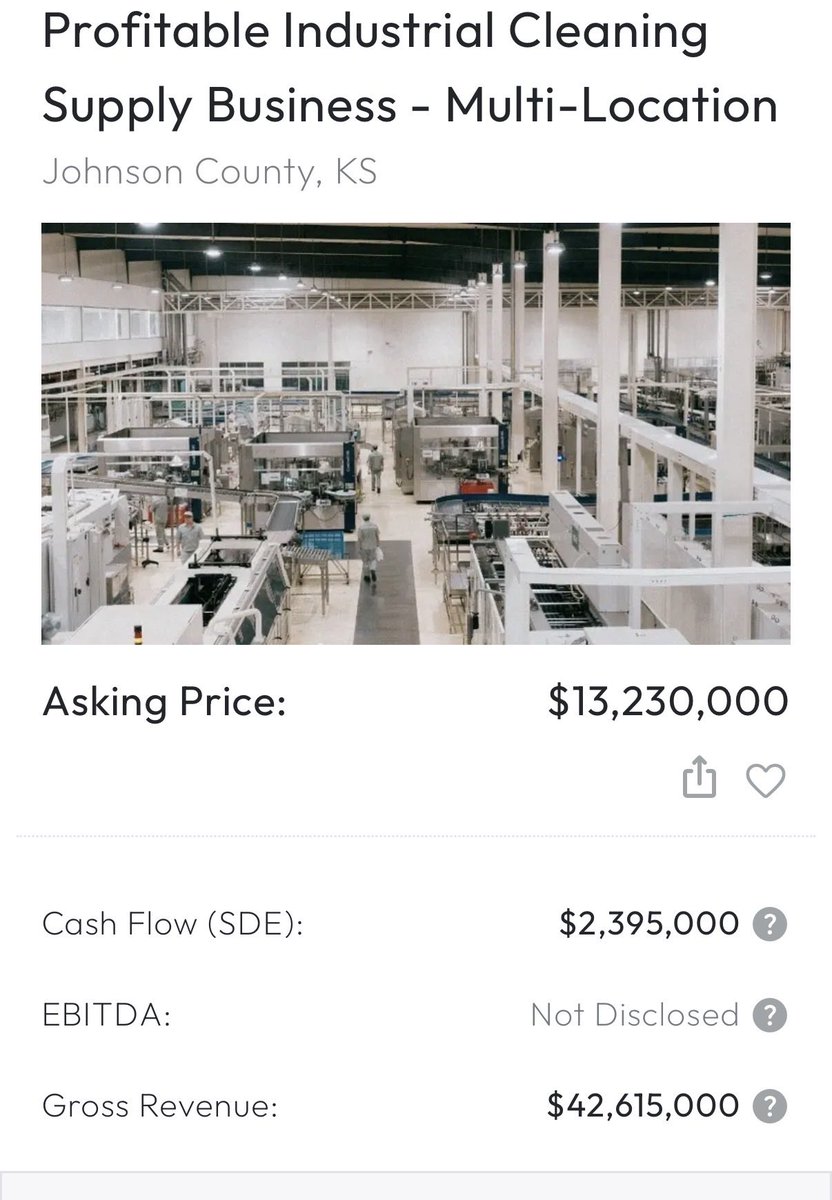
So @blueprintsmb22 and I are strongly debating selling all our assets and relocating our families to Kansas tomorrow to run this 5% margin cleaning supplies distributor / manufacturer together
Because 120 employees at 5% margin, selling commodities and presumably horrendous NWC for 6X SDE…
… is like the best thing the Kansas market has come up with in the last 12 months
Seems like a dream. Our wives will love it
YOLO
English
@Hoang_HQ Classic movie. Training Day, The Equalizer… Others as well.
English

Denzel Washington’s peak acting in one of the coldest scenes ever.💥🔫🥶
Ice-cold eyes, slow deliberate movements, and not a single wasted word. Many call this the moment Denzel absolutely nailed the gangster role — one of the best in his entire career. Pure mastery.
English
Predator (1987) stays insanely rewatchable because the cast’s chemistry was real. They were literally competing on set over workouts, stunts, & who could one-up who. That rivalry bleeds into the movie, giving every scene that “lightning in a bottle” energy.
cinesthetic.@TheCinesthetic
What is a "perfect" movie you can watch over and over?
English

Christians only.
What’s your favorite worship song or hymn?
English
@jasonmpearl Absolutely. Always tell teams top line out the door gives breathing room. And you can get your operating leverage.
English

@bdsummerfield For sure! Gotta be able to keep some. But if you don’t sell the top line, there will never be bottom line.
English
There are lots of problems a business can have.
When revenue / sales is the issue, you are in real trouble.
Consistent new sales solves many issues.
A just had a call with a new client that is having sales issues. He said "if I could get away from the chaos of the business I could focus on it ('sales') more..."
My answer was the following...(this was the first call btw)
"...If you don't focus on generating new opportunities and closing more sales, you won't have any chaos to worry about because your business will close."
I am not hired to sugar coat, I am hired to make companies better. If you can't generate new business you are in trouble.
English