
Dibya Prakash

3.5K posts

Dibya Prakash banner
Dibya Prakash

Dibya Prakash

@being_dibya

Technology Strategist | Emerging Tech | Sustainability | C-suite Advisor | RT's are not endorsement

Singapore | EU Katılım Nisan 2011
643 Takip Edilen981 Takipçiler
Dibya Prakash retweetledi

Andrej Karpathy
Andrej Karpathy@karpathy·
This works really well btw, at the end of your query ask your LLM to "structure your response as HTML", then view the generated file in your browser. I've also had some success asking the LLM to present its output as slideshows, etc. More generally, imo audio is the human-preferred input to AIs but vision (images/animations/video) is the preferred output from them. Around a ~third of our brains are a massively parallel processor dedicated to vision, it is the 10-lane superhighway of information into brain. As AI improves, I think we'll see a progression that takes advantage: 1) raw text (hard/effortful to read) 2) markdown (bold, italic, headings, tables, a bit easier on the eyes) <-- current default 3) HTML (still procedural with underlying code, but a lot more flexibility on the graphics, layout, even interactivity) <-- early but forming new good default ...4,5,6,... n) interactive neural videos/simulations Imo the extrapolation (though the technology doesn't exist just yet) ends in some kind of interactive videos generated directly by a diffusion neural net. Many open questions as to how exact/procedural "Software 1.0" artifacts (e.g. interactive simulations) may be woven together with neural artifacts (diffusion grids), but generally something in the direction of the recently viral x.com/zan2434/status… There are also improvements necessary and pending at the input. Audio nor text nor video alone are not enough, e.g. I feel a need to point/gesture to things on the screen, similar to all the things you would do with a person physically next to you and your computer screen. TLDR The input/output mind meld between humans and AIs is ongoing and there is a lot of work to do and significant progress to be made, way before jumping all the way into neuralink-esque BCIs and all that. For what's worth exploring at the current stage, hot tip try ask for HTML.
Thariq@trq212

x.com/i/article/2052…

English
832
1.8K
17K
2.5M
Dibya Prakash retweetledi
Vinod Khosla
Vinod Khosla@vkhosla·
Most engineers have never had sufficient access to real physics analysis — simulation was too expensive, slow, and specialized. @VinciPhysics vision isn’t just replacing Ansys; it’s bringing continuous physics reasoning to 100x more engineers and 1000x more simulations in a fraction fof the time.
Hardik Kabaria@hardikk13

Every major AI shift started with a new kind of world model. Language. Vision. Code. The next one is physics. @saucentoss and I published a paper today defining what a real foundation model for physics has to be and why it enables Continuous Physics Reasoning. If AI is going to help build the physical world, the bar has to be much higher. Link to full paper: vinci4ddev.wpenginepowered.com/research/conti…

English
26
58
621
73.3K
Dibya Prakash retweetledi
Claude
Claude@claudeai·
Live from Code with Claude: we're launching dreaming in Claude Managed Agents as a research preview. Outcomes, multiagent orchestration, and webhooks are now in public beta.
English
562
1.1K
14.7K
3.3M
Dibya Prakash retweetledi
Dami-Defi
Dami-Defi@DamiDefi·
A MIT professor gave the same lecture for 40 years. It is the most watched MIT lecture of all time for a reason. Most people with good ideas stay invisible. Not because the ideas are weak. Because they never learned how to present them. Patrick Winston called it "How to Speak." His argument: your success in life is determined by your ability to speak, your ability to write, and the quality of your ideas. In that order. Here is the full framework in numbered steps: 1. Never open with a joke. The audience is still adjusting to you. Start with an empowerment promise instead. Tell them exactly what they will know by the end that they did not know at the start. 2. Cycle your key ideas three times. At any given moment 20% of your audience is mentally elsewhere. If you say it once, a fifth of the room missed it. 3. Build a fence around your idea. Show how it is different from what already exists. If you do not distinguish it, someone else will confuse it. 4. Use verbal punctuation. Number your points out loud. Give people a landmark to re-enter the talk if they drifted. 5. Ask one question mid-talk. Wait seven full seconds for an answer. It feels like an eternity. Do it anyway. 6. Use a blackboard or whiteboard when teaching. The speed you write is the speed people absorb. Slides move too fast. The board forces the right pace. 7. Keep slides almost empty. Too many words forces the audience to read instead of listen. You only have one language processor. So do they. 8. Never use a laser pointer. The moment you point, you lose eye contact. Put an arrow on the slide instead. 9. End on a contributions slide, not a thank you. Your final slide should list what you did. It stays up during questions. That is your last impression. 10. Do not say thank you to close. It implies people stayed out of politeness. End with a benediction, a salute to the audience, or a forward-looking statement. The bonus insight Winston taught for four decades: talent is the smallest variable. What you know and how much you practice it matters far more than raw ability. Most people in this space have good ideas. The ones who build audiences, close deals, and get remembered are the ones who learned how to package those ideas. That gap is getting obvious fast.
English
5
13
101
11.4K
Dibya Prakash retweetledi
kache
kache@yacineMTB·
you can outsource your thinking but you cannot outsource your understanding
English
253
3.7K
16.5K
2.3M
@jason
@jason@Jason·
We started an AI founder twitter group... reply with "I'm in" if you're a founder and want to be added
English
10.9K
134
4.6K
902.9K
Dibya Prakash
Dibya Prakash@being_dibya·
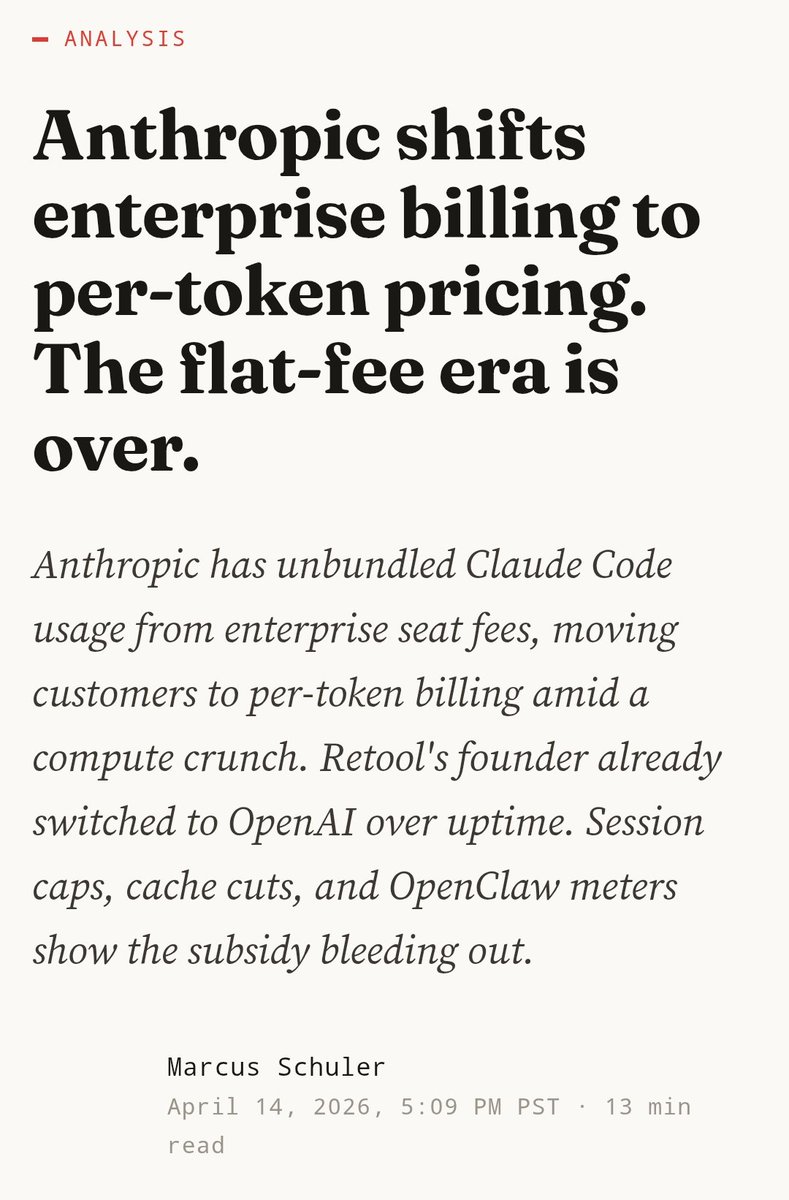
#Anthropic just confirmed what many IT leaders already suspected: With the shift to token-based pricing, cost is no longer tied to users—but to behavior. • FinOps becomes mission-critical • Engineering choices = financial outcomes • Experimentation now has a price tag
Dibya Prakash tweet media
English
0
0
0
26
Dibya Prakash retweetledi
Mustafa Suleyman
Mustafa Suleyman@mustafasuleyman·
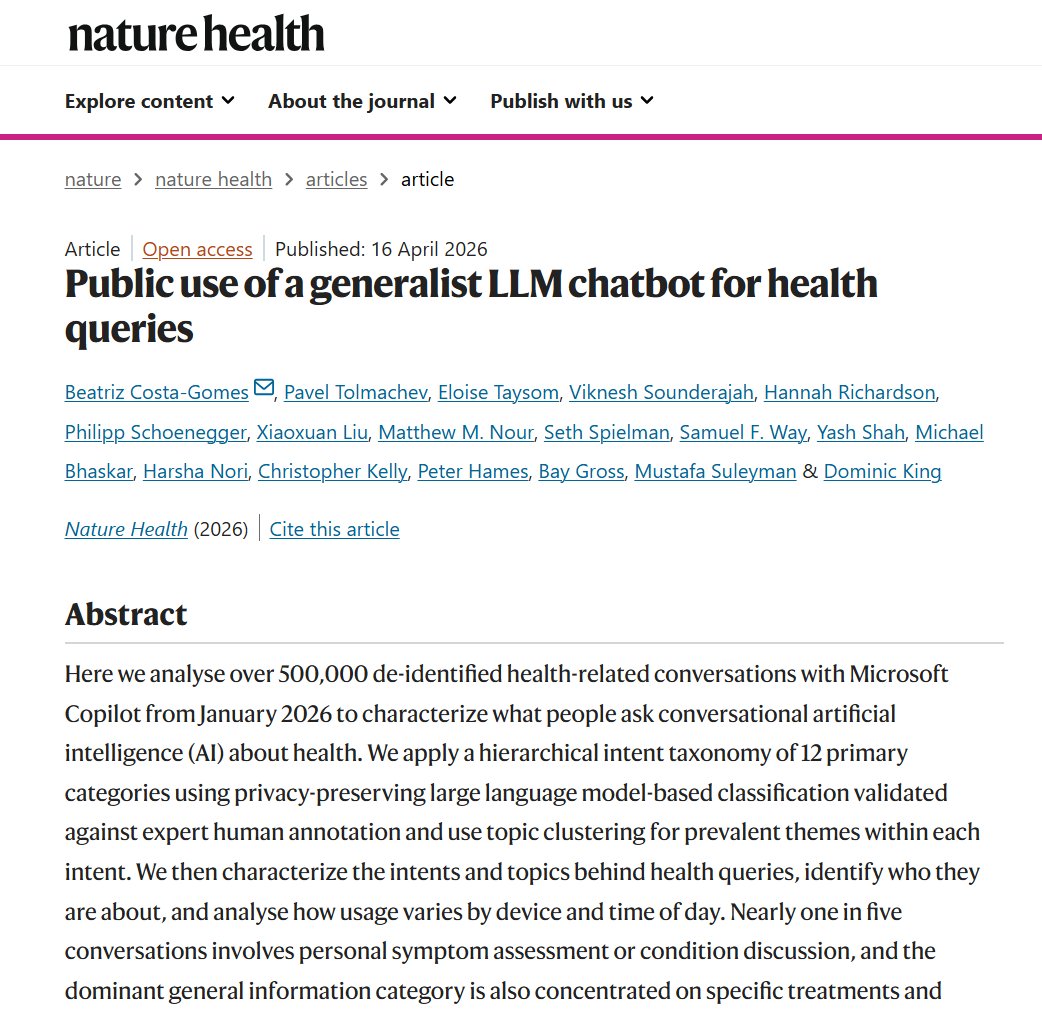
Our paper landed in Nature Health today! Healthcare is one of the most high-stakes, high-potential applications of AI. So we set out to understand how people actually use it in our AI products today. nature.com/articles/s4436…
Mustafa Suleyman tweet media
English
24
68
374
35.8K
Dibya Prakash retweetledi
Nikita Bier
Nikita Bier@nikitabier·
𝕏 has always been the best source of financial news for traders and investors. Billions of dollars are allocated every day based on what people read on Timeline. Today we're launching our new Cashtags feature in the US and Canada on iPhone, bringing real-time financial data to X. Here's how it works: 1. When you search for or post a cashtag (or contract address), X will automatically suggest matching stocks or crypto tokens, so you can select the exact asset you had in mind. 2. Anyone who taps a Cashtag will see posts mentioning it along with its price chart—without ever leaving X. This ensures that you're always matched to the chatter for the right stock or token. Cashtags are just the first step in our commitment to be the best destination for the finance and crypto community.
English
5.1K
3.9K
27.7K
6.4M
Dibya Prakash retweetledi
Tansu Yegen
Tansu Yegen@TansuYegen·
Former BYD and Huawei engineers made a device that turns any bike electric, reaching 32 km/h ⚡
English
128
722
7K
1M