Sabitlenmiş Tweet
Bex
2K posts

Bex
@bexbcld_sol
@thegoosedao LP Degen

Republic of the Philippines Katılım Kasım 2021
1.2K Takip Edilen1.1K Takipçiler
Bex retweetledi
Bex retweetledi

easy to be bearish crypto right now
we’re fifteen years in
we’ve spent enormous energy trying to build valuable stuff on top of trust-minimized technology
the results feel underwhelming
- many tokens
- few products with global impact
- asset markets that reward local attention over durable value
^ this view notwithstanding
i think a large part of what feels broken
is pretty close to being solved
not by technology
i think we’ve got all the raw material we need for crypto to dominate
the last piece is harmonization between value created (products) and value accrued (token)
and i think we’re getting pretty close
there are roughly two categories of tokens
> tokens that are money (ex. stores of value)
> tokens that make money (ex. productive assets)
i think the money tokens (BTC, ETH, SOL, etc) are better understood and further along in their adoption
so i won’t explore these ‘are money' tokens in this thread
the piece that actually feels broken to me
the one we (as an industry) just quite can’t get over the hump on
are the ‘make money’ tokens
take public equities for example
public equity assets get priced because markets can:
- verify revenue
- verify expenses
- guarantee value accrual
historically, this type of underwriting has lagged across crypto
> crypto revenue
for crypto projects with tokens, we’ve got two types of revenue:
onchain revenue; and
offchain revenue
onchain revenue is legible by default. AMM fees, sequencer revenue, bridge fees, etc
everyone sees the same dashboards
it’s all public, scrapable, and can be modeled in real time
super cool
but while that transparency is a feature, it’s also somewhat noisy, as onchain activity functions like a billboard
projects in crypto have been trained to:
(1) build for what is easily measurable; and/or
(2) broadcast what is temporally beneficial
wash trading, incentive-driven volume, liquidity mining, and farming mechanics can inflate top-line metrics without producing recurring demand
over periods
investors end up underrating, overrating, or misclassifying revenue quality
separately
offchain revenue has a slightly different problem
some crypto projects with tokens also run centralized infra, generating higher quality revenue offchain
but almost none of it is verifiable
both paths leave room for improvement:
- onchain revenue is transparent, but noisy and gameable
- offchain revenue may be easier to generate for some crypto projects, but opaque and structurally unverifiable
unlike equities, there are no real standards to adhere to
which makes underwriting difficult
> crypto expenses
like revenue, crypto projects with tokens often have two flavors of expenses
onchain expenses; and
offchain expenses
onchain expenses are easy to track and model, but because they’re public and often reported casually, onchain totals become a weak snapshot for the true cost of sustaining a product onchain
offchain expenses are real-world operating costs that are mostly opaque and often dominate the cost structure, including engineering and research salaries, cloud infra, legal and compliance spend, security, marketing, general ops
these expenses determine whether a project is actually scalable or profitable, yet are rarely disclosed with real accounting rigor
again, no standards to adhere to
which also makes underwriting difficult
> crypto token value accrual
in equity markets, assets accrue value through legally enforceable rights, including claims on residual cash flows, dividends / buybacks, voting, and priority in liquidation or acquisition events
these rights are standardized, disclosed, and protected by law, which allows markets to underwrite future cash flows and price equities based on expected value
in crypto, this is where things really start to break down
at the fundraising stage, teams face an array of optionality:
- build for equity value
- build for token value
- build for both
with no clear guidance in the U.S. on how tokens accrue traditional value (while simultaneously acknowledging that tokens are the asset that can best power labor and productivity over decentralized networks)
projects historically have raised on both SAFEs (equity) and warrants (network)
this creates a capital stack where value accrual is left ambiguous across competing instruments, out of survival
- teams preserve flexibility
- investors underwrite both paths
then the TGE happens, and there is only one brutal question left -- what is this token actually allowed to do?
- is it a security or a commodity?
- can it capture fees?
- can it receive distributions?
- can it be bought back and burned?
in the absence of legal guideposts, the majority of teams choose inaction
the token exists as a coordination incentive, but enjoy no real claim on value created
and the network never fully matures
here’s a common pattern:
> team raises money on SAFE (equity) and Warrant (token)
> team builds technology
> team launches token
> team delays value accrual to the token because acting feels legally ambiguous (at best) and legally dangerous (at worst)
> team gets tired of waiting around for answers
> team runs out of money or gets acquihired (equity)
> the foundation commits to maintaining network in perpetuity (token)
> network is no longer as competitive
feels pretty clear to me
until network tokens are explicitly allowed to return value through defined mechanisms
that take into account their unique digital shape on the internet as both (1) labor incentives; and (2) direct connection to network revenue
then:
> value accrual to tokens will remain fragile and discretionary
> markets will continue to misprice them
> risk capital will mostly remain uninterested in them
> innovators in the US will mostly remain uninterested in building networks powered by them
that brings us to today
the US has historically set the regulatory standards that global capital, companies, and markets adopt by default
clear crypto rules in the US will effectively become the reference framework for the rest of the world
in the US, we have a rare opportunity to shape how token-based capital formation, disclosures, and value accrual work globally
rather than ceding those standards to others
thankfully i think things are starting to change
and so
i tend to believe the next phase of crypto tokens will be built on the back of US legislative and regulatory leadership
where we create a verifiable trail from network revenue to token holder that is defined, repeatable, and legally durable
at all stages of a network’s life
the market is clearly looking to solve a number of these problems
recent efforts from individual crypto projects are providing leadership on different problem areas, with a few of these approaches listed below:
- at fundraising stage, moving to new unified instrument models (e.g. @colosseum STAMP)
- pre-TGE unification across equity/tokens (e.g. @rainbowdotme Class F)
- post-TGE unification across equity/tokens (e.g. @UniswapFND UNIfication)
- public token disclosure frameworks (e.g. @blockworks Token Transparency Framework)
importantly, there are also a number of concurrent efforts led by US legislators (Congress) and regulators (SEC/CFTC), including the clarity act, the SEC’s rulemaking authority re: token safe harbors, the stablecoin / market structure bills, among other federal agencies and initiatives
and while these regulatory/legislative efforts are only building blocks today, i tend to believe the net of these US efforts will converge and lead to the following over the coming years:
- better auditing of on/offchain pathways to track and manage network operations
- create "minimum viable disclosure" standards for projects launching network tokens
- harmonization across SEC/CFTC on classifying tokens as "commodity" vs "security" at different stages of a network's life
- allow early stage crypto networks to have a compliant time-limited safe harbor to launch tokens, disclose material information to public, and create new business models with tokens before final classifications apply
and so, from my view, the endgame for the “make money” tokens is just about getting back to the basics
combine:
> a project’s verifiable on/offchain activity; with
> explicit value accrual and legal rights for their token;
> all within a coherent regulatory framework in the US
and as that happens
global risk capital, from individuals to institutional allocators, won’t need to underwrite a new belief system on value accrual to participate in these global networks
for the first time
they can use the same frameworks that already work
and for me
i think that’s a pretty healthy evolution for this specific category of tokens
(crypto art by @jackbutcher)

English
Bex retweetledi
Bex retweetledi
Bex retweetledi

Bex retweetledi
Bex retweetledi

Bex retweetledi

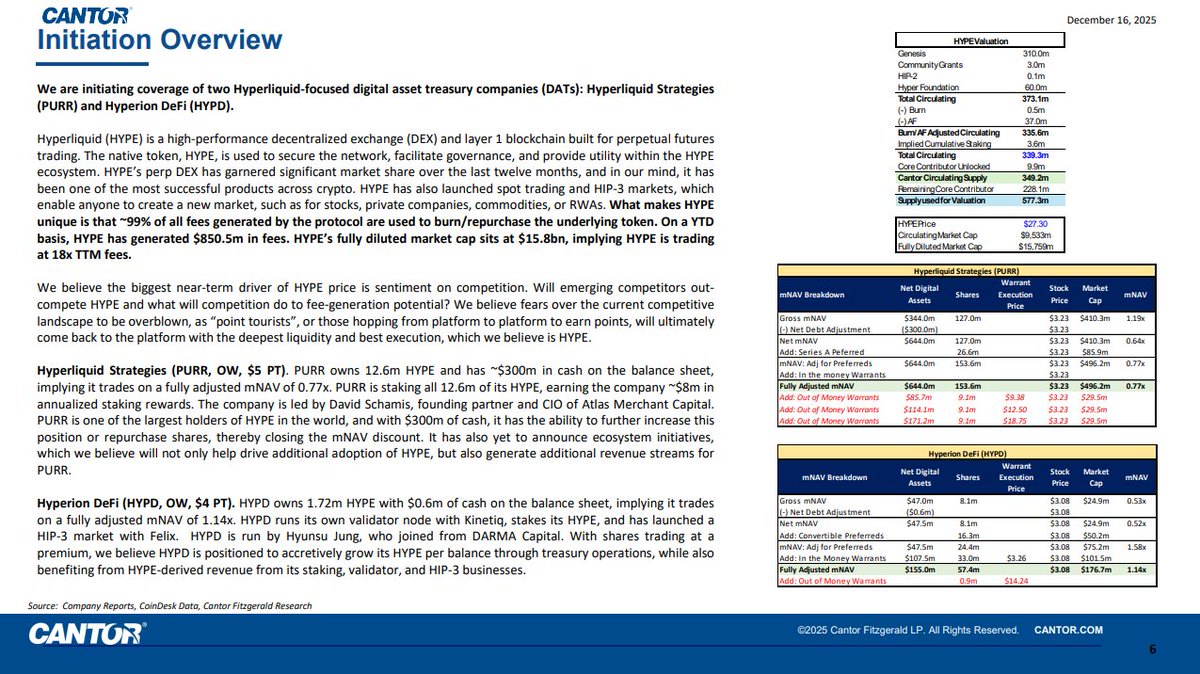
Cantor Fitzgerald just released a 62-page report on Hyperliquid, HYPE, & its DATs
In their 10-year model, they estimate a 50x multiple on $5 billion in annual revenue for a HYPE market cap of $200+ billion
They initiate coverage on both PURR & HYPD with a rating of "overweight", i.e. to outperform
A really solid report that demonstrates a deep understanding of both Hyperliquid & the perp DEX landscape!


English
Bex retweetledi

Spreading the gospel of Hyperliquid, the most exciting story in crypto, to the traditional finance world
It's always a pleasure to be on @cnbc with @BeckyQuick and Joe Kernan
Our stock starts trading this morning with the ticker $PURR
Hyperliquid
@HyperliquidX @HypeStrat @SquawkCNBC @rediamondjr
English
Bex retweetledi

DATs, Hyperliquid
Written by @13300RPM (@FourPillarsFP)
Digital Asset Treasuries (DATs) are an early attempt to formalize crypto ownership through permanent, on-chain balance sheets.
Their growth is fueled by a structural capital gap: crypto’s native investor base is saturated, while institutions with over $36 trillion in assets lack compliant channels for exposure.
Hyperliquid provides one of the clearest environments for DATs to operate at scale, with real revenue, programmable assets, and on-chain business primitives.
Hyperion DeFi (~1.7M HYPE) and Hyperliquid Strategies Inc. (~12.6M HYPE + $305M cash) are the earliest HYPE-focused treasuries, together anchoring roughly 7% of circulating supply.

Four Pillars@FourPillarsFP
English
Bex retweetledi

I don’t hold any $HYPE, but watching the discourse around the unlocks makes you wonder how detached from reality some people in this space have become.
Hyperliquid is one of the highest-earning protocols in all of crypto, printing millions in profit every single day. If anyone is capable of absorbing unlocks sustainably, it’s them.
And honestly, what exactly do people expect from the team? That they sacrifice their entire lives to work for free so bagholders can feel good? At the end of the day this is business, not charity.
@chameleon_jeff and the Hyperliquid team have already shown, repeatedly, that they prioritize the long-term health of the protocol and the interests of $HYPE holders. There were no VCs, no insiders. They fully bootstrapped the protocol with their own time, money, and sweat. That level of conviction is rare, even outside of crypto.
The token distribution was as fair as it gets. The most valuable and aligned contributors earned their share. Since then, the team has spent nearly 100% of the revenue they generate on buybacks, consistently treating token holders like actual shareholders - not exit liquidity.
These guys have been working their asses off for years, building one of the most profitable and technically impressive systems in crypto, essentially getting nothing back personally. If they want to sell a small portion of their tokens after years of hard work and massive opportunity cost, let them. If anyone in this industry has earned that right, it’s them.
As long as they’re not rage-quitting and dumping their entire stack in one click, everything will be fine.
And why on earth would they abandon a cash-printing machine that’s finally hitting escape velocity and generating infinite money after everything they’ve put into it?
It makes zero sense, so it’s not going to happen.
English
Bex retweetledi
Bex retweetledi
Bex retweetledi

We are coming to Met Dhabi!
There's still time to sign up if you want to attend and meet the goose flock live:
lu.ma/metdhabi

English
Bex retweetledi

We’re excited to announce that @HYLQstrategy (HYLQ Strategy Corp.) will be the first publicly traded company to liquid stake $HYPE via Kinetiq.
Hyperliquid

HYLQ@HYLQstrategy
The @kinetiq_xyz team are both early adopters of Hyperliquid and incredibly cracked. We're honoured to be the first public company to liquid stake $HYPE via Kinetiq! Hyperliquid.
English
Bex retweetledi

Gneko Whal3s,
Check your Hypercore portfolio for your $NEKO Airdrop 🐋
Whal3s and Nekos on top!
neko.hl@neko_hl
The Neko airdrop is now live. Check your account on HyperCore.
English
Bex retweetledi
Bex retweetledi

SAVETHEWHAL3S COMMUNITY RUN IT GIGA TURBO
WICKED RESPONSE
WE HAVE NOW RECEIVED ALL THE WHAL3S WL WALLETS FOR THE UPCOMING HYPERACTIVES MINT 💊 SPECIAL SHOUTS TO PEGSTER @Sakrexer FOR SORTING ❤️
CONGRATS TO ALL THAT WON 🧩🧩. MORE COLLABS COMING ⌛️
WHAL3S ON TOP
🐳🐋🐳🐋🐳🐋
@SaveTheWhal3s

English