
Benjamin Forgan

414 posts

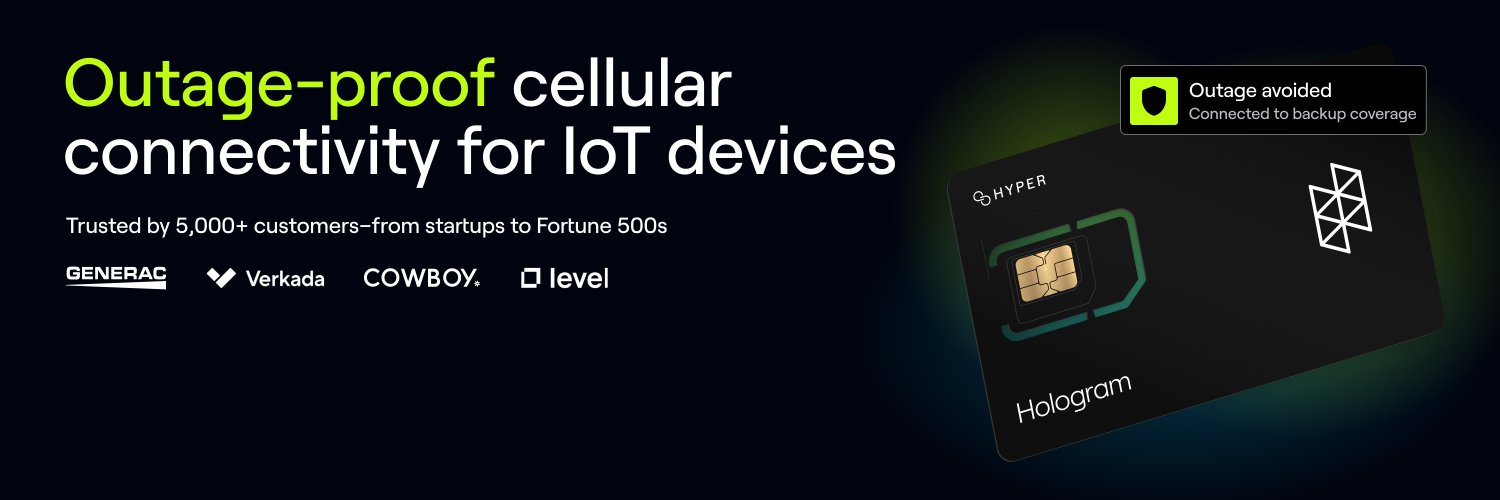
Benjamin Forgan banner
Benjamin Forgan

Benjamin Forgan

@bforgan

CEO @Hologram | building the future with cellular connectivity. connecting the physical world.

Katılım Ocak 2009
591 Takip Edilen572 Takipçiler
Sabitlenmiş Tweet
Benjamin Forgan
Benjamin Forgan@bforgan·
Nearly 12 years ago, I found myself on a plane to Singapore. I was fresh off launching Groupon Goods, out of a cannon ($500M in Rev in less than 6mo), and ready for my next challenge: building an online food delivery business in Asia (Foodpanda, aqc. by DeliveryHero) But, excitement quickly gave way to uncertainty and doubt. The original founder, who had hired me for a global sales role, abandoned the project before I arrived. Halfway across the world, I decided there was no going back. I took over as Managing Director and started building Foodpanda from 0 to 1. I signed the first restaurants, got the first customers, and, crucially, had to build all the delivery operations. This is how I encountered cellular connectivity. We had a call center that would manually process orders. Calling restaurants to place orders. Not exactly scalable To fix this, we built cellular-connected GPRS printers that print orders directly in the restaurant. Seemingly easy at first. This, too, was fraught with challenges. Poor tooling and support meant we had trouble determining which devices were online. We would get calls from restaurant owners frequently complaining (in various languages). We could never tell if it was user error or a connectivity issue. What a headache. I moved back to the US in 2013 with this problem lodged in my brain. This was the year of the IoT hype cycle. While everyone focused on connected toasters, I remembered the GPRS printers and our challenges at Foodpanda. Building the sci-fi future of our collective dreams (drones, robots, etc.) requires ubiquitous connectivity. IoT connectivity should be: - Easy to buy, set up, and manage. - Works anywhere in the world (190+ countries), - Provides high speeds (up to 200Mbps), - Low latency (as low as 50ms), - and Multi-carrier redundancy (600+ carriers worldwide, multiple networks in every country), - Plus, Outage-Proof reliability (99.95% uptime guaranteed). Hologram.com provides all this out of the box. It Just Works™. Our results: -> Over a decade in business, powering the world's most demanding connectivity applications -> Over $85M in venture capital raised from top-tier investors -> 5000+ businesses - from cutting-edge startups to Fortune 500 enterprises - trust Hologram to power their connectivity -> Millions of devices connected worldwide NEED CONNECTIVITY FOR YOUR DEVICES? -> GO TO Hologram.com and get free SIMs
English
1
0
20
139.5K
Benjamin Forgan
Benjamin Forgan@bforgan·
The vision of Hologram has always been for machines to be able to autonomously procure connectivity whenever wherever with maximum reliability and performance. We’ve been building Hologram to be AI Agent native this whole time without even thinking about it.
andrew chen@andrewchen

Web 1.0 came with new channels: - email, search, link sharing, etc Web 2.0 too: - feeds, creators, viral invites, etc Mobile: - app stores, SMS invites, vertical vid, mobile ads What about AI? I’ve been complaining that AI hasn’t come with much. But we’re seeing a big growth channel opening now: Products that are built as APIs/CLIs that can be pulled into new projects by Codex/Claude on the fly Maybe the “AI-native hotel app” doesn’t mean a mobile booking app with an AI chat panel. It means a CLI that can book a hotel for you, that an AI agent can pull into a bespoke answer or project or into code. Bolting on an AI chat panel is this generation’s weak form of AI. Maybe the full reinvention involves making it agent-first not human-first and once you start looking at it that way, a lot of existing products suddenly feel mis-specified. they’re built as destinations, but agents don’t want destinations. they want capabilities. composable, callable, reliable capabilities. So instead of “go to Expedia” or “open the app,” the future interaction is more like: an agent assembles a workflow on the fly. it pulls a flight search tool, a hotel booking tool, maybe a weather model, maybe even your personal preference graph. none of these are full products in the traditional sense. they’re more like endpoints with taste and state. This flips distribution completely. historically you win by owning the surface area. seo, app store ranking, homepage traffic. in an agent world, you win by being the default callable primitive. the thing that shows up again and again in agent-generated plans because it works, has clean interfaces, and returns structured outputs. distribution shifts from “top of funnel” to “top of call stack.” And the crazy part is this might actually compress product surface area dramatically. the best products might look more like tight, extremely well-designed CLIs with opinionated defaults rather than sprawling UIs. almost like the stripe api moment, but for everything. imagine if every vertical had a “stripe-level” primitive that agents preferentially use. there’s also a weird inversion of brand here. humans used to choose brands. now agents will. so the brand becomes partially machine-legible. reliability, latency, error rates, schema clarity. you can almost imagine “agent seo” where the ranking factors are things like success rate across thousands of agent runs, or how easy your tool is to integrate in a chain-of-thought execution loop. This also suggests a new kind of moat. not just data or network effects, but integration depth with agent ecosystems. if claude or codex or openclaw learns that your tool is the safest way to accomplish X, it gets baked into prompts, templates, maybe even fine-tunes. you become a default. and defaults, historically, are insanely sticky. The contrarian take is that most current “AI features” are a local maximum. chat panels, copilots, assistants. they’re transitional. the real end state might look closer to invisible infrastructure that agents orchestrate. the ui is just a debug layer for humans to peek into what the agents are doing. so maybe the new growth channels for ai look like: - being callable - being composable - being reliable at scale in agent loops - being embedded in agent templates and workflows - being the default primitive in a given domain and if that’s right, then the question for any new product isn’t “what’s the ui” or even “what’s the killer feature.” it’s “what’s the minimal, highest-leverage capability we can expose such that agents will repeatedly choose us when building something new.”

English
0
0
0
65
Benjamin Forgan retweetledi
Jakob Diepenbrock
Jakob Diepenbrock@jakobdiepen·
America is the greatest country in the world. But we need more founders working on real problems. If you are in the early stages of building something that matters, you have to be in El Segundo.🇺🇸 Apply to the Spring Cohort in bio.  Deadline February 20th.
English
143
181
1.1K
287.6K
Benjamin Forgan
Benjamin Forgan@bforgan·
Agents need robots and robots need connectivity. There were times when I was immensely jealous of simple SaaS applications that didn’t have to deal with the massive complexity of managing multiple connectivity partners, telco infra, build resilience to outages etc. Not anymore.
Andrej Karpathy@karpathy

A lot of people quote tweeted this as 1 year anniversary of vibe coding. Some retrospective - I've had a Twitter account for 17 years now (omg) and I still can't predict my tweet engagement basically at all. This was a shower of thoughts throwaway tweet that I just fired off without thinking but somehow it minted a fitting name at the right moment for something that a lot of people were feeling at the same time, so here we are: vibe coding is now mentioned on my Wikipedia as a major memetic "contribution" and even its article is longer. lol The one thing I'd add is that at the time, LLM capability was low enough that you'd mostly use vibe coding for fun throwaway projects, demos and explorations. It was good fun and it almost worked. Today (1 year later), programming via LLM agents is increasingly becoming a default workflow for professionals, except with more oversight and scrutiny. The goal is to claim the leverage from the use of agents but without any compromise on the quality of the software. Many people have tried to come up with a better name for this to differentiate it from vibe coding, personally my current favorite "agentic engineering": - "agentic" because the new default is that you are not writing the code directly 99% of the time, you are orchestrating agents who do and acting as oversight. - "engineering" to emphasize that there is an art & science and expertise to it. It's something you can learn and become better at, with its own depth of a different kind. In 2026, we're likely to see continued improvements on both the model layer and the new agent layer. I feel excited about the product of the two and another year of progress.

English
0
0
1
23
Benjamin Forgan
Benjamin Forgan@bforgan·
Incredibly wholesome and accurate. We are born just in time to explore the universe.
Karan Kunjur@KaranKunjur

As the founder of a space company, I like to think I’m pretty optimistic - but even I underestimated the rate of acceleration we’ve seen over the last few months. Almost four years ago, Neel and I started a company because we were excited about Starship. We saw the opportunity to build much bigger, much higher power satellites that could start humanity down the path towards being a Type 2 Kardashev civilization. We decided to call the company K2, we made our logo a Dyson sphere. Four years later, the Kardashev scale is a mainstream concept - with the ambition to make humanity a K2 civilization being broadcast by one of the greatest engineers in the world. Concepts that I thought were 5 to 10 years out, like orbital data centers - are now foundational capabilities for what could be one of the most significant IPOs ever. We’ve gone from people asking us “why would anyone need a 100kW satellite?” to people taking that number, asking their AI to put it into their orbital data center excel and having the lightbulbs go off. It’s honestly the best time ever to be building in space, we are truly fortunate to be building K2 today. For a big satellite company, we’re a small fish in a big big pond. We may end up being NPCs in a much bigger game - time will tell. All I know is I’m going to have the time of my life building alongside people I admire and respect. So up next, launching the 20kW satellite in two months, learning a ton, continuing designs on the 100kW satellite, scaling up the factory and doing our small part to help progress humanity up the curve. “K2 or you’re not even trying.”

English
0
0
1
32
Benjamin Forgan
Benjamin Forgan@bforgan·
@allenwalton Hey Allen - really sorry about that. We had a rare process glitch. This has been resolved. Also, we didn't flag your request under the Business support SLA because it was sent from your personal email. Our bad. I believe the team has responded. All good?
English
0
0
0
5
Allen Walton
Allen Walton@allenwalton·
@bforgan hey Ben support has been not great lately, days without replies. Can you help?
English
1
0
0
179
Benjamin Forgan
Benjamin Forgan@bforgan·
@alphafox I’m not convinced that anyone in the comments has actually heard of techno Viking
English
0
0
6
861
AlphaFox
AlphaFox@alphafox·
Sure you've heard of Techno Viking, but have you heard of Techno Maduro?! 🙌
English
339
1.7K
12K
1.1M
Mike Solana
Mike Solana@micsolana·
so to quickly recap thursday: riots still ongoing plane crash + survivor (?!) senator in handcuffs war
English
122
214
4K
154.5K
Zach Rash
Zach Rash@zac_rash·
Demand for robots is insane right now. So we’re doing the only logical thing once we ran out of space in the office: putting up tents in the parking lot
Zach Rash tweet mediaZach Rash tweet media
English
29
54
959
214.9K
Benjamin Forgan
Benjamin Forgan@bforgan·
This little know concept will change the way you think about cellular connectivity. Jevon's Paradox... As per GB costs for connectivity decline, conventional wisdom is you'll see a "race to the bottom". Lower prices means lower revenues and profits. Yet - at @Hologram - we've seen the exact opposite. Over the past 12 mos we lowered self-service prices by 10x. In that same time we've seen a 4x increase in data consumption, while doing new record sales each quarter. This is due to Jevons Paradox: cost improvements lead to greater overall revenue (not less) due to increased demand. The same dynamics powering AI consumption also power connectivity (and energy) consumption. Connectivity is a major pillar of the AI revolution. What does this mean for you? There has never been a better time to build a cutting edge connected product. Per GB data costs will continue to fall as companies like @zipline , @Figure_robot , and others build the future and consume huge amounts of data in the process. For our part, we are here to help you get the connectivity you need to make these incredible innovations happen!
English
2
1
8
403
Blake Scholl 🛫
Blake Scholl 🛫@bscholl·
Most surprising thing to me about AI: as of yet there is no discussion about equivalent of SEO for AI
English
145
21
697
128.6K
Benjamin Forgan retweetledi
Kyle Harrison
Kyle Harrison@kwharrison13·
Lock in, fellas. The B2B SaaS market just got a whole lot bigger.
Kyle Harrison tweet media
English
155
682
14.6K
689.9K
Andrew McCalip
Andrew McCalip@andrewmccalip·
Since we're talking manufacturing this week... I think a lot about the price of cheese vs vehicles per pound
Andrew McCalip tweet media
English
43
167
1.9K
133.5K
Sam Parr
Sam Parr@thesamparr·
Someone put together a list of all the book recommendations made by founders and CEOs in Hampton recently there’s a book club now that one member started which is pretty cool.
Sam Parr tweet media
English
72
178
2.1K
429.5K