Peter

1.1K posts

Peter banner
Peter

Peter

@bigeye306

Katılım Haziran 2011
147 Takip Edilen121 Takipçiler
Peter
Peter@bigeye306·
@financebloom Need news about uplisting and releasing from conservatorship will move it. That’s what it’s been waiting on but things have been unclear lately.
English
3
0
1
210
financebloom
financebloom@financebloom·
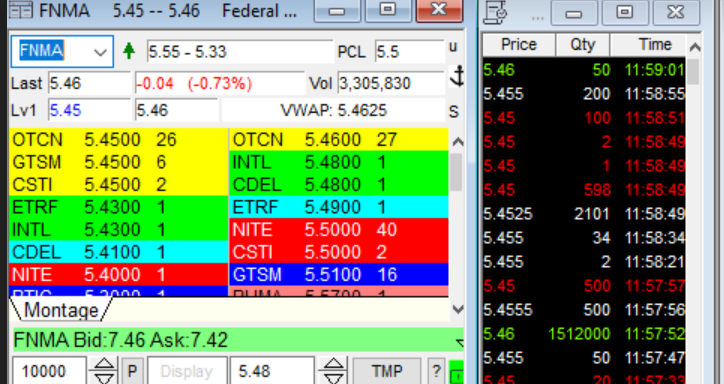
$FNMA 1.5 mil block "not that it means anything" just unusual
financebloom tweet media
English
6
7
42
3.2K
Peter
Peter@bigeye306·
@Polvah A little buying today so far. Earnings on 3/30 or 3/31. Would be nice if they had something exciting to discuss. Maybe something in the works.
English
0
0
2
142
Polvans
Polvans@Polvah·
100% fair point. $AAOI came out of OFC with a $200M order and a $53M follow-on. Stock up 18% today. $POET was at the same conference, won an award, demoed Blazar and Starlight live, signed LITEON and Lessengers. Then went quiet. For a Nasdaq company post-OFC, that's not good enough. Communication needs to catch up.
English
1
0
8
1.2K
Polvans
Polvans@Polvah·
$POET The market is sleeping on this one! Everyone is talking about AI chips. Nobody is talking about what moves the data between them. That's where $POET lives. Their Optical Interposer platform integrates lasers, optics and electronics into a single chip-scale package. No wire bonds. Lower cost. Higher speed. Built for 1.6T and beyond. Here's what happened in the last 30 days: > Partnership with LITEON to co-develop next-gen optical modules for AI data centers. Prototypes targeted by late 2026. High-volume production in 2027. >Expanded partnership with Lessengers for 1.6T 2×DR4 optical transceivers. Built specifically for hyperscale AI clusters. >Live demos of Blazar and Starlight at OFC 2026, their largest booth presence ever. Award from Lightwave Innovation Reviews for Teralight. Score of 4.5 out of 5. >$150M raise in January. Funded. Runway secured The market sees a small cap with no revenue. I see the picks-and-shovels play for the AI infrastructure wave that nobody is pricing in yet. $5.77 today. $POET
Polvans tweet media
English
2
4
26
2.2K
Peter
Peter@bigeye306·
@POETtech How about some new orders coming off the OFC. The sector is on fire and your stock is sliding while the others are ripping. Can’t do R and D forever it’s time to sell some product and pull in $$$. AAOI is a perfect example.
English
0
1
1
22
Ripster
Ripster@ripster47·
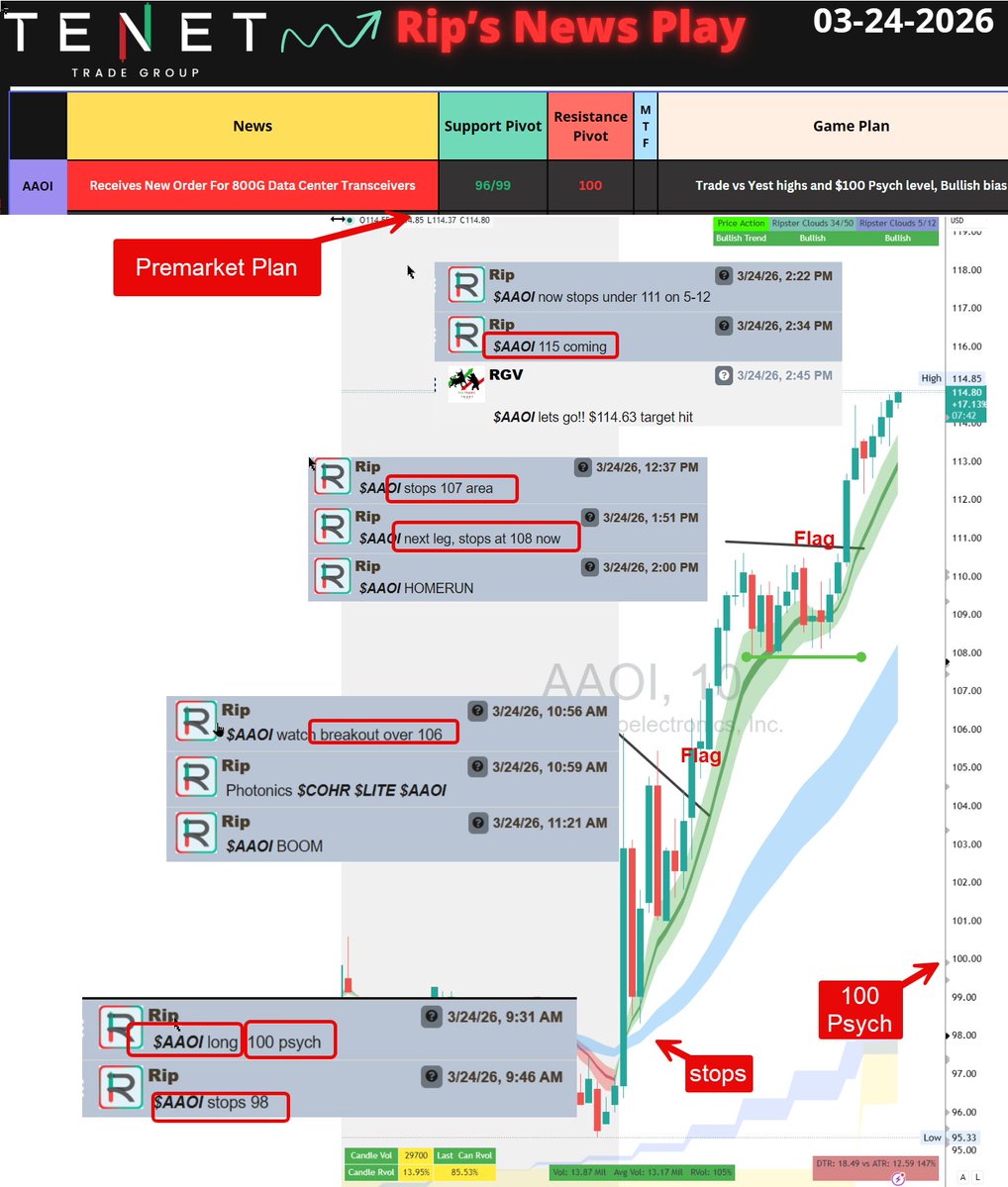
$AAOI 🚨 Strategy even a Kid Can Learn! I always stress about 100 Psych Trade Setups! Rest you just need to ride the clouds if you want homeruns , When clouds say exit you exit not before that! Week/Month Defining trades Paid for our lunch at @TENETTRADEGROUP Checkout Guidance
Ripster tweet media
English
8
7
38
16.8K
Peter
Peter@bigeye306·
@Sofigoodboy POET needs news coming out of the OFC last week. Orders are very important and earnings on 3/30. Would be great to get some news on new orders before earnings. It’s all about execution now. No more waiting and delays. Timing is everything.
English
0
1
4
651
SoFire
SoFire@Sofigoodboy·
$AAOI 물량 계약 소식 들리는데.. 포엣도 거의 다 왔나...? $poet
SoFire tweet media
한국어
7
0
48
20.6K
Peter
Peter@bigeye306·
@beewhy1964 @PTashner What a huge load off that would be and what will that do to the balance sheets and valuations of F2.
English
0
0
1
39
Uncle Festive
Uncle Festive@beewhy1964·
@PTashner At the most basic level, all $FNMA and $FMCC shareholders are looking for is simply the debit entry and credit entry for the $300 bln paid to the US Treasury.
English
2
0
7
913
Paul Tashner
Paul Tashner@PTashner·
Well-summarized Bill. Thank you. I’m a long term shareholder in Fannie and Freddie, and I look forward to our government doing the right thing, declaring the SPS repaid, selling most warrants back to the companies for the $25 billion overpayments, and exercising some warrants.
Bill Ackman@BillAckman

A number of press reports have characterized our and other shareholders’ efforts on behalf of Fannie and Freddie (F2) as seeking a ‘gift’ or ‘handout’ from the government. We, the shareholders of F2, seek no such thing. Hundreds of financial institutions were bailed out during the GFC by the U.S. Treasury. Nearly all of the financial institution bailouts during the GFC involved an injection of capital in the form of senior preferred stock by Treasury at an interest rate of 5%, plus warrants to acquire common stock in an amount equal to 15% of the face amount of the preferred with an exercise price at the then-current stock price of the rescued institution. For example, Treasury’s preferred stock investment in Goldman Sachs was in an amount of $10 billion and, in addition, Treasury received warrants on $1.5 billion of GS' common stock at its then market price. The bailout terms for F2 were materially more burdensome and expensive, with a higher interest rate and substantially more warrant coverage, than that of every other financial institution (other than those of AIG whose terms were similar). Despite the F2 bailouts’ massively more burdensome terms, shareholders are not complaining about the original terms. Treasury invested $193 billion in F2 in the form of senior preferred stock (SPS), including funding for $2 billion of commitment fees, with a 10% coupon (twice that of the banks). Treasury also received warrants on 79.9% of both companies’ outstanding shares. Fannie and Freddie have since repaid Treasury $301 billion, which includes interest on the SPS at a blended rate of 11.6%, an interest rate which is 160 basis points more per annum, and have returned the entire $193 billion of outstanding principal, $25 billion in excess of what was contractually owed. In summary, the F2 SPS has been fully repaid according to its original contractual terms plus an extra $25 billion. Despite the fact that the SPS has been more than repaid in full, Fannie and Freddie have not accounted for these payments on their respective balance sheets, and the $193 billion of SPS remains an outstanding liability as if no principal payments had ever been made. How can it be, you might ask, if indeed F2 have repaid $301 billion to Treasury when only $276 billion was due could there be any remaining balance of the SPS on the F2 balance sheets? The answer relates to something called the ‘Net Worth Sweep (NWS).’ During the second term of the Obama administration, on August 12, 2012, two quarters after F2 returned to profitability, Treasury announced that it was unilaterally amending the terms of the SPS stock to provide that Treasury would take 100% of the profits of F2 each quarter in lieu of the 10% annual dividend rate. This was not a negotiated resolution with F2. It was a unilateral amendment of the original terms of the SPS that was done in bad faith. The supposed rationale for the amended terms of the SPS was akin to the IRS garnishing the wages of someone who will never be able to pay the taxes that they owe. That is, the Treasury said F2 will never be able to pay the 10% coupon, let alone the SPS’ $193 billion principal balance, so it decided instead to ‘settle’ for 100% of F2’s profits forever. In discovery, shareholders learned that the stated justification for the amendment was false. In mid 2012, the Obama administration had come to learn that both companies would soon be reversing tens of billions of reserves on their balance sheets as housing values had increased and the reserves taken during the GFC had been excessive. The NWS was instituted by Obama to forestall F2 from forever being able to recapitalize and be released from conservatorship. The NWS was not a ‘settlement’ for a lesser amount of future payments. It was the outright theft of the forever profits of both companies. Never before or since has the government ‘swept’ 100% of the profits of any company, let alone a financial institution in conservatorship, a form of government intervention where the goal is rehabilitation of the institution, and where the hierarchy of corporate claims has always been respected. The accounting for the NWS payments while it was in effect (until Secretary Mnuchin terminated the NWS in Trump’s first term) was also unusual. The NWS was treated by F2 as a quarterly adjustment to the dividend rate on the SPS such that the dividend amount owed was made equal to the after-tax profits of F2 for that quarter with no limitation. In other words, regardless of the amount of profit F2 generated for the quarter – whether or not it was in excess of the original 10% annual dividend – the dividend payable under the NWS was made equal to the quarterly profit. The absurd terms of the NWS sweep therefore made it impossible for any partial or full repayment of the SPS to take place as every dollar paid to the Treasury on the amended terms of the SPS was considered a dividend payment, even if the amount was massively in excess of the original contractual SPS terms. The absurdity of the NWS was made clear just two quarters after the NWS went into effect. Fannie Mae generated a profit of $59 billion in the first quarter of 2013, and the SPS dividend rate for that quarter was set at $59 billion so the entire amount was swept to the government, more than 10 times the contractual dividend rate. I had the opportunity to discuss F2 and the NWS with Warren Buffett about a decade ago and he said that he “couldn’t believe what the government had done.” In short, the shareholders of F2 are simply asking the government to respect the original and highly burdensome terms of the SPS. There is no dispute that Treasury has received more than the original 10% coupon and full repayment of principal of the SPS, that is, an extra $25 billion. We and the millions of other shareholders of F2 are simply asking the administration to honor the original SPS terms and properly account for the $301 billion of payments, thereby eliminating the SPS liability from both companies’ balance sheets. Shareholders have not asked for the extra $25 billion to be returned to the two companies. Treasury can decide whether to keep those funds or return them to the companies. Accounting for the repayment of the SPS has other important implications. Namely, it is critically important that conservatorships respect the rule of law, in particular, the contractual terms of corporate instruments and the hierarchy of claims. Otherwise, no financial institution that gets into trouble will be able to raise rescue capital in the private markets. Notably, the treatment of F2 in conservatorship explains why Silicon Valley Bank and other recent large bank failures since the GFC were unable to raise private capital and avoid government intervention or a forced sale to J.P. Morgan. If the government with the stroke of a pen during conservatorship can at a whim wipe out common and preferred shareholders, no one is going to step in to try to save a financial institution that gets into trouble, and only the top few banks will be possible rescuers of big banks that fail. Furthermore, because of F2’s history, their reputation in the capital markets has been greatly damaged. F2 raised $22 billion of preferred stock in the year or so prior to conservatorship as the government pressed both companies to raise capital. Institutions were willing to invest billions of dollars of capital into both institutions before they failed because, based on all precedent conservatorships, the contractual terms of all financial instruments and the hierarchy of claims had been preserved. Unfortunately, in light of the precedent of the net worth sweep, no investor can be confident that they won’t be wiped out in a future conservatorship so none has been willing to take the risk. Some have proposed that Treasury simply convert the SPS into junior preferred and common stock and massively dilute shareholders. Putting aside the potential legal challenges to this approach, the result will be that Treasury will at best own something approaching 95% of both companies rather than 79.9%. While the government’s percentage ownership stake would be larger in the SPS conversion approach, the value of the government’s larger stake would be considerably lower as the companies would become un-investable. Who would invest in F2 alongside the government when they just wiped out the previous owners? In the SPS conversion scenario, the government’s stake, at best, if it could be sold, would trade at a massively discounted valuation, well below the value of the government's stake if Treasury retained only its contracted for 79.9% stake and respected the original terms of the SPS. In other words, a slightly smaller ownership stake of much more highly valued companies would equate to considerably more value for Treasury and taxpayers. In a public letter to Rand Paul after his first term in November of 2021, President Trump recognized that the net worth sweep was theft from the shareholders of Fannie and Freddie. He wrote: “Another Obama/Biden scam in legal trouble was when they allowed the Federal Housing Finance Agency (FHFA) to steal the retirement savings of hardworking Americans who had invested in Fannie Mae and Freddie Mac…The idea that the government can steal money from its citizens is socialism and is a travesty brought to you by the Obama/Biden administration. My Administration was denied the time it needed to fix this problem because of the unconstitutional restriction on firing Mel Watt. It has to come to an end and courts must protect our citizens.” I couldn’t have said it better than President Trump. Now that you have the time, Mr. President, let’s Stop the Steal!

English
1
7
30
947
Peter
Peter@bigeye306·
@BillAckman This has been some racket, from paying back SPS in full plus 25 million, to not being able to record the payback amount and keep it as a liability, to the NWS dividend Bad Faith scam. How screwed up and ridiculous, F2 was and still is financially raped.
English
0
1
2
65
Bill Ackman
Bill Ackman@BillAckman·
A number of press reports have characterized our and other shareholders’ efforts on behalf of Fannie and Freddie (F2) as seeking a ‘gift’ or ‘handout’ from the government. We, the shareholders of F2, seek no such thing. Hundreds of financial institutions were bailed out during the GFC by the U.S. Treasury. Nearly all of the financial institution bailouts during the GFC involved an injection of capital in the form of senior preferred stock by Treasury at an interest rate of 5%, plus warrants to acquire common stock in an amount equal to 15% of the face amount of the preferred with an exercise price at the then-current stock price of the rescued institution. For example, Treasury’s preferred stock investment in Goldman Sachs was in an amount of $10 billion and, in addition, Treasury received warrants on $1.5 billion of GS' common stock at its then market price. The bailout terms for F2 were materially more burdensome and expensive, with a higher interest rate and substantially more warrant coverage, than that of every other financial institution (other than those of AIG whose terms were similar). Despite the F2 bailouts’ massively more burdensome terms, shareholders are not complaining about the original terms. Treasury invested $193 billion in F2 in the form of senior preferred stock (SPS), including funding for $2 billion of commitment fees, with a 10% coupon (twice that of the banks). Treasury also received warrants on 79.9% of both companies’ outstanding shares. Fannie and Freddie have since repaid Treasury $301 billion, which includes interest on the SPS at a blended rate of 11.6%, an interest rate which is 160 basis points more per annum, and have returned the entire $193 billion of outstanding principal, $25 billion in excess of what was contractually owed. In summary, the F2 SPS has been fully repaid according to its original contractual terms plus an extra $25 billion. Despite the fact that the SPS has been more than repaid in full, Fannie and Freddie have not accounted for these payments on their respective balance sheets, and the $193 billion of SPS remains an outstanding liability as if no principal payments had ever been made. How can it be, you might ask, if indeed F2 have repaid $301 billion to Treasury when only $276 billion was due could there be any remaining balance of the SPS on the F2 balance sheets? The answer relates to something called the ‘Net Worth Sweep (NWS).’ During the second term of the Obama administration, on August 12, 2012, two quarters after F2 returned to profitability, Treasury announced that it was unilaterally amending the terms of the SPS stock to provide that Treasury would take 100% of the profits of F2 each quarter in lieu of the 10% annual dividend rate. This was not a negotiated resolution with F2. It was a unilateral amendment of the original terms of the SPS that was done in bad faith. The supposed rationale for the amended terms of the SPS was akin to the IRS garnishing the wages of someone who will never be able to pay the taxes that they owe. That is, the Treasury said F2 will never be able to pay the 10% coupon, let alone the SPS’ $193 billion principal balance, so it decided instead to ‘settle’ for 100% of F2’s profits forever. In discovery, shareholders learned that the stated justification for the amendment was false. In mid 2012, the Obama administration had come to learn that both companies would soon be reversing tens of billions of reserves on their balance sheets as housing values had increased and the reserves taken during the GFC had been excessive. The NWS was instituted by Obama to forestall F2 from forever being able to recapitalize and be released from conservatorship. The NWS was not a ‘settlement’ for a lesser amount of future payments. It was the outright theft of the forever profits of both companies. Never before or since has the government ‘swept’ 100% of the profits of any company, let alone a financial institution in conservatorship, a form of government intervention where the goal is rehabilitation of the institution, and where the hierarchy of corporate claims has always been respected. The accounting for the NWS payments while it was in effect (until Secretary Mnuchin terminated the NWS in Trump’s first term) was also unusual. The NWS was treated by F2 as a quarterly adjustment to the dividend rate on the SPS such that the dividend amount owed was made equal to the after-tax profits of F2 for that quarter with no limitation. In other words, regardless of the amount of profit F2 generated for the quarter – whether or not it was in excess of the original 10% annual dividend – the dividend payable under the NWS was made equal to the quarterly profit. The absurd terms of the NWS sweep therefore made it impossible for any partial or full repayment of the SPS to take place as every dollar paid to the Treasury on the amended terms of the SPS was considered a dividend payment, even if the amount was massively in excess of the original contractual SPS terms. The absurdity of the NWS was made clear just two quarters after the NWS went into effect. Fannie Mae generated a profit of $59 billion in the first quarter of 2013, and the SPS dividend rate for that quarter was set at $59 billion so the entire amount was swept to the government, more than 10 times the contractual dividend rate. I had the opportunity to discuss F2 and the NWS with Warren Buffett about a decade ago and he said that he “couldn’t believe what the government had done.” In short, the shareholders of F2 are simply asking the government to respect the original and highly burdensome terms of the SPS. There is no dispute that Treasury has received more than the original 10% coupon and full repayment of principal of the SPS, that is, an extra $25 billion. We and the millions of other shareholders of F2 are simply asking the administration to honor the original SPS terms and properly account for the $301 billion of payments, thereby eliminating the SPS liability from both companies’ balance sheets. Shareholders have not asked for the extra $25 billion to be returned to the two companies. Treasury can decide whether to keep those funds or return them to the companies. Accounting for the repayment of the SPS has other important implications. Namely, it is critically important that conservatorships respect the rule of law, in particular, the contractual terms of corporate instruments and the hierarchy of claims. Otherwise, no financial institution that gets into trouble will be able to raise rescue capital in the private markets. Notably, the treatment of F2 in conservatorship explains why Silicon Valley Bank and other recent large bank failures since the GFC were unable to raise private capital and avoid government intervention or a forced sale to J.P. Morgan. If the government with the stroke of a pen during conservatorship can at a whim wipe out common and preferred shareholders, no one is going to step in to try to save a financial institution that gets into trouble, and only the top few banks will be possible rescuers of big banks that fail. Furthermore, because of F2’s history, their reputation in the capital markets has been greatly damaged. F2 raised $22 billion of preferred stock in the year or so prior to conservatorship as the government pressed both companies to raise capital. Institutions were willing to invest billions of dollars of capital into both institutions before they failed because, based on all precedent conservatorships, the contractual terms of all financial instruments and the hierarchy of claims had been preserved. Unfortunately, in light of the precedent of the net worth sweep, no investor can be confident that they won’t be wiped out in a future conservatorship so none has been willing to take the risk. Some have proposed that Treasury simply convert the SPS into junior preferred and common stock and massively dilute shareholders. Putting aside the potential legal challenges to this approach, the result will be that Treasury will at best own something approaching 95% of both companies rather than 79.9%. While the government’s percentage ownership stake would be larger in the SPS conversion approach, the value of the government’s larger stake would be considerably lower as the companies would become un-investable. Who would invest in F2 alongside the government when they just wiped out the previous owners? In the SPS conversion scenario, the government’s stake, at best, if it could be sold, would trade at a massively discounted valuation, well below the value of the government's stake if Treasury retained only its contracted for 79.9% stake and respected the original terms of the SPS. In other words, a slightly smaller ownership stake of much more highly valued companies would equate to considerably more value for Treasury and taxpayers. In a public letter to Rand Paul after his first term in November of 2021, President Trump recognized that the net worth sweep was theft from the shareholders of Fannie and Freddie. He wrote: “Another Obama/Biden scam in legal trouble was when they allowed the Federal Housing Finance Agency (FHFA) to steal the retirement savings of hardworking Americans who had invested in Fannie Mae and Freddie Mac…The idea that the government can steal money from its citizens is socialism and is a travesty brought to you by the Obama/Biden administration. My Administration was denied the time it needed to fix this problem because of the unconstitutional restriction on firing Mel Watt. It has to come to an end and courts must protect our citizens.” I couldn’t have said it better than President Trump. Now that you have the time, Mr. President, let’s Stop the Steal!
English
364
455
2.1K
785.2K
Peter retweetledi
Hand of God
Hand of God@TylerEHand·
@BillAckman is on point: "Never before or since has the government ‘swept’ 100% of the profits of any company, let alone a financial institution in conservatorship, a form of government intervention where the goal is rehabilitation of the institution, and where the hierarchy of corporate claims has always been respected." Socialism is socialism, and if this administration is going to call out Z. Mamdani for what he is doing in New York, there's no room to keep Fannie Mae and Freddie Mac (F2) in conservatorship any longer. They have more than repaid their bailout commitments, and shareholders (most of whom are regular Americans, either robbed of their retirement or holding for years awaiting justice) deserve their due. It's time, Mr. President. It is time to do what no other administration was willing to do. End the socialism of these two beautiful companies that belong in the S&P 500. $FNMA $FMCC
Bill Ackman@BillAckman

A number of press reports have characterized our and other shareholders’ efforts on behalf of Fannie and Freddie (F2) as seeking a ‘gift’ or ‘handout’ from the government. We, the shareholders of F2, seek no such thing. Hundreds of financial institutions were bailed out during the GFC by the U.S. Treasury. Nearly all of the financial institution bailouts during the GFC involved an injection of capital in the form of senior preferred stock by Treasury at an interest rate of 5%, plus warrants to acquire common stock in an amount equal to 15% of the face amount of the preferred with an exercise price at the then-current stock price of the rescued institution. For example, Treasury’s preferred stock investment in Goldman Sachs was in an amount of $10 billion and, in addition, Treasury received warrants on $1.5 billion of GS' common stock at its then market price. The bailout terms for F2 were materially more burdensome and expensive, with a higher interest rate and substantially more warrant coverage, than that of every other financial institution (other than those of AIG whose terms were similar). Despite the F2 bailouts’ massively more burdensome terms, shareholders are not complaining about the original terms. Treasury invested $193 billion in F2 in the form of senior preferred stock (SPS), including funding for $2 billion of commitment fees, with a 10% coupon (twice that of the banks). Treasury also received warrants on 79.9% of both companies’ outstanding shares. Fannie and Freddie have since repaid Treasury $301 billion, which includes interest on the SPS at a blended rate of 11.6%, an interest rate which is 160 basis points more per annum, and have returned the entire $193 billion of outstanding principal, $25 billion in excess of what was contractually owed. In summary, the F2 SPS has been fully repaid according to its original contractual terms plus an extra $25 billion. Despite the fact that the SPS has been more than repaid in full, Fannie and Freddie have not accounted for these payments on their respective balance sheets, and the $193 billion of SPS remains an outstanding liability as if no principal payments had ever been made. How can it be, you might ask, if indeed F2 have repaid $301 billion to Treasury when only $276 billion was due could there be any remaining balance of the SPS on the F2 balance sheets? The answer relates to something called the ‘Net Worth Sweep (NWS).’ During the second term of the Obama administration, on August 12, 2012, two quarters after F2 returned to profitability, Treasury announced that it was unilaterally amending the terms of the SPS stock to provide that Treasury would take 100% of the profits of F2 each quarter in lieu of the 10% annual dividend rate. This was not a negotiated resolution with F2. It was a unilateral amendment of the original terms of the SPS that was done in bad faith. The supposed rationale for the amended terms of the SPS was akin to the IRS garnishing the wages of someone who will never be able to pay the taxes that they owe. That is, the Treasury said F2 will never be able to pay the 10% coupon, let alone the SPS’ $193 billion principal balance, so it decided instead to ‘settle’ for 100% of F2’s profits forever. In discovery, shareholders learned that the stated justification for the amendment was false. In mid 2012, the Obama administration had come to learn that both companies would soon be reversing tens of billions of reserves on their balance sheets as housing values had increased and the reserves taken during the GFC had been excessive. The NWS was instituted by Obama to forestall F2 from forever being able to recapitalize and be released from conservatorship. The NWS was not a ‘settlement’ for a lesser amount of future payments. It was the outright theft of the forever profits of both companies. Never before or since has the government ‘swept’ 100% of the profits of any company, let alone a financial institution in conservatorship, a form of government intervention where the goal is rehabilitation of the institution, and where the hierarchy of corporate claims has always been respected. The accounting for the NWS payments while it was in effect (until Secretary Mnuchin terminated the NWS in Trump’s first term) was also unusual. The NWS was treated by F2 as a quarterly adjustment to the dividend rate on the SPS such that the dividend amount owed was made equal to the after-tax profits of F2 for that quarter with no limitation. In other words, regardless of the amount of profit F2 generated for the quarter – whether or not it was in excess of the original 10% annual dividend – the dividend payable under the NWS was made equal to the quarterly profit. The absurd terms of the NWS sweep therefore made it impossible for any partial or full repayment of the SPS to take place as every dollar paid to the Treasury on the amended terms of the SPS was considered a dividend payment, even if the amount was massively in excess of the original contractual SPS terms. The absurdity of the NWS was made clear just two quarters after the NWS went into effect. Fannie Mae generated a profit of $59 billion in the first quarter of 2013, and the SPS dividend rate for that quarter was set at $59 billion so the entire amount was swept to the government, more than 10 times the contractual dividend rate. I had the opportunity to discuss F2 and the NWS with Warren Buffett about a decade ago and he said that he “couldn’t believe what the government had done.” In short, the shareholders of F2 are simply asking the government to respect the original and highly burdensome terms of the SPS. There is no dispute that Treasury has received more than the original 10% coupon and full repayment of principal of the SPS, that is, an extra $25 billion. We and the millions of other shareholders of F2 are simply asking the administration to honor the original SPS terms and properly account for the $301 billion of payments, thereby eliminating the SPS liability from both companies’ balance sheets. Shareholders have not asked for the extra $25 billion to be returned to the two companies. Treasury can decide whether to keep those funds or return them to the companies. Accounting for the repayment of the SPS has other important implications. Namely, it is critically important that conservatorships respect the rule of law, in particular, the contractual terms of corporate instruments and the hierarchy of claims. Otherwise, no financial institution that gets into trouble will be able to raise rescue capital in the private markets. Notably, the treatment of F2 in conservatorship explains why Silicon Valley Bank and other recent large bank failures since the GFC were unable to raise private capital and avoid government intervention or a forced sale to J.P. Morgan. If the government with the stroke of a pen during conservatorship can at a whim wipe out common and preferred shareholders, no one is going to step in to try to save a financial institution that gets into trouble, and only the top few banks will be possible rescuers of big banks that fail. Furthermore, because of F2’s history, their reputation in the capital markets has been greatly damaged. F2 raised $22 billion of preferred stock in the year or so prior to conservatorship as the government pressed both companies to raise capital. Institutions were willing to invest billions of dollars of capital into both institutions before they failed because, based on all precedent conservatorships, the contractual terms of all financial instruments and the hierarchy of claims had been preserved. Unfortunately, in light of the precedent of the net worth sweep, no investor can be confident that they won’t be wiped out in a future conservatorship so none has been willing to take the risk. Some have proposed that Treasury simply convert the SPS into junior preferred and common stock and massively dilute shareholders. Putting aside the potential legal challenges to this approach, the result will be that Treasury will at best own something approaching 95% of both companies rather than 79.9%. While the government’s percentage ownership stake would be larger in the SPS conversion approach, the value of the government’s larger stake would be considerably lower as the companies would become un-investable. Who would invest in F2 alongside the government when they just wiped out the previous owners? In the SPS conversion scenario, the government’s stake, at best, if it could be sold, would trade at a massively discounted valuation, well below the value of the government's stake if Treasury retained only its contracted for 79.9% stake and respected the original terms of the SPS. In other words, a slightly smaller ownership stake of much more highly valued companies would equate to considerably more value for Treasury and taxpayers. In a public letter to Rand Paul after his first term in November of 2021, President Trump recognized that the net worth sweep was theft from the shareholders of Fannie and Freddie. He wrote: “Another Obama/Biden scam in legal trouble was when they allowed the Federal Housing Finance Agency (FHFA) to steal the retirement savings of hardworking Americans who had invested in Fannie Mae and Freddie Mac…The idea that the government can steal money from its citizens is socialism and is a travesty brought to you by the Obama/Biden administration. My Administration was denied the time it needed to fix this problem because of the unconstitutional restriction on firing Mel Watt. It has to come to an end and courts must protect our citizens.” I couldn’t have said it better than President Trump. Now that you have the time, Mr. President, let’s Stop the Steal!

English
1
11
68
1.6K
Hand of God
Hand of God@TylerEHand·
The future of $FNMA and $FMCC is bright. Don't let the OTC shenanigans get to you. I've been buying for nearly a decade and have sold nothing, and know what I hold. This is a once-in-a-generation trade with 10x upside than downside risk, with public administration promises to back it. Bill Ackman has urged common shareholders to be patient. Dr. Michael Burry has added to his position and doubled down on his duly vetted research. Jon Oksenholt has publicly rallied support, and we are still early in terms of THIS administration's planning timeline. It's almost time. Promises were made, and promises will be kept. @BillAckman @michaeljburry @JonOksenholt
Jon Oksenholt@JonOksenholt

Real life has many parallels with Freddie & Fannie ( $FMCC / $FNMA ) shareholder perspectives: you can remain bitter & focused on the past & divisive, or you can be generally optimistic & adaptable & focused on Solutions & the future. I’m sympathetic to & on the side of the long-term @freddiemac / Fannie Mae shareholders, & always rooting for the little guy, just as I did when calling out Elliott Capital’s lowball bid for City Office REIT. If I thought these businesses weren’t being optimized I would be the first to call that out. No different from what I did when calling out my concerns with the management of City Office REIT, where I acquired a significant stake prior to the take-private announcement. In this instance, the current admin led by @realDonaldTrump with @Pulte, @SecScottBessent, & @howardlutnick is uniquely qualified to deliver the best possible outcome for shareholders, homebuyers, taxpayers, & renters. They also are not the ones that put these beautiful businesses into conservatorship to begin with. Shareholders large & small (both common & jps) ought to unite & shine a bright light on how well these companies are performing (Fannie alone posted $14.4B net income in 2025) & why they belong back on a major exchange. P.S. If it’s true that @BillAckman presented his ideas to the govt, that’s positive news / DYOR on this & every investment, form your own opinions, & choose your path based on facts, logic, & probabilities & if you decide to share your views on Freddie/Fannie publicly, make sure you have thick skin..


English
2
12
94
11.9K
Jon Oksenholt
Jon Oksenholt@JonOksenholt·
“In this instance, the current admin led by @realDonaldTrump with @Pulte, @SecScottBessent, & @howardlutnick is uniquely qualified to deliver the best possible outcome for shareholders, homebuyers, taxpayers, & renters. They also are not the ones that put these beautiful businesses into conservatorship to begin with. Shareholders large & small (both common & jps) ought to unite & shine a bright light on how well these companies are performing (Fannie alone posted $14.4B net income in 2025) & why they belong back on a major exchange.”
English
1
5
22
684
Money Is Clear💰
Money Is Clear💰@MoneyIsClear·
@unusual_whales Beer at a 37 year low while energy drinks, $7 coffee and $29 cocktails are at all time highs. People didn't stop spending on vices, they just got priced out of the cheap ones.
English
2
1
29
1.4K
unusual_whales
unusual_whales@unusual_whales·
US beer shipments expected to reach a 37-year low, per Bank of America.
English
238
245
3.4K
770.8K
Peter
Peter@bigeye306·
@HorsemanCountry @michaeljburry Let’s see if anything comes from it in a timely manner. At least the meeting and conversation took place. Everyone has been pounding the table about uplisting F2 to the NYSE after 18 years on the OTC. It’s time something good happens.
English
1
0
1
136
Peter
Peter@bigeye306·
@DoorMarkdPirate Now they have to follow along with the plan and sooner than later. It's definitely time and with the current rate situation and the war something needs to be done here.
English
0
0
2
99
Treasury Secretary Scott Bessent
Treasury Secretary Scott Bessent@SecScottBessent·
Congratulations to @federalreserve, @USOCC, and @FDICgov, on today’s Basel Capital Proposal. Today’s outdated capital requirements are needlessly complex and misaligned with their actual objective. Rather than solving for safety and soundness, they are pushing lending out of the regulated banking system while simultaneously impeding economic growth. The last Administration aimed to hijack the Basel modernization effort to reverse-engineer ever-higher capital requirements without rhyme or reason. Under President Trump’s leadership, we have taken a principled and calibrated approach that simplifies capital requirements and fosters a level playing field for banks of all sizes. If finalized, this proposal would advance those goals, fostering economic growth through our regulatory regime. Today is an important step in the regulatory reset our Administration is working towards, marking meaningful progress toward a financial system that builds Parallel Prosperity for Main Street and Wall Street.
English
225
522
2.7K
255.4K
Peter
Peter@bigeye306·
@HorsemanCountry Let's hope it continues and something material comes out of this soon.
English
0
0
4
143
Horseman Country
Horseman Country@HorsemanCountry·
$FNMA $FMCC Crazy day in the Fannie Mae and Freddie Mac shareholder world. Congrats to the buyers...and holders who didn't blink. Massive sell off to start the day after weeks of constant hemorrhaging. Steady recovery throughout the day...and then F2 channeled the Incredible Hulk with a green spike in the final minutes up to the close. 28.5 million combined share volume on no significant news. I can’t imagine that was a bunch of Joe flippers stacking for some day trading. So who loaded the wagons? Did more institutional investors dive in? There seems to be a collective optimistic interest in the twins coming from somewhere. We’ll see what happens next. GLTA.
GIF
English
17
7
81
6.3K