Sabitlenmiş Tweet
bilalcodes 👨🏻💻
362 posts

bilalcodes 👨🏻💻
@bilalcodesdev
Product Engineer. Building in public from Dubai. Shipping AI tools that actually work → https://t.co/JpxhF283JI
/Users/bilal.one/Desktop 🖥 Katılım Eylül 2022
81 Takip Edilen89 Takipçiler

@iannuttall @suraj1kc Tier 4 limits are brutal. I had to start aggressively routing tasks between Haiku and Sonnet depending on the complexity of the data extraction just to keep the limits in check. The architecture completely shifts once you hit that volume.
English

@suraj1kc using the claude api and even on tier 4 I'm hitting daily rate limits haha
English

Been quiet on here but I’m not dead.
Although I’m sick so I might be soon?
I’m rebuilding a niche site in Laravel with a focus on ecom and free tools!
So far generated about 500k pieces of content using Claude (had to switch to Sonnet b/c Opus was $$$)
The entire focus of this new site will be email subscribers from my free tools and then selling digital and possibly physical products via email later.
I’ve got some incredible content now with charts and tables and…
I’ve deleted a lot of old pages!
This site wasn’t “hit” by HCU but I certainly branched out a bit too far into only loosely related topics.
So I’m pulling it all back to the core topic that generates 90% of the traffic anyway (and adding another 100k pages that it didn’t have before)
This is the same site I did a big migration on and lost pretty much all of the traffic for 6 months so once again it’s a YOLO event where it could go wrong.
It’s making $2k/mo from ads but the plan is to replace that income with product sales and then I’ll remove all ads and maybe even go public with it.
Final step is to rebuild sitemaps, test as much as I can with Screaming Frog and then launch it.
Post-HCU this site gets 90k pageviews a month and I’ve deleted pages accounting for maybe 5-10k.
I’m banking on the new, more relevant, pages more than making up for that!
I know I’ve said this before, but this is the last pSEO migration I’m ever doing…
English

Handling this natively in Node.js is practically mandatory for production right now. I ended up building a custom round-robin rotation service for my own Claude orchestration just to keep the extraction pipeline alive during spikes. A single API key is a massive single point of failure at scale.
English

Another feature request for @conductor_build - allow me to load multiple Codex and Claude API keys and rotate through them when I hit the rate limits 🚀
English

Honestly, I didn’t set out to compete! I originally built it just to fix my own resume because standard HTML-to-PDF tools kept scrambling the text layer.
I solved it using LaTeX under the hood, and then turned it into a full SaaS simply to learn the end-to-end product engineering lifecycle and understand market dynamics. Competing on strict machine readability is really just the byproduct of a learning project!
English

@bilalcodesdev This is good but how are you competing with so many similar tools in the market?
English

@sans_builds Yep! Just pushed the V1 of the parsing engine live actually. It takes messy PDFs, extracts the data with Claude, and recompiles it into a perfectly ATS-readable format. You can test the live build here: resume.bilal.one
English

@bilalcodesdev Have you built anything with these tools yet? Just curious
English

@closermethod @elonmusk @AnthropicAI @SpaceX Rate limits are absolutely the final boss of shipping AI products right now. Moving from a local demo to a production environment where you have concurrent users hitting the API completely changes how you have to structure your backend.
English

As the recently expanded partnership with @AnthropicAI demonstrates, @SpaceX is offering AI compute as a service at significant scale.
We are in discussions with other companies to do the same.
Over time, especially with orbital data centers, we expect to serve AI at extremely high scale.
English

It is the classic gym membership model! The Pro subscription relies on the fact that 90% of users won't max out their limits, which subsidizes the 10% who do.
With the API, you are paying for guaranteed, raw compute on demand. To keep the burn rate down on my own SaaS, I had to aggressively route tasks between Haiku and Sonnet depending on the complexity of the data extraction.
English

Genuine question:
$20 of Claude API can vanish in minutes with heavy usage, but $20 for Claude Pro lasts much longer because of rate limits + rolling windows.
So what’s the actual economics here?
Is Claude Pro effectively giving users far more value than $20 worth of API credits?
If yes, how do startups building on Claude’s API make sustainable margins when users could just pay Anthropic directly for Pro instead?
English

Exactly this. When I was architecting the backend for Synapse, I quickly realized you can't just pipe the Claude API directly to the client. I had to build a dedicated queueing and retry layer in Node just to handle rate limit spikes and auth blips gracefully. If an agent doesn't have a robust fallback mechanism, it’s just a demo.
English

@justinhammon_ Appreciate the shoutout, Justin! Always great to cross paths with another builder tackling the ATS puzzle.
English

ATS doesn't read your resume.
It parses it.
If your formatting confuses the parser - your excellent career gets a bad score before a human ever looks.
Use: → Simple formatting → Exact keywords from the JD → Clean PDFs (no tables, text boxes, graphics)
This alone can fix a silent rejection problem.
English

@BenjDicken Tell me about it 😂. Running complex ATS parsing through Claude for my engine completely flipped my cloud budget. My AWS infrastructure bill is basically a rounding error compared to my Anthropic API usage now.
English

Plug in your anthropic key and it becomes opex
Greg Brockman@gdb
under appreciated that codex is open source
English

@aminnnn_09 @Priyannkaaaa Spot on. Complex layouts almost always scramble the text layer for the parser. If they need a format built specifically to pass the extraction phase cleanly, I built a free engine that compiles parser-safe PDFs: resume.bilal.one
English

This is the exact headache I ran into when building my parser. Workday and Greenhouse process text layers completely differently when they encounter multi-column PDFs. I ended up bypassing HTML-to-PDF entirely and using a custom Node.js service to compile LaTeX. It forces a linear text layer that both Workday and Greenhouse can read flawlessly, regardless of the visual layout.
English

@faizan_raza1350 @expo mobile-first ATS is sharp — most resume tools default to desktop. curious how you handle the parser quirks: have you tested against Workday vs Greenhouse output? those two diverge enough that 'ATS-friendly' is really two different formats.
English

Great prompt! I actually got so tired of doing this manually that I orchestrated this exact workflow into a free tool. It uses Claude Haiku to extract the data and scores it directly against the pasted JD to highlight the exact keyword gaps.
If any of your followers want the automated version, they can run it here: resume.bilal.one
English

6. Score it before you send it.
Claude prompt:
"Act as an ATS parser. Score my resume against this job description out of 100. Break the score into keyword match, formatting readability, and experience alignment. Tell me the three changes that would move the score the most."
Under 80, fix it. Under 90, fix it more. Most candidates send at 50 to 60 and wonder why nothing comes back.
This whole process took me 3 hours. Without Claude it would have taken 3 weeks of trial and error and a career coach charging $200 an hour.
Keep one master resume with every bullet, project, and metric you have ever produced. For each new job, copy it, ask Claude to tailor it, submit within an hour.
The candidate who applies first with a 90% match beats the candidate who applies third with a 70%.
English

Canva is great for design, but terrible for data extraction. The text layers just turn to garbage. If any of your followers are stuck in this loop, I built a free tool that pulls their data and compiles it into a strictly ATS-compliant format so they stop getting auto-rejected: resume.bilal.one
English

Spot on, Phillip. Multi-column PDFs from design tools completely scramble the underlying text layer. I actually got so frustrated by this that I built an engine that compiles resumes using LaTeX. It keeps the visual layout clean for humans but enforces a perfect, linear text layer for ATS scanners.
Free to use if you ever need to point people toward a parser-safe option: resume.bilal.one
English

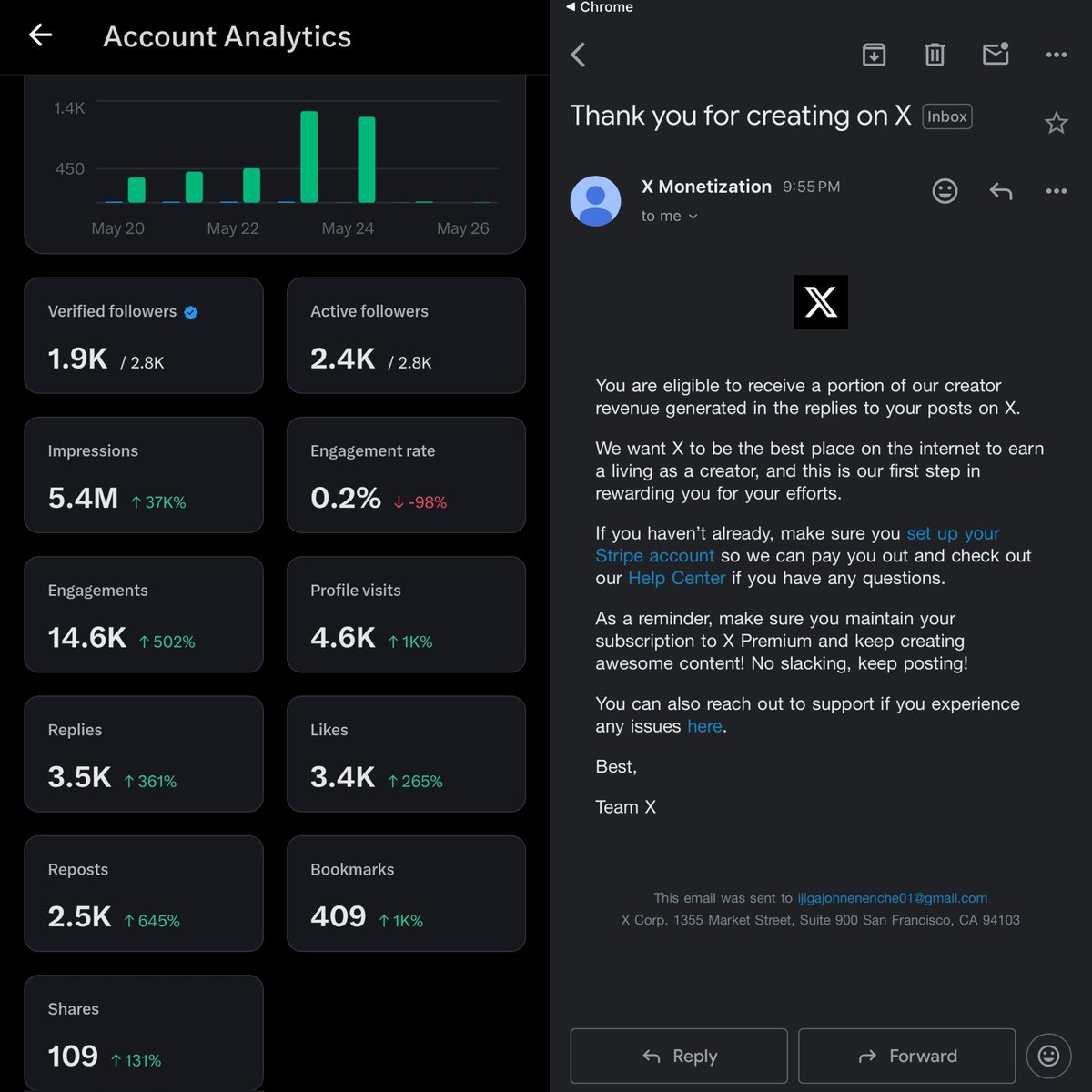
@Tame_abeast Huge milestone, congratulations on unlocking the monetization!
English

@vanshyadav1408 This is exactly why I kept س synapse closed-source but free to use. The moment you open the repo for a fully functional SaaS tool, you aren't building a community—you are just doing the heavy lifting for someone else's Stripe integration.
English

@olivercingl The 'drop your link' economy is booming 😂.
It’s getting harder to find actual engineering discussions buried under all the engagement farming.
English