

Binayak Sen

3.4K posts

Binayak Sen banner
Binayak Sen

Binayak Sen

@binayak_sen

Worked in BIDS, IFPRI & World Bank; interested in economics, history & social justice. RTs are not endorsements. Email: [email protected]

Dhaka, Bangladesh Katılım Mart 2013
511 Takip Edilen2.2K Takipçiler
Binayak Sen
Binayak Sen@binayak_sen·
There are many explanations for the disastrous electoral defeat of TMC (Mamata’s party) in West Bengal: 1. The sharp rise of religious (Hindu) nationalism; 2. Misgovernance; 3. Lack of growth & employment; 4. Gradual erosion of the Left & Secular values. thefederal.com/elections-2026…
English
0
1
1
136
Binayak Sen
Binayak Sen@binayak_sen·
The final paragraph of George Eliot’s “Middlemarch” underscores the deep, lasting impact of the main protagonist, Dorothea Brooke, and her unsung yet unquestionably positive influence on the world. The quote runs as follows: “Her finely touched spirit had still its fine issues, though they were not widely visible. Her full nature, like that river of which Cyrus broke the strength, spent itself in channels which had no great name on the earth. But the effect of her being on those around her was incalculably diffusive: for the growing good of the world is partly dependent on unhistoric acts; and that things are not so ill with you and me as they might have been, is half owing to the number who lived a hidden life faithfully, and rest in unvisited tombs.” George Eliot was a remarkable woman, not just a novelist. She was also a philosopher in disguise: she translated Spinoza’s Ethics.
English
0
0
0
77
Binayak Sen
Binayak Sen@binayak_sen·
Read this piece, and it is absolutely true. We often talk about the growth-oriented Southern states compared to the lagging Northern states of India. But the Kerala model highlighted by Amartya Sen in 1981 is more remarkable for its sustained progress over 45 years. The Gujarat model comes nowhere near its achievements. The Kerala model is not just an example of public policy-led human development, nor is it reducible to the remittance story alone. It has been leading the Indian states in per capita growth in NSS consumption expenditure over the last three decades. It was also leading in the pace of poverty reduction, however defined. Martin Ravallion and Gaurav Datt had already proved these points earlier. In sum, it is the leader in human development, poverty reduction, and growth of real per capita consumption expenditure. Social and political factors played a role in its stellar performance. Its population (with 100% literacy) is evenly divided among three major religions (Muslim, Christian, and Hindu). It has the strongest fiscal decentralization among all states. And it has a vibrant democratic politics, defined by the Left Liberalism, alternating between CPI (M) and Congress.@arvindsubraman @APanagariya
Arvind Subramanian@arvindsubraman

.@TheEconomist piece on Kerala under-sells remittances. Our book A SIXTH OF HUMANITY (chart) shows that Kerala-w/ its great human capital- is also amongst the richest states w/o dynamic agri., mfg., or IT services. Remittances partially explain the puzzle: economist.com/finance-and-ec…

English
0
0
1
204
Binayak Sen
Binayak Sen@binayak_sen·
Surah poets.org/poem/surah Read this—a poem by Tarfia Faizullah, a Bangladeshi poet born in New York. If you like this, there are more of her poems showcased on poets.org. She is the author of two poetry collections, Registers of Illuminated Villages (Graywolf Press, 2018) and Seam (Southern Illinois University Press, 2014). Faizullah’s writing, translated into Bengali, Chinese, Persian, and Tamil, has appeared widely in both the U.S. and abroad, including in publications such as The Hindu Business Line, BuzzFeed, The Huffington Post, Poetry, Ms. Magazine, Oxford American, The New Republic, and The Nation. She needs to be interviewed by scholars and literati and deserves to be widely publicized in Bangladesh.
English
1
1
5
648
Binayak Sen
Binayak Sen@binayak_sen·
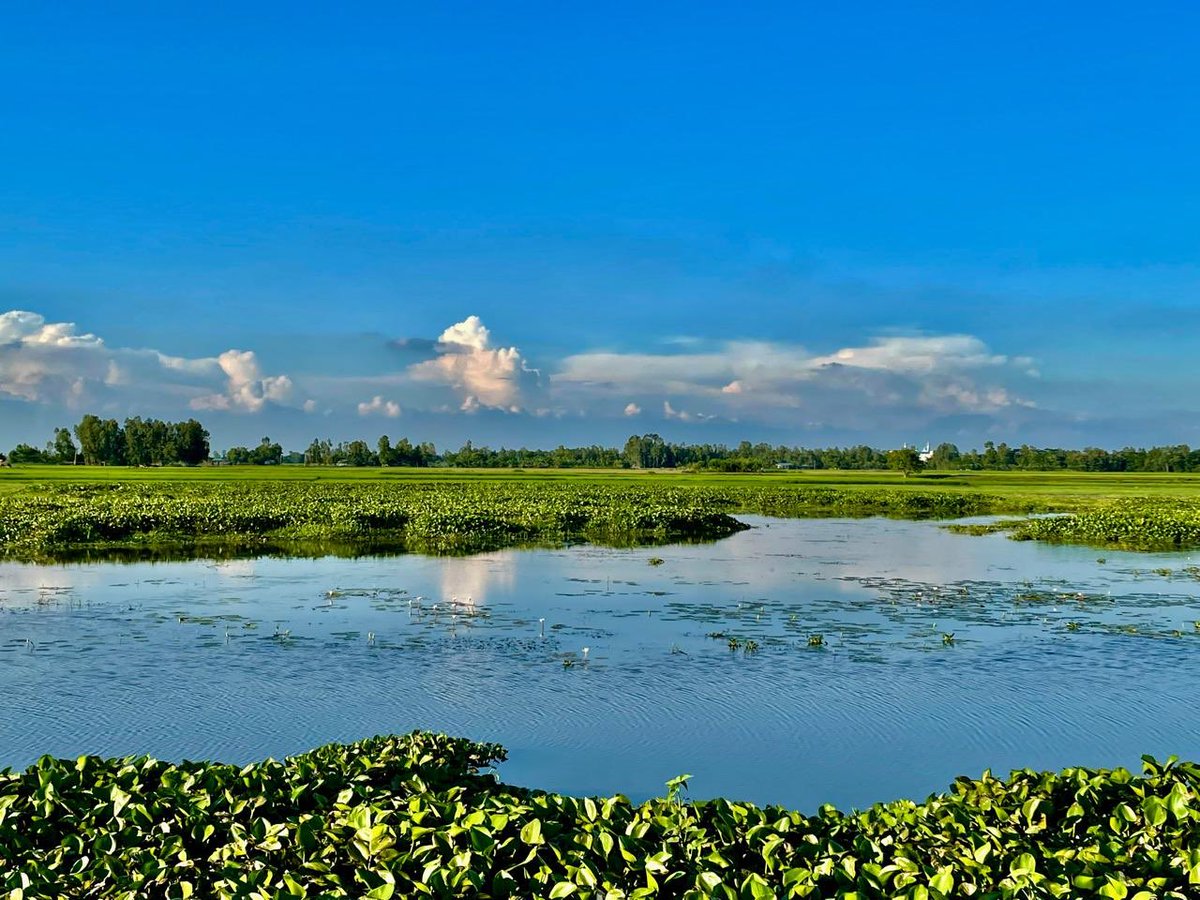
Happy Bengali New Year-2 Another view of rural Bangladesh
Binayak Sen tweet media
English
0
0
2
107
Binayak Sen
Binayak Sen@binayak_sen·
Happy Bengali New Year to all (Below is a glimpse of rural Bangladesh in Sylhet district, north-eastern region of the country)
Binayak Sen tweet media
English
0
1
4
198
Binayak Sen
Binayak Sen@binayak_sen·
1. Female advancement has been instrumental in achieving many economic and social outcomes, not just in Bangladesh. 2. But in Bangladesh, this was achieved against well-known odds. Here the role of emancipatory literature written by the early Feminists (Begum Rokeya writing as early as 1903, in “The Deterioration of the Status of Women” —স্ত্রীজাতির অবনতি—is a case in point) and vibrant intersectionality of the women’s rights movement and secular cultural movements in the 1960s and 1970s (Chayanat, Udichi, Mohila Parishad, Naripokkho) played an important ideational/ ideological role for catalyzing female education, gender sensitive health, preventing violence against women, & expanding female economic participation. 3. Fortunately, our political leaders, by and large, in successive decades were sensitized to women's rights issues because they knew the songs and poems of Tagore and Nazrul and shared their equalizing spirits. 4. However, many challenges remain, including sustaining female economic participation in modern sectors, including international migration; promoting female entrepreneurship; ensuring a more rewarding role for female-managed agriculture; preventing intrahousehold, extrahousehold & digital violence against women; and advancing their further advancement in sports, culture, and facilitating entry into gender segregated sectors.
Naomi Hossain@nomhossain

Some Bangladeshis think progress on gender equality is a nice thing to have (except for the dinosaur patriarchs ofc). But it’s actually been central to Bangladesh’s development. Read ⁦@N_Kabeer⁩ on why thedailystar.net/slow-reads/unh…

English
1
0
9
605
Binayak Sen
Binayak Sen@binayak_sen·
Let's pray and hope for the safe return of Artemis II crews as it prepares for re-entry and splashdown. Irrespective of whether you are a believer, a non-believer, or indifferent to religion. They deserve it. It is human courage, not technological ingenuity, that should touch all of us. Prayer only highlights our eternal gratitude and the enormous risks they take, with full knowledge of the risks involved, on humanity’s behalf, in such missions to deeper space.
English
0
0
1
106
Binayak Sen
Binayak Sen@binayak_sen·
On Ethics of AI: 1. Notice this retweet from the Nobel laureate Daron Acemoglu. 2. However, I would like to flag the issue of ethical modeling of AI. This is now one of the hottest areas in ethics and moral philosophy. It began with the Three Laws of Robotics in Asimov's Sci-Fi novels. But now it has gone beyond robotics, engulfing many areas of our lives, including ChatGPT, Gemini, Alexa, etc. 3. There is a lot to comment on the AI Ethics, however. Deciding on the normative theory to adopt for ethical modeling of AI is not easy. One strong view is that it cannot be based solely on the Utilitarian approach. In that case, the position of minority and already disadvantaged groups and regions may be further worsened. With that approach, the abuse of AI will increase further in everyday use, including surveillance, medical treatment decisions, immigration profiling, health insurance eligibility, creditworthiness scoring, war technology, legal processing, and a range of other areas. 4. Such an ethical modeling cannot be based on an exclusive reason-based exercise, either, such as the Kantian framework. I find the Derridean idea of friendship as a good way out. AI ought to be our intellectual companion both here on Earth and in deep-space exploration. 5. We can also add Care Ethics and Levinas's approach as ways to build trustworthy, accountable relationships with AGIs (including, in the future, ASI). 6. At the end, we must allow for a menu of ethical choices within a band—I call it the “moral tapestry”—from which AGI (and ASI) can choose the right ethical decision for a given context.
Daron Acemoglu@DAcemogluMIT

A new exciting book on AI and the designs of AI-industry leaders

English
0
0
0
147
Binayak Sen
Binayak Sen@binayak_sen·
For 40 minutes today, the crew will lose contact with Earth - BBC News This is what I called the “loneliness of 48 minutes” in my earlier tweet. I found it symbolic of profound solitude along with the celebration of the unknown (the “unknown unknowns”). apple.news/ANa3QiJL1SRKdJ…
English
0
0
3
67
Binayak Sen
Binayak Sen@binayak_sen·
Trust them—their seeing and feeling. This is the truth seen from a distance—it’s the lived experience. The oneness of us is the reality seen from the space. But who’s listening? We are busy killing people or sending people to jails or exiles & forgetting. bbc.com/news/videos/cr…
English
0
0
2
54
Binayak Sen
Binayak Sen@binayak_sen·
The Loneliness of 48 Minutes: 1. The Artemis II mission of NASA touched our souls, even in the middle of the difficulties faced by humans on Earth. No one can stay indifferent to this event, even perhaps in war-torn zones. 2. For many, for sure, the subtext of “technological optimism” (the new possibility of space travel) vs “political pessimism” (incessant wars on earth) can hardly be missed while discussing NASA’s Artemis II mission. But I am ready to gloss over this now and celebrate the current moment. I would reflect on the “loneliness of the 48 minutes” in the Artemis mission. 3. During this 10-day mission, there is a critical interval when direct communication with Earth will not be possible. This will happen due to unavoidable “technical reasons” as there are no intermediate, message-relaying lunar satellites yet. Although almost every minute of the astronauts' travel will be monitored, for about 48 minutes, the four astronauts will have “no connections” whatsoever to Earth, living in an uncertain space reality on their own. 4. What is the technical reason for the 48 minutes of non-communication? When Artemis II goes behind the moon, radio waves that travel approximately in straight lines are obstructed by the moon’s solid body. If our Earth and Artemis spacecraft are on opposite sides of the moon, the signal is blocked, preventing communication. This is classical geometry. 5. On 25 March 1969, General Ayub Khan resigned following a mass uprising. A few months later, on 20 July, the first man—US astronaut Neil Armstrong—landed on the moon. I was then only eleven years old in East Pakistan. That was the time when television first came to our home. It was a Soviet-made Elektron TV (the cheapest brand available at the time). I am now nearing sixty-eight, incidentally in the US, when we are seeing this brave and unique mission. 6. This time, Artemis II will not land on the surface of the moon, but instead will follow a “free-return trajectory” whereby the spacecraft will travel from Earth toward the moon, loop around the moon once, and then naturally return to Earth without needing major engine burns. 7. NASA’s launch of one of the most powerful rockets ever built and its mission objective to see and feel for ourselves the “dark side of the moon” (the side we never see from the earth through our own eyes) is poetic. I am reminded of Pink Floyd. 8. But it's also the beginning of a new era. Four astronauts (a curious mix of genders, races, and international partnerships) will be on this mission, sharing their lives intimately and essentially ushering in a new age of space travel for the human race. We should get more funding for these missions and build more powerful rockets, not missiles. If the wars on Earth can be stopped, raising such funds in the future will not be difficult. Since 1972, no humans have gone to the vicinity of the moon due to ever-increasing defense and war expenses. 9. Artemis mission shows that human subjectivity—seeing things through one's own eyes and not just relying on robots and AIs—is still a sacred value. Witnessing is valued separately, as is the whole “phenomenological experience,” alongside impersonal, reason-based takes. 10. It also shows that the public-private partnership is essential for speed acceleration, space-based fueling, building future transitional base stations on the moon (scheduled in 2028), and setting up the platform for future travel to Mars and beyond. 11. Why is such a moon-based platform needed? Because you need intermediate fueling and support stations. The one-way trip to the moon takes only 3 days (the entire Artemis II mission is for 10 days); a one-way trip to Mars will take 7-9 months. Humans will be alone in deep space—virtually disconnected from Earth—for months and years, not just for 48 minutes. Non-communication in deep space will arise from many such technical reasons. Loneliness in future space travel is the fate of the human race.
English
0
0
0
198
Binayak Sen
Binayak Sen@binayak_sen·
Spring in Ramna Park, Dhaka
Binayak Sen tweet media
Eesti
0
1
2
99
Binayak Sen
Binayak Sen@binayak_sen·
There are many panel (micro) data sets that can generate trends in poverty (and consumption growth) independent of macroeconomic growth data. However, one needs to be careful, as some micro-surveys do not use rigorous survey methods (sampling, data collection methods, panel comparability, etc.), creating more heat than shedding light. Comparatively speaking, poverty data generated by the HIES/ NSS are more subject to academic scrutiny (both national and international) than macro-growth data, not just in Bangladesh and India.
English
0
0
1
40
Naomi Hossain
Naomi Hossain@nomhossain·
@yusufbtri123 @binayak_sen Poverty data are harder to manipulate than growth date, the experts tell me. And not all poverty data came from the government.
English
1
0
2
54
Binayak Sen
Binayak Sen@binayak_sen·
pubs.aeaweb.org/doi/pdfplus/10… Read this AER article with contemporary ringing: “A war of average intensity is associated with an output drop of close to 10 percent in the ­ war-site econ- omy, while consumer prices rise by approximately 20 percent. The capital stock, total factor productivity, and equity returns all decline sharply. The economic ramifications of war are not confined to the war site. The evidence points to adverse economic outcomes in other belligerent and ­ third-party countries if they are exposed to the war site through trade linkages or share a common border.” This is not surprising. Analysis of the conflict-growth interface also suggests similar results.
English
0
0
1
100
Binayak Sen
Binayak Sen@binayak_sen·
Take note of this important WHO report on domestic violence faced by ever-partnered women across the countries.@_alice_evans IPV is an important indicator of female well-being. Several aspects need to be cross-checked, controlling for income and literacy (my priors are as follows): 1. While rich countries defined by per capita GNI have a lower prevalence than poor countries, economic growth is not a good predictor. Accelerating growth will not reduce IPV; 2. Level of TFR (or reproductive burden) is not related to the prevalence of violence, controlling for income and literacy; 3. Level of general literacy may not be a good predictor of IPV—it may be that the ‘type of cultural literacy’ matters; 4. The high level of ‘religiosity’ (suitably defined based on existing cross-country database) is not necessarily correlated with the low prevalence of intimate partner violence (which is why South Asia is starkly marked by a high level of IPV notwithstanding ‘high religiosity’), controlling for income and literacy; 5. The presence of democracy or gradation of democratic governance is not correlated with IPV. 6. A version of this relationship stipulated in item 5 would be to check IPV with the “quality of administrative governance”; 7. The DHS type indicator of ‘decision-making empowerment’ of women is not correlated with IPV; 8. IPV may be related to high vulnerability at the macro level—with high climate risks and high conflict risks; 9. IPV may be related to a high level of economic inequality. This is an incomplete list—more can be added. Finally, rather than checking these links with cross-country (spatial) data, it's important to cross-check—as far as possible—with micro household-level data—DHS (now defunct), or other suitable databases. So far, I have tried to sketch out the factors influencing IPV. The other issue is how a high level of IPV influences social and economic outcomes (e.g., the prevalence of acute malnutrition and low workforce participation), i.e., explore the reverse dynamics. This should be researched as well.
Alice Evans@_alice_evans

WHO report: who.int/publications/i…

English
0
0
0
183