Sabitlenmiş Tweet

We the people can no longer be at the mercy of all the powers-that-be and their self-serving manipulative machinations that threaten our personal autonomy.
All the powers-that-be need to have the rug pulled from under their feet.
Here’s how:
PROLOGUE
No ism, no one ideology is capable of molding a viable society according to its precepts alone.
History has demonstrated this fact time and again but it's a lesson we seem incapable of learning. That's one reason why societies seem to be stuck in a vicious cycle. Proceeding from one extreme ideological direction to another. Zigzagging aimlessly from one administration to another.
The ideological divide has been exacerbated by the rise of tribalism.
All the feverish claims that one ism must be installed to the absolute exclusion of the other are at best misinformed. Such claims have no basis in reality.
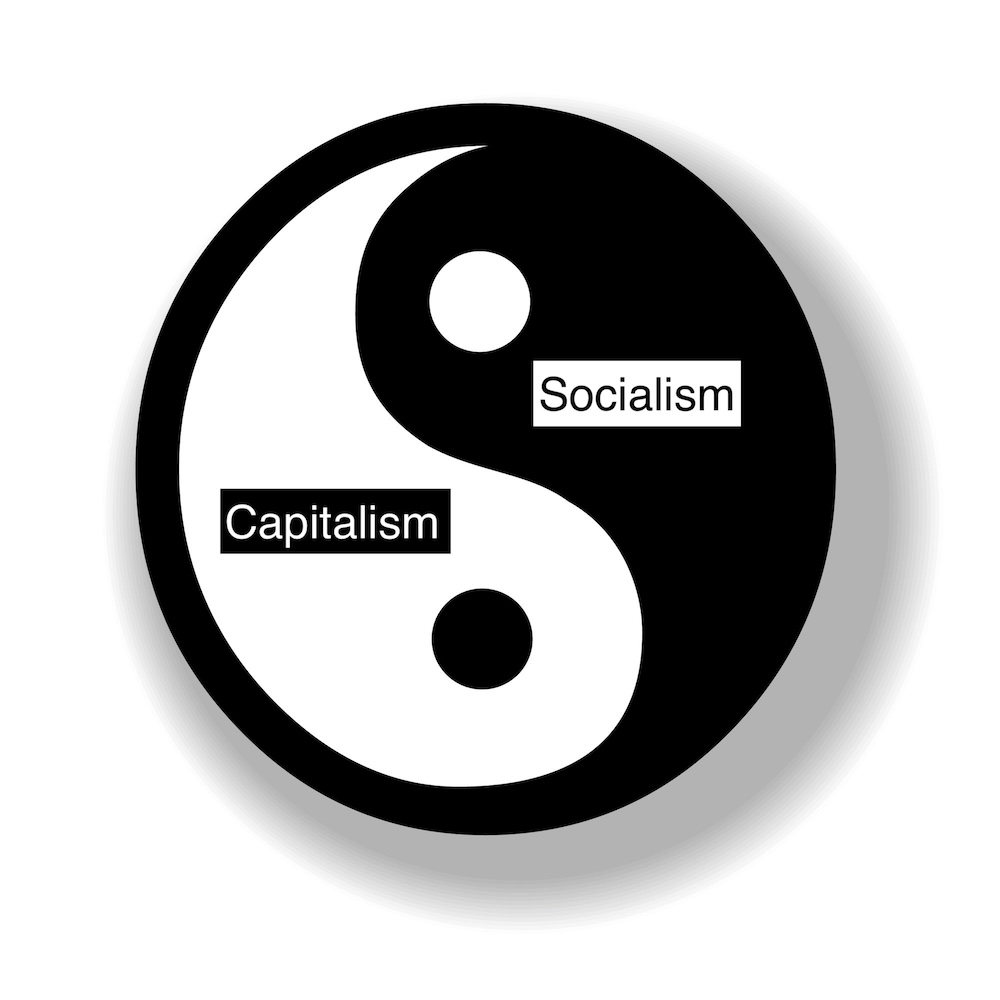
It would be much better if the isms were discarded and we regarded social systems with respect to a private sector and a public sector. As capitalism and socialism they are relegated to the fantasy land of belief systems where people adopt them as sacrosanct absolutes pitting the one against the other.
The isms are a fiction.
So, keeping that in mind, along with the fact that all collectives are formed out of the self-interest of individuals comes a revolutionary vision for a social system.
A vision that includes:
• Eliminating Poverty
• Universal Social and Economic Justice
• Reducing Wealth Inequality
• Removing the Influence of Money in Politics
• Resolving Polarization
Those objectives would be beneficial to everyone.
And contrary to popular opinion they are achievable.
Given our current state of affairs, however, you wouldn’t think so.
And you’d be right. Those objectives could never be achieved by any system now in place.
CONFLICTED PARTIES
America is at war with itself. It has become a battlefield between the extreme left and the extreme right. Each side believes that it alone should rule over this land. Each side believes that its ideology is perfection itself.
But as we all know nothing is perfect and any attempts to impose one particular ideology, one-party rule on the United States of America is subversive to our Constitutional Republic. And rather than promoting domestic tranquility and the general welfare called for by our Constitution it promotes a dangerous divisiveness.
The cause of the rampant polarization plaguing our Constitutional Republic is the two party system that was not part of the original vision of America.
Party fanaticism is something George Washington warned us about in his Farewell Address in 1796. He called this fanaticism “spirit of party” and said;
“Let me… warn you in the most solemn manner against the baneful effects of the spirit of party.
“This spirit, unfortunately, is inseparable from our nature, having its root in the strongest passions of the human mind. It exists under different shapes in all governments, more or less stifled, controlled, or repressed; but, in those of the popular form, it is seen in its greatest rankness, and is truly their worst enemy.
“The alternate domination of one faction over another, sharpened by the spirit of revenge, natural to party dissension, which in different ages and countries has perpetrated the most horrid enormities, is itself a frightful despotism. But this leads at length to a more formal and permanent despotism. The disorders and miseries which result gradually incline the minds of men to seek security and repose in the absolute power of an individual; and sooner or later the chief of some prevailing faction, more able or more fortunate than his competitors, turns this disposition to the purposes of his own elevation, on the ruins of public liberty.
“Without looking forward to an extremity of this kind (which nevertheless ought not to be entirely out of sight), the common and continual mischiefs of the spirit of party are sufficient to make it the interest and duty of a wise people to discourage and restrain it.
“It serves always to distract the public councils and enfeeble the public administration. It agitates the community with ill-founded jealousies and false alarms, kindles the animosity of one part against another, foments occasionally riot and insurrection. It opens the door to foreign influence and corruption, which finds a facilitated access to the government itself through the channels of party passions. Thus the policy and the will of one country are subjected to the policy and will of another.
“There is an opinion that parties in free countries are useful checks upon the administration of the government and serve to keep alive the spirit of liberty. This within certain limits is probably true; and in governments of a monarchical cast, patriotism may look with indulgence, if not with favor, upon the spirit of party. But in those of the popular character, in governments purely elective, it is a spirit not to be encouraged. From their natural tendency, it is certain there will always be enough of that spirit for every salutary purpose. And there being constant danger of excess, the effort ought to be by force of public opinion, to mitigate and assuage it. A fire not to be quenched, it demands a uniform vigilance to prevent its bursting into a flame, lest, instead of warming, it should consume.”
The role of government then is not to be a battleground of warring factions. The role of government is to govern in a way that promotes and maintains a cohesive society.
And it is the role of the citizenry, “…by force of public opinion to mitigate and assuage” the spirit of party.
We the people were not meant to be sheeple with respect to one party or the other. The government is supposed to be of, by and for the people not of, by, and for political parties. And it is the role of a free press to be vigilant critics of political parties and politicians to keep them in line, not to be their fanboys.
So, as it is now, the kind of reform that is needed to promote a cohesive and altogether viable society seems infinitely remote under the present system.
We are in desperate need of radical revolutionary change. And it’s not going to come from any of our out-dated puffed-up ideologies that confine everyone into insular incestuous blocs that seek the destruction of the other.
CENTERING THE DEBATE
A society, a social system, requires universal recognition of its fundamental properties in order to generate and sustain a necessary coherence.
If everyone in a given society does not have an organic sense of belonging to the same society as everyone else then that society is a failure.
That does not mean that everyone must be the same or totally equal in every way in order for everyone to be on the same page. It means that inequalities would not be so extreme.
Income and wealth inequality, for instance, would look like a trapezoid rather than a triangle.
So, differences between the wealthiest and the least wealthy would not be so huge and the wealth much less concentrated at the top.
Everyone having an organic sense of belonging to one and the same society does not mean everyone must think the same either.
It means that differences are subsumed under a common ethos that defines the society. Differences are discussed in a civil manner
A particular political party cannot define a society because, of course, no political party is all inclusive.
DEFINING A SOCIETY
No ideology can define a society. Both capitalism and socialism fail as stand-alone societal operating systems. They will always fail in that capacity. If capitalism alone was so wonderful we would not, for example, have needed child labor laws. If communism was so wonderful we would not have had Cubans risking their lives on makeshift sailing vessels to get to the US and more recently 8,000,000 Venezuelans fleeing from the communist rule of Nicolas Maduro.
And it’s plain to see that some of the most successful nation states ever are the western democracies which are all to one degree or another combinations of capitalism and socialism. We think of the Scandinavian countries as socialist but they are, of course, capitalistic as well.
Again, here is the maxim > Socialism (the public sector) needs capitalism (the private sector) to fund its programs and the private sector needs the public sector to provide a viable social system wherein business can thrive.
Conservatism and liberalism keep failing also. Their respective parties are regularly voted in and out office as their shortcomings are continually revealed — to which the chronic swing of the pendulum testifies. These isms, then, fail to correspond to the fullness of the real world. None can ever show itself to be the one and only way.
Political parties and ideologies can offer valid perspectives. But they must be folded into the fabric of society and operate within it like the ingredients of a master chef’s recipe, all contributing to the consistency of the whole.
And that defines a social system.
One that designates associations between all the elements of a society in such a way that they work together as harmoniously as possible as parts of an overall holistic system.
SELF-INTEREST
A society is a collective of individuals who are seeking to satisfy their self-interests.
We all have a self-interest in a collective wherein our self-interest can be realized.
So, the primary self-interest must be to sustain a viable coherent society, a collective, wherein healthful self-interests can flourish.
Simply agreeing to the dynamical relationship of self-interest/collective-interest would remove a lot of unnecessary conflicts in societies today. It would create a mindset that would view the self and the collective synergistically. That is a sensible view that sees self and collective interest working together.
Presently, various elements of society severely compromise the whole society as they self-nominate themselves as exclusively representing it.
Again, no one faction can represent a whole society.
In the US, and elsewhere, rabid ideologues are the order of the day. Both left and right are seduced by the notion of their infallibility. They constitute competing factions, each posturing tyrannical-like — it’s our way or no way.
Left and right in the US are behaving in contradiction to the US Constitution. Their polarizing conduct does not insure domestic tranquility, nor does it promote the general welfare. The parties constitute the very antithesis of what is required to foster a coherent society. Each party tells us that they will make things better for everyone. But even when one party is making things better the positive changes will always be transitory. Especially when they are dependent on one particular leader.
The one party says it should be all about self-interest in the market place, let the market work in its trickle down way. But it’s delusional to think that self-interest alone can create social and economic justice.
Indeed, self-interest alone cannot determine what is actually in one’s self-interest.
Focusing only on self-interest without reference to the collective-interest is what caused the financial crisis of 2008 and brought down Bear Stearns and Lehman Bros. Two giant Wall Street investment banks.
The other party says it’s all about the collective. An overbearing centralized government must be installed to micromanage our lives for us. Tell us what to think, what words to use, what cars to drive, etc. Independent-minded individuals are to be discouraged while those dependent on government largesse are encouraged as the web of government dependency and control is cast wider and wider.
DEFINING A SOCIAL SYSTEM
Both parties think they know what’s best for people and know what people want.
But here’s the thing.
We the people know what we want.
A life.
That’s it.
We all want to have a life. The kind of life that we envision for ourselves.
And that is what a society should be all about -> Providing the wherewithal for people to make a life for themselves. And not just for some people, but for everyone. Social and economic justice for one and all.
There can be no guarantee that everyone would achieve their dream life. Only for the opportunity to pursue it.
That is something that cannot be left to the machinations of the high and mighty.
The powers-that-be can only be relied upon to first and foremost shore up their own advantages.
Social and economic justice, then, must be a given.
Governments cannot be relied on to provide for it.
It must be woven into the very fabric of a social system.
A system where ideologies are Xed out
We might call the system Xism.
First rule of thumb for Xism is universal agreement on the fundamentals of a social system.
Number one fundamental is the dynamic formed by self-interest and collective-interest.
Contrary to popular belief those interests are not diametrically opposed.
As a dynamic they are inseparable.
Self-interest/collective-interest is the basic dynamic of any social system that ever was and ever we will be. It is a dynamic that occurs as a matter of course in the state of nature as well as in our contemporary nation states.
As it is now the self-interest of a powerful few dominates the social landscape everywhere. Whether the power elites are out for themselves or proclaimed do-gooders they thwart the possibility of creating a synergetic symbiosis between the self and the collective. They interfere with the natural confluence of the self/collective-interest dynamic. This is, of course, unavoidable given the structure of social bodies now in place.
The self-interest/collective-interest dynamic is the basic element of a social system.
That is as true now as it was in our primitive existence where a tribe, a collective, was formed from the universal self-interest in survival.
It is the same today. Our interest in survival, in self-preservation, is served by making money. And for the most part making money means having a job. So, through one's self-interest in having a job one becomes part of a business, a collective. As part of that collective one contributes to its ongoing survival by performing a job that promotes the collective’s profitability, survivability. And in return one’s self-interest in survival is satisfied with a paycheck.
So, in serving the collective-interest of a business one's self-interest in making money is provided for, just as serving the collective-interest of a tribe served one's self-interest in survival. And the self-interest/collective-interest dynamic is preserved through time from the prehistoric era to the present day and beyond. And it will always be thus.
So, we go about our daily business completely unaware of the self-interest/collective interest dynamic that is at base responsible for generating a nation's economy as we indulge ourselves in fantasies about either capitalism/self-interest or socialism/collective-interest being able to successfully serve as a standalone operating system for a society.
A society is a collective of individuals and groups of individuals all seeking to satisfy their self-interests.
Self-interest in having a home and a family is realized by being part of the collective of a community and supporting its interests.
The primary self-interest must be to sustain a viable coherent society. A collective, wherein healthful self-interests can flourish.
Simply agreeing to the dynamical relationship of self-interest/collective-interest would remove a lot of unnecessary conflicts in society today. It would create a mindset that would view the self and the collective synergistically .
THE SOCIAL SYSTEM
All this involves money, of course. Everything is about money one way or another.
The role of money must be first and foremost to energize the work that needs to be done to maintain a viable economy and provide all the goods and services that keep it whole. Period.
Also, the idea that - one is worth the money one makes - needs to be overwritten by the idea that - Money Makes One’s Worth Possible.
Which brings us to the next rule of thumb of Xism.
A society, like every other structure in the universe, must be formed from the microcosm.
It is always small elements that form large structures. From the tiny cells of living things, to the 1’s and 0’s of a computer program, to the bricks of a building, to the quantum particles of the universe itself. The microcosm creates the macrocosm.
Individuals create the communities, businesses and governing bodies that form a society.
And every individual must have a real sense of not only belonging to but co-creating the society that one inhabits.
This can only be accomplished in a society formed from the microcosm.
In order to accommodate such a formation the way that money is circulated in social bodies would need to be rearranged. Instead of it starting at the top of the pyramid of wealth and power the circulation of money needs to begin its journey from the base, the grass roots, the microcosm.
So, first and foremost, each and every precinct, town, village, community would have at their disposal whatever resources necessary for their ongoing welfare.
That would secure the foundation of a social body and ensure the overall health and welfare of the entire society in the process.
Each and every locality would sort out who among them would be best qualified to form their local government.
Government would not be for the excessively ambitious seeking wealth, power and their own aggrandizement.
A county government would be designated and formed by representatives from each of its localities.
Basically the whole social body would be made up of a network of autonomous communities forming from within themselves all the political, social and economic organs needed for their own particular situations while at the same time creating out of themselves the larger body politic in which they would all be incorporated.
Communities, then, would function as centers unto themselves with respect to their associations with other communities as well as to the society at large. The communities would form out of themselves a county government made up of elected representatives from each community.
This same process would be repeated at the county terminal with counties networking to form a state apparatus, and so on and so forth for regional and national terminals of government.
So, the microcosm forms the macrocosm congruous to the contours of the microcosm and therefore prevents the macrocosm from becoming something alien to the microcosm.
All government terminals, in real-time communication with one another, could contribute what timely input each had to offer from their particular vantage point in regard to a given situation and decide among themselves how best to handle it.
Generally speaking, it would be incumbent upon localities to resolve their own problems. When this would not be possible, however, the matter would be relegated to the proximate terminal and so on until some satisfactory solution was formulated. Lines of authority would not be altogether fixed but would be commensurate to the value of the input one had to offer in an ongoing process of checks and balances throughout the system.
So, if a problem were irreconcilable at a locality, authority would be given to the proximate terminal to impose a solution. However, if and when the parties involved at the locality agree to abide by a different solution arrived at among themselves, which they found preferable to the one imposed upon them by the county or other government terminal, then the imposed solution could be overturned in favor of the local agreement.
This kind of system would give communities better representation and allow for programs and policies to be as fine-tuned as possible to particular situations.
Through this kind of networking it would be possible to establish an integrated system that forms social bonds that allow for differences. Bonds that define how we are individually oriented, how we fit into the overall scheme and how we can all find ways of making things work in a mostly harmonious manner.
BANKS
A banking system would, of course, play a vital role in maintaining a viable social system.
Banks would not be the commercial enterprises that they are today. They would not be owned by any individual. The banking system would facilitate a thriving economy and act as a conduit for private and public concerns.
Each and every bank would be part of an overall system whose purpose would be to serve the interests of the society as a whole through the servicing of the self-interest of individuals and businesses.
The banking system’s infrastructure would be paid for, as it is now, from the earnings of the banks themselves.
An individual bank would exist as part of the banking system and as an integral part of the social body.
The officers of a bank would serve as guardians of the public trust as well operating as private bankers. They would be subject to review, censure and removal by the public they serve.
Taking a look at how a local community bank would conduct its business within this system will give us an understanding about the whole operation.
A local bank would be the focal point of the community. Business leaders, community leaders and bankers would all get together to assess economic, social and environmental conditions and discuss projects for investment.
They would decide what the private sector would be responsible for and what the public sector would be responsible for.
Now, again, the circulation of money starts at local banks and they would have access to whatever funds necessary at any given time to fulfill the purpose of maintaining a vigorous economy and funding the public sector.
Each and every bank would feel it necessary to conduct themselves in a fiscally responsible manner because keeping the value of money at an optimum level would be in everyone’s interest.
So, whereas a community could depend on sufficient funds in times of need it would also be extremely conscientious about using the funds prudently during those times, and also in times of prosperity.
Control of the banking system would be initiated from localities.
So, just as the various levels of government would be created out of local levels the various levels of the economy would also be created from the microcosm. And the banking system would also be formed in such a manner.
Community banks would form county banks which would form state banks and so on to regional and national banks.
A good image to illustrate this system would be to imagine the whole society afloat on a pool of money.
Individual savings accounts and liquid assets of businesses held in banks would create the money pool. Due to lack of entitlements individuals would have a strong incentive to save. So, a lot of money would be deposited into saving accounts. That money, along with all the liquid assets of every business, including those of banks, would automatically be made available to the collective pool of money.
This pool of money would, in part, substitute for the monies that are now collected through taxation.
Each local bank would have its own pool as would county banks, which would be made up of all of its local pools and so on and so forth.
When funds are allocated to government every bank account, individual and business, would be charged the same percentage so everyone would pay their fair share proportionate to the size of their account.
This would be a one for all and all for one situation where perceptions of injustice would be virtually impossible to insinuate. Neediness could be taken care of immediately at the place of need and everything would be handled by the banking system. So, no extra cost for redistribution would be incurred.
This kind of system would set up a correspondence between the public and private sectors that would be beneficial to both. The private sector would determine what role the public sector would play in order to provide for a smooth running, efficient social system. And the private sector would allocate the necessary funding out of its collective pool of money. The public sector then, freed from concerns about money and how to spend it, could concentrate on the tasks assigned to it.
Comments, questions, suggestions, critiques are all welcomed.
English