

Ali Shah
9.3K posts

Ali Shah
@blackrabbit
i want to be a computer when I grow up
hi Katılım Nisan 2007
1.9K Takip Edilen657 Takipçiler
this balloon is now with $3000 dollars
emily north@north0fnorth
funniest place i’ve ever seen someone lose a balloon
English

This is absolutely shameful. Agents of a federal agency unnecessarily escalating, and then executing a defenseless citizen whose offense appears to be using his cell phone camera. Every person regardless of political affiliation should be denouncing this.
Ryan Grim@ryangrim
Drop Site obtained harrowing footage of the latest killing which appears to be from the perspective of the woman in pink filming from the sidewalk
English
How is this how the federal government is treating citizens and fellow Americans? There’s no rule of law here.
Ryan Grim@ryangrim
Drop Site obtained harrowing footage of the latest killing which appears to be from the perspective of the woman in pink filming from the sidewalk
English
I can’t fathom that JD Vance and the government responded to the killing of a young mother in Minneapolis by a government official as her fault. It really is sad that the state of the government is this way, but even sadder that we are so numb to it that the populace silent.
English
@dwarkesh_sp What about taxing not land but perhaps power generation and make power generation owned by the laborers?
English

I’ve seen a lot of people misunderstand what we’re saying. Our claim is that in a world of full automation, inequality will skyrocket (in favor of capital holders).
People aren't thinking about the galaxies. The relative wealth differences in a thousand years—or a million—will be downstream of who owns the first dyson swarms and space ships. And space colonization isn't bottlenecked by people’s preference for human nannies and waiters.
So even if you can make 10 million dollars a year as a nanny in the post-abundance future, or get a 10 million dollar charity handout, Larry Page’s million cyborg heirs can own a galaxy each.
You might think this is fine! Why is inequality intrinsically bad, especially if absolute prosperity for everyone goes up? Fair enough, but to me quadrillion fold differences in wealth between humans seem hard to justify in a world where AIs are doing all the work anyways - these disparities in wealth are not incentivizing hard work or entrepreneurship or creativity, which is what we use to justify inequality today.
Just to recap, full automation kills the corrective mechanism on runaway capital accumulation - which is that you need labor to actually make productive use of your capital, thus driving up wages.
Some people asked: why assume AGI leads to full automation? Maybe people will still prefer human nannies and waiters. Even if true, we think labor's share of GDP—which has been roughly 2/3 for centuries—would still likely collapse toward zero, massively increasing inequality. Here's why.
It sometimes happens that when machines are only slightly better than humans, people sometimes pay a premium for the human version. But once machines become much better, that preference disappears. When carriages were not much faster than being carried on a litter, the rich sometimes preferred the litter. Now they prefer the car. They might still have a chauffeur—but once self-driving vehicles are allowed to move far faster, human-driven cars may be relegated to a slow lane.
If the economy grows 100x, wages must also grow 100x for labor's share to stay at 2/3. But prices are relative—so this means human labor becomes 100x more expensive compared to AI-produced goods. A human-cooked meal costs 100x what the robot version does. For labor share to hold steady as that ratio grows to 1,000x, then 10,000x, the preference for human-made goods would have to become increasingly fanatical. And there's a second problem: the higher wages rise, the greater the incentive to develop machine substitutes for whatever services humans still provide. The premium on human labor is precisely what incentivizes its own replacement.
Just to clarify a few other things:
- “Piketty’s long run series are disputed.” We spend a long chunk of the essay explaining why Piketty is wrong about the past! But we’re arguing that the assumption he makes (specifically that labor and capital are substitutes) would be true of a world with advanced enough automation. We spend so much time rebutting his claims about the past because the wronger you think he was about the past, the more you think will change once his assumption comes true.
- “A capital tax would lower growth.” Yes, as we point out, capital taxes incentivize consumption now instead of saving and investing for the future, at the margin. But if capital is the only factor of production, then it’s hard to come up with an inequality-capping tax that doesn’t lower growth.
- “Capital can escape, both across time and space. This makes a wealth tax impractical.” We agree! As we say in the essay and in the tweet summary below, it would be really hard to implement Pikkety’s flagship solution (a high and progressive global wealth tax). You could go Georgist and try to tax land, but the natural resource share of income is only 5% and is likely to stay low until we hit “technological maturity” for reasons we explain in the essay. We don’t see any easy ways to avoid (literally) skyrocketing inequality - in fact, that’s what inspired us to write the essay and explain this problem in the first place.
Also, to address a subtext: I think the currently proposed California wealth tax is a very bad idea for many reasons. This essay is about inequality under full automation, not about how California can make its healthcare expenditures more sustainable.
Dwarkesh Patel@dwarkesh_sp
New blog post w @pawtrammell: Capital in the 22nd Century Where we argue that while Piketty was wrong about the past, he’s probably right about the future. Piketty argued that without strong redistribution of wealth, inequality will indefinitely increase. Historically, however, income inequality from capital accumulation has actually been self-correcting. Labor and capital are complements, so if you build up lots of capital, you’ll lower its returns and raise wages (since labor now becomes the bottleneck). But once AI/robotics fully substitute for labor, this correction mechanism breaks. For centuries, the share of GDP that goes to paying wages has been 2/3, and the share of GDP that’s been income from owning stuff has been 1/3. With full automation, capital’s share of GDP goes to 100% (since datacenters and solar panels and the robot factories that build all the above plus more robot factories are all “capital”). And inequality among capital holders will also skyrocket - in favor of larger and more sophisticated investors. A lot of AI wealth is being generated in private markets. You can’t get direct exposure to xAI from your 401k, but the Sultan of Oman can. A cheap house (the main form of wealth for many Americans) is a form of capital almost uniquely ill-suited to taking advantage of a leap in automation: it plays no part in the production, operation, or transportation of computers, robots, data, or energy. Also, international catch-up growth may end. Poor countries historically grew faster by combining their cheap labor with imported capital/know-how. Without labor as a bottleneck, their main value-add disappears. Inequality seems especially hard to justify in this world. So if we don’t want inequality to just keep increasing forever - with the descendants of the most patient and sophisticated of today’s AI investors controlling all the galaxies - what can we do? The obvious place to start is with Piketty’s headline recommendation: highly and progressively tax wealth. This might discourage saving, but it would no longer penalize those who have earned a lot by their hard work and creativity. The wealth - even the investment decisions - will be made by the robots, and they will work just as hard and smart however much we tax their owners. But taxing capital is pointless if people can just shift their future investment to lower tax countries. And since capital stocks could grow really fast (robots building robots and all that), pretty soon tax havens go from marginal outposts to the majority of global GDP. But how do you get global coordination on taxing capital, when the benefits to defecting are so high and so accessible? Full automation will probably lead to ever-increasing inequality. We don’t see an obvious solution to this problem. And we think it’s weird how little thought has gone into what to do about it. Many more thoughts from re-reading Piketty with our AGI hats on at the post in the link below.
English

Gender segregated mosques are actually a modern invention. In Prophet Muhammad’s ﷺ life, men and women prayed side by side.
Women’s sections are patriarchal (not religious) and shouldn’t exist.
But that’s a conversation for another day.
Muslim Girl@muslimgirl
Zohran Mamdani has gone where no male politician has gone before. For the first time, a mayor entered the women’s section of a mosque to speak directly with Muslim women. @ZohranKMamdani
English



There is this weird trend where searching for things literally does not produce the string literal. Mac is one place, but also search on X dot com the everything app
Sergey Nazarov@sergeynazarovx
i just don't understand how this simple search for applications can be broken in macOS
English

The Sun is an enormous, free fusion reactor in the sky. It is super dumb to make tiny fusion reactors on Earth.
Even if you burned 4 Jupiters, the Sun would still round up to 100% of all power that will ever be produced in the solar system!!
Stop wasting money on puny little reactors, unless actively acknowledging that they are just there for your pet science project jfc.
English
Ali Shah retweetledi

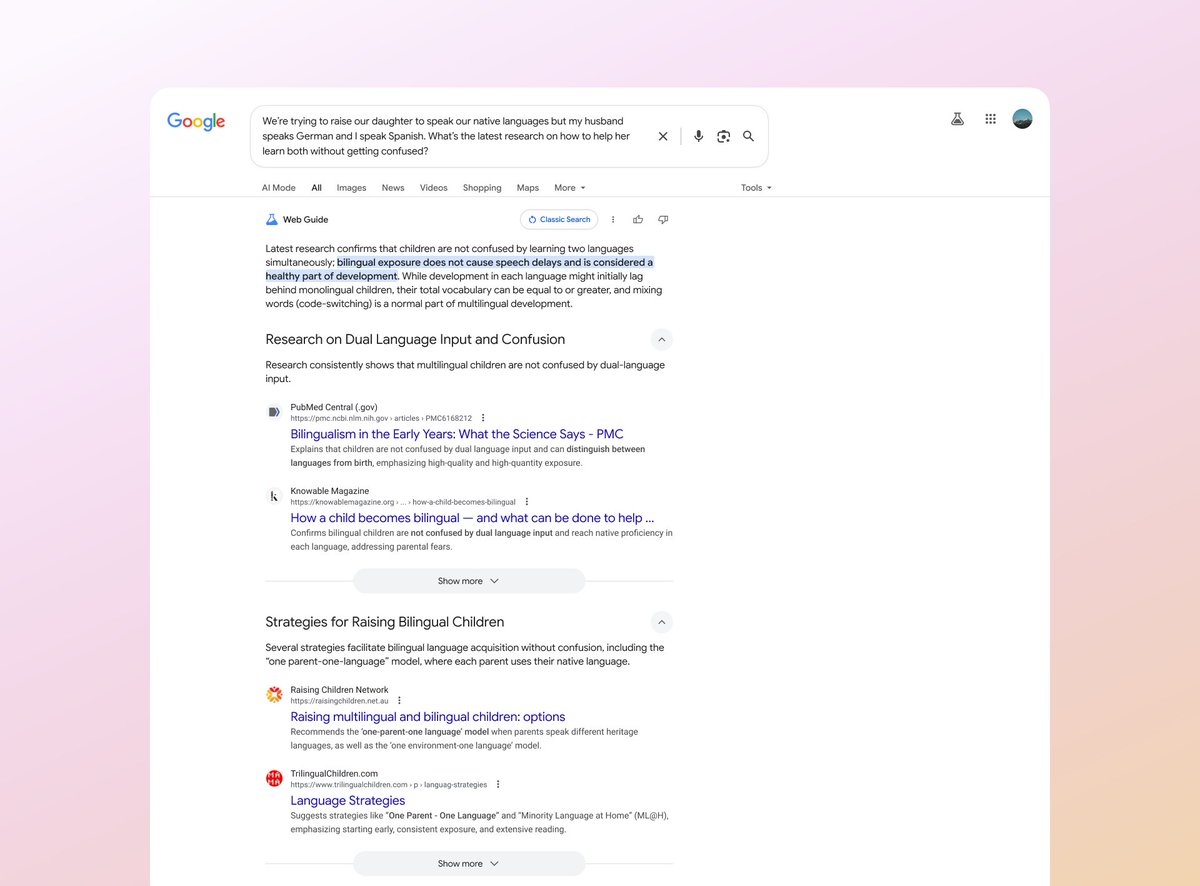
We’re expanding Web Guide from @GoogleLabs, an experimental approach to finding and organizing web links into helpful topic groups.
Especially useful for more complex, open-ended searches, it uses AI to help you discover websites you might not have found before.
English


I’ve been in tech a while now and local top is always when the zany smart guys you know just start quitting their jobs with nothing lined up. I’ve seen more in the past 3 months than the 2 years before it. Plan accordingly.
skooks@skooookum
[day 2 unemployed] direct deposit is the great sedative, the slow euthanasia. it is the drip that turns live players into docile livestock, grazing fat on biweekly illusions. the pacifier that convinces visionaries to trade prophecy for Sweetgreen rewards points.
English

It really is pretty amazing, if you step back and allow yourself to look at it, just how much liberal bias there is in mainstream media sources. You never see some trans or women’s issue qualified as “controversial” in this way. You’d only see opposition to it framed that way.
Liz Wolfe@LizWolfeReason
That controversial belief that's enshrined in our Constitution and that 51% of Americans support
English
Ali Shah retweetledi

Christ. I can’t bear this quote from Hind.
I can’t fucking bear it.

English

Pro tip: If you solve the clock skew problem, most problems in distributed systems become attainable with common sense methods. I’m glad that someone decided to go against the laws of physics and partially solved this problem.
English