Blair Bilodeau

4.1K posts

Blair Bilodeau banner
Blair Bilodeau

Blair Bilodeau

@blairbilodeau

quant

Toronto, Ontario Katılım Ağustos 2011
377 Takip Edilen1K Takipçiler
Blair Bilodeau retweetledi

Justin Trudeau
Justin Trudeau@JustinTrudeau·
You can’t take our country — and you can’t take our game.
English
48.3K
43.9K
370.7K
54.6M
Spencer Frei
Spencer Frei@sfrei_·
Job update: I've joined @GoogleDeepMind as a research scientist! I'll be working from the SF office. Super excited!
English
73
12
1.4K
102.8K
Shai Shalev-Shwartz
Shai Shalev-Shwartz@shai_s_shwartz·
I'm thinking on the sample complexity of learning distributions with the log-loss. I proved something nice based on a property I call "the margin of a distribution", defined as min { p[i] : p[i] > 0 }. I'd appreciate references. Funny anecdote 1/2
English
9
1
45
16K
Blair Bilodeau
Blair Bilodeau@blairbilodeau·
@mraginsky @aryehazan Modern version with covariates: projecteuclid.org/journals/annal… To be minimax for log loss, we must smooth away from the boundary in a way that depends on n. So if you’ve observed zero events, our minimax estimator will still put some small (~1/n) prob on an event happening
English
0
0
3
338
Aryeh Kontorovich
Aryeh Kontorovich@aryehazan·
here's what I find dissatisfying in Taleb's approach as well as the one in the 2 papers mentioned below (Hughes, Zabell). They all attack the same basic fundamental problem: estimating a very small (possibly 0) Bernoulli parameter p from iid draws. A number of differnt smoothing
Aryeh Kontorovich@aryehazan

interesting, and I’ll bookmark the John Hughes paper (link below) for later reading But maximum ignorance probability isn’t always the way. What’s the probability it’ll rain tomorrow? You’ve observed tomorrow 0 times, so frequentism is useless. You need a model. That’s my go-to

English
1
0
2
2.1K
Karl Rohe
Karl Rohe@karlrohe·
1) We need to teach more people statistics 2) We need to teach them "when" and "why". not "how" (i.e. stop the math and the coding) Figuring out a way to do this is a 100x problem. Yet, I've not heard any discussion about it (mea culpa?)
English
19
14
142
30.5K
Blair Bilodeau
Blair Bilodeau@blairbilodeau·
@sp_monte_carlo Mostly, I think >95% of so-called “inference” problems are actually this kind of problem in disguise
English
1
0
1
169
Blair Bilodeau
Blair Bilodeau@blairbilodeau·
@sp_monte_carlo Hot take: these are only used by theorists. Applied stats def to me is “a model, which is a map from data to decisions, is good if applying it to my data gives a good outcome for problem X”. Usually problem X is how best to intervene in a system tomorrow using yesterdays data
English
1
0
7
418
Blair Bilodeau
Blair Bilodeau@blairbilodeau·
@anshulkundaje @natashajaques @PangWeiKoh @_beenkim I agree this sounds like a cool problem that could have a big impact. Right now unfortunately my schedule has no time for a new collab, but I'll let you know if that changes. Also happy to provide any support that I can if you start pursuing it. Thanks for engaging with our work!
English
0
0
1
76
Blair Bilodeau
Blair Bilodeau@blairbilodeau·
@anshulkundaje @natashajaques @PangWeiKoh @_beenkim The class of models you're trying to explain (\mathcal{F} in the paper) is also critical, and has very specific structure for your setting. If we can formalize this structure (I.e., encode it as an assumption), then it may be possible to prove positive results.
English
1
0
1
64
Blair Bilodeau
Blair Bilodeau@blairbilodeau·
@anshulkundaje @natashajaques @PangWeiKoh @_beenkim Baseline is an issue, but it is more than that. I am certain I can reproduce our experiments with DeepLift regardless of baseline (the salient properties that make the experiment work are identical between DeepLift, SHAP, IG, etc).
English
1
0
1
69
Blair Bilodeau
Blair Bilodeau@blairbilodeau·
@anshulkundaje @natashajaques @PangWeiKoh @_beenkim Yes, if you start using multiple baselines and averaging then our theory does not apply (the end task also sounds more global than local in this case). Would be great to prove when such approaches might work, and formalize these methods (AFAIK only heuristic in literature)
English
0
0
1
30
Blair Bilodeau
Blair Bilodeau@blairbilodeau·
@anshulkundaje @natashajaques @PangWeiKoh @_beenkim Thanks, Anshul. It is impossible to say that a method will *never* work, especially if one can finetune the baseline/method after the model/example are fixed. But in the wild, we don't know the right baseline, and can’t tell if the method is failing since ground truth is unknown.
English
2
0
5
388
Blair Bilodeau retweetledi
Natasha Jaques
Natasha Jaques@natashajaques·
Our recent PNAS paper shows that widely used interpretability methods, when used to ask simple counterfactual questions about models like “if I pay down this credit card will my credit score increase?”, are provably no better than random guessing. This is really problematic bc...
Blair Bilodeau@blairbilodeau

Excited to finally share that "Impossibility Theorems for Feature Attribution" is published in PNAS. TL;DR Methods like SHAP and IG can provably fail to beat random guessing. w/ @natashajaques @PangWeiKoh @_beenkim PNAS: pnas.org/doi/10.1073/pn… arXiv: arxiv.org/abs/2212.11870

English
1
6
42
11.8K
Blair Bilodeau retweetledi
Been Kim
Been Kim@_beenkim·
Many previous work of mine and others hinted ‘something fishy’ about saliency-based methods. But we never had a rigorous proof of what we saw. This work “Impossibility Theorems for Feature Attribution", now published in PNAS, to me marks a point of new beginnings.
Been Kim tweet media
Blair Bilodeau@blairbilodeau

Excited to finally share that "Impossibility Theorems for Feature Attribution" is published in PNAS. TL;DR Methods like SHAP and IG can provably fail to beat random guessing. w/ @natashajaques @PangWeiKoh @_beenkim PNAS: pnas.org/doi/10.1073/pn… arXiv: arxiv.org/abs/2212.11870
English
3
46
347
84.4K
Blair Bilodeau
Blair Bilodeau@blairbilodeau·
Where do we go from here? We now know we can't always trust the intuitive conclusions of feature attributions. But we can use hypothesis testing to understand these methods. This opens up a new direction: design methods that reliably test properties of trained models. n/n, n = 6
English
0
1
8
918
Blair Bilodeau
Blair Bilodeau@blairbilodeau·
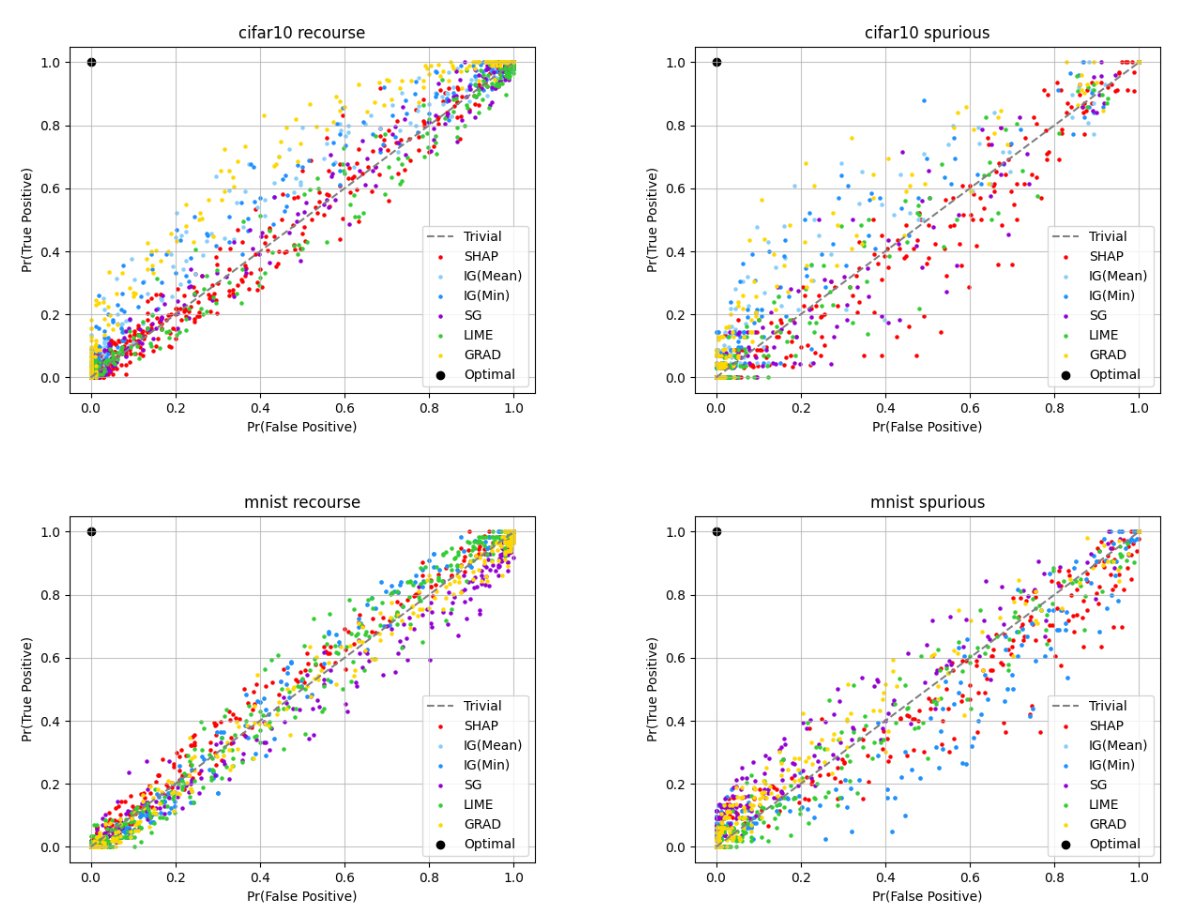
Our theory applies to many models, including neural nets, which we empirically validate. Thm 3.3 is equivalent to saying your ROC curve will be a diagonal, and when we use real methods to conduct hypothesis tests about models trained on ML datasets, that's what we see!
Blair Bilodeau tweet media
English
1
0
5
1.1K