Sandesh Bhat

7.2K posts

Sandesh Bhat banner
Sandesh Bhat

Sandesh Bhat

@blazingbhat

CPD UK NSDC Certified Metabolic Health Coach | Food is medicine & Stock Markets is my alcohol

Mangaluru/Bengaluru Katılım Aralık 2013
1.1K Takip Edilen9.9K Takipçiler
Sandesh Bhat retweetledi
Shashi Iyengar | Metabolic Health India®
With low carb ketogenic diet, sat fat ghee butter and coconut oil around 60g a day .. my Lp(a) dropped from 44 to <25 Many studies have supported the fact that saturated fat lowers Lp(a) Fun fact: Statins increases Lp(a)
Dr Shawn Baker 🥩@SBakerMD

Lp(a) has emerged as a relatively potent driver of residual cardiovascular risk! We are told it is genetic and that a healthy diet cannot effect it! The reality is that several studies show that replacing carbs with saturated fat can and does lower it, sometimes fairly significantly! pmc.ncbi.nlm.nih.gov/articles/PMC78…

English
1
6
27
2.2K
Sandesh Bhat retweetledi
Chris Palmer, MD
Chris Palmer, MD@ChrisPalmerMD·
In this small pilot trial, 10 Indian children with autism were found to have differences in metabolic biomarkers compared to neurotypical children that partially normalized with a ketogenic diet. Some of their symptoms of autism also improved with the ketogenic diet.
J P Fanton@HealthyFellow

Plasma metabolomic signatures in children with autism spectrum disorder and their modulation following a gluten-free modified ketogenic diet Attn: ⁦@ChrisPalmerMD⁩ ⁦@Metabolic_Mindlink.springer.com/article/10.118…

English
5
27
172
24.2K
Sandesh Bhat retweetledi
Dr David Unwin
Dr David Unwin@lowcarbGP·
I am often asked if someone following a vegetarian diet can achieve drug free T2 diabetes remission Here is a published case report TEN YEARS !! 🤩
Shashi Iyengar | Metabolic Health India®@shashiiyengar

🚨 Just Released: 10 Years of T2D Remission! 🚨 It is now part of the scientific record. The study documents medication-free remission over a decade, achieved using a low-carbohydrate, lacto-ovo vegetarian diet, with systematic long-term safety evaluation. To our knowledge, this is the first such study conducted globally. What makes this work unique is not just remission, but rigour and duration. For most of this period (approximately 70-75%), I followed a ketogenic diet; during the remaining time, I followed a low-carbohydrate diet with carbohydrate intake below 100 g/day. This is a prospective N-of-1 longitudinal study, followed for a full decade, with repeated assessments across multiple domains: •Glycaemic control (HbA1c, fasting glucose, CGM) 🩸 •Insulin dynamics 🧬 •Advanced lipids including ApoB and Lipoprotein(a) •Inflammatory markers 🔥 •Liver and renal function (including cystatin-C) •Serial coronary artery calcium scans 🫀 •CT coronary angiography 🫀 •Carotid imaging (CIMT) •Bone mineral density (DEXA) 🦴 •Detailed ophthalmic imaging 👁️ Starting Hba1c was 7.2%. FBS 152 & PPBS 253 mg/dl. Achieved remission in the 4th month with Hba1c of 5.2% Over 10 years: •HbA1c, FBS & PPBS remained consistently in the non-diabetic range •Average Hba1c was 5 in 10 years. (4.7 to 5.3) •Average LDL and ApoB remained higher than recommended, but stable •No microvascular complications •No macrovascular disease •No deterioration in renal, skeletal, or ophthalmic health This was achieved without diabetes medication. Importantly, this is an Indian study. The dietary pattern was: •Low carbohydrate •Lacto-ovo vegetarian •Culturally adapted •Sustained for 10 years in a South Asian individual with the MONW (Metabolically Obese Normal Weight) phenotype This directly addresses a major gap in the literature: the absence of long-term, real-world safety data for low-carbohydrate approaches in South Asian, predominantly vegetarian populations. It demonstrates that: •Long-term remission is possible •Sustainability over a decade is possible •Comprehensive safety monitoring is feasible •Replication at larger scale is testable The intent of this work is not to prescribe, but to inform, challenge existing assumptions, and invite replication. As an N-of-1 longitudinal study, these findings are not generalizable by design. They are hypothesis-generating and intended to inform larger, prospective cohorts. India carries one of the highest diabetes burdens globally. Evidence addressing sustainability must emerge from within this context. This study is now part of the scientific record. Big thanks to Dr Jasmeet Phd @jasmeet481, whose relentless effort and scientific rigour made this study possible. She invested enormous time and care in shaping the manuscript and strengthening it to publication standard. Grateful to my guru, Anup Singh, who introduced me to low-carb nutrition in 2015 at the time of my Type 2 diabetes diagnosis. His guidance laid the foundation for my 10-year low-carb journey. Thank you to Arun Kumar who helped me when I was newly diagnosed. Big Thanks to the 3 doctors who were part of my 10 years journey & are the co-authors also. Dr Sharat Kolke MD (Med) - Physician - Criticare Asia Hosp. - Mumbai Dr Mihir Raut - MD - Diabetologist - Nanavati Max Hosp - Mumbai Dr R K Singh MD DM (Interventional Cardiologist) - Gandhi Medical College - Bhopal frontiersin.org/journals/nutri…

English
8
36
112
11.4K
Sandesh Bhat retweetledi
ARUN KUMAR
ARUN KUMAR@arunkumar3112·
Magnesium is required to convert vitamin D into its active form, calcitriol. Without adequate magnesium vitamin D remains functionally inactive. Vitamin D increases calcium absorption from the gut. Vitamin K2 directs that calcium into bones and teeth and away from soft tissues, like arteries. Without adequate vitamin K2 higher vitamin D driven calcium absorption can increase the risk of ectopic calcification, not stronger bones.
English
16
58
434
30.2K
Derrick Evans
Derrick Evans@DerrickEvans4WV·
This is one of the craziest things I’ve ever heard. This doctor says a patient was needing to be intubated from COVID-19. Instead they took him outside in the sun light. They did this for 5 days and discharged the patient home without oxygen. This is amazing…
English
83
875
3.5K
70.6K
Sandesh Bhat retweetledi
Sama Hoole
Sama Hoole@SamaHoole·
The average Indian diet is: - High in carbs (rice, chapati, bread) - Cooked in seed oils (sunflower, soybean) - Low in animal protein - Rich in legumes and vegetables This is basically what Western nutritionists recommend. India's diabetes rate has tripled in 30 years. Maybe the advice isn't working.
English
366
420
5.8K
428.3K
Sandesh Bhat retweetledi
Shashi Iyengar | Metabolic Health India®
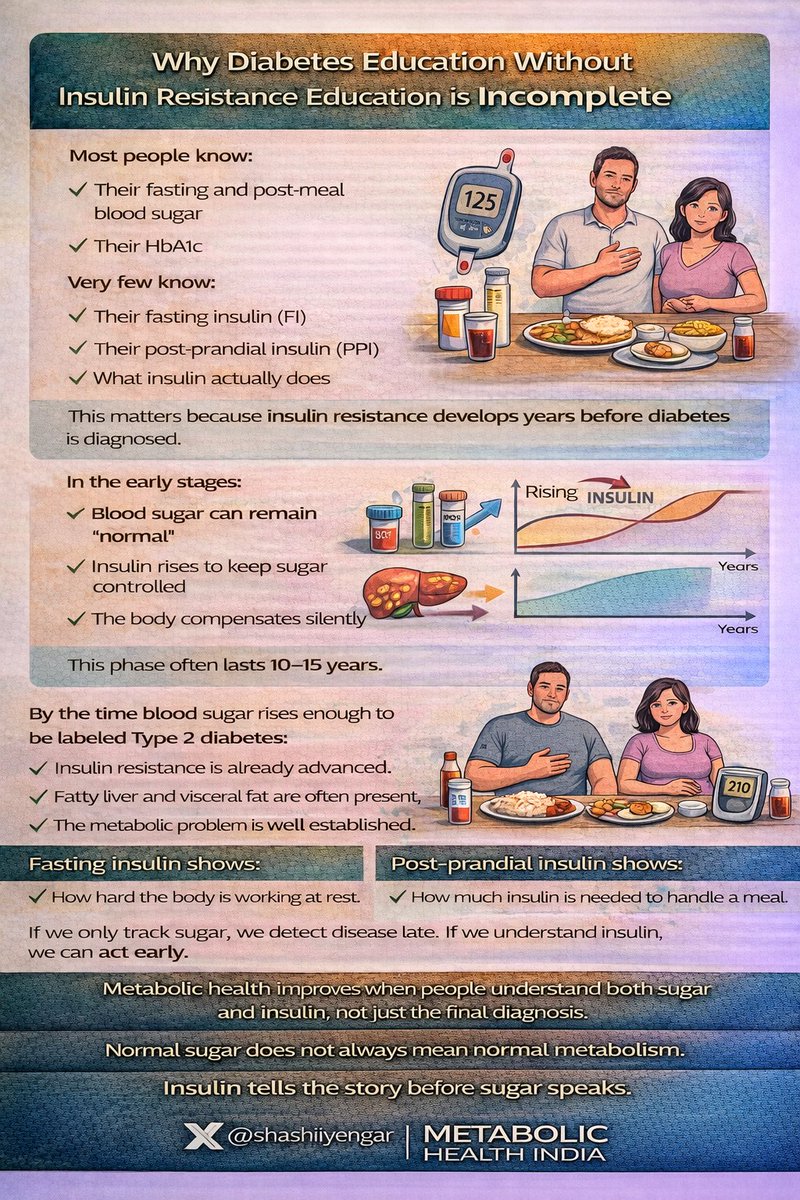
Why Diabetes Education Without Insulin Resistance Education Is Incomplete Most people know: Their fasting and post-meal blood sugar Their HbA1c Very few know: Their fasting insulin (FI) Their post-prandial insulin (PPI) What insulin actually does? Why insulin stays high long before sugar rises? This matters because insulin resistance develops years before diabetes is diagnosed. In the early stages: Blood sugar can remain “normal” Insulin rises to keep sugar controlled The body compensates silently This phase often lasts 10–15 years. By the time blood sugar rises enough to be labeled Type 2 diabetes: Insulin resistance is already advanced Fatty liver and visceral fat are often present The metabolic problem is well established Fasting insulin shows: How hard the body is working at rest Post-prandial insulin shows: How much insulin is needed to handle a meal High insulin with normal sugar is not normal. It is a warning sign. If we only track sugar, we detect disease late. If we understand insulin, we can act early. Knowledge gap leads to delayed action. Delayed action becomes a treatment gap. Metabolic health improves when people understand both sugar and insulin, not just the final diagnosis. Please follow these only if you are keen to understand and prevent the development of diabetes. Else just scroll through. -Metabolic Health India
Shashi Iyengar | Metabolic Health India® tweet media
English
3
28
82
4.5K
Sandesh Bhat retweetledi
Dr. Jasmeet Kaur (PhD)
Dr. Jasmeet Kaur (PhD)@jasmeet481·
If insulin resistance is not the same in everyone, can the treatment really be the same for all? Insulin resistance does not arise from a single tissue, a single pathway, or a single cause. It can originate in the liver, muscle, or adipose tissue. It can be driven by inactivity, stress hormones, illness, sleep loss, aging, or excess fuel. Yet it is often approached as one uniform condition with one uniform protocol. Calling all of this “one disease” oversimplifies human physiology. Insulin resistance is tissue-specific, stage-specific, and context-dependent. Two people can have the same HbA1c and completely different underlying biology. This is why lab numbers alone don’t tell the full story. And why blanket explanations often miss the mark. When biology is heterogeneous, standardization has limits. Personalization isn’t a trend or something fancy, it’s actually a physiological necessity.
Dr. Jasmeet Kaur (PhD) tweet media
English
4
27
99
6.5K
Sandesh Bhat retweetledi
Sandesh Bhat
Sandesh Bhat@blazingbhat·
"Fasting glucose is the final exam in metabolic healing" Learning this hard while working with a long term diabetic. @shashiiyengar
English
1
1
5
1.5K
Sandesh Bhat retweetledi
Dr. Jasmeet Kaur (PhD)
Dr. Jasmeet Kaur (PhD)@jasmeet481·
Protein triggers insulin. Yes, and that is exactly how normal physiology works. If protein did not trigger insulin, much of it would be treated as excess fuel and diverted toward glucose production. Insulin is the hormone that tells the body what to do with incoming fuel. It is not just a storage hormone. It is a traffic controller. Without insulin: • Amino acids cannot enter muscle efficiently • Protein cannot be used for repair and rebuilding • The liver continues releasing glucose unchecked This is why even Type 1 diabetics require insulin with a pure protein meal. Not to manage dietary glucose, but to suppress hepatic glucose output. Without insulin, blood glucose remains elevated for longer due to ongoing liver glucose release. Protein-induced insulin is physiological, not harmful Protein-triggered insulin: • Occurs with low glucose • Is moderate and short-lived • Directs amino acids into muscle • Suppresses unnecessary liver glucose release • Prevents excessive conversion of protein to glucose This is normal physiology, not pathology. Excess protein intake is largely self-limiting Protein has the strongest satiety signal of all macronutrients. In real-life conditions, chronic overconsumption of protein is not possible. What is dangerous is chronic elevation of insulin above physiological levels. So is chronic elevation of blood glucose. That combination: • Drives insulin resistance • Promotes fatty liver and visceral obesity • Accelerates Type 2 diabetes, PCOS, and cardiovascular disease Insulin is essential. Glucose is a normal fuel. Chronic elevation of either is pathological. The goal is not to suppress insulin. The goal is metabolic regulation, not metabolic fear. Insulin used for repair and regulation is not the same as insulin used to clean up dietary damage.
Shashi Iyengar | Metabolic Health India®@shashiiyengar

“Protein triggers insulin.” Context matters. Biology matters. Let’s stop treating all insulin spikes as equal. 1. Insulin response: carbohydrates vs protein vs fat Carbohydrates (especially refined carbohydrates): a) Large glucose spike b) Large insulin spike c) Insulin often stays elevated for longer This is the insulin pattern to fear. Protein: a) Minimal glucose rise b) Moderate, short-lived insulin rise c) Insulin is required to transport amino acids into muscle d) Supports muscle protein synthesis and repair This is physiological insulin, not pathological. Fat: a) Minimal glucose rise b) Minimal insulin response c) Primarily an energy source, not anabolic 2. Acute insulin spike after protein is NOT harmful Protein-induced insulin: a) Occurs with low glucose b) Is short-lived c) Is essential for amino acid uptake and muscle preservation If protein did not stimulate insulin, muscle building and repair would not occur. Insulin without glucose toxicity is not the enemy. 3. What we should actually fear: chronically high basal insulin The real danger is: a) Chronic intake of refined carbohydrates and sugars b) Combined with industrial seed oils c) Leading to persistently elevated fasting (basal) insulin d) High basal insulin is primarily driven by chronic energy surplus (energy toxicity), especially when excess energy comes from refined carbohydrates and ultra-processed foods. This pattern drives: Type 2 diabetes Fatty liver (NAFLD) Visceral obesity PCOS Cardiovascular disease This is hyperinsulinemia, not a normal post-meal insulin rise. Also compare 2-hour post-meal insulin levels after a high-protein meal versus a high-carbohydrate meal. You’ll get your answer. 4. India is a protein-deficient nation with a metabolic disease crisis India has: a) Low protein intake b) High refined grain intake c) A high burden of Type 2 diabetes, CVD, NAFLD, and PCOS Blaming protein for insulin resistance in this context is misplaced. 5. “Overconsumption of protein” is largely a myth Protein has a strong satiety signal. You can easily eat: ½ kg of cake But try eating: ½ kg of paneer You will find it challenging. Protein self-limits intake. Refined carbohydrates do not. 6. “Animal protein causes diabetes” - weak evidence, wrong conclusions Claims linking animal protein to Type 2 diabetes are largely based on: FFQ-based observational studies Heavily confounded by: Processed meats Seed oils Refined breads and buns Ultra-processed food patterns There is no strong interventional evidence showing that unprocessed animal protein, when eaten in place of refined carbohydrates, causes diabetes. Correlation ≠ causation. 7. The correct public-health message for India a) Cut refined and ultra-processed carbohydrates b) Avoid industrial seed oils c) Ensure adequate (not extreme) protein intake d) Emphasize whole foods e) Increase vegetables for micronutrients f) Build muscle through resistance training Fear chronic insulin elevation from refined carbs and ultra-processed foods. Do not fear a normal, short-lived insulin rise after protein. Insulin used for repair is not the same as insulin used to clean up dietary damage. My story: I was a vegetarian until I was diagnosed with Type 2 diabetes 10 years ago. I then shifted to a lacto-ovo-vegetarian diet and have been in diabetes remission for the last 10 years, backed by robust longitudinal data. My data includes: a) HbA1c b) Fasting and post-prandial blood sugars Fasting insulin c) Lipid and other labs d) Safety markers such as CT coronary angiography, CIMT, ophthalmic exams, dental health, and DEXA scans Animal-source proteins consistently help lower blood glucose levels. If anyone doubts this, try a simple self-experiment: Eat 2 idlis and check your blood glucose On another day, eat 2 eggs and check your blood glucose Compare the results and draw your own conclusion. As a large public account, there is a responsibility to share accurate, evidence-based information, because what you post can easily mislead many. Hope this clarifies the issue. h/t @junoesque @thenishachar

English
4
19
106
11.9K
Sandesh Bhat retweetledi
Shashi Iyengar | Metabolic Health India®
“Protein triggers insulin.” Context matters. Biology matters. Let’s stop treating all insulin spikes as equal. 1. Insulin response: carbohydrates vs protein vs fat Carbohydrates (especially refined carbohydrates): a) Large glucose spike b) Large insulin spike c) Insulin often stays elevated for longer This is the insulin pattern to fear. Protein: a) Minimal glucose rise b) Moderate, short-lived insulin rise c) Insulin is required to transport amino acids into muscle d) Supports muscle protein synthesis and repair This is physiological insulin, not pathological. Fat: a) Minimal glucose rise b) Minimal insulin response c) Primarily an energy source, not anabolic 2. Acute insulin spike after protein is NOT harmful Protein-induced insulin: a) Occurs with low glucose b) Is short-lived c) Is essential for amino acid uptake and muscle preservation If protein did not stimulate insulin, muscle building and repair would not occur. Insulin without glucose toxicity is not the enemy. 3. What we should actually fear: chronically high basal insulin The real danger is: a) Chronic intake of refined carbohydrates and sugars b) Combined with industrial seed oils c) Leading to persistently elevated fasting (basal) insulin d) High basal insulin is primarily driven by chronic energy surplus (energy toxicity), especially when excess energy comes from refined carbohydrates and ultra-processed foods. This pattern drives: Type 2 diabetes Fatty liver (NAFLD) Visceral obesity PCOS Cardiovascular disease This is hyperinsulinemia, not a normal post-meal insulin rise. Also compare 2-hour post-meal insulin levels after a high-protein meal versus a high-carbohydrate meal. You’ll get your answer. 4. India is a protein-deficient nation with a metabolic disease crisis India has: a) Low protein intake b) High refined grain intake c) A high burden of Type 2 diabetes, CVD, NAFLD, and PCOS Blaming protein for insulin resistance in this context is misplaced. 5. “Overconsumption of protein” is largely a myth Protein has a strong satiety signal. You can easily eat: ½ kg of cake But try eating: ½ kg of paneer You will find it challenging. Protein self-limits intake. Refined carbohydrates do not. 6. “Animal protein causes diabetes” - weak evidence, wrong conclusions Claims linking animal protein to Type 2 diabetes are largely based on: FFQ-based observational studies Heavily confounded by: Processed meats Seed oils Refined breads and buns Ultra-processed food patterns There is no strong interventional evidence showing that unprocessed animal protein, when eaten in place of refined carbohydrates, causes diabetes. Correlation ≠ causation. 7. The correct public-health message for India a) Cut refined and ultra-processed carbohydrates b) Avoid industrial seed oils c) Ensure adequate (not extreme) protein intake d) Emphasize whole foods e) Increase vegetables for micronutrients f) Build muscle through resistance training Fear chronic insulin elevation from refined carbs and ultra-processed foods. Do not fear a normal, short-lived insulin rise after protein. Insulin used for repair is not the same as insulin used to clean up dietary damage. My story: I was a vegetarian until I was diagnosed with Type 2 diabetes 10 years ago. I then shifted to a lacto-ovo-vegetarian diet and have been in diabetes remission for the last 10 years, backed by robust longitudinal data. My data includes: a) HbA1c b) Fasting and post-prandial blood sugars Fasting insulin c) Lipid and other labs d) Safety markers such as CT coronary angiography, CIMT, ophthalmic exams, dental health, and DEXA scans Animal-source proteins consistently help lower blood glucose levels. If anyone doubts this, try a simple self-experiment: Eat 2 idlis and check your blood glucose On another day, eat 2 eggs and check your blood glucose Compare the results and draw your own conclusion. As a large public account, there is a responsibility to share accurate, evidence-based information, because what you post can easily mislead many. Hope this clarifies the issue. h/t @junoesque @thenishachar
Aravind@aravind

Protein triggers insulin. Who will tell this to the protein propaganda bros in India promoting over-consumption of protein to an Indian population genetically pre-disposed for insulin resistance, and also causing a unnecessary demand spiking protein prices (like eggs and milk) risking the public health of already protein deficient poor people among us? Eat unnecessary amount of proteins now and, as an Indian, you may end up with diabetes later. So always better to moderate consumption of all nutrition - cut on refined, processed carbs, take only required lean protein for your health needs, increase fiber, vitamins, and minerals by eating more vegetables. And most importantly, don't fall for health fads from foreign lands parroted by colonized minds telling you "our food is bad, our ghee is bad, our coconut oil is bad, our breakfast is bad so follow this new fad" etc just like that. Think for yourself before going for any fad.

English
21
79
371
43.9K
Sandesh Bhat retweetledi
Shashi Iyengar | Metabolic Health India®
Bookmark & share this. Very improtant for India. Meal Sequencing Matters in Type 2 diabetes (Glucose & Insulin levels measured) What you eat matters. But the order you eat it matters too. A simple rule that works consistently: Protein + fats first Vegetables / fibre next Carbohydrates last (if any) Why this works Eating protein and fats first: •Slows gastric emptying •Blunts post-meal glucose spikes •Reduces insulin response •Improves satiety •Lowers overall glucose exposure When carbs are eaten last, their impact on blood sugar is significantly reduced. Same food. Different order. Different metabolic response. This works for type 2 diabetes In the study given below its found that isocaloric meals same carbs and proteins produced different results with blood sugar & serum insulin when food sequencing was changed. What changed? • Post-meal glucose fell by ~30–37% at 30–60 minutes • Total glucose exposure (iAUC) fell by ~73% • Post-meal insulin levels were significantly lower • Total insulin exposure dropped by ~48% Same food. Less glucose spike. Less insulin needed. Reference: Shukla AP et al. “Food order has a significant impact on postprandial glucose and insulin levels.” Diabetes Care. 2015. PMID: 26106234
English
8
27
104
13.2K
Dumeelkuppam vavaalu 🦇
Dumeelkuppam vavaalu 🦇@SureshA91437137·
@joker_talks @shashiiyengar I had anti tpo positive, and I'm on thyroxine for almost an year it reduced to 1 and I stopped taking and increased back.. My question was is my cholestrol because of my hypothyroidism
English
1
0
1
43
Shashi Iyengar | Metabolic Health India®
If you still rely only on HbA1c, FBS, and PPBS to assess diabetes risk, you’re looking too late. These markers rise after years of metabolic damage. The earliest abnormality is insulin resistance, long before blood sugar becomes abnormal. Measuring post-prandial insulin reveals this early. As Dr Joseph Kraft showed, people can have normal glucose but abnormal insulin responses, which he called “diabetes in situ.” This allows the prediction of Type 2 diabetes 10–15 years before diagnosis. Practical targets to know: Fasting insulin: ≤ 6 µIU/mL HOMA-IR1 : < 1.9 Postprandial insulin (2 hrs): ≤ 30 µIU/mL TG/HDL ratio: < 1.9 Glucose shows the problem late. Insulin shows it early.
English
14
149
615
79.7K
Sandesh Bhat
Sandesh Bhat@blazingbhat·
@SureshA91437137 Hypothyroidism is in most cases secondary to something else. Also check for Vitamin D B12 Iron and Ferritin hypocalorie diets Lack of bioavailable protein in diet Gut/gallbladder issues Thyroid Antibodies (Hashimotos) and in very few cases Heavy metals toxicity Mold infections
Dumeelkuppam vavaalu 🦇@SureshA91437137

@shashiiyengar Hey doc, My tsh is 9 and I'm currently prescribed from 50mcg from 37.5 27 yrs old, 58kg weight. Fasting insulin 4.31, HOMa ir - 1.0, TG:HDL - 4.5 My endo said my tsh is impacting my cholestrol, tg, LDL etc. What do you suggest I do?

English
1
0
2
244
Sandesh Bhat retweetledi
Shashi Iyengar | Metabolic Health India®
South Asian ASCVD risk is real - but saturated fat is being wrongly scapegoated @P_McCulloughMD The ACC/NLA scientific statement correctly highlights that South Asians (SAUS) experience: •earlier and more aggressive ASCVD •higher diabetes prevalence •higher Lp(a) •unhealthy lifestyle patterns However, the dietary conclusions drawn may be incomplete and misleading. 1. The ACC study itself lists refined carbs & sweets FIRST - not ghee The highlighted paragraph states that unhealthy dietary patterns in South Asians include: •fried foods (reused multiple times rancid oxidised) •snacks rich in refined carbohydrates •sweets (mithai, jalebi, gulab jamun) (sugars) •and foods high in saturated fats (ghee, coconut oil, paneer) This is important: Refined carbohydrates, sugar, and deep-fried foods are named as dominant contributors and consumed pan india. Saturated fat is mentioned later, without quantification, and without regional or intake context. This is not evidence that saturated fat is the primary driver of ASCVD risk in Indians. 2. Ghee, paneer, and coconut oil are NOT universally consumed across India The statement treats “Indian diet” as homogeneous. It is not. •Coconut oil – predominantly used in Kerala and limited southern coastal regions •Paneer - mainly a North Indian, urban, higher-income food •Ghee is expensive, used sparingly today, especially among middle- and lower-income groups In contrast: •Refined seed oils •Ultra-processed snacks •Deep-fried foods •Sugar-rich sweets are pan-Indian, inexpensive, and heavily consumed. Blaming ghee/paneer for a national ASCVD epidemic lacks dietary realism. 3. Red meat consumption in India is among the lowest globally, and is largely confined to specific regions and communities; therefore, it cannot plausibly explain the nationwide excess ASCVD burden observed among Asian Indians. 4. The Malhotra Indian Railways study contradicts the saturated fat narrative (PMID: 6023727) The Indian Railways cohort study (Malhotra et al.) showed: •North Indian railway workers ohigher intake of dairy fat (ghee, butter) olower coronary heart disease rates •South Indian railway workers ohigher intake of seed oils ohigher CHD rates Despite similar physical activity and socioeconomic status. This directly contradicts the idea that dairy-saturated fat explains higher Indian ASCVD risk. 5. PURE study: Dairy fat is not associated with higher CVD risk The PURE study (Prospective Urban Rural Epidemiology) – which included large South Asian cohorts – found: •Higher whole-fat dairy intake associated with: olower total mortality olower stroke risk •No increase in cardiovascular events with dairy fat This aligns with multiple meta-analyses showing: •Dairy fat behaves differently from processed meat •Food matrix matters more than isolated “saturated fat grams” The ACC statement does not engage with this data. 6. The real Indian dietary driver: carbohydrates + insulin resistance The ICMR-INDIAB study shows: •Indians consume >60–65% of calories from carbohydrates •High intake of: orefined grains opolished rice owheat-based processed foods osugars (They missed tracking seed oil intake) India simultaneously leads in: •Type 2 diabetes •Visceral adiposity •NAFLD •Hypertriglyceridemia •Low HDL •High TG/HDL ratio These are hallmarks of carbohydrate + seed oil -driven insulin resistance, not dairy fat excess. ASCVD risk in Indians should be assessed by insulin resistance, not ghee consumption. 6. Lp(a) is genetic - not caused by ghee or paneer The ACC statement correctly notes higher Lp(a) in South Asians. But: •Lp(a) is genetically determined •Blaming saturated fat for Lp(a)-driven risk is biologically incorrect 7. What the evidence actually supports (India-specific) For South Asians at high ASCVD risk, evidence supports: •Eliminating industrial seed oils & trans fats •Reducing refined carbohydrates and sugar •Addressing insulin resistance early •Measuring and targeting hyperinsulinemia, fatty liver & TG/HDL •Avoiding replacement of fat with refined carbs A blanket “saturated fat is unnecessary” stance risks worsening metabolic disease in India. @DIY_Tardis @ProfTimNoakes
Peter A. McCullough, MD, MPH®@P_McCulloughMD

Asian Indians Have Some of The Highest Rates of ASCVD in the World For that reason saturated fats are unnecessary and cannot be supported by me as a cardiologist in any new food pyramid, particular among Asian Indians at risk for heart attack and stroke. In the Asian Indian diet, the consumption of saturated animal fats—primarily from full-fat dairy (ghee, butter, paneer) and red meats—presents several distinct dangers for coronary heart disease (CHD) due to unique metabolic predispositions in this population. @American_Heart @theindianheart @MartyMakary

English
4
9
26
3.8K
Michael Morelli
Michael Morelli@morellifit·
Here’s the Hollywood peptide stack celebrities use to get shredded and camera-ready in just 6 weeks. Watch till the end (Then comment “EBOOK” and I’ll send you the peptide guide I use that goes into detail on how they work.): *Must follow to receive the DM.* (For educational purposes only. Not medical advice or endorsement of human use.)
English
529
140
1.3K
85.4K