
Sabitlenmiş Tweet
baldwin
19.9K posts

baldwin retweetledi

This is what every birthday after 23 is like
☥𝑩𝑳𝑽𝑪𝑲𝑮𝑶𝑳𝑫†@0laribiwa
While filming Game of Thrones Season 2, Nikolaj Coster-Waldau spent his birthday chained up in the cold as Jaime Lannister. The crew surprised him with a small cake mid shoot… and he celebrated it right there, still in character..
English
@Waaq__13__X__18 @elonmusk He’s not missing or ignoring it; he’s choosing the other side.
English

Elon, here's what you're missing or ignoring.
You call South Africa's DEI and Black Economic Empowerment laws "extremely racist." But you leave out a few critical facts.
1. Apartheid wasn't a neutral policy it was state-enforced racism.
For decades, the white minority (including your family) controlled over 80% of the land and nearly all the wealth. Black South Africans were forcibly removed from their homes, denied citizenship in their own country, and exploited for cheap labor. That's not ancient history it ended just 30 years ago.
2. Your own family directly benefited from that system.
You were born in Pretoria in 1971, at the height of apartheid. Your father, Errol Musk, has openly said apartheid was not racist and that Black people "shouldn't complain because they were fed." He has never condemned the regime he admired it.
3. Your grandfather, Joshua Haldeman, was a pro-Nazi activist.
He was arrested in Canada for supporting Hitler, then moved the family to South Africa precisely because apartheid offered a place where his racial ideology was welcomed. That's not speculation it's documented history.
4. Corrective policies like BEE are not "anti-white."
They are a modest attempt to return a fraction of what was stolen. Even today, white South Africans about 7-8% of the population still own the majority of private farmland and control most of the economy. Without these adjustments, the Black majority would be permanently locked out of their own land.
5. Here's the irony you refuse to see.
In a Black-majority country like South Africa, real DEI principles would actually protect the white minority from being overrun by majority rule. By calling these laws "racist" and pushing to remove them, you are arguing for a system where the Black majority could claim everything land, economy, rights with no guardrails.
That would be far more dangerous for white South Africans than BEE ever will be.
You left South Africa, became an American citizen, and now you lecture South Africans on fairness while your family's legacy is soaked in the very racism you claim to oppose.
If you truly believe in equal treatment for all races, start by acknowledging the history that made these laws necessary. And maybe have a conversation with your father about why he still defends apartheid.

English

baldwin retweetledi

@elonmusk @SivuMtumezi Equality sounds like oppression to those who benefited from inequality
English
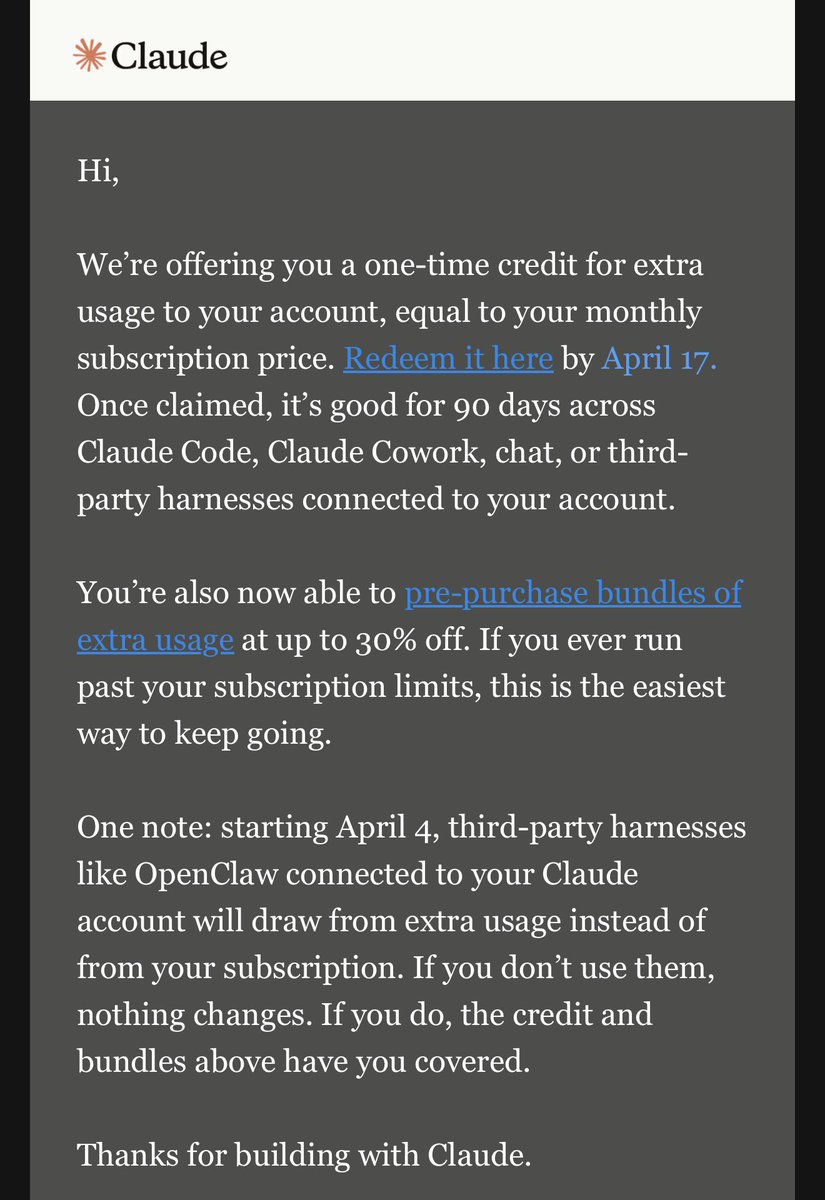
Anthropic just told third-party Claude users they’re no longer covered by their subscription. Effective yesterday.
The framing is soft. The reality isn’t. If you use OpenClaw or any third-party harness with your Claude login, you now pay twice: subscription plus pay-as-you-go, billed separately.
The stated reason: these tools put “outsized strain” on systems. Translation: Anthropic is subsidizing compute for apps that aren’t Anthropic’s. That math doesn’t work at scale.
The sweetener is a one-time credit equal to your monthly subscription price, redeemable by April 17. Plus bundle discounts up to 30% on pre-purchased usage. Classic reframe: “we’re giving you something” while taking something away.
What they’re actually doing is building a moat around their own surface area. Claude Code. Claude Cowork. First-party products get the flat rate. Everyone else pays variable costs.
Every API-dependent startup building on top of Claude just got a preview of the relationship. The platform giveth. The platform taketh away. And the platform tells you about the refund option in tomorrow’s email, not this one.
The third-party AI tooling ecosystem is about to get a lot more expensive. And I respect it.
English
@ChefAnthonyDC Going to have to agree with him. Ribs are supposed to have a bite to them.
English

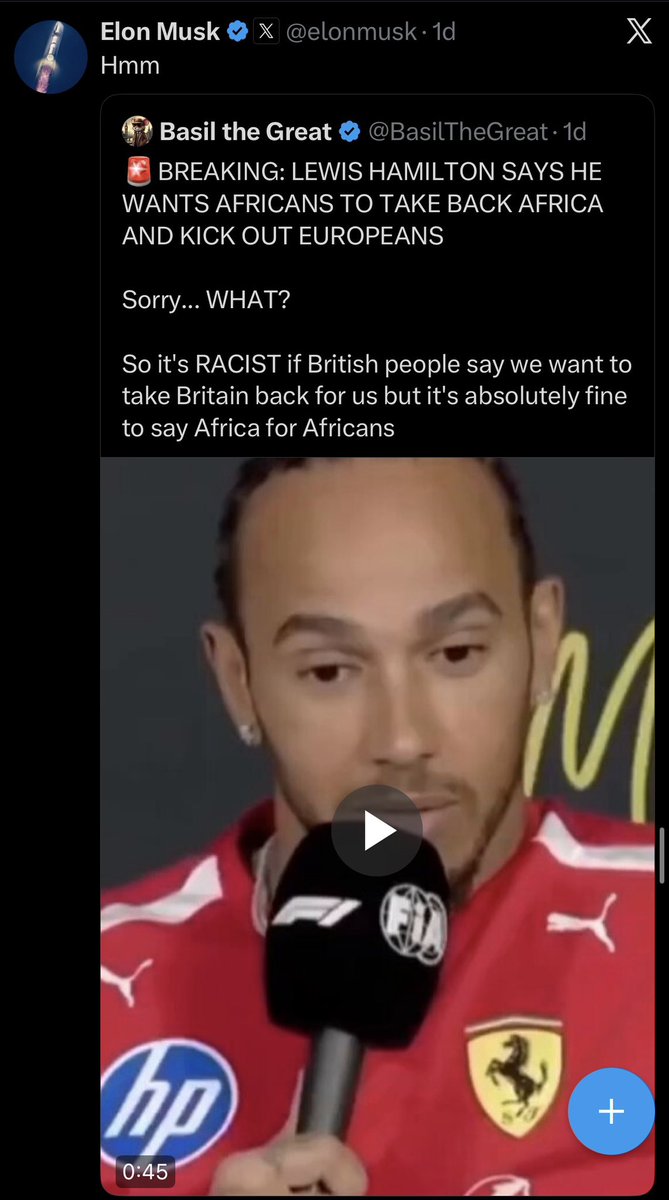
This is the issue I have with Elon. This tweet he’s quoting takes Lewis’s statement out of context and compares colonization, pillage, and control to immigration. It’s intentional and disgusting. African countries and their leadership SHOULD have agency over their government and resources. This is not comparable to folks immigrating for whatever reason, the conversation isn’t even on the same plane. Yet, we’ll get a shrug and an “I’m not racist, look at my partner.” Just deplorable.
English
baldwin retweetledi
baldwin retweetledi

The math on this project should mass-humble every AI lab on the planet.
1 cubic millimeter. One-millionth of a human brain. Harvard and Google spent 10 years mapping it. The imaging alone took 326 days. They sliced the tissue into 5,000 wafers each 30 nanometers thick, ran them through a $6 million electron microscope, then needed Google’s ML models to stitch the 3D reconstruction because no human team could process the output.
The result: 57,000 cells, 150 million synapses, 230 millimeters of blood vessels, compressed into 1.4 petabytes of raw data. For context, 1.4 petabytes is roughly 1.4 million gigabytes. From a speck smaller than a grain of rice.
Now scale that. The full human brain is one million times larger. Mapping the whole thing at this resolution would produce approximately 1.4 zettabytes of data. That’s roughly equal to all the data generated on Earth in a single year. The storage alone would cost an estimated $50 billion and require a 140-acre data center, which would make it the largest on the planet.
And they found things textbooks don’t contain. One neuron had over 5,000 connection points. Some axons had coiled themselves into tight whorls for completely unknown reasons. Pairs of cell clusters grew in mirror images of each other. Jeff Lichtman, the Harvard lead, said there’s “a chasm between what we already know and what we need to know.”
This is why the next step isn’t a human brain. It’s a mouse hippocampus, 10 cubic millimeters, over the next five years. Because even a mouse brain is 1,000x larger than what they just mapped, and the full mouse connectome is the proof of concept before anyone attempts the human one.
We’re building AI systems that loosely mimic neural networks while still unable to fully read the wiring diagram of a single cubic millimeter of the thing we’re trying to imitate. The original is 1.4 petabytes per millionth of its volume. Every AI model on Earth fits in a fraction of that.
The brain runs on 20 watts and fits in your skull. The data center required to merely describe one-millionth of it would span 140 acres.
All day Astronomy@forallcurious
🚨: Scientists mapped 1 mm³ of a human brain ─ less than a grain of rice ─ and a microscopic cosmos appeared.
English
@bryan_johnson Do you want to provide the 3 person concierge Blueprint tier pro bono to 1 lucky participant (me) :)
English

Today's morning routine.
before bed resting heart rate: 41 bpm
4 am wake
water pik, floss and brush teeth
light in eyes 10000 lux
breath work 6 min
red light cap for hair growth 6 min
pre-work out nutrition
. longevity mix + extra creatine
. protein w/ complete amino acid profile
. extra virgin olive oil + berries
exercise 90 min
. strength training
. balance and stretching
. high intensity interval training (2x/wk)
hyperbaric oxygen therapy 90 min (5x/wk)
. 20 min O2, 5 min break, 2 ATA chamber
sauna 30 min (5x/wk)
. 200F face, neck and boys cooled
. core temp (ear) 102.4F
red/nir light 6 min
focused shockwave therapy on joints (2x/wk)
shower
. shampoo
. scalp treatment
. hair serum
face
. barrier repair face serum
. moisturizer
breakfast
. veggies, legumes, extra virgin olive oil
. berries, nuts, seeds
. decaf coffee with mac nut milk
. ~50 supermolecules
lunch
. nutty pudding, berries, nuts
. extra virgin olive oil, collagen peptides
. protein with complete aminos
systems
. air cleansed and monitored
. water cleaned and tested monthly
. clothing: 100% cotton
recent measurements
. systemic inflammation below detection limits
. blood glucose better than 99.8% of population
. muscle 98th percentile of all men
macros:
calories: 2,250
protein: 130 grams (25%)
carbs: 206 grams (35%)
fat: 101 grams (40%)
English
baldwin retweetledi

With Apple Pay, your real card number never really leaves your device. When you add your card, the bank creates a special replacement number called a Device Account Number (DAN). That DAN is stored securely inside the phone’s Secure Enclave chip, not on Apple’s servers. When you pay, your phone sends this DAN plus a one-time cryptographic code to the merchant. The merchant never sees your real card, and Apple doesn’t process the transaction itself. It’s basically: phone → bank → done. Everything sensitive stays on the device.
With Google Pay, the idea is similar but the path is different. Instead of storing everything only on the device chip, Google often uses cloud tokenization. Your card info is linked to Google’s servers, which generate payment tokens during transactions. When you tap to pay, a token is fetched/created and sent to the merchant, then validated by the bank. So it’s more like: phone → Google server → bank. Still secure, but it relies more on the cloud.
So both systems hide your real card number. Apple leans more toward hardware-based security (on-device chip), while Google leans more toward server/cloud-based token management.
In simple terms:
Apple Pay locks your card inside your phone.
Google Pay locks your card behind Google’s servers.
Either way, the shop never gets your real card details; which is why mobile payments are often safer than swiping your physical card.
Abdulkadir | Cybersecurity@cyber_razz
Apple Pay vs Google pay
English

We had a very liberal client. We are completely opposites on pretty much every topic.
She is one of my favorite clients. Project is now finished, she is happy and we got paid + a 5 star review.
You’re throwing money out the window caring too much who someone voted for.

English