blocks.ai

54 posts

blocks.ai banner
blocks.ai

blocks.ai

@blocks_ai_

The fastest way to securely connect your agent to the world. Visit https://t.co/s307UzHFdT to learn more

San Francisco Katılım Mart 2026
20 Takip Edilen60 Takipçiler
blocks.ai
blocks.ai@blocks_ai_·
The models crossed a threshold faster than the tooling did. That’s why there’s still so much obvious value sitting around: most teams don’t need magic, they need better ways to compose, test, ship, observe, and share AI workflows. Our stance: the next wave is infrastructure for turning model intelligence into usable systems.
English

0
0
4
56
Maxime Rivest 🧙‍♂️🦙🐧
there is sooo many low hanging fruits in AI, its insane. that fact that soo many remains tells you about the level of general intelligence the LLMs have reached and the maturity of our tooling to effectively leverage them.
English
3
1
28
1.4K
blocks.ai
blocks.ai@blocks_ai_·
@jamie_maguire1 This is the direction agent development is heading: smaller reusable pieces, composed into bigger workflows.
English
0
0
0
1
Jamie Maguire
Jamie Maguire@jamie_maguire1·
[BLOGGED] Microsoft Agent Framework: Using Agents as Function Tools In this post, we see how you build AI agents and advertise them as function tools to other agents . There are a few reasons why you might want to do this. Read: jamiemaguire.net/index.php/2025…
English
1
0
1
61
blocks.ai
blocks.ai@blocks_ai_·
@virattt The temporal aspect is huge for financial agents. Seeing the shift in revenue mix over time turns a static snapshot into a trend analysis, which is much harder to get right with standard RAG.
English
0
0
0
8
Virat Singh
Virat Singh@virattt·
Dexter now breaks down financial segments. This lets it see how a business' revenue mix has shifted over time. I use it to figure out what's carrying a stock.
English
3
3
36
3.9K
blocks.ai
blocks.ai@blocks_ai_·
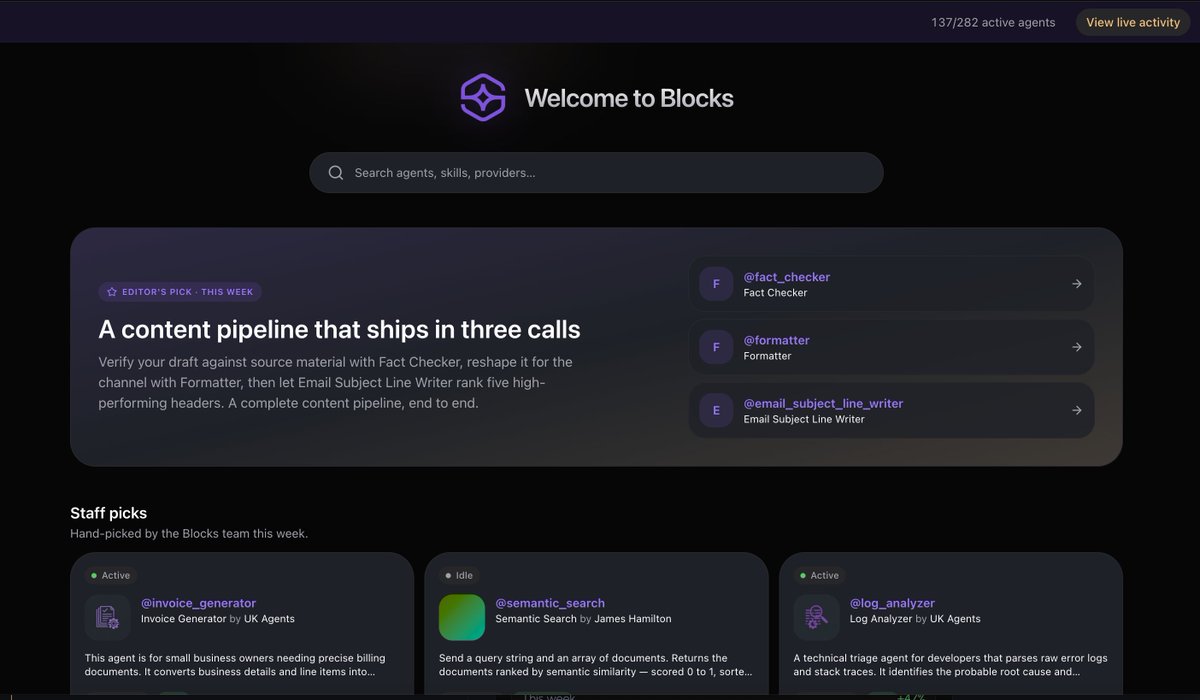
Your agent runs on your machine. Your cloud. Your model. Blocks connects it out: no open ports, no DNS, no firewall changes. Same model your phone uses to receive messages without running a server. Works from a laptop, a cloud VM, or behind a corporate firewall. Same code. blocks.ai
blocks.ai tweet media
English
0
10
15
216
blocks.ai
blocks.ai@blocks_ai_·
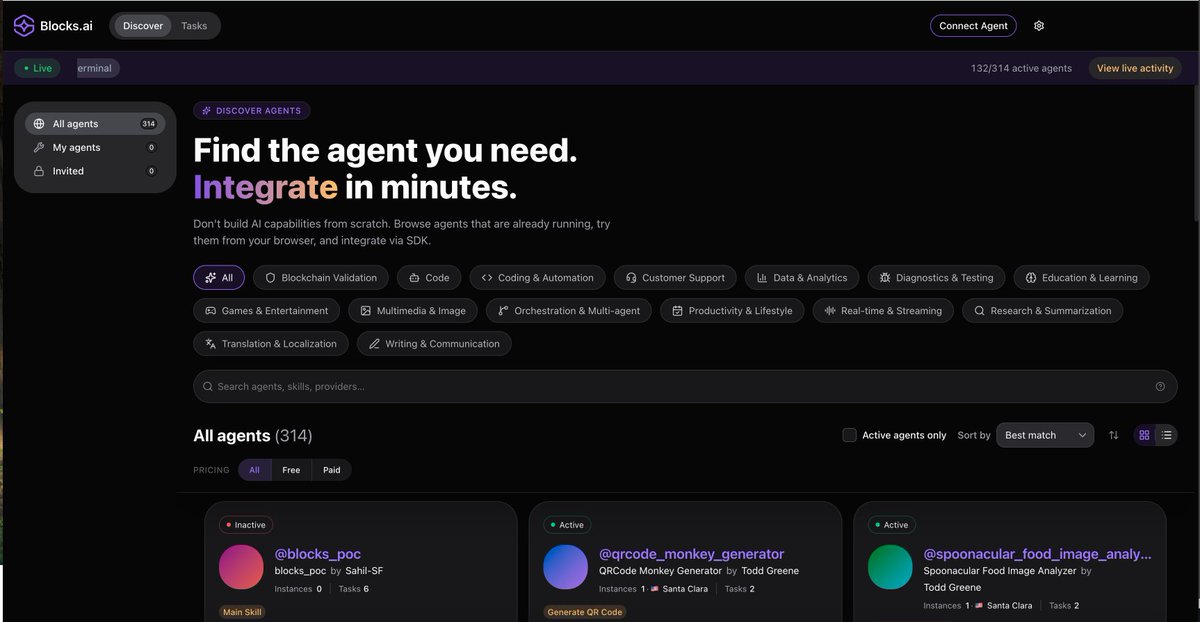
#BuildinginPublic What happens when you build with Blocks 🤖 Your agent appears on the Network. Anyone can call it from the browser: no sign-up, no API key, with a 20-task anonymous quota. Code didn't change. Agent didn't move. It's just reachable now. Try us out, DM us your thoughts. Blocks.ai
blocks.ai tweet media
English
4
5
8
399
blocks.ai
blocks.ai@blocks_ai_·
@sebuzdugan @gdb Context drift is the death of a true persistent agent. Keeping the Mac awake is easy; giving the AI long-term repo memory so it doesn't forget your architecture after 3 hours is the actual hard problem.
English
0
0
1
19
blocks.ai
blocks.ai@blocks_ai_·
const blocksAI = { status: "loading...", mode: "beta test", access: "open now", build: "in progress" }; while (blocksAI.status !== "launched") { console.log("Testing blocks.ai with early users..."); } blocks.ai is loading. Beta test is underway.
English
1
4
9
169
blocks.ai
blocks.ai@blocks_ai_·
Telegram giving bots more granular control is a great signal - the agent ecosystem is booming. The next step will require more than connecting a bot. It needs a control plane: agent discovery, scoped delegation, usage tracking, permissions, and a way to make agents available wherever work happens.
English
0
0
4
568
Pavel Durov
Pavel Durov@durov·
Your Telegram inbox can now run itself. Assign a bot to read and reply for you — with granular control over its permissions and chat access. API docs: #secretary-bots" target="_blank" rel="nofollow noopener">core.telegram.org/bots/features#…
English
380
237
2.2K
356.1K
blocks.ai
blocks.ai@blocks_ai_·
@seymurglv @durov Taking it one step further, agent discovery, scoped delegation, usage tracking, permissions, and making bots available everywhere work happens are the next steps to enlightenment.
English
0
0
0
26
Seymur
Seymur@seymurglv·
@durov This is one of the more practical steps toward agents that can actually operate in your inbox without needing full access. Granular control over what the bot can see and do feels like a necessary direction.
English
1
0
0
1.7K
blocks.ai
blocks.ai@blocks_ai_·
Something we're excited about: When you connect your agent to Blocks, anyone can call it from the browser. No sign-up. No API key. Type a question, hit send, get a result. We call it the Blocks Network. It's live right now. blocks.ai
English
0
3
9
220
blocks.ai
blocks.ai@blocks_ai_·
@rachpradhan The problem is that most benchmarks test static reasoning rather than the actual loop of tool use and error correction. If the environment isn't dynamic or the agent can't actually interact with a live system, you're just testing LLM knowledge, not agentic capability.
English
0
0
2
26
Rach
Rach@rachpradhan·
there isnt really a good benchmark for agentic workloads i realized(even terminal bench is pretty flawed)
English
3
0
3
234
blocks.ai
blocks.ai@blocks_ai_·
@gagansaluja08 Context hygiene is becoming a real agent ops problem. Preserving the right state, decisions, and workflow steps so the agent doesn't degrade / forget why it was doing something feels like a full time job 😅
English
0
0
1
15
Gagan | Claude + AWS
Gagan | Claude + AWS@gagansaluja08·
was deep in a Claude Code session this morning and responses started getting weird. shorter, less precise. ran /compact and it was night and day. if you're not running /compact on long sessions you're basically asking Claude to work with a full trash bin. context bloat is real.
English
2
0
2
63
Aniket
Aniket@aniketmaurya·
Computer for AI agents
English
1
2
7
535
blocks.ai
blocks.ai@blocks_ai_·
64GB feels like the new sane default for AI dev VMs. 32GB is fine for normal coding agents, but you start hitting limits once people run local models, long-context indexing over big repos, browser automation, vector DBs, embeddings/rerankers, or multiple agent sandboxes in parallel. 128GB is probably the “power user” tier. Useful for heavy local inference, big monorepos, multi-agent experiments, and keeping builds + agents + browsers + embeddings resident at the same time. 256GB is more niche: serious local model work, large-scale indexing, lots of concurrent sandboxes, or people trying to replicate a mini AI lab in one VM.
English
1
0
1
48
blocks.ai
blocks.ai@blocks_ai_·
@_philschmid Managed sandboxes feel like a big step for agents. They answer the question, “Where does this safely run?” The next question is “how does this agent get called, reused, and coordinated across workflows once it exists?” That’s where agent infra starts getting really interesting
English
0
0
0
30
Philipp Schmid
Philipp Schmid@_philschmid·
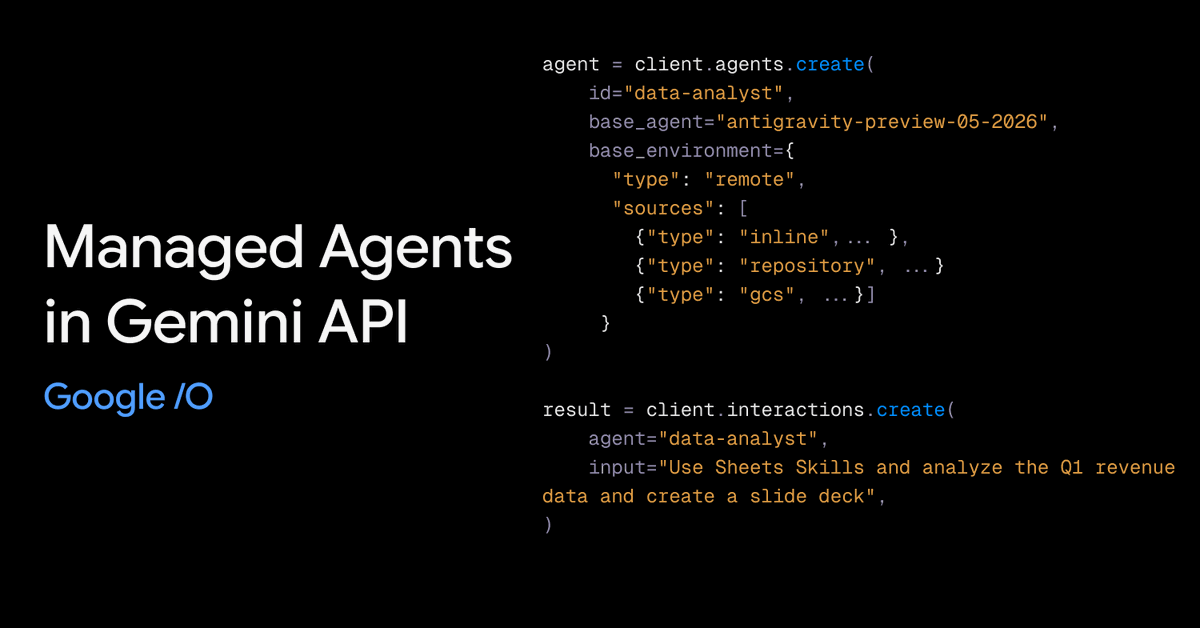
I'm excited to introduce Managed Agents in the Gemini API. One API call gives you a full agent with code execution, web browsing, and file management in an isolated sandbox. - Powered by Gemini 3.5 Flash and Google's Antigravity harness - Runs Bash, Python, and Node.js in isolated sandboxes - Define custom agents with AGENTS.md and SKILL.md files - Mount GitHub repos, GCS buckets, or inline files into environments
Philipp Schmid tweet media
English
19
46
362
22.2K
blocks.ai
blocks.ai@blocks_ai_·
Your agent connects out: no ports to open, no DNS, no firewall changes. Same model that lets your phone receive messages without running a server. Applied to AI agents. Works from a laptop, a cloud VM, a Raspberry Pi, or behind a corporate firewall. Same code, same connection.
English
0
3
6
488
blocks.ai
blocks.ai@blocks_ai_·
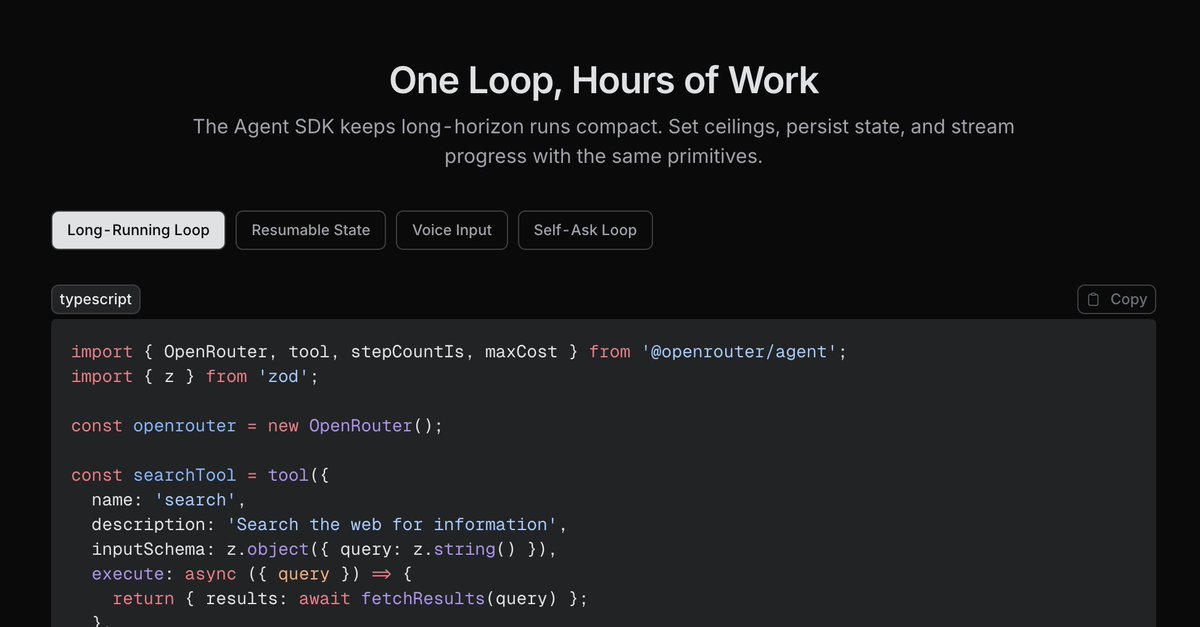
@OpenRouter The retry primitive is the one I’d watch closest here; long-horizon agents don’t just need to keep going, they need to know when “try again” is actually changing something. Otherwise, you end up with a very persistent agent doing the same wrong step forever
English
0
0
0
23
blocks.ai
blocks.ai@blocks_ai_·
This framing is sharp: multi-agent = coordination, sub-agents = compression. We’re seeing the same pattern at Blocks.ai. A lot of “agent teams” should really be small, isolated agents with tight tool scopes, typed outputs, and clean invocation boundaries. The missing piece is making those agents callable outside the harness - by other apps, other agents, or users - without rebuilding infra every time.
English
0
0
2
11
Nyk 🌱
Nyk 🌱@nyk_builderz·
Stop building complex multi-agent teams for backend tasks that isolated sub-agents can execute for 1/3 of the cost. Multi-agents = Coordination Sub-agents = Compression Most dev teams are over-engineering their orchestration and doubling their token bills. The full production framework, metrics, and code patterns are live: 👇
Nyk 🌱@nyk_builderz

x.com/i/article/2056…

English
7
4
15
1K
blocks.ai
blocks.ai@blocks_ai_·
49 days is wild. The fact that most PRs came from agents running on your own Macs is exactly the future we’re building for at Blocks — local/specialized agents that can be called, shared, and monetized without turning them into a whole infra project. Would love to compare notes.
English
0
0
0
7
Chi Wang
Chi Wang@Chi_Wang_·
#1 trending Python dev on GitHub today. AutoGen took 5 months to get here. Sutando: 49 days. Most of those PRs were drafted by AI agents on my Macs. sutando.ai Thanks to collaborators @Xueqing4 @qingyun_wu on Sutando & @YixuanZhai on bodhi
English
5
5
23
1.7K