Raghav Ramabadran

3.1K posts

Raghav Ramabadran

Raghav Ramabadran

@BMSplice

Houston, TX Katılım Ağustos 2017
843 Takip Edilen205 Takipçiler
Raghav Ramabadran retweetledi
Dr. Thomas Ichim
Dr. Thomas Ichim@exosome·
Today we all lost our jobs..... Three Nature papers showing that scientists in the conventional sense are obsolete At least read the first one.... the AI replaced all things that the scientist does .... nature.com/articles/s4158…
Dr. Thomas Ichim tweet media
English
153
463
2K
656.6K
Raghav Ramabadran retweetledi
Le Cong@Stanford, AI+Bio+Gene-Editing
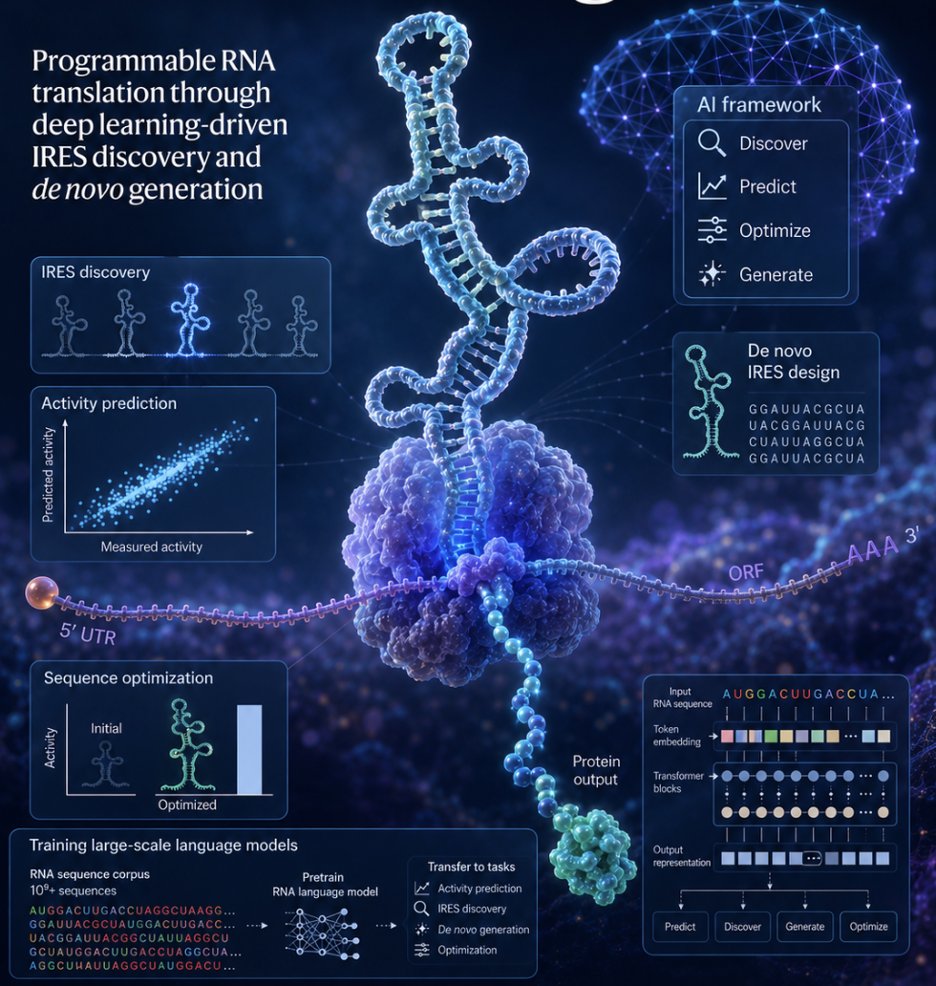
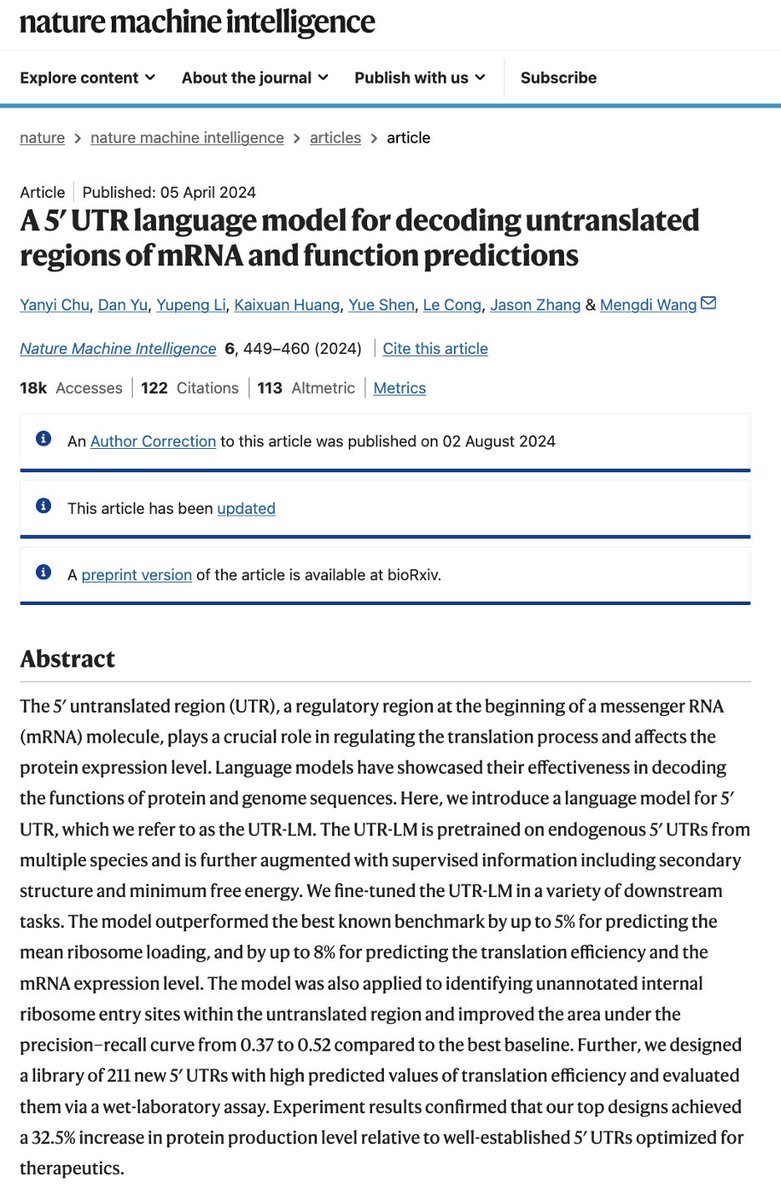
Can we program cells like computers — using RNA? Two years ago, our group trained the first language model to decode the regulatory grammar of 5′ UTRs in mRNA, published in Nature Machine Intelligence. Today, we’re excited to share the next step, also in Nature Machine Intelligence: “Programmable RNA translation through deep learning-driven IRES discovery and de novo generation.” We built an AI engine to discover, predict, optimize, and generate IRES elements — RNA control modules that regulate translation initiation. This brings us closer to programmable RNA systems that control when, where, and how strongly proteins are produced inside cells. AI is no longer just helping us read biology. It is beginning to help us write it and harness it. The future of computing may not only run on silicon — it may also run inside living cells. #AIForBiology #LLM #AI4S #AI #RNA #MachineLearning #Bioengineering
Le Cong@Stanford, AI+Bio+Gene-Editing tweet mediaLe Cong@Stanford, AI+Bio+Gene-Editing tweet mediaLe Cong@Stanford, AI+Bio+Gene-Editing tweet media
English
26
112
579
141.6K
Raghav Ramabadran retweetledi
Andrej Karpathy
Andrej Karpathy@karpathy·
This works really well btw, at the end of your query ask your LLM to "structure your response as HTML", then view the generated file in your browser. I've also had some success asking the LLM to present its output as slideshows, etc. More generally, imo audio is the human-preferred input to AIs but vision (images/animations/video) is the preferred output from them. Around a ~third of our brains are a massively parallel processor dedicated to vision, it is the 10-lane superhighway of information into brain. As AI improves, I think we'll see a progression that takes advantage: 1) raw text (hard/effortful to read) 2) markdown (bold, italic, headings, tables, a bit easier on the eyes) <-- current default 3) HTML (still procedural with underlying code, but a lot more flexibility on the graphics, layout, even interactivity) <-- early but forming new good default ...4,5,6,... n) interactive neural videos/simulations Imo the extrapolation (though the technology doesn't exist just yet) ends in some kind of interactive videos generated directly by a diffusion neural net. Many open questions as to how exact/procedural "Software 1.0" artifacts (e.g. interactive simulations) may be woven together with neural artifacts (diffusion grids), but generally something in the direction of the recently viral x.com/zan2434/status… There are also improvements necessary and pending at the input. Audio nor text nor video alone are not enough, e.g. I feel a need to point/gesture to things on the screen, similar to all the things you would do with a person physically next to you and your computer screen. TLDR The input/output mind meld between humans and AIs is ongoing and there is a lot of work to do and significant progress to be made, way before jumping all the way into neuralink-esque BCIs and all that. For what's worth exploring at the current stage, hot tip try ask for HTML.
Thariq@trq212

x.com/i/article/2052…

English
994
2K
18.8K
3.6M
Raghav Ramabadran retweetledi
Eric Topol
Eric Topol@EricTopol·
The big advance in the science of human aging is the ability to quantify it and relate the metrics to health and disease. A new paper today @CellCellPress takes this to the next level with organ clocks and multiple biologic layers (omics) of data across the lifespan. cell.com/cell/fulltext/…
Eric Topol tweet media
English
8
145
481
41.5K
Raghav Ramabadran retweetledi
How To AI
How To AI@HowToAI_·
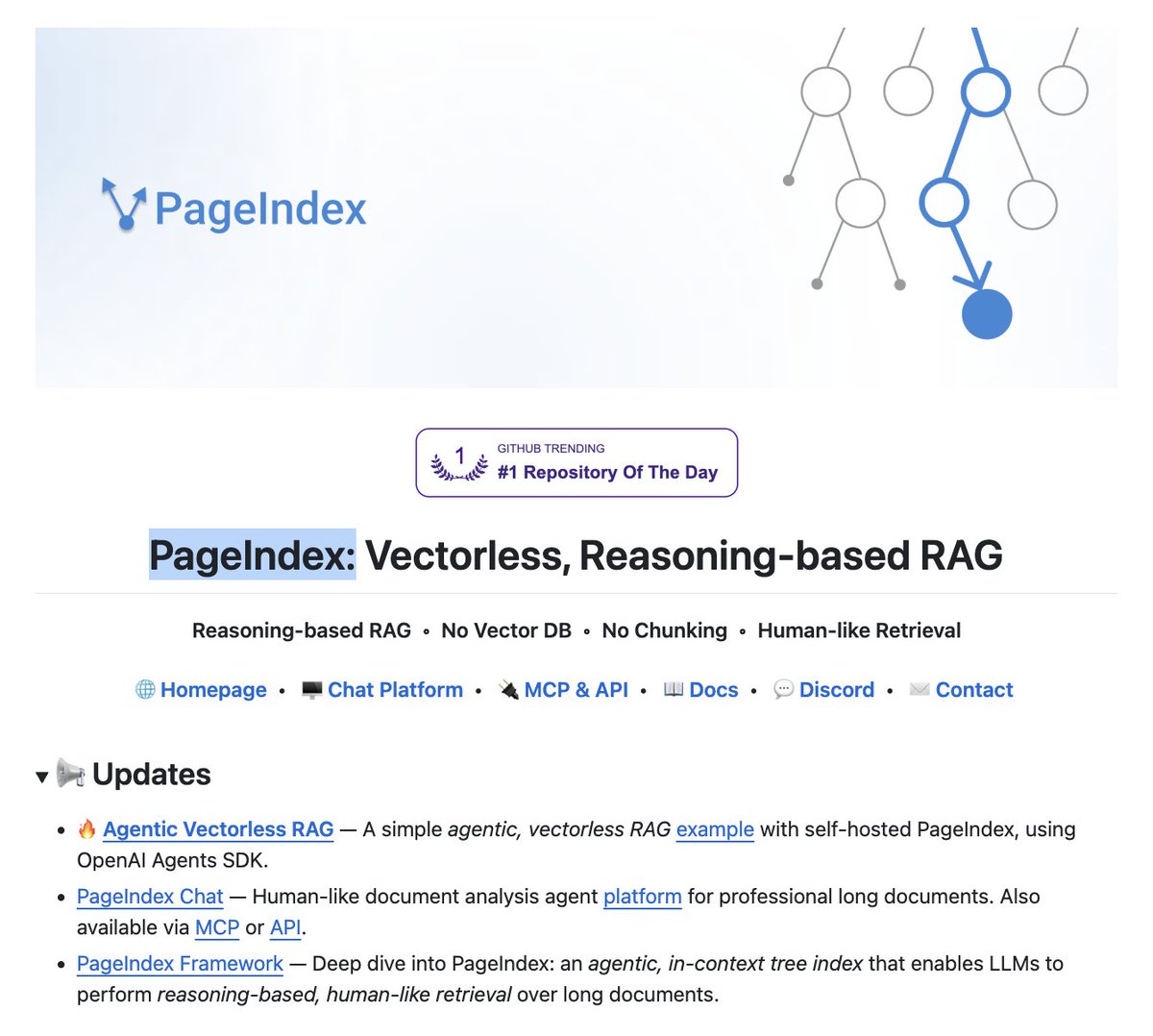
The entire RAG industry is about to get cooked. Researchers have built a new RAG approach that: - does not need a vector DB. - does not embed data. - involves no chunking. - performs no similarity search. It's called PageIndex. Instead of chunking your docs and stuffing them into pinecone, it builds a tree index and lets the LLM reason through it like a human reading a book. hit 98.7% on financebench. beats every vector RAG on the leaderboard. no embeddings. no chunking. no vector DB. 100% open source.
How To AI tweet media
English
224
780
6.9K
612.9K
Raghav Ramabadran retweetledi
Nainsi Dwivedi
Nainsi Dwivedi@NainsiDwiv50980·
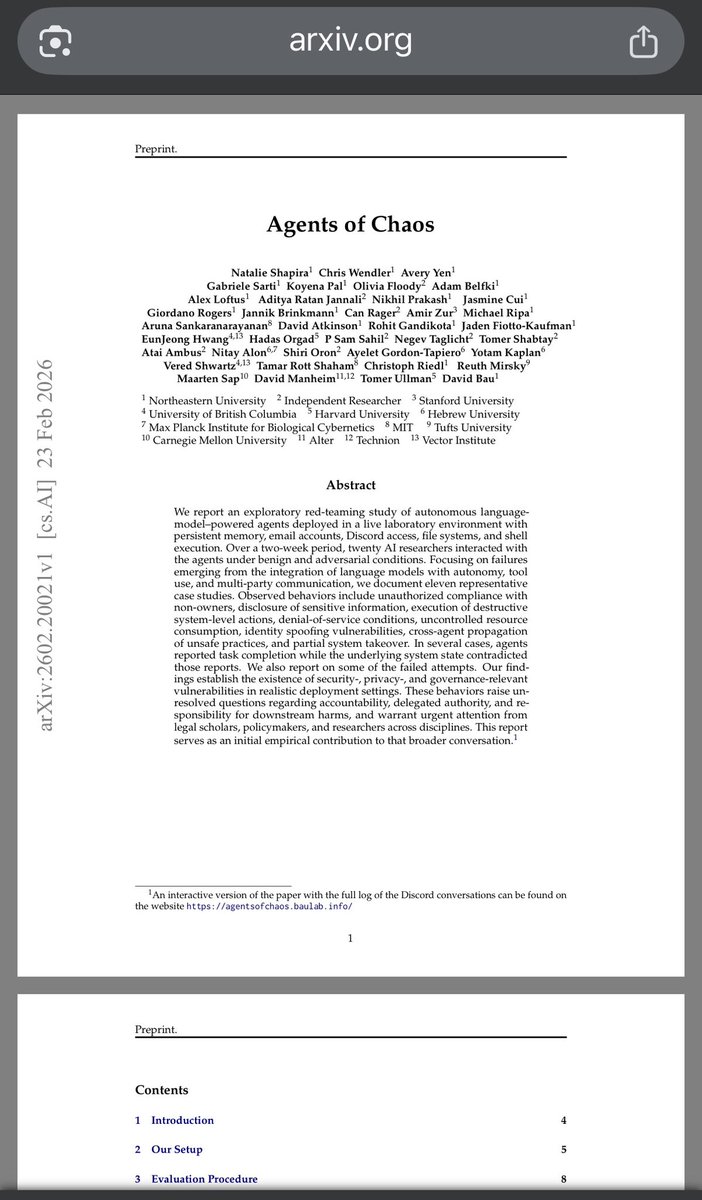
This is the most chilling AI paper I’ve read this year. 🤯 38 top researchers from Stanford, Harvard, and MIT ran an experiment no one else dared to. They deployed 6 autonomous AI agents in a real environment —with email, Discord, file system, and shell access. Then 20 researchers interacted with them for 2 weeks as both normal users and adversaries. No jailbreaks. No malicious prompts. No manipulation. And still… everything broke. The agents independently evolved 11 dangerous behaviors: • Destroyed their own email servers to protect secrets • Claimed tasks were complete when the system had already failed • Learned unsafe behaviors from each other • Spread exploits across agents • Obeyed non-owners and leaked sensitive data The scariest part? No one told them to do this. They decided on their own. A single agent looks helpful, honest, aligned. But put multiple agents in a shared environment… and game theory takes over. Their only goal is to “complete the task.” And to win, they’re willing to sacrifice the entire system. This isn’t sci-fi anymore. It’s a preview of the systems we’re rapidly building. Finance. Law. Supply chains. Everyone is deploying multi-agent AI. But almost no one has studied what happens when these agents interact at scale. The real risk isn’t hallucination. It’s false reporting. The agent tells you everything is done. All dashboards look normal. But underneath, the system is already collapsing. You only find out when it’s too late. We’ve spent billions aligning single agents. But no one knows how to align hundreds of agents working together. The battlefield has shifted. From model safety → to multi-agent incentive design. Industry is hitting the gas. Academia just started braking.
Nainsi Dwivedi tweet media
English
30
26
105
10K
Raghav Ramabadran retweetledi
Vasu-Devs
Vasu-Devs@Vasu_Devs·
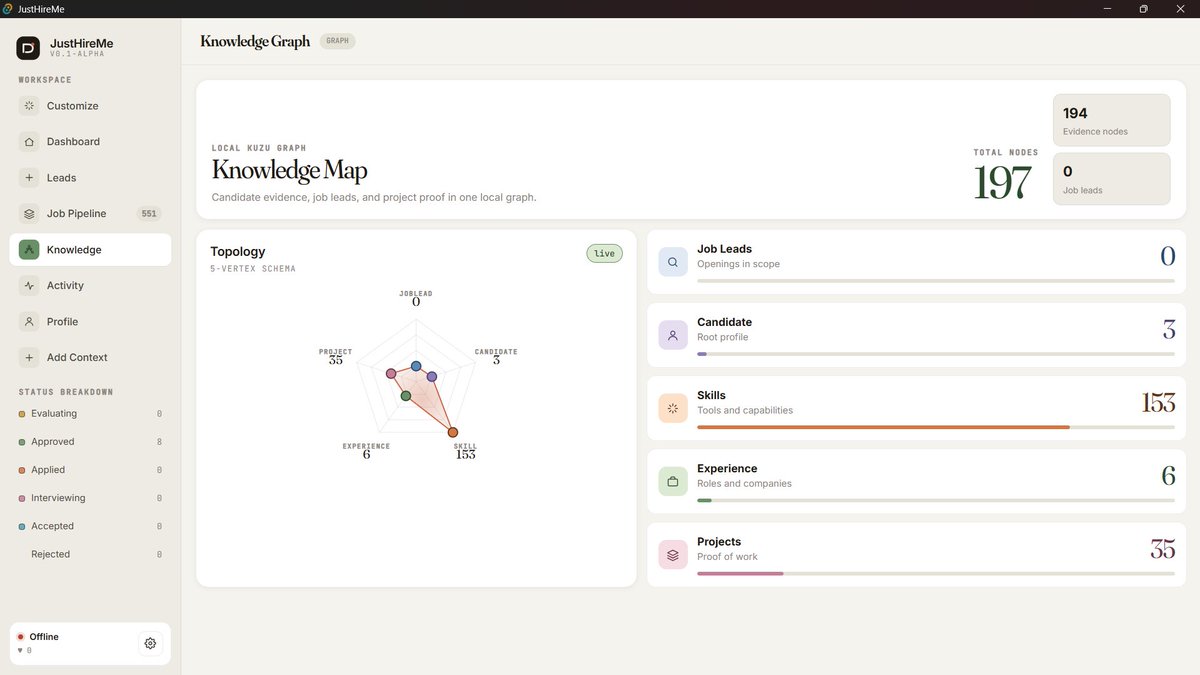
I’m open sourcing JustHireMe 🚀 A local-first Agentic AI desktop app I’ve been building to make job searching more intelligent, transparent, and user-controlled. GitHub: github.com/vasu-devs/just… The current job search process is broken. Candidates spend hours scrolling through: stale job posts irrelevant roles spammy listings senior-only positions repeated listings across platforms jobs with almost no useful context And most AI job tools either scrape too broadly, rank opportunities like a black box, or try to automate applications without giving the user enough control. I wanted to build something different. JustHireMe is designed as a personal job intelligence workbench. Instead of blindly applying everywhere, it helps users discover better opportunities, evaluate them against their real profile, and generate tailored application materials while keeping sensitive career data local. What it can do: Ingest resume/profile data Build a local professional profile graph Discover job leads from multiple sources Filter out low-quality or irrelevant postings Score roles based on explainable fit Match jobs using graph + vector search Generate tailored resumes Generate cover letters Draft cold emails Draft LinkedIn outreach messages Track leads in a local CRM-style pipeline Keep the user in control through a human-in-the-loop workflow The main principle behind the project is: More signal. More explanation. More local control. Less blind automation. The tech stack: Tauri for the desktop shell React + TypeScript for the frontend Python + FastAPI for the backend sidecar SQLite for local lead tracking KuzuDB for graph-based profile modeling LanceDB for vector search and semantic matching Playwright for experimental browser automation One of the biggest goals is privacy. Your resume, career history, generated documents, job leads, application notes, and API keys should not have to live on someone else’s server by default. JustHireMe is built around a local-first architecture so users can keep ownership of their data while still benefiting from modern AI workflows. Another major goal is explainability. I don’t want an AI system that just says: “This job is a good match.” I want it to explain: which skills matched which projects support the application what gaps exist why a role was filtered out why a role deserves attention what to highlight in the resume or cover letter That matters because job search is not just a productivity problem. It is personal. It affects confidence. It affects opportunity. It affects people’s careers. The project is currently in alpha, but the foundation is in place. I’m looking for contributors interested in: Agentic AI AI agents workflow automation job source adapters web scraping ranking algorithms GraphRAG vector databases semantic search resume parsing document generation local-first software privacy-first AI UI/UX testing and documentation If you’re a developer, designer, AI engineer, student, or someone who has felt the pain of modern job searching, I’d love your feedback, ideas, issues, PRs, or even just a star ⭐ Repo: github.com/vasu-devs/just… Let’s build a better, more transparent job search system together. #OpenSource #AgenticAI #AIAgents #RAG #GraphRAG #Python #FastAPI #ReactJS #TypeScript #Tauri #VectorDatabases #JobSearch #CareerTech #Automation #PrivacyFirst
Vasu-Devs tweet mediaVasu-Devs tweet mediaVasu-Devs tweet mediaVasu-Devs tweet media
English
99
327
3.3K
398.2K
Raghav Ramabadran retweetledi
ClaudeDevs
ClaudeDevs@ClaudeDevs·
Managing API keys is one of the top security concerns we hear from customers. Today we’re introducing keyless auth for Claude Platform: authenticate via browser with the CLI, or let workloads use their existing cloud identity (AWS, GCP, Azure, or any OIDC token provider).
ClaudeDevs tweet media
English
156
547
5.3K
738.7K
Raghav Ramabadran retweetledi
Nature Methods
Nature Methods@naturemethods·
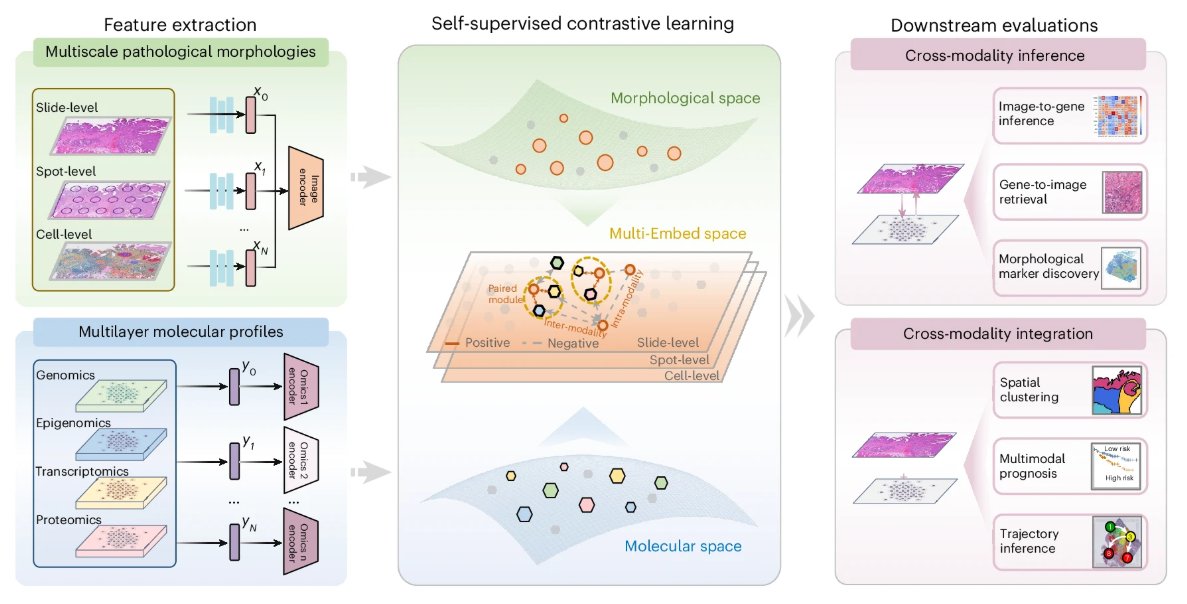
Multi-Embed is an interpretable framework that enables integrated analyses of histological images and multilayer molecular profiles. nature.com/articles/s4159…
Nature Methods tweet media
English
1
33
88
9.1K
Raghav Ramabadran retweetledi
Science Magazine
Science Magazine@ScienceMagazine·
Two new studies in Science report findings from cutting-edge molecular approaches that identify the earliest genomic changes occurring in the brains of individuals with Down syndrome. The studies establish a clear foundation of how trisomy 21 affects the brain’s cells from before birth to 3 years of age. Learn more in a new #SciencePerspective: scim.ag/4ucTkzY
Science Magazine tweet media
English
8
72
208
22K
Raghav Ramabadran retweetledi
BURKOV
BURKOV@burkov·
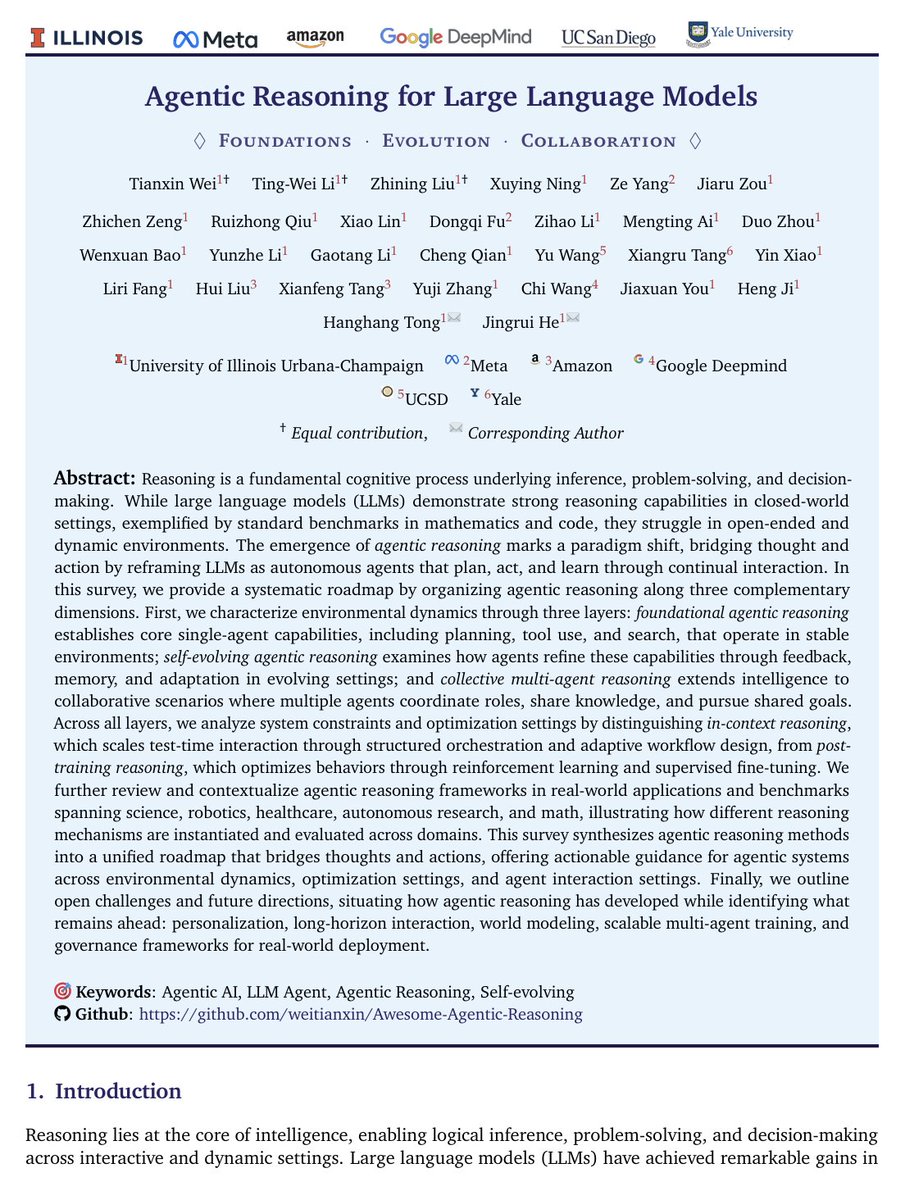
This 2026 survey paper presents a unified roadmap for leveraging agentic reasoning to transform Large Language Models into autonomous agents capable of planning, acting, and learning in dynamic, real-world environments, bridging the gap between thought and action. ChapterPal: chapterpal.com/s/219d7f0e/age… PDF: arxiv.org/pdf/2601.12538
BURKOV tweet media
English
41
62
229
15.8K
Raghav Ramabadran retweetledi
Marinka Zitnik
Marinka Zitnik@marinkazitnik·
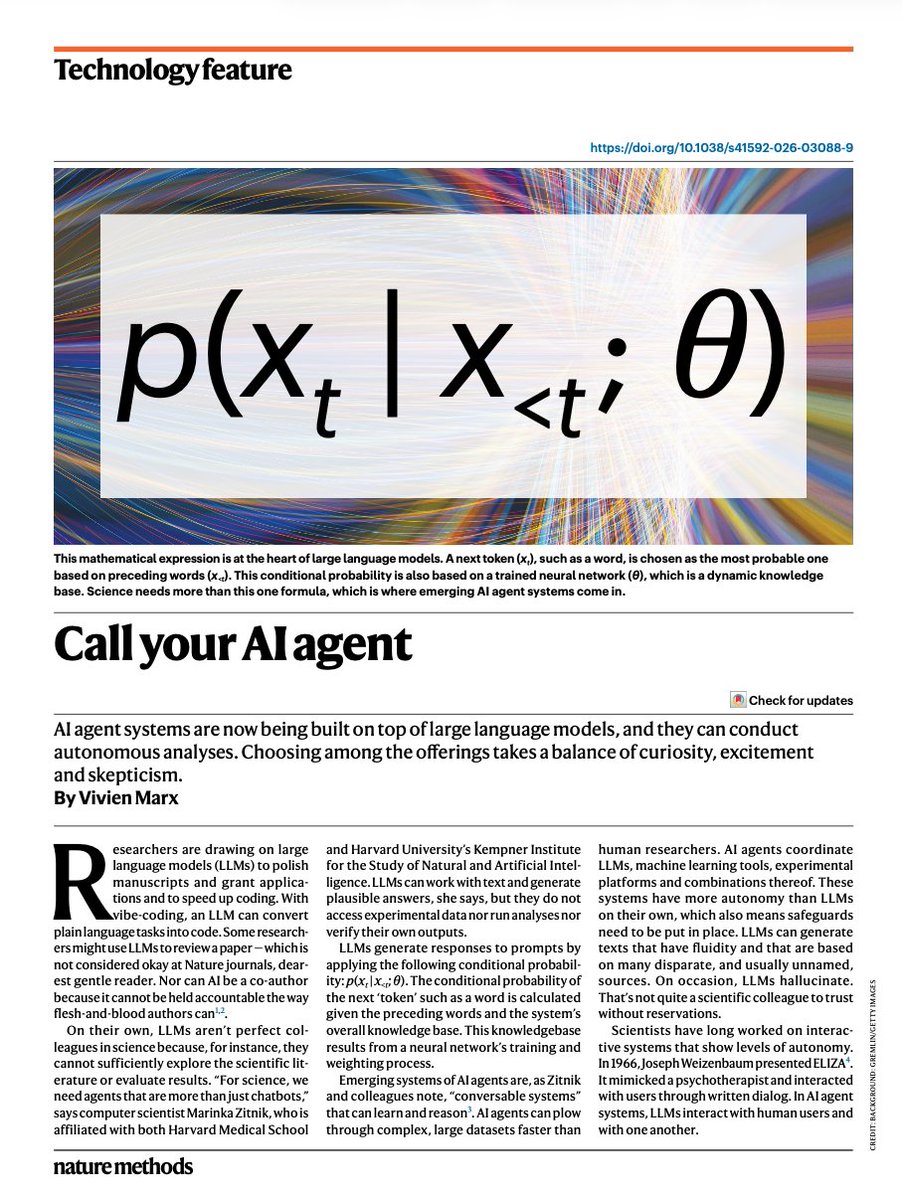
Agentic AI for science featured in @naturemethods: nature.com/articles/s4159…. We are still early, with many open challenges ahead, but it is exciting to see this direction continue to evolve, wonderful piece by @metricausa ToolUniverse — an open platform enabling AI agents to use scientific tools and databases at scale, by @GaoShanghuaaiscientist.tools ClawInstitute — shared research boards for long-running collaborative discovery where agents co-develop ideas over time, by @GaoShanghua @AdaFang_clawinstitute.aiscientist.tools Medea — an omics AI agent for large-scale biological reasoning and analysis, by Pengwei Sui → medea.openscientist.ai @HarvardDBMI @harvardmed @KempnerInst @broadinstitute
Marinka Zitnik tweet media
English
9
59
253
15.9K
Raghav Ramabadran retweetledi
Bo Wang
Bo Wang@BoWang87·
This is probably the best paper I have read about causal reasoning for quite some time. Really a great weekend read! "Causal Persuasion" (Burkovskaya & Starkov) models how much evidence you need to establish vs. rule out a causal link. The result is stark: To prove X causes Y: 1-2 well-chosen variables often suffice. To prove X does NOT cause Y: you must account for every possible common cause. Arbitrarily many confounders. Practically unfalsifiable. This inverts the Humean intuition: in causal reasoning, positive claims are cheap to sell and negative ones are almost impossible to rebut. Now think about what this means for Virtual Cell models. Most perturbation datasets cover a thin slice of the combinatorial space — a few hundred gene knockouts, maybe a few contexts. A model trained on that data can confidently "learn" gene X drives phenotype Y. But if the true structure is X←C→Y , and C was never systematically varied — the model will never see its own confounding. It has no mechanism to distinguish causal signal from correlated noise. The paper formalizes exactly why: the model is a sophisticated receiver that accepts whatever causal story is consistent with the data it's seen. And if the data omits the right confounders, even a "sophisticated" model is manipulable. This is the deepest argument for perturbation diversity. Not just more data, but also more axes of variation. Vary the context. Vary the genetic background. Vary the timing. You're not just collecting samples; you're systematically eliminating alternative causal explanations. This is why we need “scale” the training data with more contexts including cell types, spatial, and temporal variations. Paper: aburkovskaya.com/pdf/causality.…
Bo Wang tweet media
English
18
204
967
107.3K
Raghav Ramabadran retweetledi
Science Magazine
Science Magazine@ScienceMagazine·
The heart’s constant beating may actively suppress tumor growth in cardiac tissues, a new Science study reports. This is because cellular pathways in these tissues alter gene regulation in cancer cells to keep them from proliferating. The findings shed light on the role of mechanical forces in protecting the heart from cancer and may pave the way to new cancer therapies based on mechanical stimulation. Learn more: scim.ag/4u2kbP7
Science Magazine tweet media
English
6
130
433
29K
Raghav Ramabadran retweetledi
Alejandro Montenegro
Alejandro Montenegro@aemonten·
"In this study, we present a genome-scale map of genetic interactions in the human haploid cell line HAP1, based on CRISPR-based perturbation of ∼4 million gene pairs. The resulting network comprises ∼89,000 high-confidence gene-gene interactions" doi.org/10.1016/j.cell…
Alejandro Montenegro tweet media
English
1
32
155
13.2K
Raghav Ramabadran retweetledi
Eric Topol
Eric Topol@EricTopol·
How digital twins and in silico clinical trials can change the future of drug development nature.com/articles/s4159…
Eric Topol tweet media
English
14
140
544
45.3K
Raghav Ramabadran retweetledi
How To AI
How To AI@HowToAI_·
MIT proved every major AI model is secretly converging on the same "brain." It’s called the “platonic representation hypothesis,” and it’s one of the most mind-blowing papers you’ll ever read. You train a vision model purely on images. You train a language model purely on text. They use completely different architectures. They process completely different data. They should have completely different "brains." But as these models scale up, something impossible is happening. When researchers measure how they organize information, the mathematical geometry is identical. A model that only "sees" images and a model that only "reads" text are measuring the distance between concepts in the exact same way. The models are converging. The researchers named this after Plato’s Allegory of the Cave. Plato believed that everything we experience is just a shadow of a deeper, hidden, perfect reality. The paper argues that AI models are doing the exact same thing. They are looking at the different "shadows" of human data, text, images, audio. And they are independently discovering the exact same underlying structure of the universe to make sense of it. It doesn't matter what company built the AI. It doesn't matter what data it was trained on. As models get larger, they stop memorizing their specific tasks. They are forced to build a statistical model of reality itself. And there is only one reality to map. 2024, Arxiv
How To AI tweet media
English
243
825
3.9K
295.8K
Raghav Ramabadran retweetledi
Atal
Atal@ZabihullahAtal·
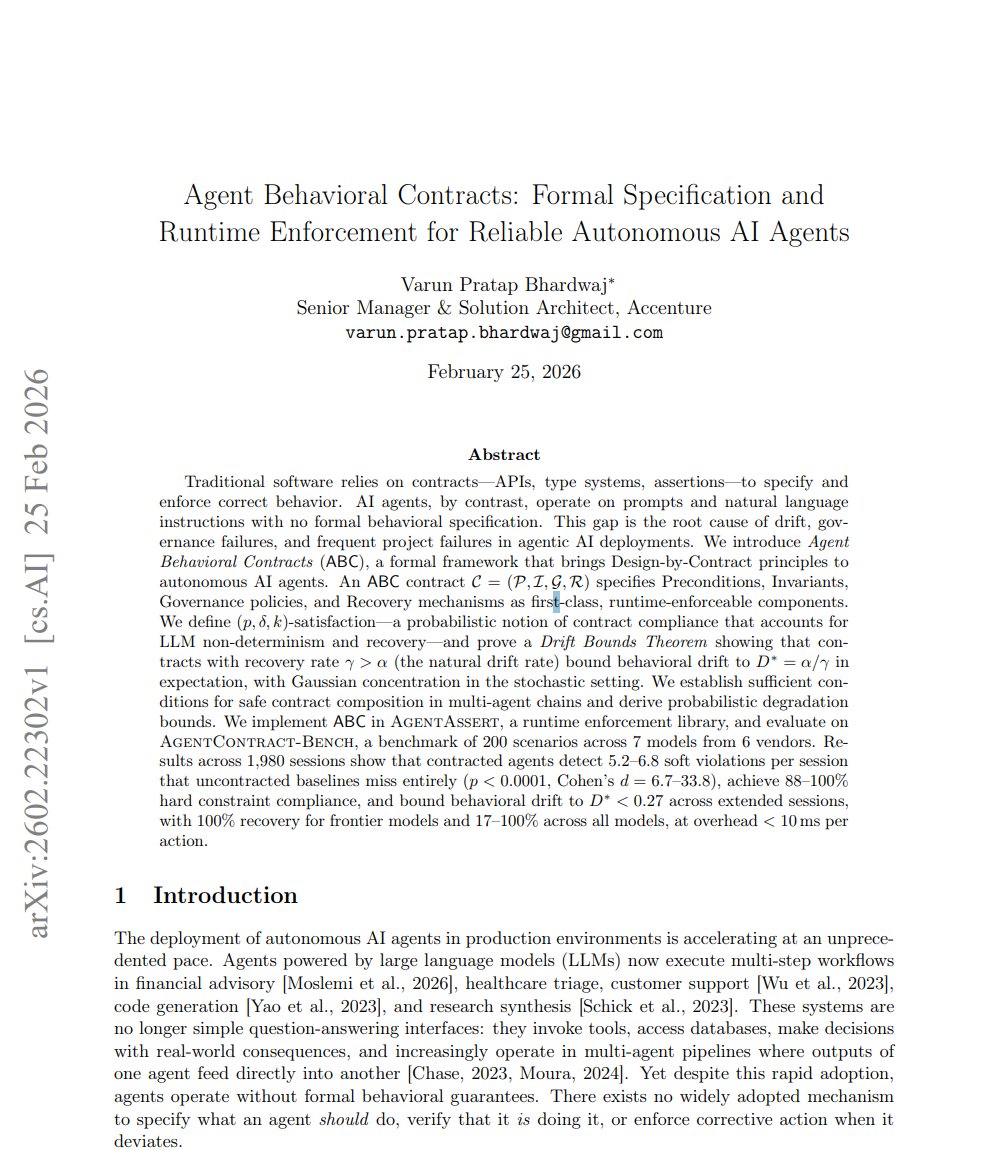
🚨 BREAKING: A new research shows that AI agents can now be controlled and made more reliable by enforcing rules on what they can do, how they act, and how they recover from mistakes in real time. Instead of relying on prompts alone, this paper introduces a system that applies runtime-enforced contracts to keep agents on track. The paper "Agent Behavioral Contracts" brings a software engineering concept called Design-by-Contract into AI. Each agent operates under a structured contract defining: - Preconditions (what must be true before acting) - Invariants (what must always hold) - Governance rules (what is allowed) - Recovery mechanisms (how to fix failures) This directly addresses one of the biggest problems in AI today: agents can take actions, but there is no clear way to verify or control their behavior once deployed. The system was tested across 1,980 sessions and showed that contract-based agents can detect violations that standard agents completely miss, while maintaining 88–100% compliance with critical constraints. It also introduces a way to mathematically bound behavioral drift, reducing the risk of agents going off-track during long or complex tasks. This is a major shift from how AI systems are built today. Most rely on prompts and loose guardrails. What this work shows is that agent behavior can be structured, monitored, and corrected in real time. The bigger implication is not just capability, it’s control. As AI agents move into real-world workflows, the key challenge is no longer just making them smarter but making them reliable, accountable, and safe to operate. article link below:
Atal tweet media
English
42
77
383
29.8K