Bob Jordan

344 posts

Bob Jordan banner
Bob Jordan

Bob Jordan

@bobjordanjr

CEO/Architect, https://t.co/5wkIXg1sPn: compute change impact. https://t.co/PY7I2fYdxS + https://t.co/B5SoxEgGOn | I lean libertarian. Repost != endorse. @EquatorOps

Orange County, California, USA Katılım Kasım 2022
358 Takip Edilen213 Takipçiler
Bob Jordan
Bob Jordan@bobjordanjr·
@Calmprices @ClownWorld She just looks like a child to me, and she's pretty in her own way, I'm glad she's confident. I just don't see the point in tearing her down and making fun of her as a spectacle. At this point, people should feel bad.
English
0
0
0
16
James O'Keefe
James O'Keefe@JamesOKeefeIII·
My team, myself & @camhigby were just violently assaulted on Skid Row, my camera crew were punched in the neck and face, we were pepper sprayed, but thankfully just escaped. Some members of our team had to run 10 blocks to get out. We were in the heart of Skid Row confronting the petitioners who @Savsays and my team caught on tape illegally offering drugs for ballot signatures. Please share this video to understand what we’re up against.
James O'Keefe@JamesOKeefeIII

CALIFORNIA ELECTIONS FRAUD CASH FOR BALLOTS PART I: Homeless Bribed with Cash & Drugs In Exchange For Registering To Vote & Signing Election Petitions Caught On Tape Undercover On Skid Row In California. “You can just put Pinocchio Lane.” California NGOs Encourage Fake Addresses To Homeless People To Sign Petitions & Register Voters, A State & Federal Felony. Footage Shows 28 Instances Of Cash Changing Hands For Ballot Signatures & Voter Registration Forms. Many of the petitioners had no understanding of the petitions’ purpose they were advertising. Circulators also instructed individuals to use fake addresses. “Oh, you can just fake an address.” Weingart Center, which received hundreds of millions in public funding, is on tape directing people to where the fraudulent petitioners are located, and directing homeless individuals to petitioners & coaching plausible deniability. “See they say ignorance is no excuse for the law. But a lot of times, I have to say ‘I didn’t know, I had no idea.’” We encountered 28 instances of petitioners offering cash, cigarettes, and marijuana for signatures on petitions. Weingart employees advised: “See they say ignorance is no excuse for the law. But a lot of times, I have to say ‘I didn’t know, I had no idea.’” All happening outside taxpayer-funded housing organizations. Weingart CEO earned $432,000 before resigning from the Los Angeles County Affordable Housing Solutions Agency. James O’Keefe and the OMG Team went undercover on Skid Row, posing as homeless individuals. On hidden cameras, petitioners admitted they are paid $7–$10 per signature, sometimes earning $1,000 or more per day, collecting signatures from individuals with minimal knowledge of what they were signing. “$7 a signature, $5 a signature, $10 a signature.” “We gon’ give you $2.” Populus Inc., a political consulting firm, was circulating petitions funded by @Uber, @Delta, @United, and the American Hotel & Lodging Association (@AHLA). On camera, one petitioner said, “We have one that taxes billionaires 5%. One-time tax. 5% and that’s gonna go towards healthcare.” Other petitions sought to overturn LA’s $30 minimum wage for hotel and airline workers. Paying per signature and encouraging fake addresses violates federal and state election law and is proof of fraud happening in California. Weingart employees were caught directing the homeless to the location of the petitioners and coaching them on plausible deniability. Intake coordinator Jason Warren told an undercover journalist exactly where and when to find them: “Most time they be right across the street, under that tree… Monday through Friday.” In 2016, nine individuals were arrested on Skid Row for exchanging cash and cigarettes for signatures; in 2019 they were charged on 14 counts under the exact same California Elections Code section. Yet when confronted, nearby LAPD officers dismissed the activity as “a civil lawsuit.” “Paying per signature violates state election law and is evidence of election fraud in California,” the investigation concludes. On Skid Row, we captured conduct on tape that violates Federal Law 52 U.S. Code §10307 and state law California Election Code §18603. Part II coming soon. @CAgovernor @MayorOfLA @AGPamBondi @TheJusticeDept @NathanHochmanDA @GovPressOffice @LADAOffice @CASOSVote @USAttyEssayli @GavinNewsom Follow Citizen Justice League @ctznjusticelg A network of citizen journalists exposing corruption and demanding accountability for America YT: @citizenjusticeleague?si=SYUXXv7nN0eshG_a" target="_blank" rel="nofollow noopener">youtube.com/@citizenjustic… IG: instagram.com/citizenjustice… FB: facebook.com/share/1CdcJb1b… TikTok: @citizenjusticeleague?_r=1&_t=ZP-94juhHbdzIN" target="_blank" rel="nofollow noopener">tiktok.com/@citizenjustic… Paid partnerships with: American Independence Gold: Free Extra Gold & Silver with Qualifying Purchases. Go to OKEEFEMEDIAGOLD.com

English
2.8K
33.1K
83K
2.5M
Bob Jordan
Bob Jordan@bobjordanjr·
They need impact intelligence in the ability to foresee the consequences of downstream changes. At EquatorOps,com, we developed tech we use for this in managing changes across a wide range of real-world events regulated industries such as manufacturing, construction, medical devices, and aerospace. We are currently finishing integrated support for AI agents and software development.
English
0
0
0
12
Yann LeCun
Yann LeCun@ylecun·
Danger does not come merely from agency, but from agency with no ability to anticipate consequences and with no safety guardrails. The solution? AI agents that can predict the consequences of their actions (world models) and only take actions whose predicted outcomes satisfy safety guardrails. I've been saying this for over 5 years. I've been designing objective-driven AI systems based on world models for that reason.
English
82
38
386
42.1K
Bob Jordan
Bob Jordan@bobjordanjr·
@elonmusk Unless you are in real estate, this is absolutely the most business hostile administration we’ve had in the last 50+ years.
English
0
0
0
13
Clown World ™ 🤡
Clown World ™ 🤡@ClownWorld·
Ben Stiller tries promoting his soda brand in a grocery store while most customers completely ignore him. Embarrassing
English
928
599
6.6K
453.4K
Bob Jordan
Bob Jordan@bobjordanjr·
@ClownWorld Well, she seems like a real pleasant person to be around. Hard to believe something like that happened to her.
English
0
0
2
434
Clown World ™ 🤡
Clown World ™ 🤡@ClownWorld·
A traffic stop in Hurst, Texas escalated after a mother pulled over for speeding refused to accept the citation, saying the stop was racial profiling. After the officer tossed the ticket toward her, she threw it out the window and was arrested.
English
591
411
4.8K
385.1K
Bob Jordan
Bob Jordan@bobjordanjr·
@arakharazian @bcherny I now see Claude code and Codex CLI as both essential to my workflow. They have different strengths. Codex since 5.3 brought a level of depth and accuracy that seems above opus4.6 high ability. Now, I let opus4.6 high draft plans but codex reviews and adds tons of value.
English
0
0
0
193
Ara Kharazian
Ara Kharazian@arakharazian·
I've seen enough. Anthropic is the new default for businesses. Says latest Ramp AI Index.
Ara Kharazian tweet media
English
54
128
1.6K
156.2K
Bob Jordan
Bob Jordan@bobjordanjr·
@elonmusk Wild to see how political positions change over time. I suspect most of the change is attributable to iterative alignment with what they think can get them elected over time. Nothing much to do with right or wrong.
English
0
0
0
49
Elon Musk
Elon Musk@elonmusk·
That’s what he said
English
7.1K
42.9K
179.5K
22.1M
Bob Jordan
Bob Jordan@bobjordanjr·
Stop guessing the downstream impacts of a change decision. At EquatorOps, we are applying graph theory to eliminate operational blind spots so any business can approve changes with total confidence. Take a look at exactly how we do it below.
English
0
0
2
69
Bob Jordan
Bob Jordan@bobjordanjr·
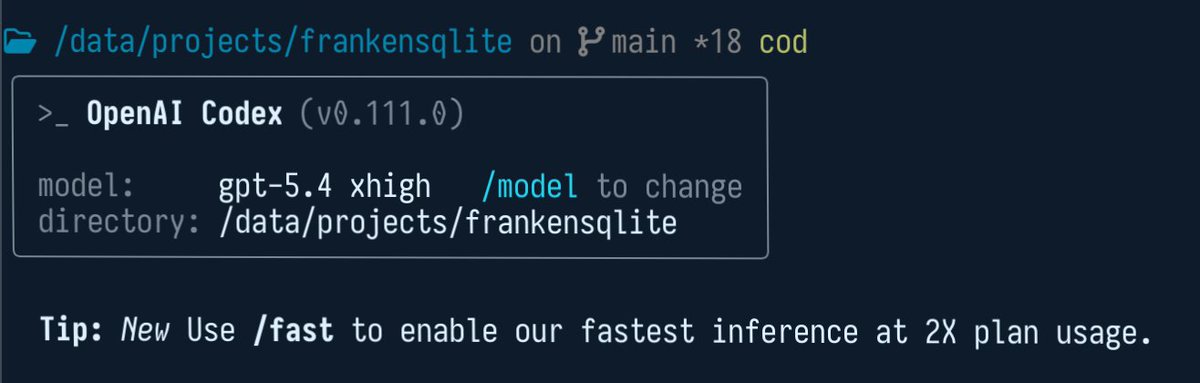
Yeah I’m also trying to navigate. Actually I already tested and convinced myself that xhigh is fine for planning and discussion. But high is about 2x faster for pretty much no loss on implementation quality: so, I use high for codex implementation, especially in my internal “swarm” which uses up to 24 agents in parallel. High is clearly better in that regard.
English
1
0
1
163
Jeffrey Emanuel
Jeffrey Emanuel@doodlestein·
I have a feeling this /fast thing is going to cost me a lot of money...
Jeffrey Emanuel tweet media
English
6
0
50
6.4K
Bob Jordan
Bob Jordan@bobjordanjr·
I just posted our @EquatorOps explainer video. EquatorOps computes the downstream impact of ops changes before rollout. Supplier swaps, spec updates, process revisions. It maps what a change touches across supply chain, compliance, and schedule, and it generates audit-ready traceability for regulated teams.
EquatorOps@EquatorOps

New explainer video for EquatorOps. We compute the impact of ops changes before you approve them. See what breaks, what must be re-verified, and what it will cost in schedule and risk. Built for regulated environments, useful for any ops team.

English
0
0
1
51
Bob Jordan
Bob Jordan@bobjordanjr·
@amorriscode This is awesome, our existence has fundamentally changed
English
0
0
1
23
Bob Jordan
Bob Jordan@bobjordanjr·
@CollinRugg I grew up in WV where 16yrs is legal age of consent. I'm not saying this is not morally repugnant, but evidently in LA its 17yrs. Seems like we should just agree on this nationally.
English
0
0
3
7.2K
Collin Rugg
Collin Rugg@CollinRugg·
A Louisiana mayor was caught by her own children r*ping one of their 16-year-old friends at pool party, according to a new report. 43-year-old Misty Roberts is currently on trial for third-degree r*pe. After finding out about the alleged assault, the mother of the victim texted the then-mayor to make sure she wasn’t pregnant. Roberts took a screenshot of the messages and shared it in a chat with friends before ordering Plan B on DoorDash. The son of Roberts explained to investigators that he saw his mother having s*x with his friend before changing his story. Roberts’ ex-husband recently testified that she told him directly that she had s*x with the teen. “A photo seen by the jury showed Roberts at the party in her bikini, with the teen victim looking up at her and smiling,” the New York Post reported. “The victim’s friend said Roberts’ daughter told a group of teens that night she saw her mom and the minor making out by the pool. He said he later he saw Roberts and the boy having s*x.”
English
1.4K
1.9K
16.5K
5.8M
Bob Jordan
Bob Jordan@bobjordanjr·
@ryancarson Do you think it's best to prepare to let agents use your app by CLI? Or via API? Or both?
English
0
0
2
62
Ryan Carson
Ryan Carson@ryancarson·
It's time for you to think about how an agent can use your app via CLI. In the future, none of us (including our agents) are going to want to log in to a web interface to do anything. Agents will to do everything via CLI + writing their own code.
English
61
28
255
16.9K
🍓🍓🍓
🍓🍓🍓@iruletheworldmo·
this from the ceo of cursor is a must read. probably one of the best articles i've read in the last few years and perfectly captures the changing landscape you simply have to read this, read it right now. the ground is shifting beneath us, be ready.
Michael Truell@mntruell

x.com/i/article/2026…

English
61
165
3.1K
1.5M
Bob Jordan
Bob Jordan@bobjordanjr·
@doodlestein I have not used everything in the agent flywheel stack, but I can tell what you're doing is a superb approach given all of our early stage coming to speed with this tech, you're at the cutting edge for shipping solid high velocity software from a dev tool perspective. But, where dev tool "shipped working software" fails in being truly usable for industry use, is in the traceability and proofs sections. For example, do you think your agent-flywheel approach can be used in a regulatory environment, such as say, building firmware for a class III life/death medical device with it? Or building aerospace industry related software that ensures planes don't crash? There is still a large gap between high velocity dev tool shipping usable software, and what regulated industry requires for proofs. That's the gap I'm working on closing these days. Cursor's CEO's blog kind of foreshadows it a bit, regarding what he describes as "parallel practical, because artifacts and previews give you enough context to evaluate output without reconstructing each session..." at least it aligns with the direction I'm taking.
English
1
0
2
204
Jeffrey Emanuel
Jeffrey Emanuel@doodlestein·
@iruletheworldmo I’ve been doing this kind of thing for like 4-5 months now. It’s all available today, 100% open-source and free, in a way that works with any model or agent provider at agent-flywheel.com . No need to get trapped inside a walled garden that doesn’t even work as well.
English
6
3
68
5.2K
Bob Jordan
Bob Jordan@bobjordanjr·
FCP Trust Escalation Ladder — Implementation Plan (v2) Context The Flywheel Connector Protocol evaluation (docs/connector_protocol/platform_fcp_evaluation_022726_v2.md) identified a coherent set of improvements that form a trust escalation ladder: Quarantine → Sanitizer Receipt → Operation Intent → Egress Gateway → Operation Receipt → Approval Token → Entity Audit Chain → Signed Compliance Export The platform already has significant infrastructure at the lower rungs. The work is: 1. Fix confirmed defects (destructive test endpoint, two compliance implementations, DNS gap, stub hooks) 2. Wire the existing OperationEvidence model into execution lifecycles 3. Add the missing rungs as new models + services 4. Assemble them into a coherent trust architecture Implemented as 5 sequential agent swarm runs. Run 6 (Sovereign Runtime) deferred.
English
0
0
1
31
Bob Jordan
Bob Jordan@bobjordanjr·
@doodlestein I finally got a chance to dig into this FCP protocol you created today, fed it to GPT-Pro vs some key parts of our code base. Although I can't really use the lib as is, the review did help me use some of the core aspects to harden key parts of the system. You're doing Gods work.
English
2
0
1
64
Jeffrey Emanuel
Jeffrey Emanuel@doodlestein·
When you're designing a complex protocol specification, especially when security is involved, just one iteration of review by GPT Pro 5.2 with Extended Reasoning doesn't cut it. I'm now working on what I call the Flywheel Connector Protocol, which is my approach to combining potentially dangerous or untrusted data pipes to and from various sources such as Telegram, Discord, Gmail, X, etc. You can see the main goals of the project in the README file here: github.com/Dicklesworthst… Basically, the goal is to have security and isolation built in at the protocol level, and also extreme performance and reliability, with everything done in Rust in a uniform manner that conforms to the protocol specification. You can see the current version of the spec here: github.com/Dicklesworthst… This is already my 5th iteration, where each round starts in a new session and begins with the full revised specification and readme file from the prior round that has had all the previous changes integrated using Claude Code. Despite that, these aren't just minor tweaks, as you can see in the attached screenshot. But they are starting to dampen in magnitude. It very much reminds me of a numerical optimizer gradually converging on a steady state after wild swings in the initial iterations. With each round, the specification becomes "less wrong." Not only is this a good thing because the protocol improves, but it also means that in the next round of review, GPT Pro can focus its considerable intellectual energies on the nuanced particulars and in finding just the right abstractions and interfaces because it doesn't need to put out fires in terms of outright mistakes or security problems that preoccupy it in earlier rounds. Normally I don't do more than 5 or 6 rounds, but given that this is probably the most ambitious thing I've attempted and I want to make sure it's perfect before I start implementing a massive amount of Rust connectors, I am going to try to do between 15 and 20 rounds. Every time I do a round of review on the spec document and integrate the latest revisions, I then have Claude Code and Codex revise and harmonize the README for the Flywheel Connectors project as a whole and also harmonize this related document here: github.com/Dicklesworthst… This document details the canonical connector implementations in Rust, and it helps to keep everything grounded, and also leaves an audit trail in the git commit history to trace through the evolution of the system both in the abstract "specification space" and then in the more concrete "implementation space." You might object that it's pointless to update the README and this implementation document if we know already that we are going to make many more revisions to the specification document, but when you start thinking of each round of iteration as a sort of perturbation in an optimization process, it seems intuitively desirable to me (at least I have a very strong gut feeling that I can't fully explain) that you want these changes mirrored in the implementation as you go. This reduces the shock of trying to apply N revisions all at once and helps to surface problems better. After all, when you start turning ideas into Rust, the faulty assumptions get surfaced earlier and can feed back into your specification revisions. In fact, once every few review sessions, I also include the entire implementation file as another check so that it can be factored in (doing so surely reduces the intensity of the review on the specification because of the context dilution and forcing the model to spread its attention more thinly, but I think it's worth it). To make this more concrete, I will share the various prompt templates I use for this process. To take the last version of the spec and get revisions to it in GPT Pro 5.2 with Extended Reasoning in the webapp, I do this: --- First, read this README: ``` ``` --- NOW: Carefully review this entire plan for me and come up with your best revisions in terms of better architecture, new features, changed features, etc. to make it better, more robust/reliable, more performant, more compelling/useful, etc. For each proposed change, give me your detailed analysis and rationale/justification for why it would make the project better along with the git-diff style change versus the original plan shown below: ``` ``` --- That's it, pretty simple, really. You can see an actual example round here: chatgpt.com/share/69653838… And of course, you can see the full revision history on GitHub here: github.com/Dicklesworthst… Then you paste the full output from GPT Pro into Claude Code; but before doing that, you have to make sure CC is "primed": ❯ First read ALL of the AGENTS dot md file and README dot md file super carefully and understand ALL of both! Then use your code investigation agent mode to fully understand the code, and technical architecture and purpose of the project. Read ALL of the V2 spec doc and the connector doc. Then paste in the GPT Pro output like this: ❯ Now integrate all of this feedback (and let me know what you think of it, whether you agree with each thing and how much) from gpt 5.2: ```[Pasted text #1 +948 lines]``` | be meticulous and use ultrathink. Then follow it with this: ❯ We need to revise the README too for these changes (don't write about these as "changes" however, make it read like it was always like that, we don't have any users yet!) Use ultrathink. If at any point it did a compaction, all bets are off! You must force it to reread ALL of the primary documents again before continuing, which you can do like this: ❯  Reread AGENTS dot md so it's still fresh in your mind. Also reread the entire V2 spec so it's fresh before you read the docs/fcp_model_connectors_rust.md . Use ultrathink. Then you can harmonize the implementation doc like this: ❯ Now review docs/fcp_model_connectors_rust.md ultra carefully and ensure it is 100% harmonized with the V2 spec and as optimized as possible subject to those constraints. Then after that, I separately have Codex with GPT 5.2 Codex Extra High do some checks: › Reread AGENTS dot md so it's still fresh in your mind. Also reread the entire V2 spec so it's fresh before you read the docs/fcp_model_connectors_rust.md . OK, now I just made a bunch of revisions to the V2 spec so you once again need to harmonize docs/fcp_model_connectors_rust.md with the latest v2 spec and ensure it's perfectly compatible with the protocol and as optimized as possible subject to those constraints. I don't tell Codex that I already had CC revise the implementation document because I want it to try harder and think it has more to do besides just reviewing it. Finally, push your changes so you have a record of each round: › Now, based on your knowledge of the project, commit all changed files now in a series of logically connected groupings with super detailed commit messages for each and then push. Take your time to do it right. Don't edit the code at all. Don't commit obviously ephemeral files. Use ultrathink. Now you're ready to do it all over again, taking the latest spec doc and starting a new conversation with GPT Pro in the webapp. As I mentioned, once every 3 or 4 rounds, you can simply also include the implementation document in the input you provide to GPT Pro, introducing it after the readme part as: --- And here is a document detailing Rust implementations for the canonical connector types that follow the specification document given below; you should also keep the implementation in mind as you think about the specification, since ultimately the specification needs to be translated into the Rust code eventually! ``` ```
Jeffrey Emanuel tweet media
English
11
4
47
11.6K