Brennan Simon

13 posts

Brennan Simon

Brennan Simon

@brennan__simon

Agents for Computational Cancer Research - Graduate Student, Cancer Biology PhD Program Stanford University


Katılım Eylül 2025
60 Takip Edilen4 Takipçiler
Brennan Simon
Brennan Simon@brennan__simon·
@nickcammarata It’s so satisfying to interpret a comp bio model and see that it learned both true biology and previously unknown biology
English
0
0
0
10
Nick
Nick@nickcammarata·
I think more computational biologists should consider switching to nn interpretability, you don’t have to play on hard mode
English
9
5
268
16.8K
Brennan Simon
Brennan Simon@brennan__simon·
@karpathy Extremely exciting idea for an application in science research - curating a subfield-specific knowledge base based on relevant papers, datasets, methods, hypotheses, etc. Anyone in the comments have experience setting this up for academic science?
English
0
0
0
2
Andrej Karpathy
Andrej Karpathy@karpathy·
LLM Knowledge Bases Something I'm finding very useful recently: using LLMs to build personal knowledge bases for various topics of research interest. In this way, a large fraction of my recent token throughput is going less into manipulating code, and more into manipulating knowledge (stored as markdown and images). The latest LLMs are quite good at it. So: Data ingest: I index source documents (articles, papers, repos, datasets, images, etc.) into a raw/ directory, then I use an LLM to incrementally "compile" a wiki, which is just a collection of .md files in a directory structure. The wiki includes summaries of all the data in raw/, backlinks, and then it categorizes data into concepts, writes articles for them, and links them all. To convert web articles into .md files I like to use the Obsidian Web Clipper extension, and then I also use a hotkey to download all the related images to local so that my LLM can easily reference them. IDE: I use Obsidian as the IDE "frontend" where I can view the raw data, the the compiled wiki, and the derived visualizations. Important to note that the LLM writes and maintains all of the data of the wiki, I rarely touch it directly. I've played with a few Obsidian plugins to render and view data in other ways (e.g. Marp for slides). Q&A: Where things get interesting is that once your wiki is big enough (e.g. mine on some recent research is ~100 articles and ~400K words), you can ask your LLM agent all kinds of complex questions against the wiki, and it will go off, research the answers, etc. I thought I had to reach for fancy RAG, but the LLM has been pretty good about auto-maintaining index files and brief summaries of all the documents and it reads all the important related data fairly easily at this ~small scale. Output: Instead of getting answers in text/terminal, I like to have it render markdown files for me, or slide shows (Marp format), or matplotlib images, all of which I then view again in Obsidian. You can imagine many other visual output formats depending on the query. Often, I end up "filing" the outputs back into the wiki to enhance it for further queries. So my own explorations and queries always "add up" in the knowledge base. Linting: I've run some LLM "health checks" over the wiki to e.g. find inconsistent data, impute missing data (with web searchers), find interesting connections for new article candidates, etc., to incrementally clean up the wiki and enhance its overall data integrity. The LLMs are quite good at suggesting further questions to ask and look into. Extra tools: I find myself developing additional tools to process the data, e.g. I vibe coded a small and naive search engine over the wiki, which I both use directly (in a web ui), but more often I want to hand it off to an LLM via CLI as a tool for larger queries. Further explorations: As the repo grows, the natural desire is to also think about synthetic data generation + finetuning to have your LLM "know" the data in its weights instead of just context windows. TLDR: raw data from a given number of sources is collected, then compiled by an LLM into a .md wiki, then operated on by various CLIs by the LLM to do Q&A and to incrementally enhance the wiki, and all of it viewable in Obsidian. You rarely ever write or edit the wiki manually, it's the domain of the LLM. I think there is room here for an incredible new product instead of a hacky collection of scripts.
English
2.9K
7.1K
58.9K
21.1M
Brennan Simon
Brennan Simon@brennan__simon·
@Prof_Lundberg Amazing work! Can this be fine tuned for proteome-wide prediction from H&E images? There’s been progress in predicting transcriptomics from H&E but proteome prediction would be better, expression levels and/or interactions. H&E might not mark the ER or microtubules well though…
English
0
0
0
5
Emma Lundberg
Emma Lundberg@Prof_Lundberg·
What would it look like to see all ~13,000 proteins inside a single human cell at once? We share ProtiCelli — a generative model that makes this possible. Besides benchmarking, we demonstrate utility in many tasks. Preprint: bit.ly/3NY175q A thread 🧵👇
English
8
121
455
37.5K
Brennan Simon
Brennan Simon@brennan__simon·
Obsidian seems like the popular choice
elvis@omarsar0

Building a personal knowledge base for my agents is increasingly where I spend my time these days. Like @karpathy, I also use Obsidian for my MD vaults. What's different in my approach is that I curate research papers on a daily basis and have actually tuned a Skill for months to find high-signal, relevant papers. I was reviewing and curating papers manually for some time, but now it's all automated as it has gotten so good at capturing what I consider the best of the best. There are so many papers these days, so this is a big deal. You all get to benefit from that with the papers I feature in my timeline and on @dair_ai. The papers are indexed using @tobi qmd cli tool (all of it in markdown files along with useful metadata). So good for semantic search and surfacing insights, unlike anything out there. I am a visual person, so I then started to experiment with how to leverage this personal knowledge base of research papers inside my new interactive artifact generator (mcp tools inside my agent orchestrator system). The result is what you see in the clip. 100s of papers with all sorts of insights visualized. I keep track of research papers daily, so believe me when I tell you that this system is absolutely insane at surfacing insights. This is the result of months of tinkering on how to index research and leverage agent automations for wikification and robust documentation. But this is just the beginning. The visual artifact (which is interactive too) can be changed dynamically as I please. I can prompt my agent to throw any data at it. I can add different views to the data. Different interactions. I feel like this is the most personalized research system I have ever built and used, and it's not even close. The knowledge that the agents are able to surface from this basic setup is already extremely useful as I experiment with new agentic engineering concepts. I feel like this knowledge layer and the higher-level ones I am working on will allow me to maximize other automation tools like autoresearch. The research is only as good as the research questions. And the research questions are only as good as the insights the agents have access to. Where I am spending time now is on how to make this more actionable. I am obsessed about the search problem here. The automations, autoresearch, ralph research loop (I built one months ago) are easier to build but are only as good as what you feed them. Work in progress. More updates soon. Back to building.

English
0
0
2
18
Brennan Simon
Brennan Simon@brennan__simon·
Big implications for science research, imagine a knowledge base tailored to your subfield consisting of relevant papers, methods, datasets, hypotheses, etc. Going to try a system for this to be automatically updated by agents with new papers and to support hypothesis generation
Andrej Karpathy@karpathy

LLM Knowledge Bases Something I'm finding very useful recently: using LLMs to build personal knowledge bases for various topics of research interest. In this way, a large fraction of my recent token throughput is going less into manipulating code, and more into manipulating knowledge (stored as markdown and images). The latest LLMs are quite good at it. So: Data ingest: I index source documents (articles, papers, repos, datasets, images, etc.) into a raw/ directory, then I use an LLM to incrementally "compile" a wiki, which is just a collection of .md files in a directory structure. The wiki includes summaries of all the data in raw/, backlinks, and then it categorizes data into concepts, writes articles for them, and links them all. To convert web articles into .md files I like to use the Obsidian Web Clipper extension, and then I also use a hotkey to download all the related images to local so that my LLM can easily reference them. IDE: I use Obsidian as the IDE "frontend" where I can view the raw data, the the compiled wiki, and the derived visualizations. Important to note that the LLM writes and maintains all of the data of the wiki, I rarely touch it directly. I've played with a few Obsidian plugins to render and view data in other ways (e.g. Marp for slides). Q&A: Where things get interesting is that once your wiki is big enough (e.g. mine on some recent research is ~100 articles and ~400K words), you can ask your LLM agent all kinds of complex questions against the wiki, and it will go off, research the answers, etc. I thought I had to reach for fancy RAG, but the LLM has been pretty good about auto-maintaining index files and brief summaries of all the documents and it reads all the important related data fairly easily at this ~small scale. Output: Instead of getting answers in text/terminal, I like to have it render markdown files for me, or slide shows (Marp format), or matplotlib images, all of which I then view again in Obsidian. You can imagine many other visual output formats depending on the query. Often, I end up "filing" the outputs back into the wiki to enhance it for further queries. So my own explorations and queries always "add up" in the knowledge base. Linting: I've run some LLM "health checks" over the wiki to e.g. find inconsistent data, impute missing data (with web searchers), find interesting connections for new article candidates, etc., to incrementally clean up the wiki and enhance its overall data integrity. The LLMs are quite good at suggesting further questions to ask and look into. Extra tools: I find myself developing additional tools to process the data, e.g. I vibe coded a small and naive search engine over the wiki, which I both use directly (in a web ui), but more often I want to hand it off to an LLM via CLI as a tool for larger queries. Further explorations: As the repo grows, the natural desire is to also think about synthetic data generation + finetuning to have your LLM "know" the data in its weights instead of just context windows. TLDR: raw data from a given number of sources is collected, then compiled by an LLM into a .md wiki, then operated on by various CLIs by the LLM to do Q&A and to incrementally enhance the wiki, and all of it viewable in Obsidian. You rarely ever write or edit the wiki manually, it's the domain of the LLM. I think there is room here for an incredible new product instead of a hacky collection of scripts.

English
0
0
1
8
Brennan Simon retweetledi
Ayyuce Demirbas 🍀
Ayyuce Demirbas 🍀@demirbasayyuce·
Single-cell RNA-seq data is noisy and sparse. If you look at a count matrix, where rows are genes and columns are cells, the vast majority of entries consist of zeros. In traditional bulk RNA-seq, a zero usually means the gene is not expressed. However, in scRNA-seq, a zero is ambiguous. It could be Biological Zeros (True Zeros), where the gene is simply not being transcribed in that cell at that moment (the count should be zero), or Technical Zeros (Dropouts) where the gene is being expressed, but the sequencing technology failed to capture or amplify the mRNA molecule. The count should be non-zero, but it was dropped to zero. This causes Zero-Inflation. Zero-Inflation means there are more zeros in the data than standard statistical distributions (like Poisson or Negative Binomial) would predict. The Poisson distribution is the standard for counting events, but it assumes that Mean = Variance. In biological data, variance is usually much higher than the mean (overdispersion). Using Poisson would underestimate the variability of gene expression. To fix the variance issue, we use the Negative Binomial (NB) distribution. It has an extra parameter (dispersion) that allows the variance to be much larger than the mean. However, while NB handles high variance, it still cannot account for all those extra zeros caused by technical dropouts. A popular way to handle this is to use a Zero-Inflated Negative Binomial (ZINB) model, which treats the data as coming from two processes: one that randomly gives extra zeros and another (a negative binomial) that models actual gene expression counts, including some zeros too. In machine learning tools for single-cell analysis, the ZINB loss is basically the negative log-likelihood of this model, meaning the network tries to find parameters (like expression level, variability, and how many extra zeros there are) that best explain the observed counts under the ZINB assumption. This approach acknowledges both technical and biological reasons for zeros and tends to fit scRNA-seq data better than simpler models. I’ve implemented the ZINB loss function from scratch in both PyTorch and TensorFlow. You can check out the full code and implementation details in my notebook here: github.com/ayyucedemirbas…
Ayyuce Demirbas 🍀 tweet media
English
3
17
173
12.1K
Brennan Simon
Brennan Simon@brennan__simon·
Just filmed my submission for Stanford’s 3 Minute Thesis competition - distilling an entire research project while including context and avoiding jargon is tough but good practice, accessible research dissemination is challenging but important
English
0
0
1
19
Brennan Simon
Brennan Simon@brennan__simon·
There’s so much buzz around Claude Code and agentic LLMs, just using ChatGPT 5.2 to write me code and iterate back and forth in the chat makes me feel like I’m falling behind even though it’s so effective. I wonder how much of a boost Claude code provides for bioinformatics
English
0
0
1
37
Brennan Simon retweetledi
James Zou
James Zou@james_y_zou·
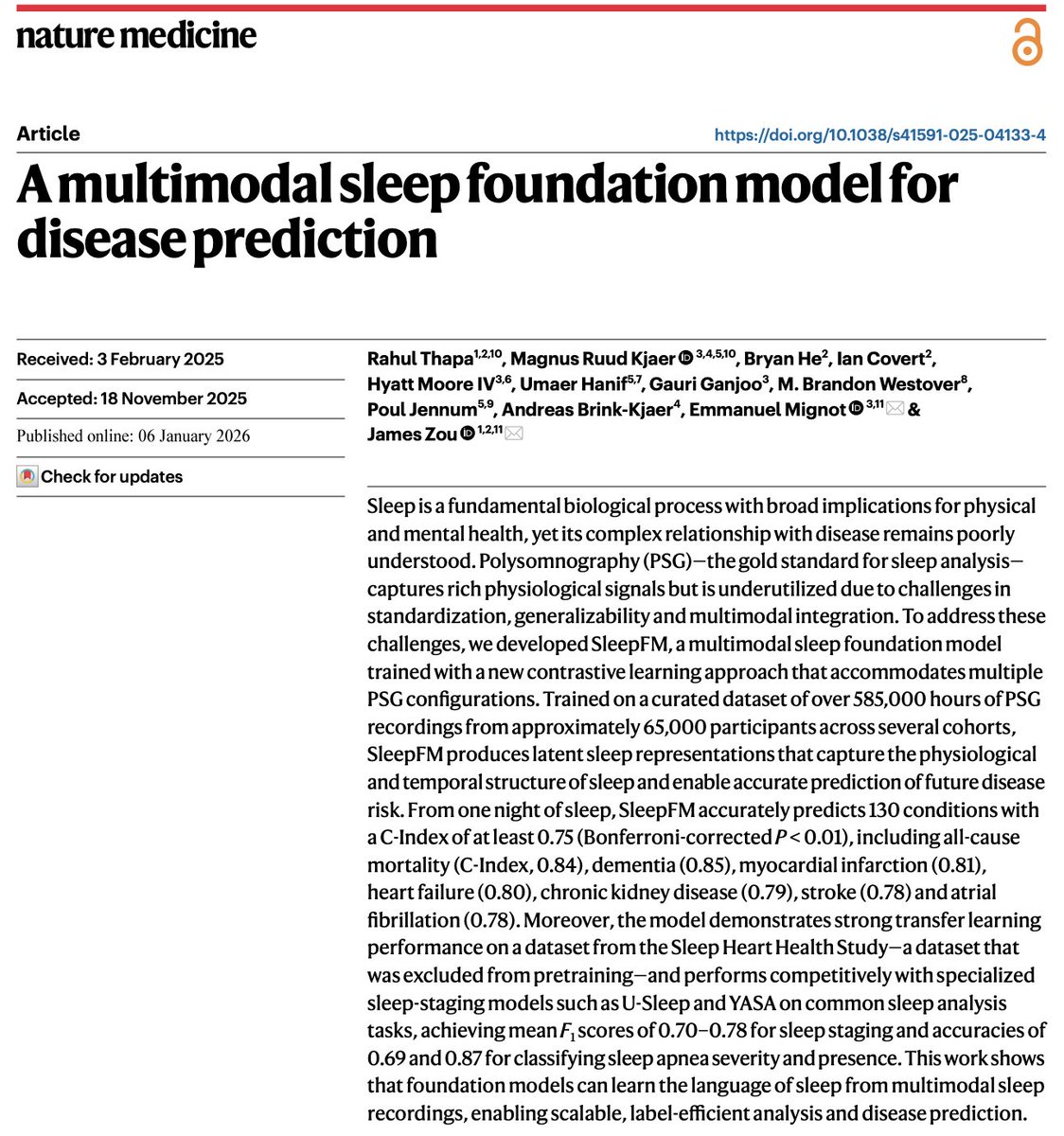
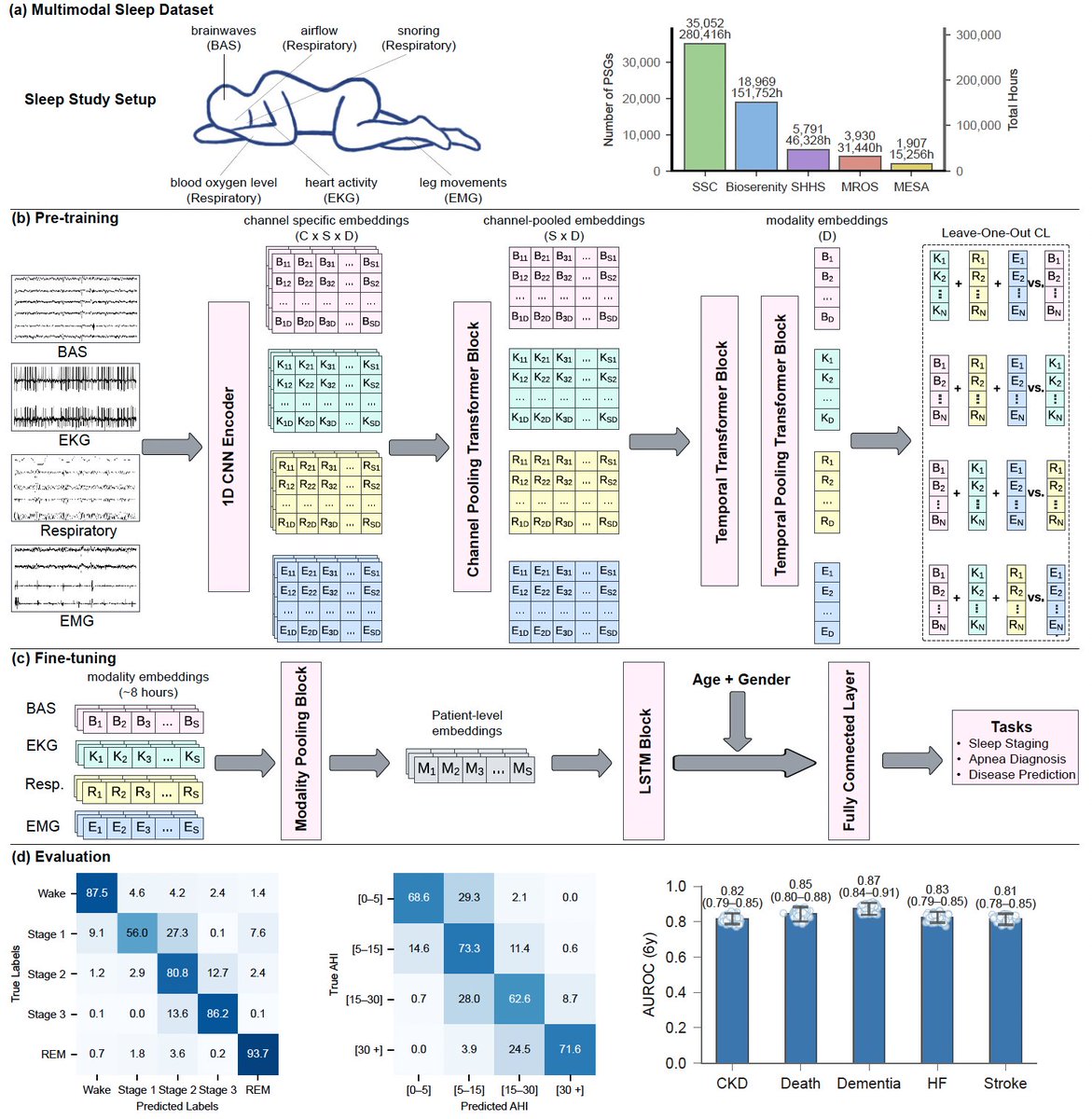
Today in @NatureMedicine we report that AI can predict 130 diseases from 1 night of sleep🛌 We trained a foundation model (#SleepFM) on 585K hours of sleep recordings from 65K people—brain, heart, muscle & breathing signals combined. AI learns the language of sleep🧵
James Zou tweet mediaJames Zou tweet media
English
272
2.1K
11K
914K
Brennan Simon
Brennan Simon@brennan__simon·
How does the scientific community feel about the role of generative AI in science? Not LLMs, but generating synthetic data in situations where real data is sparse due to cost or other reasons, to improve sample size for analysis/model training? Optimistic? Dubious?
English
2
0
2
23
Brennan Simon retweetledi
Stanford HAI
Stanford HAI@StanfordHAI·
📢Introducing #AIIndex2025: This year's report highlights the most critical trends in AI – from shifting geopolitical landscape and rapid technological evolution, to AI’s expanding role in science and medicine, business, and public life. Read more: hai.stanford.edu/ai-index/2025-…
English
23
212
411
157.7K