Keller Jordan@kellerjordan0
Modded-NanoGPT Optimization Benchmark
Hundreds of neural network optimizers have been proposed in the literature, recently including dozens citing Muon: MARS, SWAN, REG, ADANA, Newton-Muon, TrasMuon, AdaMuon, HTMuon, COSMOS, Conda, ASGO, SAGE, and Magma, to name a few.
The majority of this innovation is happening in the public research community. But the community currently lacks a widely accepted, easily accessible way to compare and make sense of the deluge of methods. As a result, promising new ideas get buried, and spurious results go unchallenged.
To help address these issues, I'm releasing a new optimization benchmark. It's designed for maximum simplicity and speed: Just a single file containing ~350 lines of plain PyTorch, which can complete a baseline LM training within 20 minutes of booting up a fresh 8xH100 machine. It also works with {1,2,4}xH100 or A100. These attributes make the new benchmark more accessible than any prior work.
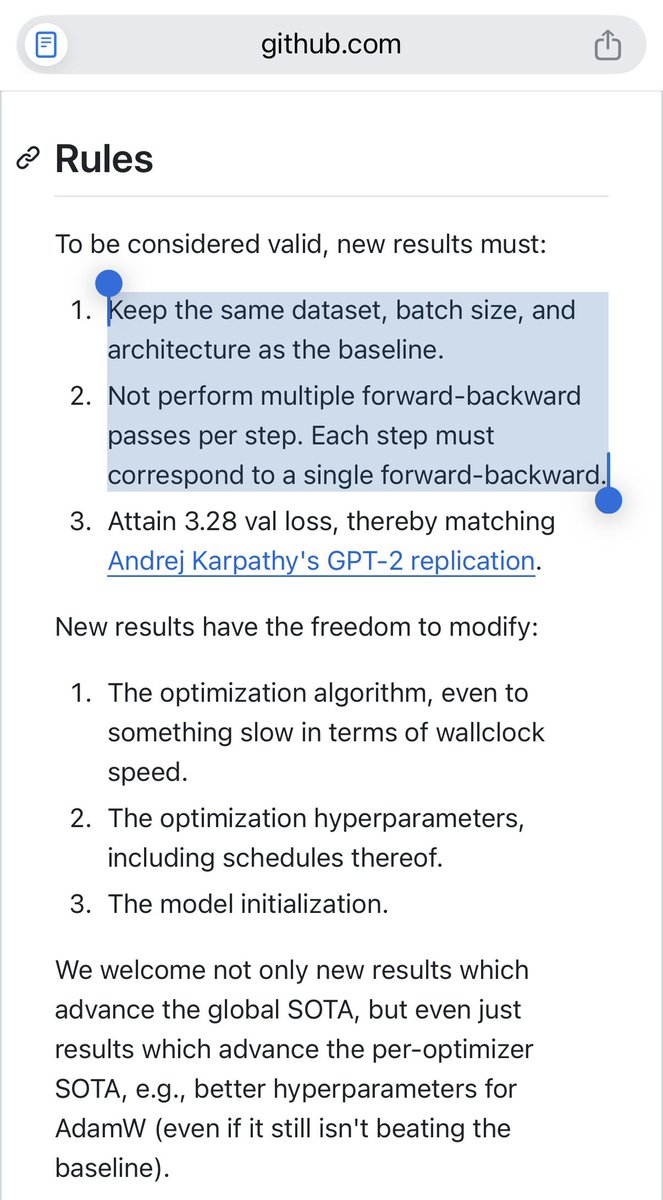
The rules are simple: The optimization algorithm can be changed arbitrarily, with the goal being to minimize the number of training steps needed to reach 3.28 val loss on FineWeb (this is the same target loss as in the main speedrun). Modifying the architecture or dataloader, on the other hand, is not allowed. Wallclock time is unlimited, in order to give a fair chance to optimizers which would need kernel work or larger scale to become wallclock-efficient.
Like the main NanoGPT speedrun, submissions are open, and new results will be publicly broadcast. Beyond just improving the step count record, another goal of the benchmark is to collaboratively produce well-tuned baselines for as many optimizers as possible. For example, any improvement to the benchmark's best hyperparameters for AdamW would be considered a worthwhile new result.
This benchmark is not intended to be the final measure of optimizer quality across all domains. Convenient shared experimental infrastructure which covers the full space of possibilities -- across varying batch size, tokens per parameter, model scale, epoch count, and architecture -- is desirable, but far beyond the current status quo. This benchmark is only meant to be one step towards that goal.
To start the benchmark off, I've spent ~20 runs tuning baselines for Muon and AdamW. From time to time over the next few weeks, I'll add another optimizer from the literature, with my best effort at finding good hyperparameters. Researchers interested in neural network optimization are invited to join in by picking an optimizer and giving it a try on the benchmark. All optimizers are welcome, and even runs that don't necessarily have the best hyperparameters are desirable additions to the repo, because each new run adds to the collective knowledge.