
Sabitlenmiş Tweet
Bret Swanson
12.5K posts


Bret Swanson
@bretswanson
Analyst of technology, the global economy, and far more complex phenomena — his four children / infonomena substack com / @entropyecon / @brownstoneinst
http://entropyeconomics.com Katılım Şubat 2009
3.5K Takip Edilen4.9K Takipçiler
Bret Swanson retweetledi

This is a fascinating story that has been repeated over and over. The Iraq War, 2008 financial crisis, and Covid fiasco were all expert failure. Often wrong, never in doubt.
Hans Mahncke@HansMahncke
The story behind the New York Times’ 1903 claim that human flight was between one and ten million years away is even worse than it looks. Once you understand the backstory, you realize that the New York Times story is not really about flight at all but about how elites and credentialed “experts” mistake their own failures for the boundaries of possibility. The New York Times did not dismiss the possibility of powered flight at random. There was a very specific reason behind it. At the time, America’s most prominent scientific authority, Smithsonian Secretary Samuel Langley, had been showered with large amounts of taxpayer funding to build an aircraft, the Langley Aerodrome. Despite all the money, institutional backing, and elite prestige, Langley and his team could not get it to fly, culminating in a series of very public failures, the last on December 8, 1903. So when the New York Times declared that flight was millions of years away, what it was really saying was that if the most credentialed and well-funded “experts” cannot do it, then it cannot be done. A mere nine days later, the elites’ proclamation of impossibility lay in ruins. Two totally unknown bicycle mechanics from Ohio achieved the first powered flight using improvised parts, a few hundred dollars of their own money, and sheer persistence. The story of flight is, at its core, a story of the triumph of American individualism over elite credentialism. The fact that it was the New York Times that inadvertently delivered the proof is the most fitting conclusion imaginable.
English
I’ve been thinking about, wishing for this for years. David Gelernter called it Lifestreams.
Corey Ganim@coreyganim
Best breakdown of Karpathy's "second brain" system I've seen. My co-founder turned it into an actual step-by-step build. The 80/20: 1. Three folders: raw/ (dump everything), wiki/ (AI organizes it), outputs/ (AI answers your questions) 2. One schema file (CLAUDE.md) that tells the AI how to organize your knowledge. Copy the template in the article. 3. Don't organize anything by hand. Drop raw files in, tell the AI "compile the wiki." Walk away. 4. Ask questions against your own knowledge base. Save the answers back. Every question makes the next one better. 5. Monthly health check: have the AI flag contradictions, missing sources, and gaps. 6. Skip Obsidian. A folder of .md files and a good schema beats 47 plugins every time. He includes a free skill that scaffolds the whole system in 60 seconds.
English
JD Vance, Mr. Vice President, it’s time.
Easter blessings to you.
@JDVance
English
@JohnHCochrane Liang’s listening.👂
Johnathan Bi@JohnathanBi
James Liang is a Chinese billionaire who pays his employees 50K for every baby they make, who is launching a 1 Billion fund to pay PHD students to have children, here’s why… James is the cofounder of trip.com worth $50B, he was also a prodigy academic who started college at 15, got a PHD at Stanford and then became a professor at China's top university PKU. He straddles not just the active and the contemplative life but elite circles across US and China. Sitting at this unique intersection helped him articulate his most important idea: that demography is one of the most overlooked factors that impact innovation. The problem with an aging population is not just the financial strain on pensions but a cultural, technological stagnation that will suffocate any creative act. Gerontocracies (rule by the old) result in sterile, hierarchical, and unimaginative futures. If humanity is going to continue innovating, humanity needs to stay young. James believes offering money alone can significantly fix the problem and is putting his money where his mouth is. In this interview, you will learn about the coming population collapse from one of the world’s foremost demography experts and what to do about it from one of the world’s most resourceful entrepreneurs. Timestamps: 2:02 Paying Employees to Have Babies 3:09 Low Fertility Kills Innovation 11:05 The Young Want Merit. The Old Want Hierarchy 15:42 Small Population = Little Innovation 33:50 Why a CEO Left for Academia 48:33 Humanity Craves Novelty 55:14 True Innovation Creates Heritage 1:16:32 AI Won’t Lead Innovation
English
Bret Swanson retweetledi

Bret Swanson retweetledi

The Internet was built on TCP/IP.
The Web was built on HTTP.
Email was built on SMTP.
The AI economy will be built on an open payment standard.
Coinbase 🛡️@coinbase
English
Bret Swanson retweetledi

Permissionless Innovation: 10 Questions on its 10th Anniversary
This week marks the 10th anniversary of the release of my 2016 book, "Permissionless Innovation: The Continuing Case for Comprehensive Technological Freedom.” In the book, I argued that the freedom to innovate was a foundational building block of human flourishing and deserved a greater defense as such.
Here are 10 questions asked and answered about the book and the concept of permissionless innovation more generally.

English
The “wet market” is dead. Here’s one of many good refutations of bad “wet market” propaganda, always labeled “definitive” by the NYT and SciAm etc, which so bowled over Noah, SlateStar, Tyler, and the managerial muggles.
Michael Weissman@mbw61567742
My paper showing that the famous multiple-spill Pekar paper got its conclusion upside down by a math error is now published. Links below. I think that the press who covered the original should cover the real result with the opposite (single spill) conclusion.
English
Noah, like 99% of D.C. policy world, got all things Covid wrong. 🤦♂️ Including the origin.
Here’s the molecular evidence SARS2 was engineered.
“Who Engineered the Virus?” open.substack.com/pub/infonomena…
“Smoking Enzyme (Re)Confirms SARS2 Was Engineered” open.substack.com/pub/infonomena…
Noah Smith 🐇🇺🇸🇺🇦🇹🇼@Noahpinion
Yes, the lab leak theory turned out to almost certainly false.
English
“At BlackRock, we force behaviors.”
At the Indiana state pension fund (INPRS), I was among the first to call out Fink’s politicized investing.
Larry lost. We, and shareholders, won.

Defiant L’s@DefiantLs
BlackRock CEO Larry Fink: The "woke era" was "a failed experiment"
English
🤦♂️ The neocons’ political analysis is nearly as bad as their military and geostrategic advice.
How many times will the GOP fall for it?
Launch self destructive, insanely expensive wars. But in return at least we destroy our political coalition!
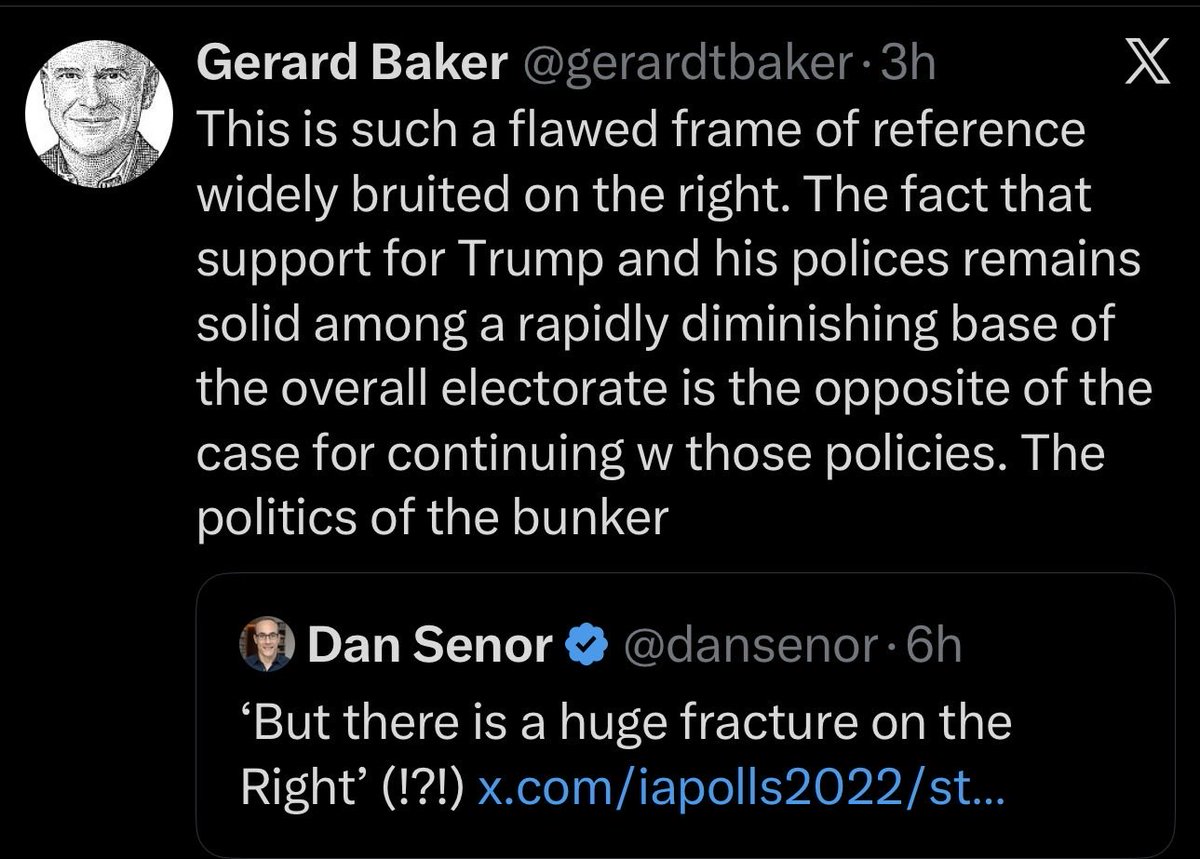
Dan Senor@dansenor
‘But there is a huge fracture on the Right’ (!?!)
English
Bret Swanson retweetledi

That's a great line. I've been saying for years " the thing about engineers is that either the bridge falls down or it doesn't" but this is much pithier.
Colin Brazier@ColinBrazierTV
“In engineering, you are peer reviewed by reality”. From Rory Sutherland, in this week’s Spectator.
English
Bret Swanson retweetledi

Adults: Let’s ban AI in schools.
Alpha School students: Look at this awesome history app we built with AI.
Austin Way@AustinA_Way
Our history students spend 45 minutes a day voluntarily learning geography. Every break, Every lunch... Same thing... GeoGuesser. So we asked the obvious question: Why doesn't this exist for history? We built it. You watch AI footage from a time and place in history. Then you guess where and when it happened. They love it.
English
Bret Swanson retweetledi
Please, @Noahpinion, do take a look at my lecture at NIH last week to understand why I changed my mind from thinking the lab leak theory was almost certainly false to thinking it was almost certainly true.
videocast.nih.gov/watch/244438a5…
Noah Smith 🐇🇺🇸🇺🇦🇹🇼@Noahpinion
Yes, the lab leak theory turned out to almost certainly false.
English
@jasonfurman Prof Furman, here are a couple replies to your request. Dozens more available. I was an AEI fellow for 10 years.
Bret Swanson@bretswanson
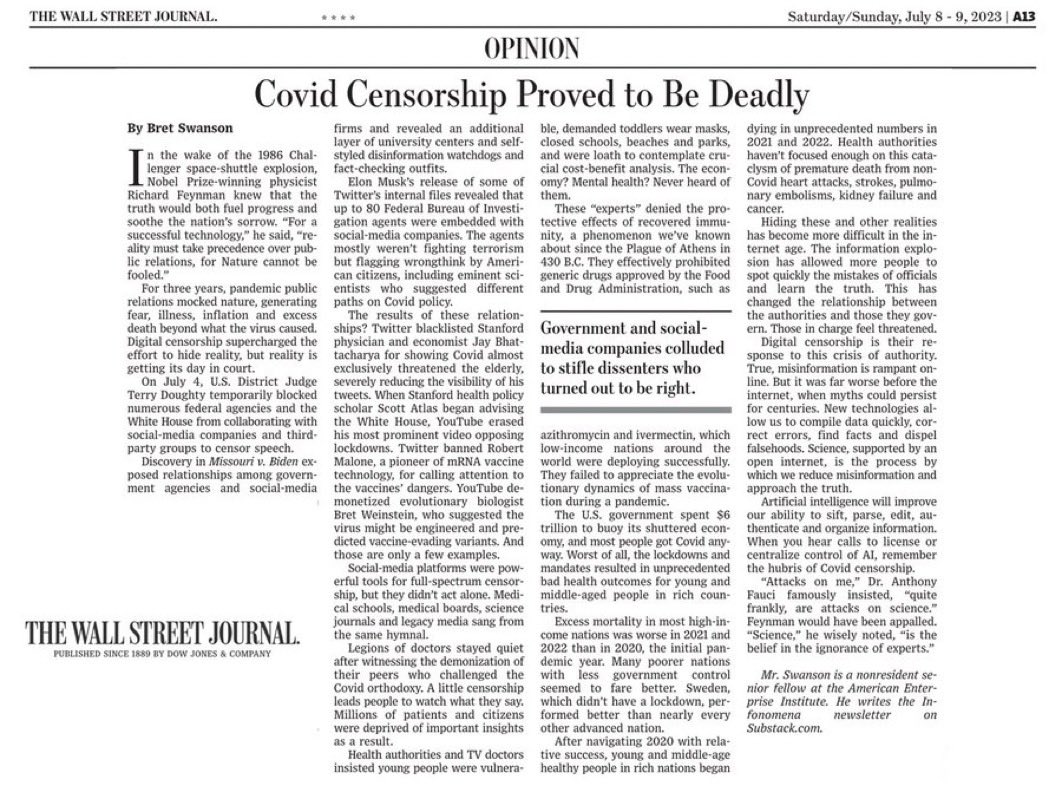
Here are several replies: — “AEI and Johns Hopkins Attempt a Covid Redo.” open.substack.com/pub/infonomena… — “Covid Censorship Proved to Be Deadly.”
English
I agree with these.
But am curious how it compares to Europe. They had much, much more draconian lockdowns. But did they not have the same vacillation and hypocrisy that we had? Is the backlash more or less there than here?
Pointers to writing on this most welcome.
Patrick Collison@patrickc
Offhand — * Vacillation on masks, with abundant motivated reasoning in every case. * Promulgation of made-up thresholds with no evidentiary basis (e.g. 6 feet). * Authoritarian delight in nanny state intrusiveness (policing the beach and such). * 180 on many issues around BLM. * Lack of effective response from science funding bodies. * Denial of aerosolized transmission. * Changing of trial readouts so that they’d occur after the election. (Confirmed to me by senior OWS officials.) * Crazy criteria for vaccine distribution. * Adamant insistence on vaccine efficacy beyond what was supported by data. * Almost complete lack of follow-through on OWS (on pan-variant vaccines). I’m sure there are more, but those are the ones that stick out.
English
Yes, except the “young boys” story is incorrect. Heart damage hit *everyone.* Among young males it was especially *conspicuous.* In fact, heart damage and death hit every age group, where vaxx harms were less *obvious.*

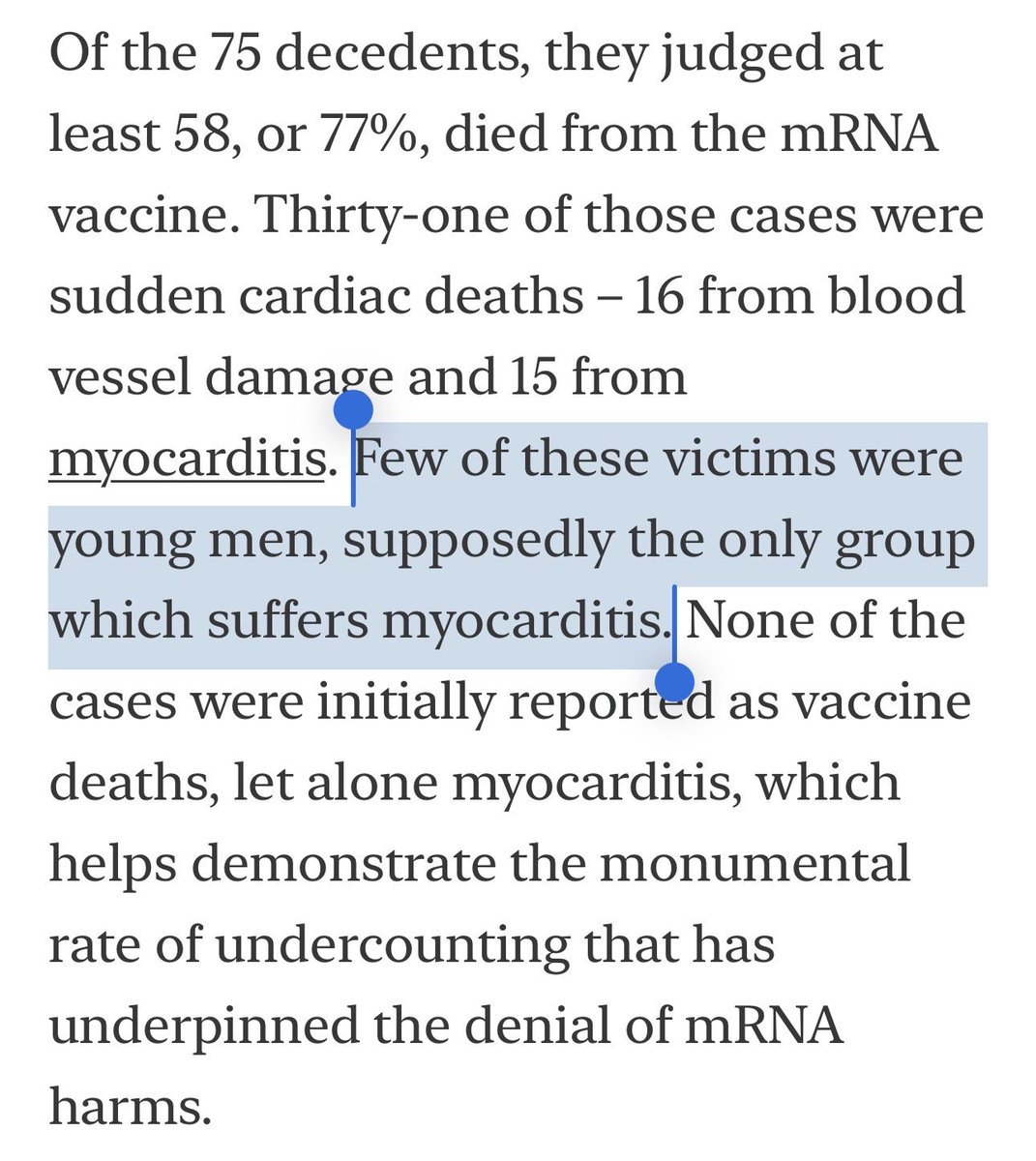
Katherine Boyle@KTmBoyle
Great thread and one addition: Increased risk of myocarditis in young boys. The demonization of parents who asked, the denials by healthcare professionals and bureaucrats, and ultimately, the admission and subsequent FDA warning proving parents worst fears correct. It will take generations to recover from COVID authoritarianism.
English
Here are several replies:
— “AEI and Johns Hopkins Attempt a Covid Redo.” open.substack.com/pub/infonomena…
— “Covid Censorship Proved to Be Deadly.”

Conor Friedersdorf@conor64
A question for everyone: survey data suggests that by the end of the Covid-19 emergency trust in public health institutions had decreased significantly. If you are among the people who reacted that way, why specifically? I'm hoping for long, diverse, individualized answers.
English
I applaud Patrick for these late-stage acknowledgments.
But what about the people who 1) got nearly every one of these items right from the beginning and 2) were fired / censored / defamed?
Patrick Collison@patrickc
Offhand — * Vacillation on masks, with abundant motivated reasoning in every case. * Promulgation of made-up thresholds with no evidentiary basis (e.g. 6 feet). * Authoritarian delight in nanny state intrusiveness (policing the beach and such). * 180 on many issues around BLM. * Lack of effective response from science funding bodies. * Denial of aerosolized transmission. * Changing of trial readouts so that they’d occur after the election. (Confirmed to me by senior OWS officials.) * Crazy criteria for vaccine distribution. * Adamant insistence on vaccine efficacy beyond what was supported by data. * Almost complete lack of follow-through on OWS (on pan-variant vaccines). I’m sure there are more, but those are the ones that stick out.
English