Brett Harrison

5.2K posts

Brett Harrison banner
Brett Harrison

Brett Harrison

@BrettHarrison

Founder & CEO @Architect_Fi | Derivatives exchange group for AI commodities and perpetual futures. Offering the American Innovation Exchange and AX.

Katılım Mayıs 2021
3.1K Takip Edilen63.2K Takipçiler
Sabitlenmiş Tweet
Brett Harrison
Brett Harrison@BrettHarrison·
Introducing the American Innovation Exchange, the first U.S. derivatives exchange designed for trading the AI economy. Trade futures and options on compute, metals, energy, and other critical instruments in the AI supply chain. Coming soon from Architect.
English
30
49
365
68.4K
Brett Harrison
Brett Harrison@BrettHarrison·
How do you size the US compute futures market? Looking at ratios of annual derivatives volume to annual production for a variety of commodities, the answer is somewhere between power and oil: US power: 2.5 Crude oil: 26 Aluminum: 29 Soybeans: 34 Copper: 56 Gold: 86,014
Brett Harrison tweet media
English
12
14
73
5K
Brett Harrison
Brett Harrison@BrettHarrison·
We’re hearing from GPU capacity sellers that customers have been rotating from H100s to B200s, but this change isn’t fully reflected in 12-month forward rental prices. Halfway through 2026, the @ComputeDesk H100 index is up ~40% while the newer B200 return sits at ~27%. For most of the year, surging demand for training and interference hit the H100 fleet first while B200 capacity was unfilled. The H100-B200 spread started to close only over the last few weeks in response to a marketwide demand spike.
Brett Harrison tweet media
English
8
34
152
55.8K
Teng Yan
Teng Yan@tengyanAI·
@BrettHarrison @ComputeDesk every dcf on the buildout assumes last-gen gpus fall off a cliff the moment the new part ships. this says that schedule is way too aggressive. changes the roi math on a lot of capex if h100s hold value longer
English
1
0
5
489
Brett Harrison
Brett Harrison@BrettHarrison·
Inference token costs have been proposed as an alternative to GPU hours as the hedgeable unit of compute for futures and options, but no token index currently offered is viable for US-regulated futures markets due to manipulability. Inference tokens are a potential basis for compute futures and options in addition to GPU capacity. Compute sellers are exposed to GPU rental prices, but commercial and retail end-users of AI require tokens. Converting GPU-time into tokens is a refining step, a similar relationship crude oil has to heating oil where US exchanges list futures on both and the spread between them. By that analogy, inference tokens warrant their own futures contracts alongside GPU-hours. But current inference token indexes carry too much manipulation risk to be compatible with US-regulated futures markets. These indexes are anchored to commercial LLM prices, set by a small number of major frontier model companies at their sole discretion. This pricing methodology is manipulable and conflicts with the CFTC's Core Principles for reference indexes and related US-listed futures. A promising solution for token-based futures uses the “Standard Inference Token” (paper linked below), defined as a token from any model that clears specified thresholds on normalized benchmarks. An index averaging Standard Inference Tokens served by open-source models on well-defined hardware would likely be robust enough to settle hedging instruments for US corporates. Several companies including our partner @ComputeDesk are now building the next generation of inference token indexes. Architect is excited to work within the ecosystem to expand our forthcoming suite of AI-linked US derivatives on the American Innovation Exchange. This discussion is live in our compute markets Telegram. Join us if you're working in this area or want to follow along.
Brett Harrison tweet media
English
9
16
92
6.7K
Brett Harrison
Brett Harrison@BrettHarrison·
Architect is now pre-onboarding individuals and institutions to trade US-listed compute futures on the American Innovation Exchange, launching imminently. Open an account on our website or app, trade the first-ever US GPU futures and options, join our liquidity programs: American Innovation Exchange futures are purpose-built for the US AI ecosystem: • Compute consumers (AI labs, model developers, hyperscalers) can hedge forward GPU pricing and reduce earnings volatility. • Compute producers and neocloud operators can hedge inventory, generate yield through covered strategies, and better finance expansion. • Asset managers, hedge funds, and proprietary trading firms gain efficient, regulated long/short exposure to compute as a distinct asset class. • The broader market benefits from transparent price discovery, a visible forward curve for deprecation, and supply/demand forecasting, and reduced basis risk through collaboration with index providers. Trading will be supported across desktop, mobile, and API, with order book and block trading capabilities. The launch of Architect’s compute futures marks a significant step in developing mature US financial markets for AI infrastructure and supporting the critical buildout of American compute capacity. We look forward to offering a seamless trading experience with low fee and favorable margin treatment to individuals and firms across AI and finance.
English
16
14
84
9.3K
Brett Harrison
Brett Harrison@BrettHarrison·
Onboard at ai.exchange DM or email us for information on liquidity incentive programs, block trading, API access, and clearing firm support.
English
1
0
9
1.3K
Brett Harrison retweetledi
Architect
Architect@Architect_Fi·
PRE-ONBOARDING FOR THE AMERICAN INNOVATION EXCHANGE IS LIVE. Sign up to trade Architect’s Nvidia GPU compute futures and options. Access the first US derivatives market for compute. Competitive margin, low fees, desktop/mobile/API access, block trades supported 🇺🇸
English
4
10
30
6.7K
Brett Harrison
Brett Harrison@BrettHarrison·
@bennpeifert I'm glad you agree this is an interesting new options contract, as our company created it and owns the DCM it will trade on.
English
0
1
58
2.9K
Brett Harrison
Brett Harrison@BrettHarrison·
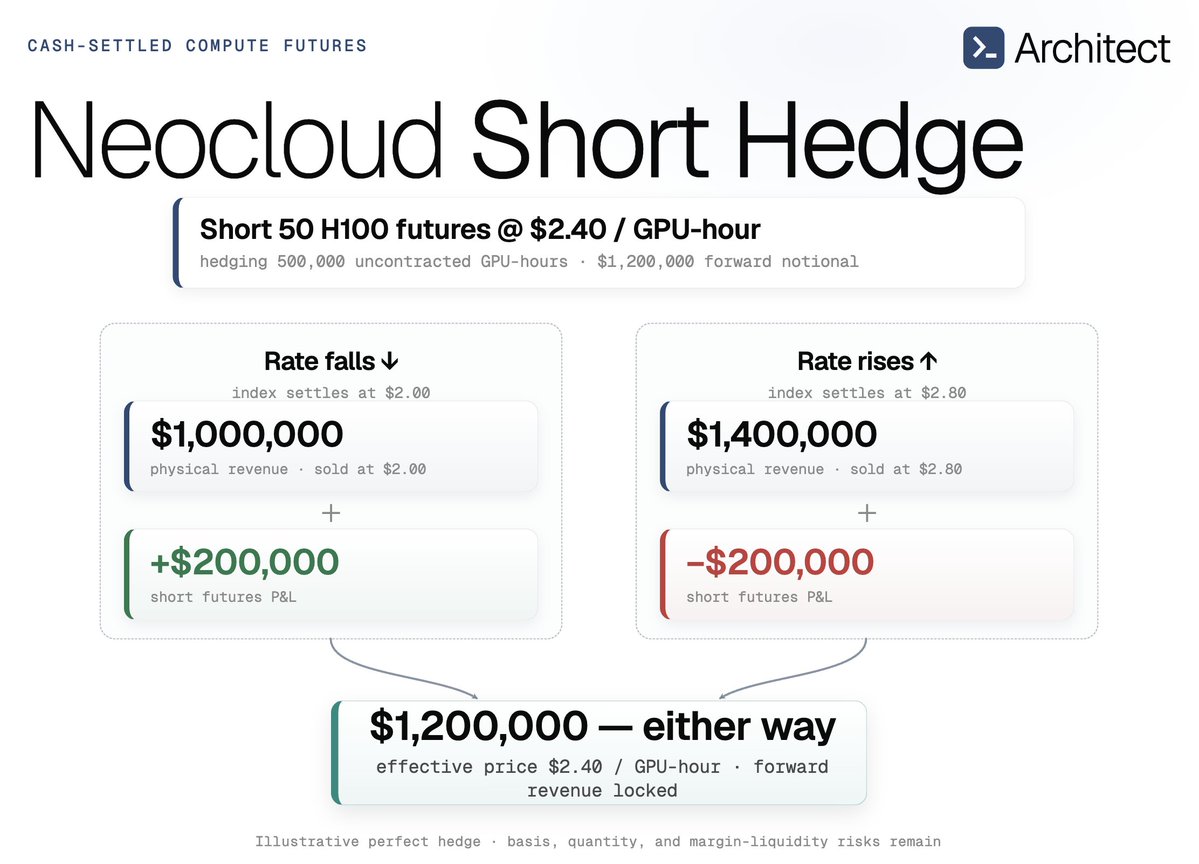
Cash-Settled Compute Futures: Mechanics of a Neocloud Short Hedge The American Innovation Exchange’s GPU compute futures will soon be live for US investors, pending regulatory review. This post walks through a futures trade from the perspective of a neocloud hedging forward unsold capacity. 1. Background Below is a single fully-worked numerical trading example from the perspective of a neocloud operator using a short futures position to lock in the forward sale price of capacity it expects to have available but has not yet contracted to end customers. The example illustrates position sizing, daily mark-to-market, variation margin, cash settlement under two states of the world, and the residual risks that remain after hedging. The futures contract used in this example is cash-settled. At expiration, the position’s P&L is marked to the settlement value derived from the reference index. Cash settlement is the standard convention for commodity derivatives whose underlying is a service or a non-storable, non-deliverable quantity, and compute time falls into this category. Architect will also offer ComputeConnect, an exchange-for-physical mechanism for converting positions into actual compute capacity. In a future post, we will detail how a cash-settled future can be converted to actual compute capacity using EFPs. 2. Contract Specification The following specification is an example of how a single-accelerator, cash-settled compute future could be constructed. The actual exact contract unit, tick size, and margin parameters of any listed contract are set by the futures exchange and its clearing house. • Underlying: NVIDIA H100 rental-price index • Price quotation: U.S. dollars per GPU-hour • Contract unit: 10,000 GPU-hours • Minimum price fluctuation (tick): $0.001 per GPU-hour = $10.00 per contract • Contract months: Monthly, extending along the forward curve • Settlement method: Cash settlement against the final settlement value of the reference index • Final settlement value: Published index level for the delivery period on the last trading day • Initial margin: $6,000 per contract • Maintenance margin: $4,800 per contract 3. The Hedging Problem A neocloud is, in commodity terms, a producer: it holds an inventory of accelerators and sells their output, compute time, to customers. Its economic exposure resembles that of any producer holding unsold inventory. If the market rental rate for H100 capacity declines before the operator has contracted its available GPU-hours, the revenue realized on that capacity falls. The operator is therefore long the physical commodity and bears the risk of a price decline. The standard remedy is a short hedge: the producer sells futures in a quantity that approximates its unsold physical exposure. A decline in the market rate reduces physical revenue but produces an offsetting gain on the short futures, because a short position profits when the futures price falls. A rise in the market rate does the reverse. In both directions the combined outcome converges toward a price fixed at the outset, converting an uncertain forward revenue into a substantially known one. This is the mechanism by which a producer "locks in" a forward sale price without having yet found a counterparty for the physical product. When executed properly, a compute futures hedge removes price variance from a defined block of capacity so that build-out, financing, and margin commitments can be underwritten against a known revenue figure. 4. Establishing the Position Assume the following facts as of the trade date. • The operator projects that it will have 500,000 H100 GPU-hours of uncontracted, saleable capacity during the March 2027 delivery window. • The March 2027 H100 future is trading at a price of F₀ = $2.40 per GPU-hour. • The operator wishes to fix the revenue on the full 500,000 GPU-hours at the prevailing forward level. Number of contracts. The hedge quantity is the physical exposure divided by the contract unit: N = 500,000 GPU-hours ÷ 10,000 GPU-hours per contract = 50 contracts Action. The operator sells (goes short) 50 March 2027 H100 futures at $2.40 per GPU-hour. Notional value hedged. 50 × 10,000 × $2.40 = $1,200,000 Initial margin posted. Each contract has a value of 10,000 × $2.40 = $24,000 at the entry price. Initial margin is 25% of contract value: 50 × (0.25 × $24,000) = 50 × $6,000 = $300,000 The $300,000 is a good-faith performance bond held with the clearing broker (FCM), not a payment for the contracts. It is returned when the position is closed, adjusted for accumulated gains and losses. The economic significance of the position is the $1,200,000 of forward revenue whose price has now been fixed, posted against 25% of that sum in initial margin, which illustrates the capital efficiency of a marginable hedge relative to pre-selling the capacity outright. 5. Daily Mark-to-Market and Variation Margin Futures positions are marked to market at the close of each trading session. The change in the settlement price is converted into a cash flow called variation margin that is debited from or credited to the position holder's account daily. For a short position, a fall in the futures price produces a credit and a rise produces a debit. The following two sessions illustrate the mechanism. Session 1. The futures settle at $2.34, a decline of $0.06 from the entry price. • Variation margin: ($2.40 − $2.34) × 500,000 = +$30,000 The account equity rises from $300,000 to $330,000. Because equity now exceeds the initial margin requirement, the $30,000 excess is available for withdrawal. Session 2. The futures settle at $2.60, a rise of $0.26 from the prior close. • Variation margin: ($2.34 − $2.60) × 500,000 = −$130,000 The account equity falls from $330,000 to $200,000. The maintenance margin requirement is 50 × $4,800 = $240,000. Because equity ($200,000) has fallen below the maintenance level ($240,000), the FCM issues a margin call requiring the operator to restore equity to the initial margin level of $300,000 with a payment of at least $100,000. 6. Cash Settlement at Expiration On the last trading day the contract is settled in cash against the final settlement value of the reference index for the March 2027 window, denoted Sₜ. The cumulative profit or loss on the short futures position is: Futures P&L = (F₀ − Sₜ) × 500,000 This figure is the algebraic sum of all daily variation-margin flows over the life of the position; the final session's mark simply brings the futures price into convergence with the settlement index. In parallel, the operator sells its 500,000 uncontracted GPU-hours into the physical market at the prevailing rate, which for this illustration is taken to equal the settlement index. Two scenarios are considered: Scenario A — The rental rate declines (Sₜ = $2.00) • Physical revenue: 500,000 × $2.00 = $1,000,000 • Futures P&L: ($2.40 − $2.00) × 500,000 = +$200,000 • Combined proceeds: $1,200,000 • Effective realized price: $1,200,000 ÷ 500,000 = $2.40 / GPU-hour The physical revenue is $200,000 below the amount the operator would have received at the entry price, but the short futures position gains exactly $200,000, restoring the combined proceeds to $1,200,000. Scenario B — The rental rate rises (Sₜ = $2.80) • Physical revenue: 500,000 × $2.80 = $1,400,000 • Futures P&L: ($2.40 − $2.80) × 500,000 = −$200,000 • Combined proceeds: $1,200,000 • Effective realized price: $1,200,000 ÷ 500,000 = $2.40 / GPU-hour The physical revenue is $200,000 above the entry-price benchmark, but the short futures position loses $200,000, again returning the combined proceeds to $1,200,000. In both scenarios the effective realized price is $2.40 per GPU-hour, equal to the futures price at which the hedge was established. This symmetry is the defining characteristic of a fully executed short hedge: the operator has exchanged all upside above $2.40 for complete protection below it, fixing the forward revenue on the hedged block of capacity regardless of the direction of prices. 7. Hedge Effectiveness and Residual Risks The example above assumes a perfect hedge, in which the price realized on the physical capacity equals the settlement index, and the hedged quantity equals the quantity ultimately sold. In practice, two residual exposures remain. Basis risk. The rate the operator actually realizes on its own capacity, Rₜ, need not equal the settlement index level, Sₜ, because the index aggregates transactions across many configurations, geographies, and counterparties. The effective realized price generalizes to: Effective price = Rₜ + (F₀ − Sₜ) = F₀ + (Rₜ − Sₜ) where the term (Rₜ − Sₜ) is the basis. If, for instance, the operator realizes $1.95 per GPU-hour while the index settles at $2.00, the effective price becomes $2.40 + ($1.95 − $2.00) = $2.35 rather than the intended $2.40. Basis risk is the price of standardization: a single index cannot perfectly track the heterogeneous rate a specific operator obtains, and the residual is borne by the hedger. Selecting the reference SKU and delivery window that most closely matches typical physical exposure minimizes, but does not eliminate, this term. Volumetric risk. The contract count is fixed at inception on the basis of a projection of saleable capacity. If the operator ultimately has only 450,000 saleable GPU-hours rather than 500,000, it is over-hedged by 50,000 GPU-hours, or five contracts, and that slice of the short position is no longer offset by any physical inventory. It becomes an outright short exposure to the compute price and produces an unhedged gain or loss. Conservative sizing, i.e. hedging a quantity at or below the highly probable minimum of expected saleable capacity, limits this exposure. Liquidity and margin risk. As shown in Section 5, an adverse move in the futures price requires variation margin to be posted in cash before the offsetting physical gain is realized. A hedge that is economically sound can still impose a financing burden during its life, and this must be provisioned for. 8. Summary A cash-settled compute future allows a neocloud to fix the forward sale price of capacity it expects to have available but has not yet contracted. By selling a number of futures equal to its uncontracted GPU-hours divided by the contract unit, the operator establishes a short position whose daily and terminal profit-and-loss offsets the change in the value of its physical inventory. In the worked example, 50 March 2027 H100 contracts sold at $2.40 per GPU-hour fix the proceeds on 500,000 GPU-hours at $1,200,000, whether the rental rate subsequently falls to $2.00 or rises to $2.80. The instrument converts an uncertain forward revenue into a substantially known one, subject to basis risk, volumetric risk, and the intraperiod liquidity demands of the margin system. For an operator underwriting build-out and financing commitments against future capacity sales, that conversion of variable revenue into a hedged forward curve is the central economic function of the trade.
Brett Harrison tweet media
English
4
13
97
8.6K
Brett Harrison
Brett Harrison@BrettHarrison·
@jessiedong_ We're also working on the physical delivery piece, with a clearing layer that guarantees SLAs on compute performance. x.com/BrettHarrison/…
Brett Harrison@BrettHarrison

Announcing ComputeConnect, the financial industry’s first exchange-for-physical (EFP) network for compute, coming soon from Architect and @ComputeDesk. ComputeConnect links US exchange-traded compute futures to compute capacity delivery. Exchange-listed cash-settled compute futures are entering US markets to correct course on the current AI economy, reorienting debt to long-term growth: • Creating price discovery and transparency independent of any single capacity provider. • Establishing a forward curve for measuring deprecation and forecasting supply and demand. • Providing financial hedges for compute consumers and producers. • Enabling hedge funds, ETF companies, and traders to gain long and short financial exposure to compute. US cash-settled compute futures lack a physical delivery mechanism, and ComputeConnect fills this gap. Existing physically settled futures such as energy and agriculturals require their clearing house (DCO) to set a uniform standard for the grade and delivery method for the underlying commodity. Compute, by contrast, is highly fragmented, heterogeneous, and rapidly evolving, making it infeasible for any single DCO to define and enforce comparable standards. ComputeConnect establishes a network of compute capacity providers and links the network with Architect’s US futures products using exchange-for-physicals (EFPs), OTC contracts in which futures positions are exchanged for the assets the futures track. EFPs allow counterparties to negotiate the grade, timing, location, and other characteristics of the commodity along with a basis tied to the futures settlement price. ComputeConnect will • Build a network of capacity providers and capacity marketplaces. • Establish an open protocol for members of the network to receive delivery requests and advertise available GPUs. • Publish standard basis tables for different SKUs, memory configurations, and locations for GPUs. • Book the futures legs of the transactions to Architect’s DCM, the American Innovation Exchange. • Facilitate and guarantee delivery of capacity using Compute Desk’s ComputeClear platform. The advancement of US AI is constrained at every link in the supply chain: materials, power, chips, capital… The American Innovation Exchange, ComputeConnect, and our industry partners aim to secure compute’s dominance as an American asset class.

English
1
0
13
1.1K
Jessie Dong
Jessie Dong@jessiedong_·
let’s say I’m planning to rent h100s next month, so I use futures to hedge against rental prices increasing. if I end up renting a cluster with enough failing gpus, networking issues, or stragglers, I’d still be pretty upset. the hedge only protects me from higher prices. it seems like right now people mainly care about whether gpus are available at all because of the shortage. but as compute futures become more common, people will (and should) care about the difference between the capacity you pay for and the capacity that’s delivered
Brett Harrison@BrettHarrison

A Guide to the US Financialization of Compute We frequently receive questions about compute trading from neoclouds, GPU-as-a-service providers, data center operators, training and inference companies, energy companies, HFTs, brokerages, investment banks, FCMs, CTAs, RIAs, ETF issuers, VCs, and others. Here's a current summary of the market structure and participants: Three main participants in the US compute derivatives universe: 1. CFTC-regulated derivatives exchanges (DCMs) Definition • Exchanges where CFTC-regulated futures, options on futures, and swaps can be legally traded in the US. • Designs, certifies, and lists derivatives contracts. Engages with third-party index providers for cash-settled derivatives’ underlying settlement prices. • Facilitates capital formation and investment in new US commodity, currency, and energy products. • Responsible for market monitoring, position limits, circuit breakers, recordkeeping, and protection against market manipulation. Participants • American Innovation Exchange: Architect acquired a DCM this year to launch the first AI-industry-dedicated futures exchange in the US. Going live soon with listed compute futures and options, with index data from Compute Desk. • CME: the largest US futures exchange by volume, concentrated in stock indexes, rates, and agriculture. In an exclusive agreement with data provider Silicon Data to list compute futures later this year. • ICE Futures US: the second-largest US futures exchange (run by NYSE's parent), concentrated in energy/power and soft agricultural derivatives. ICE announced intent to list compute futures in an exclusive agreement with data provider Ornn. (pending regulatory review) Role in compute futures/options • Create derivatives contracts that allow commercial compute consumers, compute producers, financial firms, and individuals to hedge and speculate on the price of compute for different GPU types. • Build a broad liquidity profile to create price discovery across the futures expiry curve. • Facilitate sufficient liquidity and volume for the creation and redemption of compute ETFs, currently registered by six ETF issuers. 2. Compute index providers Definition Independent third parties that combine rental price offers and private transactions into single values representing the cost of compute per accelerator. Participants • Compute Desk, Silicon Data, Ornn, SemiAnalysis. • Free aggregators (not formal index calculators): United Compute, AI Multiple, GPU Lease Index, CloudePrice_net, Thunder Compute. Role in compute futures/options • Standardize pricing data across the range of GPU manufacturers, SKUs, configurations, and geographies to build a useful index for hedging by commercial consumers and producers of compute. • Build non-manipulable, IOSCO-compliant benchmarks for use in CFTC-regulated cash-settled futures contracts on DCMs. 3. Spot/forward compute capacity platforms Definition • Marketplaces that match customers seeking short- and long-term capacity with the neoclouds and GPU-as-a-service providers that make delivery. Participants • Nvidia DGX Cloud Lepton, Compute Desk, Compute Exchange, Vast_ai, Andromeda, VoltagePark, HydraHost, RunPod, Ornn, SF Compute, Shadeform, Spheron, Hyperbolic, SaladCloud, Prime Intellect, Clore_ai, Cudo Compute, Akash Network, Digital Ocean, Aethir. Role in compute futures/options • Collect and normalize raw GPU pricing data for index providers. • Aggregate fragmented physical supply/demand and establish compute grades as precursor to development of physically-settled exchange-traded futures. • Create transparency in a market where suppliers may prefer opaque pricing power. ———————————————————— Architect’s thesis is that compute will mature as a US exchange-traded asset class very quickly. We're excited to compete with incumbent exchanges, support index providers, provide ETF liquidity, and partner with capacity platforms to augment our cash-settled futures markets with physical delivery capabilities.

English
1
1
16
7.2K
Brett Harrison
Brett Harrison@BrettHarrison·
SK Hynix listed today as an American Depositary Receipt (ADR) on Nasdaq. ADRs are the primary instrument for US investors to gain exposure to foreign stocks. and they’re what I started my career trading at Jane Street. The main advantages of perpetual futures over ADRs: • Coverage isn't gated by a bank. An ADR only exists if a depositary bank builds the ADR program with permission from the underlying company. SK Hynix illustrates the gap this creates: until this week, a US investor seeking exposure to the second-largest global memory maker had to trade an illiquid over-the-counter line or open a Korean equities account. Perpetuals require only a reliable price feed to enable a listed foreign name to be tradeable, with no sponsorship, roadshow, or multi-billion-dollar offering required to unlock access. • No fixed pool of receipts. ADRs are registered in a finite quantity on Form F-6. When demand exceeds that pool and the depositary suspends creation of new receipts, the ADR detaches from the underlying and trades at a large premium. A perpetual has no such ceiling. Its funding-rate mechanism is what keeps the price tethered to fair value, rather than a bank's inventory, • Ability to short. Shorting an ADR requires locating borrow, paying a stock-loan fee, and living with recall risk. In November 2023 Korea imposed a full short-selling ban that was only lifted in March 2025, which carried through to depositary receipts. Shorting a perpetual, on the other hand, is structurally symmetric to buying a perpetual. High borrow costs will be reflected in the perpetual funding rate, but shorting perpetuals will always be mechanically possible. • No depositary fees. Depositary banks charge custody and servicing fees on ADR positions, typically extracted from dividends. Perpetuals don’t carry these fees, and the full amounts of dividends are reflected in the funding rate. • Better price discovery. The SKHY ADR on Nasdaq and its underlying stock 000660 on KRX have no trading hours in common. There is never an opportunity for true arbitrage where the two markets can be brought in line. Perpetuals can easily trade 24/7 and provide ample time for the derivative and the underlying stock prices to converge. SK Hynix ringing the Nasdaq bell is a genuine milestone for the ADR model as the largest ADR offering by a foreign company in history. Regulated US perpetuals will augment our ADR markets and provide investors wider exposure to strategic global companies in AI and other advanced industries.
Brett Harrison tweet media
English
9
13
128
12.8K
Brett Harrison retweetledi
Architect
Architect@Architect_Fi·
SK Hynix single stock perpetual futures are now live on AX. SKHY is the dominant producer of HBM, one of the scarcest inputs to high-end AI GPU production. AX is the only institutional platform for perpetuals on chip/memory stocks, base/precious metals, and FX for the AI economy.
English
1
5
19
2.2K
Paul Grewal
Paul Grewal@iampaulgrewal·
After 6 years I’m leaving @Coinbase. I’ll be transitioning to an advisory role at the end of the month and continue my service on the Board of Coinbase National Trust Company. I will be a Coinbase ally for life and am grateful to @brian_armstrong, @emilemc and the Coinbase board for the opportunity of a lifetime. ⬇️
English
413
125
2.9K
787.6K
Wintermute
Wintermute@wintermute_t·
Wintermute executed its first compute forward referencing Nvidia H100 pricing Compute is becoming a market of its own, with the tools to price and hedge it now starting to emerge
Wintermute tweet media
English
28
22
480
101.9K