Brett Harrison

5K posts

Brett Harrison banner
Brett Harrison

Brett Harrison

@BrettHarrison

Founder & CEO @Architect_Fi Offering AX, the financial industry's first exchange for compute derivatives and perpetual futures on traditional assets.

Katılım Mayıs 2021
2.9K Takip Edilen58.5K Takipçiler
Sabitlenmiş Tweet
Brett Harrison
Brett Harrison@BrettHarrison·
A future for perpetuals on traditional assets @Architect_Fi has been engaging with industry participants over the last several months on the question of bringing perpetual futures on traditional assets to market. Along with my team and many in the industry, I see perpetuals as transformative instruments that greatly reduce the operational cost and complexity of obtaining exposure to any underlying asset class. Swaps resembling perpetual futures contracts have been offered over-the-counter by traditional financial institutions for decades. The digital asset industry has innovated on and exposed latent global demand for these products, establishing a $100B daily notional market through use of central limit order books, vertically integrated clearing systems, and modern interfaces. Here’s a brief overview of the untapped potential of perpetuals when applied to traditional asset classes, and the regulatory and operational challenges of successfully integrating these contracts into existing futures trading and clearing regimes. The defining characteristic of a perpetual futures contract is that it never expires. The contract approximates an auto-rolling future using a periodic (e.g. daily) settlement in which the buyer pays the seller an amount of cash based on the difference between the contract’s mark price and the underlying benchmark price. This feature of perpetuals offers many benefits over standard expiring futures contracts: -Traders save on the exchange fees and other operational costs that would otherwise be associated with rolling futures contracts forward at each expiration. -Investors save on the implicit costs from rolling futures through contango, under which longer dated futures contracts are more expensive than shorter dated ones. -The settlement/funding mechanism provides continuous realized P&L instead of unrealized margin credit/debit, simplifying backend processes for both contract holders and clearing systems. -The contract provides a more continuous time series for price discovery, compared to the discontinuous jumps from front-month to second-month that occur at expiry (see VIX futures). There are myriad applications for perpetual contracts as applied to traditional underlying assets. Here are a few examples: -ETPs that hold expiring futures contracts could instead use perpetuals, reducing the fees and NAV depreciation associated with gradually rolling their baskets to longer dated contracts as expirations approach. This includes ETFs such as USO, which holds WTI light sweet crude oil futures, and ETNs such as VXX, which holds VIX futures. -Commodity hedgers that need to protect against their long term economic exposure but don’t need to take physical delivery of a commodity or tie such hedging to a particular tenor can reduce operating costs through perpetuals. Insurance companies are a prime example of such institutions. -Speculating on or hedging risk in restricted foreign currencies such as INR or IDR often require trading non-deliverable 30-day or 90-day forwards, which are typically non-standard contracts that only trade over-the-counter. These could be replaced easily with financially settled USD-denominated perpetual contracts. In spite of the benefits and universal applicability of perpetuals, these products have yet to “catch on” for traditional assets as they have for digital assets. Establishing a regulated traditional perpetuals exchange hinges on navigating significant institutional financing, clearing, settlement, risk, and contract design challenges: -Attracting arbitrageurs to make markets on traditional perpetuals would require some capital netting between these new perpetual products and existing expiring futures contracts (e.g. on CME). International futures clearing/prime broker entities would need to provide portfolio financing across these two different clearing systems. -While non-US perpetual contracts on digital assets allow for collateralization using USDC and USDT, traditional commodities investors are typically not familiar with stablecoins and require access to traditional USD funding rails. -The mathematical models used by both US and non-US clearing houses for establishing overnight initial and maintenance margin for expiring futures are not easily repurposable for perpetual contracts. -For non-US digital asset perpetuals, the volatility of the underlying as well as the non-recourse nature of allowing margin trading from a globally diverse set of traders necessitates an auto-deleveraging system that operates 24/7. Using a similar system for traditional perpetuals may be untenable for existing commodities traders that are accustomed to standard margin calls that only can occur during normal market hours. -The underlying prices for perpetual contracts can freely be set to front-month expiring future prices from exchanges like CME or ICE, but the contracts would then exhibit many of the same problems as their expiring counterparts when benchmark prices roll from one contract month to the next. The ideal underlying for a perpetual is an official spot benchmark index that conforms to IOSCO standards. Unlike digital assets, whose prices are public domain and therefore freely available to include in derivatives contracts, trusted official benchmark values for stock indexes, metals, foreign exchange pairs, and other asset classes are the intellectual property of index providers. Utilizing these benchmarks requires licensing agreements with these companies, which may present significant up-front commercial and legal costs to new exchanges. While numerous and complex, these challenges are all tractable, and I look forward to sharing more as @Architect_Fi advances in this area. If you’re interested in further discussion or involvement, please reach out!
English
27
25
235
63.3K
Joe Weisenthal
Joe Weisenthal@TheStalwart·
Stuyvesant Square park is a mystery to me. It occupies a significant area in a busy part of Manhattan. Yet in 22 years of living in NYC, I’ve never once been inside it. I’ve never heard it once discussed. I wasn’t ever sure the name until I looked it up just now.
English
81
7
660
174.5K
Steve Hou
Steve Hou@stevehou·
Today was my last day at Bloomberg. I joined on Jun 8, 2020 in the middle of the COVID pandemic on @tracyalloway’s referral. These 6 years were a tremendously rewarding experience! I’m deeply grateful to my Bloomberg colleagues and friends. Now onto something new! Stay tuned! 🙏
Steve Hou tweet media
English
145
18
1.3K
113.5K
Brett Harrison
Brett Harrison@BrettHarrison·
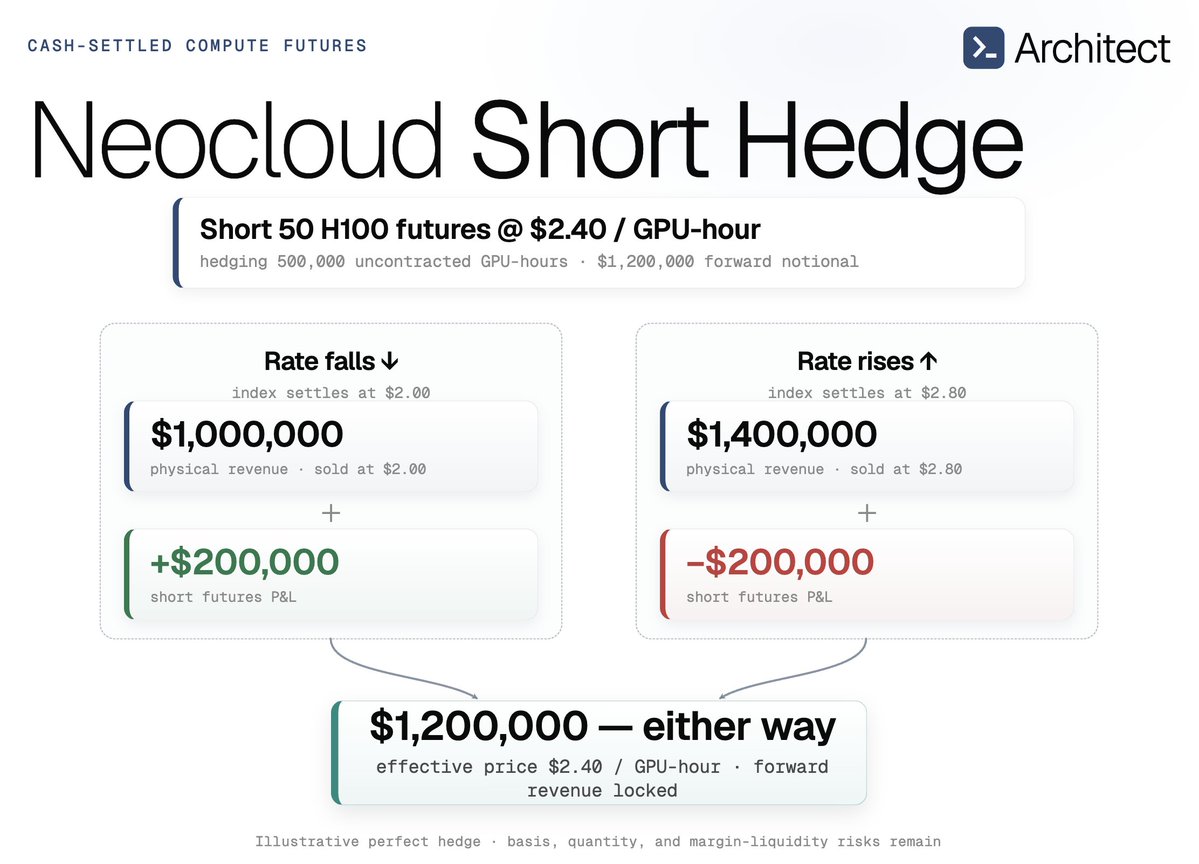
Compute futures have arrived: quarterly, monthly & yearly contracts on Nvidia H100/H200 prices trading on Architect. Purpose-built for companies with exposure to GPU price volatility. Intuitive trading interface, instant settlement, our team online 24/7.
English
56
111
1.1K
349.5K
·
·@sinnformer·
@BrettHarrison “Request Access” button was broken.
English
1
0
1
18
Brett Harrison
Brett Harrison@BrettHarrison·
The financialization of compute has created a new class of trader. Hyperscalers, AI model companies, and lenders need to lock in short- and long-term prices, without the complexity of interfaces built for assets they don’t trade.
English
0
4
64
10.1K
Brett Harrison retweetledi
Architect
Architect@Architect_Fi·
We’re launching our first expiring futures and they’re all on compute. Trade Nvidia H100/H200 GPU rental price futures on a brand new expertly-designed trading interface built specifically for AI compute. Believe it.
English
3
11
40
3.3K
Brett Harrison
Brett Harrison@BrettHarrison·
Architect AX continues to roll out more equity perpetual products – now live with AMD, Micron, SanDisk, and Intel. AX is the only exchange where you can trade perpetuals on AI compute as well as the companies critical to the AI supply chain.
English
7
20
88
6K
Brett Harrison retweetledi
Architect
Architect@Architect_Fi·
AMD INTC SNDK MU Trade AI hardware stock perpetuals + perpetuals on AI compute prices on AX.
English
2
11
34
1.9K
Brett Harrison
Brett Harrison@BrettHarrison·
Institutional demand for regulated perps on traditional assets (FX, equities, rates, metals, AI compute & more) is accelerating. The hybrid model is working: innovation from digital asset derivatives + traditional risk management and oversight.
English
2
1
12
1K
Brett Harrison
Brett Harrison@BrettHarrison·
Architect AX has more than doubled its 24H exchange volume record in three weeks — approaching $35 million. Weekly volume has more than doubled over the same time period too.
Brett Harrison tweet mediaBrett Harrison tweet media
English
11
20
76
6.4K
Brett Harrison retweetledi
hummingbot
hummingbot@_hummingbot·
Architect 🏛️ 🚀 New connector alert! We're thrilled to welcome Architect Exchange to the Hummingbot ecosystem! @Architect_Fi perpetual futures connector is now available in Hummingbot Release v2.14.0 — sandbox testing, order placement, position lifecycle, and token-specific leverage. A huge shoutout to petioptrv (github.com/petioptrv) for building this! 🔗 Bounty #7919 (github.com/hummingbot/hum…) 📝 hummingbot.org/release-notes/…
English
1
8
28
2.5K