

Brian ᴸ¹ 🔺
2.1K posts

Brian ᴸ¹ 🔺
@brianman1
Your Avalanche Sherpa 🏔️ | Ecosystem Relations @AvaLabs | Bringing founders, funds & infra together | Maple Syrup Maximalist 🍁 Views Mine
🔺All Over 🔺 Katılım Eylül 2011
2.7K Takip Edilen1.9K Takipçiler
Brian ᴸ¹ 🔺 retweetledi

Avalanche now rank among the top five blockchain networks for tokenized assets (RWAs) by both distributed and represented value.
@avax has been focused on bringing the world’s assets onchain from day one, and this is still just the beginning.
Across native origination and servicing, collateral mobility, and liquidity, traditional financial services and decentralized financial infrastructure are increasingly converging on Avalanche. The ecosystem brings together some of the world’s largest asset managers, leading financial institutions, and the next generation of DeFi partners.
Avalanche offers a combination that many enterprise networks cannot: liquidity & native integrations, a thriving DeFi ecosystem, EVM compatibility, and the ability to create highly customizable, purpose-built networks.
Modernizing financial services is not a trend we recently embraced. Rather, it has always been core to our mission and it will continue to define what we build toward next.
app.rwa.xyz/networks
English
Brian ᴸ¹ 🔺 retweetledi

The @avax network continues attracting capital: #2 in RWA value for @BlackRock BUIDL. Avalanche = where institutional issuers deploy.

English

Feeling in a pretty good mood this Friday. Looking to use @YourGrails' new feature and gift a few people some packs. Comment under here with your address.
Giraffes might get double entries. Sorry, a bit of a bias here.

English
Brian ᴸ¹ 🔺 retweetledi

Brian ᴸ¹ 🔺 retweetledi
Real-World Everything —
real world assets
real world use cases
real world partners, customers
This is the theme of the next 12 months.
Avalanche🔺@avax
BREAKING: Hyundai completes first stablecoin payments on Avalanche Hyundai Card and Hyundai Motor Company have laid the groundwork for stablecoin payments on Avalanche, completing a successful pilot with Tether and Axiym.
English

Introducing Stable Vaults - powering a clean Earn experience for companies and developers wanting to access DeFi yield
Stani@StaniKulechov
We've built the easiest way to bring DeFi into user-facing applications. Stable Vaults offer fixed yield, cross-chain access, multi-strategy allocation, tier-based rates, and more. Stable Vaults power the Aave App's Earn experience and are now available to businesses looking to offer stablecoin yield to their users.
English
Goodmorning USA
theblock.co/post/407660/hy…
One of the largest companies in the world, finished testing intercompany $ transfers using stablecoins on @avax @tether @AxiymFinance
"This entire process took approximately seven minutes, whereas traditional interbank transfers would take three to four hours."
This is what we call a marked improvement.
Better money.
From hours to minutes.
Congratulations once again on the excellent work by @justinkim415 and crew.
English
Brian ᴸ¹ 🔺 retweetledi

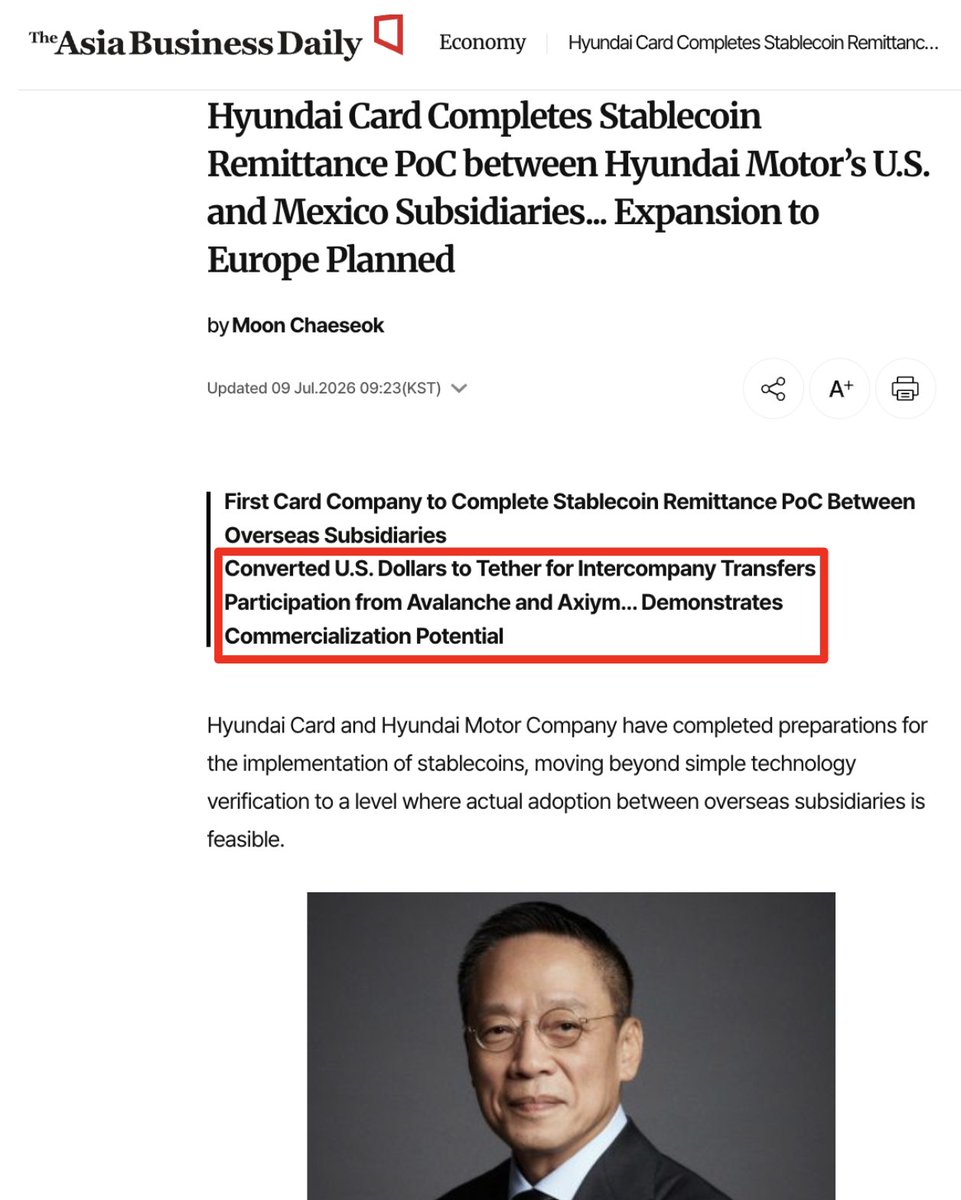
BREAKING : Hyundai Motor Group(@HMGnewsroom) and @AvaLabs — together with our partners @tether and @AxiymFinance — have built and completed a stablecoin remittance layer between the group's overseas subsidiaries, settled on-chain on and only on @avax.
This wasn't a lab experiment. It was real intercompany settlement — the kind that runs through multinational enterprise every day — moving from dollars to stablecoin, across borders, and back, in a fraction of the time a traditional wire takes.
What made it work was the years of partnership behind it. Alongside Tether and Axiym, #HyundaiCard and larger Hyundai Motor Group brought deep operational expertise and did the hard work across accounting, tax, legal, and internal controls in every jurisdiction. We're proud to have built the rails together on avalanche.
And we're just getting started. The world's largest enterprises are moving real treasury on-chain. Not someday. Now. On @avax.
Grateful to our partners and excited to keep building together.
Read more at : asiae.co.kr/en/article/fin…
English


Brian ᴸ¹ 🔺 retweetledi

Brian ᴸ¹ 🔺 retweetledi

Another milestone in the books!
Over $500,000 volume during our closed beta.
We're building a platform that puts collectors first, with premium inventory, verifiable onchain randomness, incredible pack EV, and an unmatched entertainment experience. This is just the beginning.

English
Brian ᴸ¹ 🔺 retweetledi
Brian ᴸ¹ 🔺 retweetledi

Our CBO, John Nahas, with the Securitize team today on the NYSE floor: x.com/johnnahas84/st…
John Nahas@JohnNahas84
Honored to be at the NYSE today with @carlosDomingo as @Securitize begins trading as $SECZ. Tokenization has grown from concept to powering billions in real-world assets onchain, and now it’s trading on the world's most iconic exchange. This isn't just a milestone for one company, it's validation that the infrastructure layer for tokenized finance is here, it works, and institutions are building on it. The next chapter for capital markets is being written onchain. Congrats to Carlos and the entire team. Tokenize the World.
English
BREAKING: The largest tokenized stock makes its debut on Avalanche 🔺
@Securitize now has > $700m worth of RWAs tokenized on Avalanche

English
A must read
@avax
Matias@frostLedger
To the Avalanche community: Yes. I've been quiet. Quiet isn't idle. I understand why the two look the same from the outside, and closing that gap is on me. So here's what the quiet actually held. We put forward three ACPs aimed at validator economics and how the network rewards the work of securing itself. We built more precise ways to measure the chain's economic activity, and shared early results. Behind that, we tightened how the team runs day to day. Less visible, but it's why the rest moved, and why it moves faster now. I recognize the frustration, because this work isn't always visible from the outside. But the work happened, and it's happening. I did a poor job telling you what we could. That's my communication failure, not a work failure. I've written a piece that lays out the exact economic reasoning behind the recent proposals and the direction they point, and it goes out with this letter. Now the part I want to be straight about: tokenomics is not a solved problem. Not here, not anywhere. I'm not interested in patches that look good for a cycle and unwind in the next one. I'm interested in fixes that compound. And compounding is slow before it's fast. We're being deliberate about the order. You can't design how a network captures value until you've defined what value it actually produces, and that "what" has been loosely defined across this industry for years. So we started there. Think of it the way an economy tracks more than one number. There's the value produced on the chain, the revenue protocols earn because they build here, which is what our gross chain product metric captures. And there's the value that accrues to the people using it, the activity that exists only because the chain does. We're building measures for both, to see value from enough angles to form a cohesive picture. Measure the "what," then design the "how." Get it backwards and you optimize for the wrong thing. That design could eventually include new transaction types or new primitives at the platform level, conveniences worth paying for. That can only come once measurement tells us what's worth building. How we find the "right" design is by experimenting. Short term, that means taking parameters that have sat as static constants since launch and letting the network set them dynamically, measured and adjusted on purpose, so we can watch how the system responds to small changes. ACP-283 is one example: it's about learning empirically where fees begin to dampen on-chain activity, so the network can stay well below that line instead of guessing at it with a number set years ago. Everyone contributes here. Validators decide whether these changes activate, and where the fee floor sits over time. My job is to make the case in the open and show the work, not hand down an answer. I'll also be honest about the limits. There's only so much we can test without risking the robustness of the chain, which is exactly why these initial changes are small. Every data point we can gather safely matters. Each one is a hint about whether the long-term design holds, or whether it's time to go back to the drawing board. The answer won't be identical for every chain. It can't be. But the process I trust is the same everywhere: measure honestly, design deliberately, ship, observe, adjust. I know patience is thin and the doubt is real. I'm not going to narrate it back to you; you and I both live in it. What I'll say is that my confidence comes from the work I see every day, from people who could be somewhere easier and aren't. They stay because the hard problems are the ones worth staying for. One thing I want understood because it's the whole point. In proof of stake, security isn't a feature you ship. It's a bill an attacker has to pay, denominated in the network's own token. The economic weight behind that token isn't incidental to security. It *is* the security. And it sets a ceiling: no serious institution settles more value on a chain than it would cost to compromise it, because past that line the attack stops being a tail risk and becomes a trade. Getting the economics right is what keeps that ceiling above the value the chain carries, even as that value grows. That's not a vanity exercise. That's the work, and it's why I prioritize it. So yes, AVAX matters. On communication: you'll see the detail behind the ACPs and the metrics, not just letters like this one. Hold me to that. I came here to be a compounding force in this ecosystem. That's a slow way to start and a hard one to stop 🔺
English