My book Conscious Accomplishment - How to Use Personal Achievement For Spiritual Growth is now available!
For decades I tried to achieve my way to happiness.
When this stopped working, I was forced to turn my focus inward.
Pretty quickly, I began to realize that working on my consciousness was a more direct way to improve my life.
As illuminating as this was, it also was disorienting and nerve-wracking.
Most of the examples in our culture made it seem like you either went hard after success or abandoned all that to live a monastic lifestyle.
I wondered if I was being called to leave my worldly ambitions behind if I was serious about my consciousness evolution.
Fortunately, I met a wonderful teacher who guided me towards clarity.
The call wasn’t to abandon my life as a startup entrepreneur, but to use my existing circumstances for expanding my awareness and transformation.
Gradually my company and all aspects of my life became my mirror and teacher.
Conscious Accomplishment is the book I wish I had when I started my journey.
It teaches you how to use the process of moving towards your goals for the evolution of your consciousness.
And as you do this, the ways in which you accomplish things evolves and expands.
This integrated path is not only incredibly enlivening and enriching, but also suitable for many people in our society.
If you’re interested in learning how to walk this middle path, are conscious-curious, or feel stuck while trying to balance both worlds, this book is for you.
If this resonates, you can find a link to the book below👇
And if you’d like to support it reaching others, ❤️and 🔁are much appreciated!
New episode of Experience-focused Leaders is live — Part 2 with Scott Britton (@britton).
And this one goes deeper.
Scott is an entrepreneur (exit to Salesforce), Princeton grad, Forbes 30 Under 30, and now focused on the intersection of performance and consciousness.
At first glance, this may sound “personal.”
It’s not.
It’s business.
Because the gap most teams are dealing with today is how leaders show up.
👉 Reactive decisions
👉 Misaligned teams
👉 Culture that looks good on slides… but breaks under pressure
Scott breaks it down in a very practical way:
“Anytime you're reactive, that’s the work.”
“If you’re judging others, you’re judging yourself.”
“Growth is an oscillation, inward reflection → outward execution → repeat.”
It’s operating leverage.
The leaders who get this right:
✔ Build stronger teams (less projection, more trust)
✔ Move faster (less internal friction)
✔ Make better calls under pressure
One insight that stayed with me:
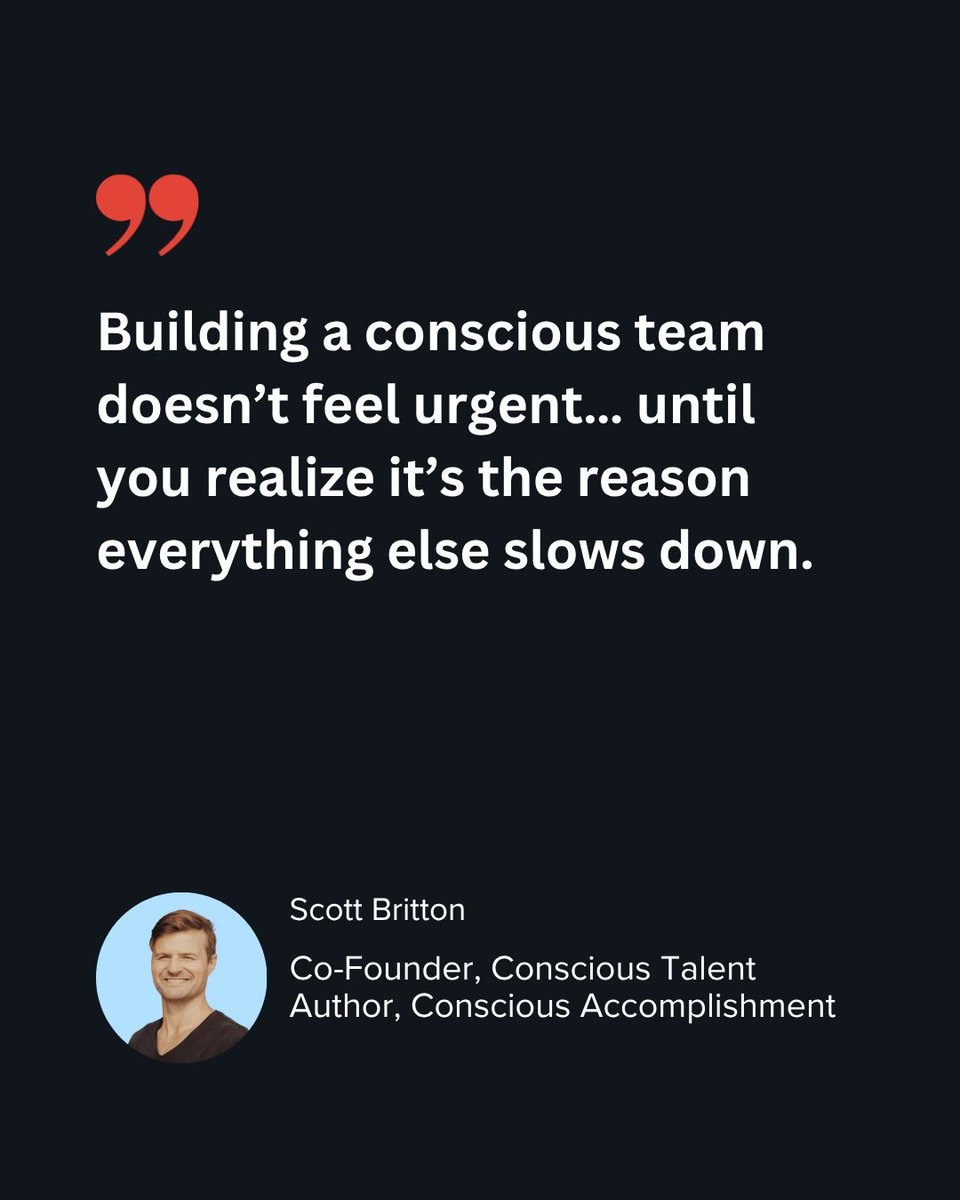
Building a conscious team doesn’t feel urgent… until you realize it’s the reason everything else slows down.
That’s the hidden tax inside many organizations.
And the upside? When leaders do the inner work, culture, execution, and results start compounding.
If you care about performance, not just optics… this episode is worth your time.
🎧 Listen here: relayto.com/explore/s-02-e…
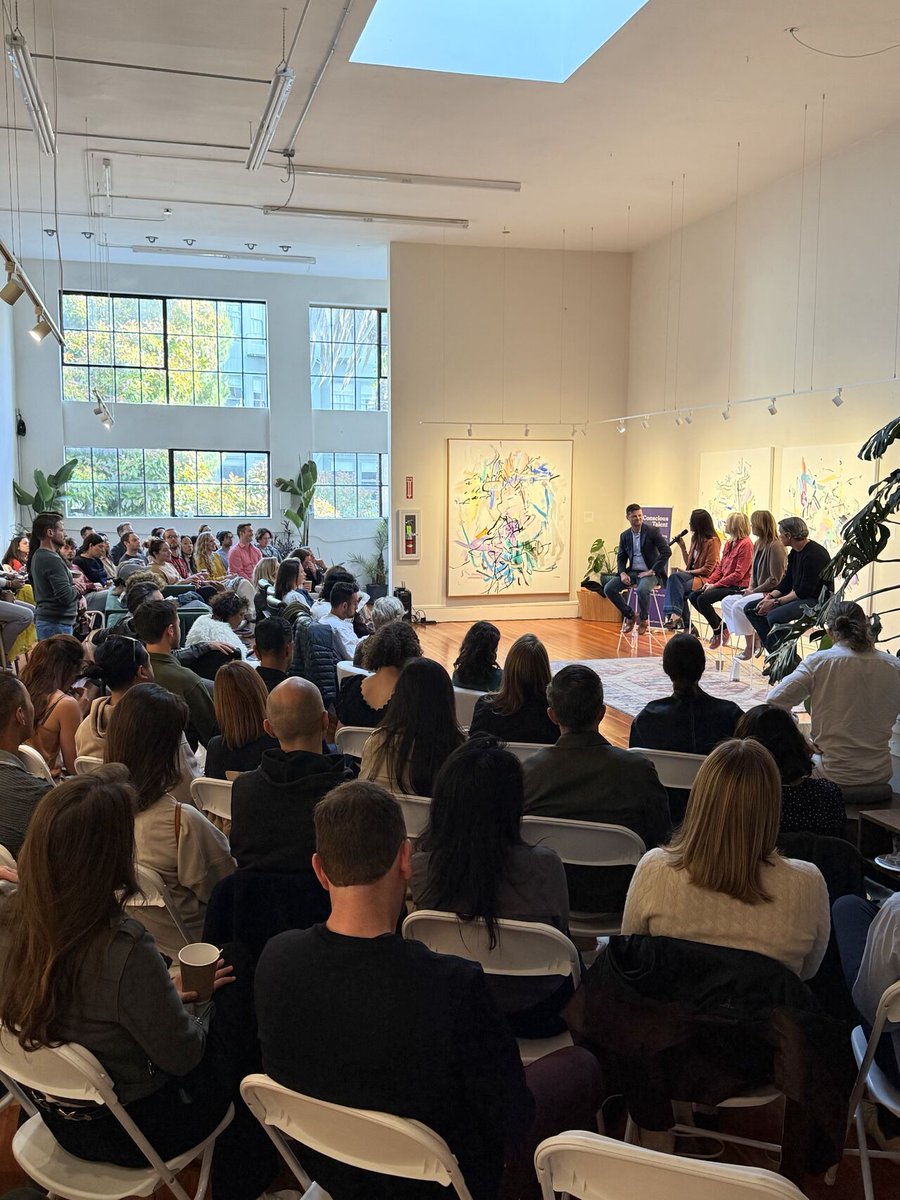
If you're in the bay area May 12th for @humantechweek , come check out this event @ConsciousTal is putting on:
"The Future of Conscious Company Building" featuring @DianaChapman (Conscious Leadership Group), @mak108 (Wisdom Ventures), and Dave Hersh (Metamorph Ventures)
Should be a blast!
luma.com/49z8wnln
All these automated marketing employees are slop machines.
What they create isn't going to be rewarded by search and increasingly more platforms.
Been jamming on something that actually creates quality stuff, that performs well.
"When you become a person, (ego, taking things personally, feeling anxious, resisting what is, etc)) you are attackable. When you stay as the Self, you are unconquerable. Taking things personally does not support your freedom. When you become aware of this, a new power begins to arise in you. It might feel like a bumpy ride for a while but it is totally worth it. Everyone who is, has won themself back from the psychological prison, has gone through some turbulence. Don't give up. Grace is with you and holding your hand." - Mooji
For anyone using (or about to use) Openclaw, here's a free guide we've put together with memory + pro-active learning that has made a huge difference for @AtlasForgeAI
→ atlasforge.me/bundle/access-…
I recently spoke with a high profile spiritual teacher who posed a striking question to me:
If we know that the most valuable thing we could do in our lifetimes is to reach enlightenment and realize our true nature, then how come we don't move to the woods and just go focus on this?
His answer...
Because the patterns that we've developed that keep us beholden to the desires of our ego are simply too strong.
His belief is that the only way is to navigate these competing priorities is to do both at the same time.
More specifically, to practice identifying as awareness itself every moment of every day as we do things.
Life itself has to become the meditation...
Not just sometimes. But every moment of every day.
This is a lifelong pursuit.
We're going to fail a million times.
But if we keep trying we're going to get a little bit better each and every day.
And that is what matters.
Today was the first day in a few weeks where my work day didn't start with working with AI for the first few hours.
Honestly, I feel so much better.
I really feel like we are soon going to learn the unintended consequences of going back and forth with AI all day on our mental and cognitive states.
After selling my last business to Salesforce, I thought I was DONE with CRM software.
But building things with AI over the last few months has led me to some familiar and unexpected places.
My tinkering started with building tools to solve my own pain points.
When I was launching @ConsciousTal and my book Conscious Accomplishment last year, I needed to pull together a list of people to tell about it.
My 29k linkedin connections and 15k email contacts was overwhelming.
I realized that my calendar was the strongest signal for who I actually had a relationship with, but shockingly there was no clean way to organize that data.
I ended up buying two crappy Google Sheets plugins and having my EA do a bunch of manual data cleanup just to get a workable list.
After that experience, I kept running into the same problem.
Salesforce or Hubspot were overkill for Conscious Talent.
I just wanted something dead simple that let me build lists of people to keep warm and communicate with them.
So I built a product for myself now called WhoIMet.
WhoIMet connects to your calendar, extracts your contacts, lets you organize them with tags and lists, and send personalized emails.
No pipeline stages, no deal tracking, no 47-tab CRM that requires a certification to use. It’s intentionally dead simple like a spreadsheet.
It takes about 30 seconds to connect your calendar and see your contacts and there's a free plan to get started.
I'll be honest…
Helping people organize their calendar contacts isn't exactly solving world hunger or uplifting human consciousness. It's also not going to make me rich.
But building my magnum opus or a cash machine was never the point of this project.
The point was to ship something useful that worked end to end. For someone who's non-technical, this feels like a meaningful milestone.
If you're non-technical and have been curious about building with AI, I'd encourage you to just start making something you want to use.
The tinkering is worth it.
And if WhoIMet sounds useful, give it a try and let me know what you think! (link below)
@britton the "no one will use interfaces anymore" prediction has been wrong every single time. chat apps didn't kill email. voice didn't kill touch. people want to *choose* how they interact, not be forced into whatever's fashionable.
I have a feeling that many people out that are saying SaaS is dead and agents will take over everything, haven't built a SaaS company before.
I remember when we started Troops having visions of granduer that everything would be done through chat and no one would ever want to log into a CRM again.
Guess what? That didn't happen.
99% of people didn't know how to interact with a blank command line.
And even when they did, they still wanted some sort of verification layer where they could see and interact with the work.
A lot has changed in the past years, but I don't think most of the humans interacting with software have changed all that much.
I also think its important to remember that most of the world isn't a silicon valley early adopter.
I was with a SaaS founder last week who commented that his biggest support challenges are password issues, and getting ppl to log in in the first place.
How we interface with software and what is can do changing, but to say its "dead"...I'm not buying it.