
Richard Dorfman

12.9K posts

Richard Dorfman banner
Richard Dorfman

Richard Dorfman

@brooklynrichied

Retired law firm administrator, horse racing pundit, bonsai enthusiast, basketball aficionado, soccer fanatic. Social justice advocate. Defining the odds.

Shelburne, VT Katılım Temmuz 2015
1.8K Takip Edilen491 Takipçiler
Richard Dorfman
Richard Dorfman@brooklynrichied·
@DonDurrett @badcharts1 Wrong chart to post in response. Patrick’s chart covers a miner, yours is a chart of relative strength (gold v S&P). Not apples to apples. Gold could actually drop in price but rise on your chart if the S&P drops by a greater % within a similar timeframe.
English
0
0
2
386
Patrick Karim
Patrick Karim@badcharts1·
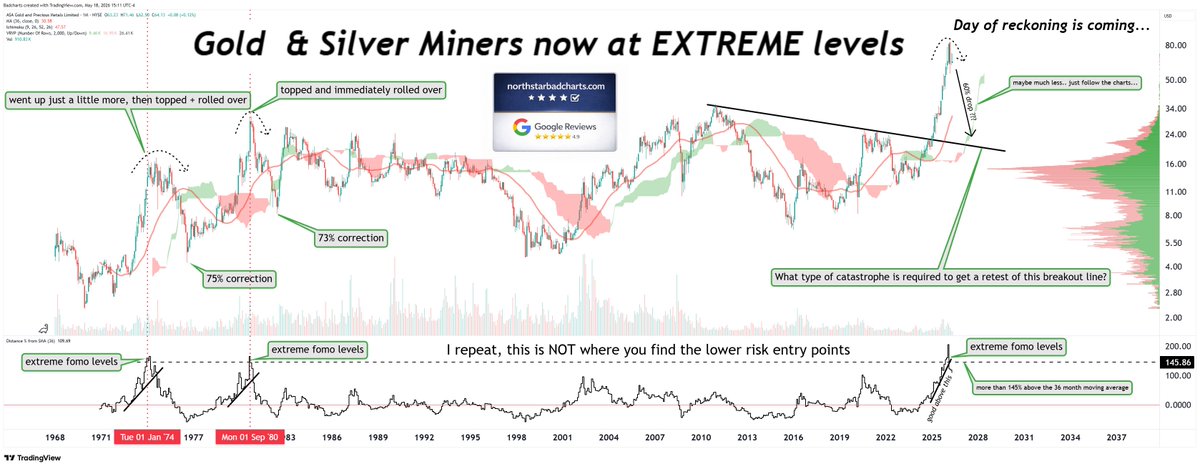
Truth About The Gold & Silver Miners. Yes, they had a great run. Most of our winning trades have been miners in the past year. But that seems done now. I wouldn't trust anybody that can manage to spin this as a lower risk, higher reward "BUYING" opportunity.
Patrick Karim tweet media
English
96
33
403
56.8K
Richard Dorfman
Richard Dorfman@brooklynrichied·
@mig4450 About as disappointing a response as I could have imagined. You’ve forgotten your racing roots and sold out to corporate interests. If I wanted to watch the races on a screen rather than through binoculars, I would stay home, sit on a lounge chair in my garden and bet by computer
English
2
0
1
161
TheMig4450
TheMig4450@mig4450·
@brooklynrichied The backyard area will be bigger than the previous one and there will be plenty of space to sit outside. The infield will also be open to the public on big days
English
1
0
5
337
TheMig4450
TheMig4450@mig4450·
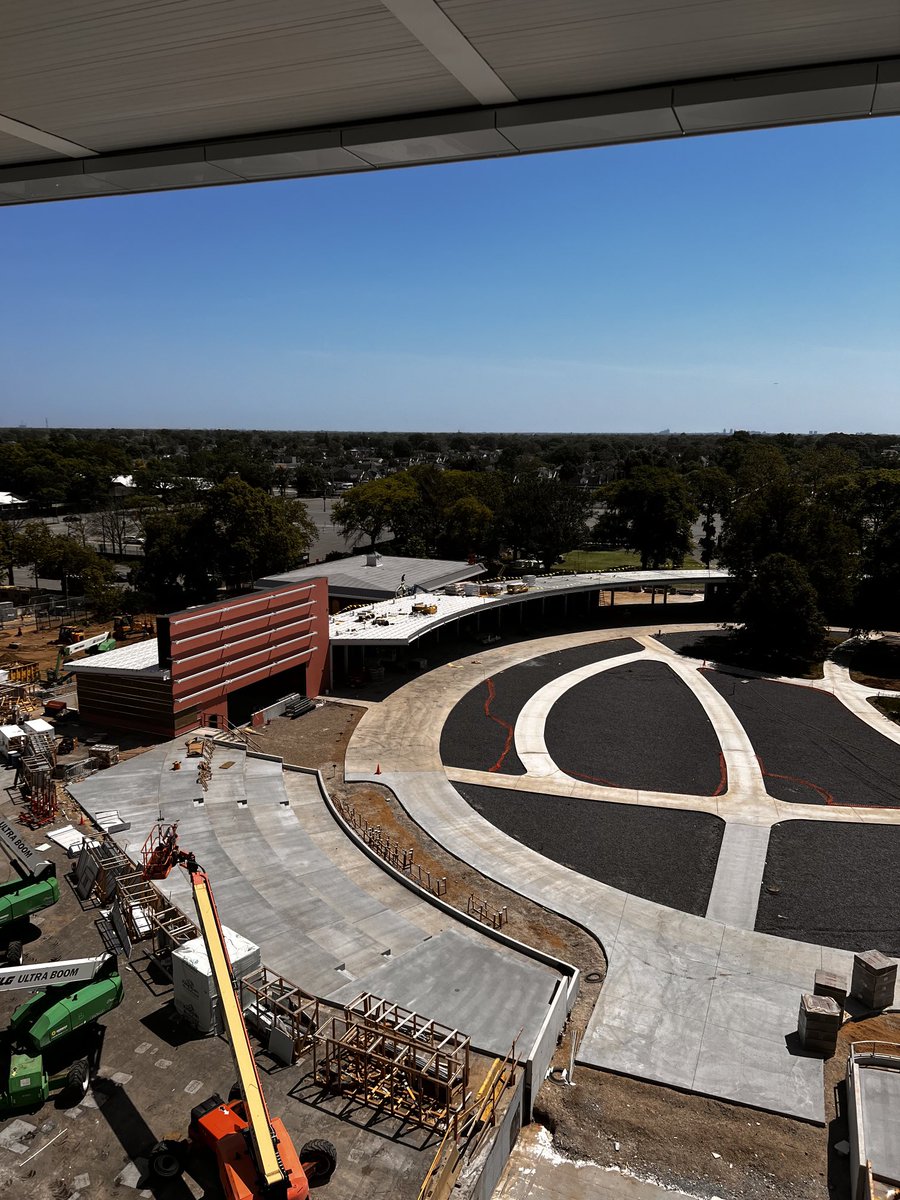
I got a tour of the new building at Belmont today. It’s getting really exciting around here. I think people are going to be happy with the finished product.
TheMig4450 tweet mediaTheMig4450 tweet mediaTheMig4450 tweet media
English
34
22
341
15.9K
Chris Martenson
Chris Martenson@chrismartenson·
@kevinolearytv Why are Americans against data centers and AI infrastructure? 1 - The consume vast amount of energy 2 - They create a lot of noise and heat 3 - They produce nothing of tangible value to anybody in the local communities 4 - They are being used to surveil and subjugate us further
English
208
620
3.8K
33.8K
Kevin O'Leary aka Mr. Wonderful
Why is there suddenly such an aggressive push against American data centers and AI infrastructure? After seeing a major spike in coordinated opposition campaigns around our Utah projects, we conducted a digital audit and traced a large amount of the activity back to an organization called Alliance for a Better Utah, which has been pushing misinformation throughout Box Elder County about our data center developments. What’s even more concerning is where the funding appears to originate. After reviewing IRS Form 990 filings and tracing the network behind it, the money appears tied to Chinese linked funding channels connected through an organization called Arabella. Think about the incentive, if China is racing to dominate AI and compute capacity, why wouldn’t they want to slow American infrastructure down?
English
4.3K
2.9K
10.6K
1.3M
Richard Dorfman
Richard Dorfman@brooklynrichied·
@CNBC Not sustainable as long as the Straight of Hormuz remains closed. Likely to lead to shortages and much higher prices.
English
0
0
1
35
Richard Dorfman
Richard Dorfman@brooklynrichied·
@CHelleaven @CasuallyGreg Concept may be right, but $20/hr is not a livable wage. At minimum that number needs to be $40-$50/hr. And yes, that will be built into the prices you see on the menu.
English
0
0
2
53
𝐆𝐫𝐞𝐠
𝐆𝐫𝐞𝐠@CasuallyGreg·
“Pay our employees, because we won’t.”
𝐆𝐫𝐞𝐠 tweet media
English
6.8K
21K
263.2K
15.6M
Richard Dorfman
Richard Dorfman@brooklynrichied·
@RussReeder @Ai_Tech_tool Felt like it was already set at 2x. Brilliant mind, but if the objective is for the audience to assimilate the content, he needs to pause periodically.
English
0
0
0
12
AilaunchX
AilaunchX@Ai_Tech_tool·
Instead of watching an hour of Netflix, watch this 2 hour hour Stanford lecture will teach you more about how LLMs like ChatGPT and Claude are built than most people working at top AI companies learn in their entire careers.
English
31
854
4.6K
621.1K
Richard Dorfman
Richard Dorfman@brooklynrichied·
@ZhouTony Absolutely no way to know in advance if early (fixed) odds will be the best odds on the day. But more to the pt, if you aren’t using binoculars & watching the horses gallop down to the gate before making a bet, you’re playing at a huge disadvantage. I’ll argue that with anyone.
English
1
0
0
130
Richard Dorfman
Richard Dorfman@brooklynrichied·
@WelbourneStud I love Saratoga but…until the Belmont Stakes returns to Belmont Park and is run at a mile and a half around two turns, there really isn’t a triple crown in the purist sense.
English
1
0
1
57
WelbourneStud
WelbourneStud@WelbourneStud·
Curious: who is for leaving the TB Triple Crown as-is or changing it to provide more spacing among the three races? I've always been of the mindset that achieving the Crown should be difficult; & kudos to trainers who realize their Derby winners aren't suitable to pursue it.
English
10
2
6
963
Richard Dorfman
Richard Dorfman@brooklynrichied·
@ZhouTony And I’d add: “confident enough to say no when a horse doesn’t look sharp going down to the gate”…which is most of the time.
English
0
0
0
170
Tony Zhou
Tony Zhou@ZhouTony·
Horse racing is one of the most complex tests of decision-making under uncertainty. It’s not just about picking winners. It’s about being smart enough to see the edge, humble enough to doubt it, disciplined enough to size it, and cold enough to walk away when the price is wrong.
English

20
21
239
28.3K
Richard Dorfman
Richard Dorfman@brooklynrichied·
@BillFinley3 HISA was created to ensure the welfare of racehorses. Either the use of Lasix is performance enhancing and should be eliminated, or most horses have a bleeding problem that is primarily being addressed through medication. Neither is a good look for the industry.
English
0
0
1
11
Richard Dorfman
Richard Dorfman@brooklynrichied·
@BloodHorse HISA was created to ensure the welfare of racehorses. Either the use of Lasix is performance enhancing and should be eliminated, or most horses have a bleeding problem that is mainly being addressed through medication. Neither is a good look for the industry.
English
0
0
1
13
Richard Dorfman
Richard Dorfman@brooklynrichied·
@Tinky47flat HISA was created to improve the welfare of racehorses. Either the use of Lasix is performance enhancing and should be eliminated, or most horses have a bleeding problem that is only being addressed through medication. Neither is a good look for the industry.
English
0
0
2
42
Tinky
Tinky@Tinky47flat·
‡ HISA's Lasix Decision: The Dubious Subtext While it is fair to suggest that the Lasix issue ranks well down the list of current, important problems facing the American racing industry, it continues to be a hot-button issue, and one that I have both followed and written about over decades now. The headline of the recently released "determination" made by HISA's Board of Directors is that the status quo will remain intact. The use of furosemide (i.e. Lasix) within 48 hours prior to a race will continue to be permitted for "Covered Horses" (i.e. those racing at HISA tracks), with the exception of two-year-olds, and those competing in stakes races. I consider the decision to be far better than a reversion to all horses being eligible, but arguably not as positive for the long-term health of the horses, and the industry, as further restrictions may have ultimately been. While it is worth discussing further, that headline decision is not the main topic of this post. But before I delve deeply into the aspects that primarily caught my interest, note that the related (pdf) document released by HISA is – wait for it – 158 pages long! And while I can certainly appreciate the potential value of supporting details, the length of the document makes it impossible for me to respond fairly with anything other than a long post (~3,900 words; ~15 minutes reading), even by my standards. So, if you don't have a real interest in the topic, some time on your hands, and a willingness to wade into the weeds, I'd suggest that you either skip the post, or skim the bolded sections. *** Included in the official "modifications" described in the Board's document is an assertion that I believe to be based partly on dubious science, and also in some respects disingenuous. I am referring to this claim: "iii. That furosemide has no performance-enhancing effect on individual horses." In support of the assertion, this questionable definition is found on page 43: “A performance enhancing drug is defined as one that builds muscle, increases strength, enhances endurance, acts as a stimulant or speeds recovery. Furosemide has not been shown to do any of these.” That is both misleading, and arguably false. There are at least two identifiable physical mechanisms by which Lasix can, based on science, effectively enhance performance, and a third which isn't even applicable to HISA's very specific, dubious, and possibly politically motivated definition of a PED. Let's review the relevant facts. 1⃣ The most basic, and compelling evidence that Lasix has Performance Enhancing properties is pure science, in the form of Newton's Second Law of Motion. Rapid (fluid) weight loss just prior to a race allows horses treated with Lasix to perform with less weight than those which have not been treated with the drug. Formula One (race car) teams spend millions in efforts to shave ounces off of chassis, in order to gain similar physics-based performance advantages. I have repeatedly presented that unassailable fact over 25+ years, and no one, including pro-Lasix trainers and vets, has been able to refute it. It alone is sufficient to demonstrate that HISA's claim is fundamentally false. 2⃣ The second biological effect of Lasix that could produce performance advantages was summarized well in a recent post by @byronrogers73 (bold emphasis mine): Lasix produces an elevation in Total Carbon Dioxide averaging approximately 1.7mml/l for a standard 250mg IV dose. Basically, it is milkshaking and it is why for tc02 testing in North America has a higher threshold than elsewhere. tc02 buffering is correlated to distance/runtime to fatigue. The longer the race, the more important tc02/lactic acid becomes in determining fatigue. Higher tc02 levels provide a larger "buffering capacity," meaning the blood can neutralize more acid before the pH drops to a level that interferes with muscle contraction. To be clear, Lasix does not produce as potent an alkalising effect as Milkshaking, but it would be naïve to assume that its effects are negligible, especially over longer distances. 3⃣ The third is, oddly, simultaneously both subtle and obvious. It is a simple fact that Lasix lowers blood pressure, which is a primary mechanism through which it helps to mitigate EIPH (i.e. bleeding). But there is a coincidental impact which, while known to all horsemen and vets, is almost never talked about as being performance enhancing: it tends to calm horses pre-race. And given that a certain percentage of horses are quite highly strung, the lowering of blood-pressure can have the effect of allowing such horses to conserve valuable energy that might otherwise be squandered before the gates open. That, of course, doesn't fit into HISA's carefully crafted definition of a PED. Yet Acepromazine, a (powerful) sedative commonly used to relax highly strung horses in morning training, is not allowed within ~72 hours of a race. Neither are any other sedatives allowed. So if Lasix creates a sedative effect that may help horses to perform better than they might without being treated, it creates a type of performance advantage. Not "enhancement" in the commonly accepted sense, meaning that a horse might be able to run faster than naturally possible, but it may enhance the likelihood that a peak performance could be achieved, and that is a potentially unfair advantage over untreated horses. *** On page 13 of the document, this appears: Based on a review of earlier observational studies conducted prior to the Act, along with research commissioned and monitored by the FAC, the FAC concluded that “[t]here is no scientific evidence to support the statement that furosemide is a performance enhancing drug.” Id. As I, and others, have repeatedly pointed out over the years, there is, contrary to the above claim, a peer-reviewed study, published in the Sept. 1, 1999, issue of the Journal of the American Veterinary Medical Association entitled: Effects of furosemide on performance of Thoroughbreds racing in the United States and Canada (K W Hinchcliff, et al) The authors analyzed 22,589 race records provided by the Daily Racing Form, and included horses that finished a race on a dirt surface in the United States and Canada between June 28 and July 13, 1997, in jurisdictions that allowed the use of furosemide. A subset of 16,761 (74.2%) had been administered Lasix. The authors concluded that: Horses that received furosemide raced faster, earned more money, and were more likely to win or finish in the top 3 positions than horses that did not. The magnitude of the effect of furosemide on estimated 6-furlong race time varied with sex, with the greatest effect in males. When comparing horses of the same sex, horses receiving furosemide had an estimated 6-furlong race time that ranged from 0.56 ± 0.04 seconds (least-squares mean ± SE) to 1.09 ± 0.07 seconds less than that for horses not receiving furosemide, a difference equivalent to 3 to 5.5 lengths. So, contrary to the HISA claim that there is "no scientific evidence to support the statement that furosemide is a performance enhancing drug", that study does provide such evidence. We can argue about possible weaknesses in the study's methodology, but it was a large-scale, peer-reviewed study, which reached a clear, and from HISA's apparent perspective, inconvenient conclusion. Note also that the above study was confined to races run at 6f., and that the potential PED effects of Lasix should be even more valuable, and easy to discern over longer races. In the HISA document, under the heading Furosemide & Racing Performance (p. 132), these are the objections to the study that are lodged: There are a few confounding limitations to the research however, including unknown dose and timing of furosemide treatment, and failure to account for EIPH status, racetrack physical characteristics, or track surface conditions. Finally, the decision to race with/without furosemide was voluntary in this racehorse population. In other words, the trainers essentially chose the inclusion criteria and selected the subjects for the two study treatment groups, which likely led to group-selection bias. Given that 75% of the starts in the dataset were with furosemide, a trainer that chose not to run their horse on Lasix may well have been more conservative when it comes to other performance factors as well, such as exercise training protocols, overall management, or use of other medications. Identifying confounding limitations, or variables as they are sometimes referred to, is a standard form of criticism of scientific studies. But while many studies are open to that type of criticism, the appearance of such variables does not, in and of itself, invalidate the findings. There is subjectivity both in the interpretation of the importance of the variables, and any related conclusions. In this case, consider the confounding variables noted below, and my analyses of them: • including unknown dose and timing of furosemide treatment The current HISA/HIWU rules allow the equivalent use of up to 10cc of Lasix pre-race. That has long been the recommended ceiling provided by the vast majority of vets, including over decades when Lasix was less strictly regulated. It is a high dose that is/was typically given to serious bleeders, while the vast majority of runners are/were typically given (often considerably) lower doses. In fact, trainers and vets have long known that the higher the dosage, the greater the possibility that the drug may produce a somewhat uncommon, and unwanted "dulling" side-effect. As for timing, four hours out has also long been the typical cut-off, as it is thought to produce the most efficacious results. Any horses that received the drug closer to race time during the 1999 study would have been in a tiny minority, and statistically insignificant. What this suggests is that there is no evidence that a statistically meaningful percentage horses were either receiving higher doses of Lasix, or being injected closer to post time, when the 1999 study was conducted. Which in turn suggests that while those variables may be technically "confounding", their potential impact on the results of the study would have been negligible. • failure to account for EIPH status There is a large body of evidence to support the conclusion that only a small percentage of horses suffer from "serious" EIPH. Which is to say that while a high percentage of horses experience the condition, only between 5-10% are difficult to manage without Lasix. It strains credulity to imagine that trainers who chose not to treat runners with Lasix were often doing so with horses that had shown symptoms of being in the high-risk category. Therefore, while accounting for EIPH status would have been potentially interesting and useful, it is likely to have been a trivial contributor to the slower times recorded by horses that raced without Lasix. • racetrack physical characteristics, or track surface conditions Along with speed, class, and tracks, the 1999 study took into account "track surface, race distance, and weight carried". So the above claim is inaccurate. • the decision to race with/without furosemide was voluntary in this racehorse population. In other words, the trainers essentially chose the inclusion criteria and selected the subjects for the two study treatment groups, which likely led to group-selection bias. Given that 75% of the starts in the dataset were with furosemide, a trainer that chose not to run their horse on Lasix may well have been more conservative when it comes to other performance factors as well, such as exercise training protocols, overall management, or use of other medications. What would have been the most likely "biases" that trainers would have succumbed to? The choice to race more serious bleeders with Lasix, and the least likely to bleed without, if you want to call those biases? Ironically, if the author's suggestion is that faster horses may have been chosen by trainers to race with Lasix, and slower ones without, it would, if true (and we don't know), have been primarily a reflection of their widespread understanding, or belief, if you prefer, that Lasix was a PED. As to the final sentence, it is sheer speculation. Given the above, coupled with the very large size and scope of the 1999 study, and clear conclusion, I do not believe that the "confounders" mentioned form a compelling enough argument to undercut its essential finding (that Lasix enhances performance). *** HISA funded three of its own studies on Lasix. One, "DeNotta (2025)", arrived, among others, at the conclusion that: Body Weight: There was no sustained difference between treated and control horses. That finding is ridiculous on its face, and casts serious doubt on any other findings in the study (which I am unable to locate online). It is a well and long-established fact that Lasix is a potent diuretic, and that as a result of its use, horses typically excrete significant amounts of urine pre-race as a result of its use. No trainer, or vet, would dispute that fact. The more salient performance-related study is entitled Examining Associations Between Furosemide Treatment & Racehorse Health and Welfare (Dr. Amanda Waller, PhD). I can find no link to the completed study, though it is specifically referenced in the HISA document. As an aside, if the organization's Board of Directors were willing to arrive at important conclusions about Lasix, based in no small part on the results of that very study, why would it not be available online? Has it even been published yet? Has it been peer-reviewed? Are we, in other words, being asked to blithely accept criticisms of a large, compelling, peer-reviewed study on the performance effects of Lasix, while those very criticisms, and associated data that is purported to demonstrate that the drug produces no PED effects, are found in a study that apparently has yet to have been published, let alone peer-reviewed? The Principal "Investigator" associated with the study is Amanda Waller, Bsc, PhD, a Research Scientist at the Center for Clinical and Translational Research, Nationwide Children's Hospital. According to her X account, she is also an Equine Exercise Physiologist and OTTB owner, which is fine, as far as it goes. But not for the first time, I have to wonder aloud about how qualified someone who almost certainly has no serious handicapping experience, would be to construct a study that, at least in part, relies rather heavily on related knowledge. And along similar lines, someone who presumably has no experience as a racetrack vet. I have already noted multiple questions about Dr. Waller's objections relating to "confounders", and identified weaknesses in her efforts to undermine the 1999 Lasix study. But to underscore the point further, consider that she also referenced a relatively recent study (bold emphasis mine) in the subject document: A recent study by Shoemaker et al (2024) appears to be the sole publication to date which examines the association of furosemide and performance in the time frame after the widespread furosemide ban was put in place. The authors examined n=830 two-year old Thoroughbreds racing at 15 American racetracks in 2020. Interestingly, the data demonstrate a clear negative effect of furosemide treatment on race performance, such that horses administered race day furosemide were significantly slower (lower speed figures) than horses that did not receive treatment, a relationship that persisted regardless of EIPH status. Superficially, the bolded conclusion appears to support the HISA 𝗍̶𝖺̶𝗅̶𝗄̶𝗂̶𝗇̶𝗀̶ ̶𝗉̶𝗈̶𝗂̶𝗇̶𝗍̶ view. But there is a rather obvious, and serious problem with it. In 2020, Churchill Downs, Keeneland, NYRA tracks, Maryland tracks, Del Mar, Oaklawn, Arlington, and The Stronach Group tracks (among others), all began to ban Lasix in 2yo races. So when the study that Dr, Waller cites was performed, no two-year-olds at any (associated) major tracks raced on Lasix. That, in turn, suggests that an extremely large percentage (likely >90%) of the best bred, and most expensive two-year-olds, trained by the most successful trainers in the industry, were almost certainly confined to the study's non-Lasix group. Furthermore, Lasix was administered at 6 of the 15 anonymized tracks, in only 127 of the 1,071 post-race endoscopic examinations. That's 11.8%. Taking the above into account, the foundation of Dr. Waller's conclusion, that "horses administered race day furosemide were significantly slower (lower speed figures) than horses that did not receive treatment", and it's implications, are rendered dubious, at best. In fact, the conclusion derived from the raw data almost certainly had nothing whatsoever to do with the presence or absence of Lasix, but rather with the lopsided quality and class divided between the two categories of runners, based largely on which tracks they happened to be based. That Dr. Waller arrived at what appears to be a highly misleading interpretation of the data can be explained in one of two ways: either she was displaying a form of confirmation bias (i.e. goal-seeking), and/or her lack of handicapping experience and expertise resulted in a damaging blind-spot. Either explanation would be problematic, and raise further questions about her (yet-to-be-published?) study, on which the HISA Board of Directors apparently based, at least in part, some of their important decisions. A final note on Dr. Waller's (above) comments on the Shoemaker study. The bolded section ends with this: "...a relationship that persisted regardless of EIPH status." She is making the point that the group of non-Lasix horses ran faster than those treated with the drug, irrespective of whether or not they bled. Now, juxtapose that finding with one of her objections to the 1999 study: "failure to account for EIPH status". What that demonstrates is that a finding in a recent study that she attempted to use to build her case that Lasix is not performance enhancing, undercuts one of her objections to the most comprehensive, peer-reviewed study ever undertaken on the topic, which happens to lead to the opposite conclusion. *** Now let's move to the final chapter of this particular saga: Dr. Waller's study relating to Lasix and performance. This sets the stage (p. 156): Objectives and Hypothesis The objective of Aim 3) was to examine the effect of race day furosemide treatment on racing performance and the integrity of competition, in Thoroughbred racehorses competing in the United States between 2020-2024. It was hypothesized that the race day administration of furosemide does not significantly affect racing performance, at either the individual or group population level. Note that her skeptical hypothesis is presumably based on her dubious criticisms of earlier studies, and that the most compelling of those studies suggests precisely the opposite of her hypothesis. As to the substance of the study, it is complicated. She uses data from 2019-23, confined to Graded stakes, and broken up into several categories. Results of races in which horses raced with Lasix were compared with the same races after Lasix was banned. Equibase Speed Figures were used to make comparisons. While I do not have a sufficient background in statistical analysis to comment with confidence on certain technical aspects of the study, I will make some what I consider to be important related points. Dr. Waller both reasonably and understandably reminds readers that her study is more tightly controlled than the earlier ones that she criticized. And in a vacuum, those controls should lead to more accurate data, and conclusions. But I would argue that there are problems with both her methodology, and related conclusions. Given the length of this post, and that too much granular detail can cause fatigue, I'm going to restrict my related criticisms to a small number. I will also focus on the data relating to three-year-olds and older runners, as the results of those arguably produce deeper, and more accurate data than those restricted to two-year-olds. I could have spent much more time analyzing, and producing further criticisms, but did not want to invest the time, and believe that the points above and below are sufficient to raise serious concerns about some important aspects of Dr. Wallers study. 1⃣ The first issue relates to the 2019-23 period that was chosen. Beginning in 2021, Lasix was banned in Graded stakes in all major racing jurisdictions in the U.S. What that means is that for the most important of Dr. Waller's comparisons of older runners, only two years of data of horses racing with Lasix was used, compared with three years during which it was banned. Why the concern? Because the disparity amounts to a 33% larger data set for the Lasix-free group. Why would such a choice have been made, when it would have been easy to include a third year (2018) in the Lasix group set? 2⃣ There was no parsing of the distances of races, even into a simple sprint/route division. Given the rapid weight-loss, and alkalising effects that typically occur from the use of Lasix, performance enhancements are likely to be more pronounced over longer distances. Therefore, Dr. Waller's failure to parse, separate and compare results over sprint distances and 1m+ distances was arguably a significant oversight. To illustrate the point, I compiled 10 years worth of results of Grade I races (2016-25), contested on dirt over distances of 8f.+. These are the 24 races that are included: BC Classic BC Dirt Mile Woodward Whitney JC Gold Cup Met Mile Cigar Mile Pegasus World Cup* (2020 L-free; adjusted) Santa Anita Hcp. Pacific Classic Goodwood Stakes Awesome Again Clark Hcp. Stephen Foster KY Derby Preakness Belmont Travers Haskell Florida Derby Blue Grass Arkansas Derby Santa Anita Derby PA Derby I used 10 years worth of data for two reasons. First, the larger data sets reduce the possibility of a weak crop (or group of older runners) skewing the data. Secondly, I used an evenly matched number of years (5) for both the Lasix and Lasix-free results. Using the Equibase figure for the winner of each race, I arrived at these results: 21 of the 24 races produced higher aggregate figures for the Lasix group than the non-Lasix group. That means that in 87.5% of the races, the groups of winning horses treated with Lasix outperformed those that raced without the drug. The combined Lasix winners averaged 21.6 points higher than the combined Lasix-free group in those 21 races. In the three races that favored the Lasix-free group, the difference was much smaller: 11.3 I would argue that the above results suggest strongly that Dr. Waller's failure to parse out the distances of the Graded stakes included in her study, or to include larger data sets of runners that raced with Lasix, degraded its quality, and raise questions about the validity of her conclusions. 3⃣ page 136: These findings show there were no significant differences in racing performance in Graded Stakes races conducted before vs after permitted race day furosemide, in any cohort group, for any year-over-year period studied (Figure 8). Thus, race day furosemide treatment did not significantly affect overall racing performance in a controlled population of Thoroughbreds recently competing in the U.S. at the highest level of racing class. I've just demonstrated (above) that Dr. Waller failed to create an arguably highly relevant "cohort group" (i.e. horses that raced 8f.+), which, had she done so, would likely have produced results inconsistent with her conclusion. *** In summary, the conclusion that the HISA board reached, that "furosemide has no performance-enhancing effect on individual horses", is highly dubious. Not only does a simple, irrefutable law of physics explain why, but there are two other biological mechanisms through which Lasix can potentially confer performance advantages The foundation on which that arguably false assertion was built, contained in Dr. Waller's work, is problematic at best. Not only are a number of her objections to the most comprehensive, peer-reviewed study on the topic dubious, but her own "tightly controlled", recent study, appears to suffer from some potentially important "confounders". I'm sorry to conclude that this appears to possibly have been, at least in part, a goal-seeking exercise. Arguing publicly for the use of Lasix has long been complicated by its PED properties, and it appears that a concerted effort may have been made to sweep that uncomfortable aspect of the drug under the rug. I find it to be disappointing. *The full, related pdf report can be downloaded through the HISA link below: hisaus.org/news/hisa-boar…
Daily Racing Form@DailyRacingForm

"HISA board unanimously votes to continue raceday administration of Lasix" More on this morning's news from @DRFHegarty drf.com/news/hisa-boar…

English
6
0
11
3.3K
Richard Dorfman
Richard Dorfman@brooklynrichied·
@Jackpotkimm Mainly indoor corporate suites for entertaining guests with limited outdoor seating for real horseplayers. Who will fill those suites on a cold, rainy day in November or when it snows in February?
English
1
0
4
517
olrailbird
olrailbird@olrailbird·
@Jackpotkimm @theTDN @ChurchillDowns CAW hedges. They aren't picking winners per se. They have special access to pool data. Once in a while they whiff. Most of the time they turn $6 winners into $4.80 winners.
English
1
0
1
45
Gulf-SchemePark(Decoupling soon)
Here's Randy Moss defending the CAWS again today. @theTDN The caws win appr. Between $200 & $300 million from horseplayers every year. They get huge rebates and get to bet last with batch betting. They also raise takeout. At @ChurchillDowns they raise takeout from 22% to over 30%
Gulf-SchemePark(Decoupling soon)@Jackpotkimm

Randy Moss is a big supporter of caws. Without Mike Tirico, the price drop-down of T O Elvis would not have been discussed on air. Caw handle raises takeout on regular horseplayers. @ChurchillDowns has mostly 22% takeout, but with CAWs, the effective/real takeout is over 30%.

English
44
9
76
30.9K
Roadwarrior627
Roadwarrior627@Roadwarrior627·
@Hennigracing And there won't be a single gen adm seat outside for regular people from April-October. I'll take the old huge building. They want $43.75 a day for 20 day mini plans, and since they're giving you $25 food credit, chances are you can't bring your own. If true place is ruined.
English
1
0
1
110
Hennigracing
Hennigracing@Hennigracing·
Belmont progress…..
English
25
53
434
40.6K
Richard Dorfman
Richard Dorfman@brooklynrichied·
@NTamm1215 The statistics support the obvious, but yes it makes sense. Under the tutelage of a top trainer, quality horses point for certain targets and have a limited and managed campaign. With claimers, you strike when the iron is hot and take full advantage of short-term sharpness.
English
0
0
1
93
Nick Tammaro
Nick Tammaro@NTamm1215·
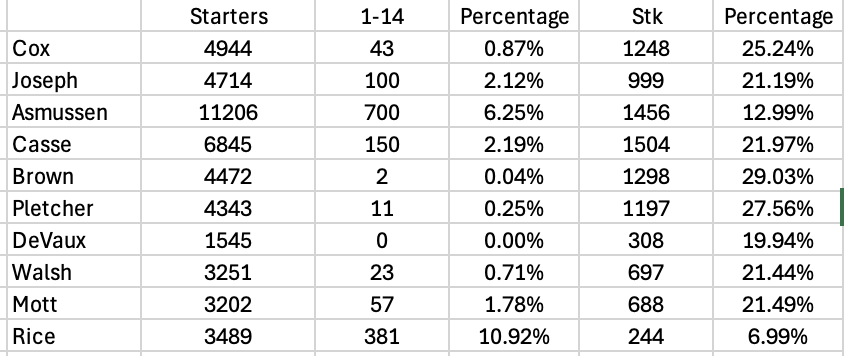
The better their horses, the less frequently the top 10 trainers run them. These are the top 10 by earnings on the year and how many starters they have on 1-14 days' rest last 5 years, plus how many stakes (grd & ungraded) starters they have in the last 5 years..
Nick Tammaro tweet media
English
16
13
63
15.5K