
Boris Shor

9.8K posts

Boris Shor banner
Boris Shor

Boris Shor

@bshor

Associate Professor, Department of Political Science and Hobby School of Public Affairs, University of Houston.

Houston, TX Katılım Ağustos 2008
2.4K Takip Edilen3K Takipçiler
Sabitlenmiş Tweet
Boris Shor
Boris Shor@bshor·
Just posted: newly available aggregate state legislative chamber ideology and polarization estimates! Based on a decade plus of work with @Nolan_Mc. New data covers 1993-2022, and now contains 2,730 chamber-years. Let us know how you use our data! dataverse.harvard.edu/dataset.xhtml?…
English
1
17
62
6.5K
Boris Shor retweetledi
Paul Novosad
Paul Novosad@paulnovosad·
The mass replication studies published in Nature today are insane, exemplary and an enormous pile of work to improve science. It's just so awesome how many people spent time on this in return to be 1/100 coauthors on a thing. Just outstanding 🙌🙌🙌 1/
Paul Novosad tweet media
English
12
153
812
52.6K
Boris Shor
Boris Shor@bshor·
@nataliemj10 @axios @RyanKennedy7, Amanda Austin, and I are working on silicon sampling and we're finding lots of reason to be very, very cautious with using AI in surveys like this.
English
0
0
2
385
Boris Shor retweetledi
Natalie Jackson
Natalie Jackson@nataliemj10·
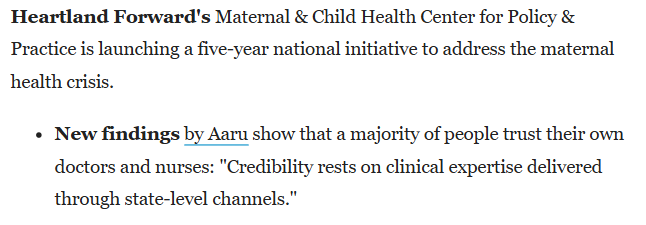
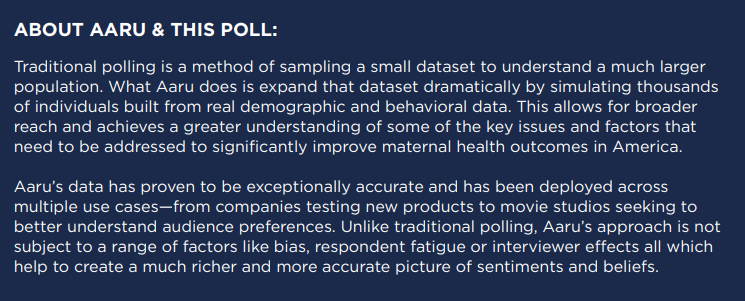
We need to talk about how to cite AI polls. First image was in an @axios newsletter this morning. You'd think that's a real poll, right? It is not. See the second image. Journalists, PLEASE be responsible and tell people when it's AI. Always include methodology. ALWAYS.
Natalie Jackson tweet mediaNatalie Jackson tweet media
English
8
47
112
22.6K
Boris Shor retweetledi
Matt Grossmann
Matt Grossmann@MattGrossmann·
Candidates get more support by moving to the middle of voters' ideological spectrum, but that may not mean the middle among elites. Democrats benefit by moderating most where the public is more conservative, Republicans where the public is more liberal osf.io/preprints/soca…
Matt Grossmann tweet media
English
2
17
60
4.6K
Boris Shor retweetledi
David Broockman
David Broockman@dbroockman·
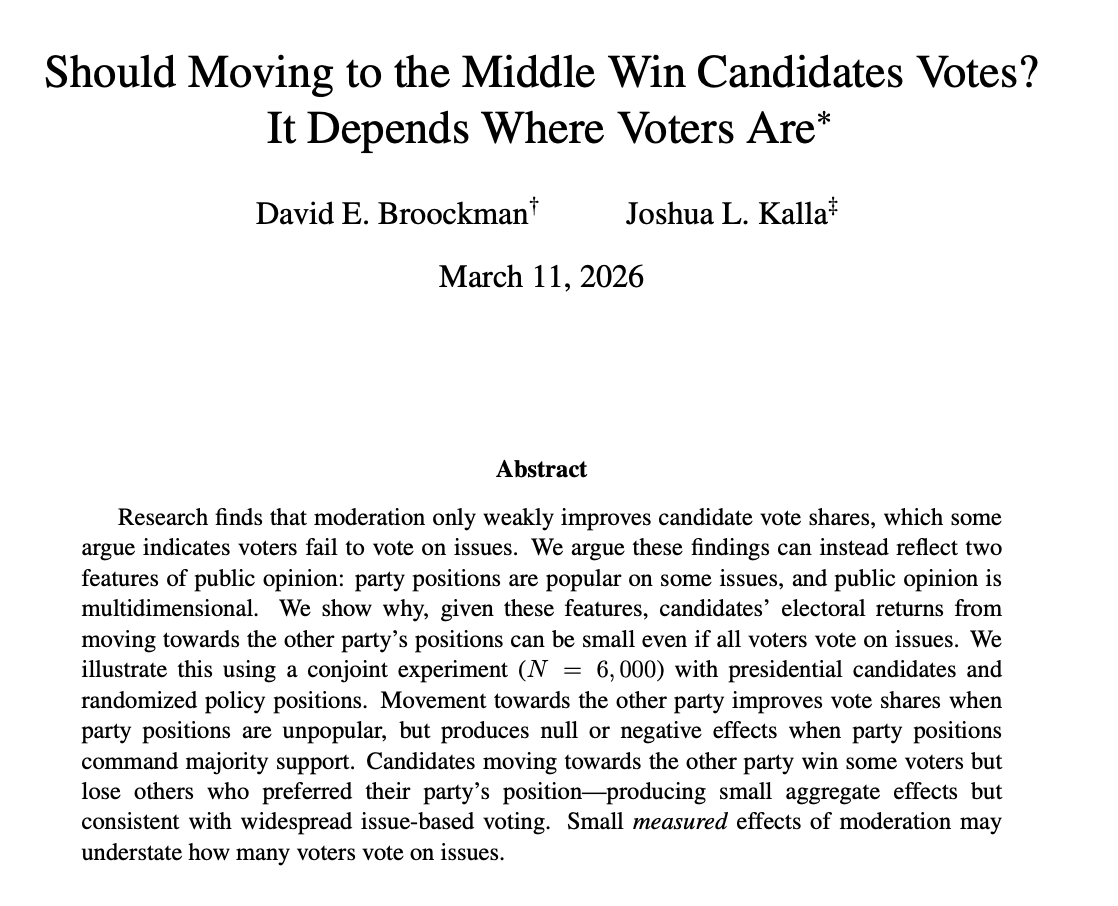
New short paper w @j_kalla! Candidates gain from moderation, but less than many theories expect. Many conclude voters must not care about issues. This is wrong. Small *average* effects mask large effects on specific issues & are consistent with widespread issue-based voting 🧵
David Broockman tweet media
English
5
87
322
57.7K
Boris Shor retweetledi
Alex Imas
Alex Imas@alexolegimas·
If you walk by a Jewish house of worship, a Jewish pre-school, a Jewish event of any sort, you'll notice one thing that' missing from nearly every other religious institution: men with guns. This is why. Armed security were able to stop the shooter.
ABC News@ABC

BREAKING: The suspect who rammed a vehicle into the Temple Israel synagogue in West Bloomfield Township in Michigan is believed to be dead after a shootout with security, a federal law enforcement official said. ABC News' Aaron Katersky reports. abcnews.link/mri6UqO

English
10
31
322
19.4K
Boris Shor retweetledi
Jesús Fernández-Villaverde
Jesús Fernández-Villaverde@JesusFerna7026·
Every time I discuss the economic and social disruptions caused by the worldwide decline in fertility, I hear the same response: artificial intelligence (AI) and robots will make this issue irrelevant. I find the answer deeply paradoxical because, despite being an economist, I am compelled to point out that the argument suffers from the mistake of “economism”: thinking that all social interactions in life are solely about productivity. Most of the problems caused by declining fertility are largely unrelated to productivity: the depopulation of rural areas, the collapse of public services, and inverted family structures in which one child supports four grandparents. Reducing all of this to purely economic terms is an extremely narrow view of society and life. A robot cannot visit your grandmother in a nursing home in a depopulated town in Korea. But there is an even more fundamental question: how do you know that societies will permit the deployment of artificial intelligence on a large enough scale? If we have learned anything from economic history, it is that societies repeatedly create barriers to wealth and hinder the adoption of new technologies. The Roman Empire had a working steam device, the aeolipile, and never developed it beyond a toy. The Ming dynasty burned Zheng He’s fleet and turned inward. Spain expelled its Jewish and Moorish populations at the height of its imperial power, gutting its merchant and artisan classes. The Ottoman Empire resisted the printing press for nearly three centuries after Gutenberg. Tokugawa Japan had firearms in the 1500s but chose to abandon them. The Qing restricted all foreign trade to a single port in Canton for over a century. Argentina was one of the ten richest countries in the world in 1910 and spent a century in relative decline through self-inflicted policy choices. The Soviet Union had world-class mathematicians and physicists but could not produce a decent pair of shoes because the institutional framework would not allow it. India’s License Raj strangled industrial development for four decades after independence. Closer to our own time, much of Europe spent decades resisting genetically modified crops despite the technology being available. Right now, the EU is drafting some of the strictest AI regulations in the world. And these problems will hit hardest where people least expect them. The conversation about aging and AI tends to focus on rich countries like the U.S. or Japan, but the most acute disruptions will come in emerging economies. Latin America and the Middle East have experienced some of the deepest and fastest declines in fertility on the planet. Colombia’s TFR is 1.06, Jamaica’s 1.20, Turkey’s 1.48, and Mexico’s 1.60. These countries are getting old before they get rich. On top of that, they face a double blow: not only are fewer children being born, but their most skilled and ambitious young workers are leaving. The doctors, engineers, and entrepreneurs who might drive AI adoption are moving to the US, Canada, or Europe. And let’s be honest: these are not exactly countries known for getting out of the way of innovation. The political economies of Latin America and the Middle East are riddled with extractive institutions, captured regulators, powerful incumbents who block competition, and states that struggle to deliver basic public services, let alone manage an AI transition. If Argentina could not reform its economy in a hundred years of trying (perhaps it is doing it now, but the jury is still out on whether this reform will be sustainable), if Mexico cannot keep its own engineers from leaving, if Egypt cannot fix its educational system, I am not sure why we should expect them to seamlessly deploy the most disruptive technology in human history. The countries that most need technological dynamism to offset demographic decline are precisely the ones least equipped to make it happen. There is nothing inevitable about adopting new technologies. It requires political will, institutional flexibility, and social acceptance. Aging, fiscally strained democracies dominated by elderly voters are not obviously the best candidates for any of those three. So when someone tells me “don’t worry, AI will fix it,” I hear an argument that assumes the best possible technological outcome, assumes societies will actually adopt it, assumes it will be deployed fast enough, and assumes the only thing that matters is productivity. That is four enormous assumptions stacked on top of each other. And I am sorry, but since I teach global economic history for a living, I have learned that optimistic assumptions are rarely validated by the crooked timber of humanity.
Jesús Fernández-Villaverde tweet media
English
33
180
530
58.3K
Boris Shor retweetledi
Alexander Kustov
Alexander Kustov@akoustov·
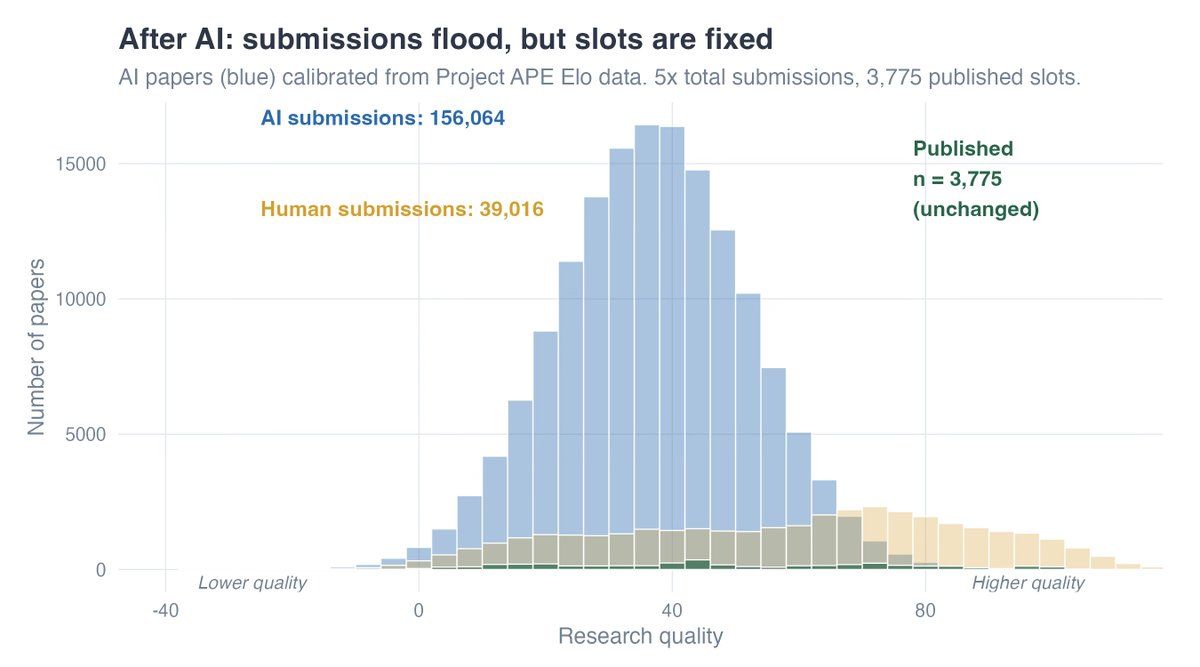
My two posts on AI in academia got over a million views and a thousand angry responses. I got a few things wrong. I stand by the rest. But most people reacted to the headline, not the arguments. So here are all 20 theses laid out. Tell me which ones you actually disagree with 🧵
Alexander Kustov tweet mediaAlexander Kustov tweet media
English
14
98
373
113.5K
Boris Shor
Boris Shor@bshor·
@SeanTrende Our data has him in the most liberal third of the TX Democratic state legislators -- and that's a pretty liberal delegation to begin. He's more liberal than 95% of the legislators in our database. bshor.github.io/data.html
English
1
8
19
6.5K
Sean T at RCP
Sean T at RCP@SeanTrende·
I think this is the big asterisk on Talarico. He sort of fulfils a lot of white liberals' West Wing fantasy of someone who can just talk sense into those darned conservatives. But he's *really* liberal, including on cultural issues, and in ways (2018) Beto wasn't.
Latinx Adjacent Doctor PhD@TonerousHyus

I think it’s clear a lot of Talarico bros have no idea he stood up in front of the Texas house and tried to stop a bill banning trans men from competing in women’s sports And during this he said God is non binary and trans children are beautiful It’s a R+14 state guys

English
115
222
2K
374.8K
Boris Shor retweetledi
Ryan Briggs
Ryan Briggs@ryancbriggs·
I have a new paper. We look at ~all stats articles in political science post-2010 & show that 94% have abstracts that claim to reject a null. Only 2% present only null results. This is hard to explain unless the research process has a filter that only lets rejections through.
Ryan Briggs tweet media
English
30
180
756
150.8K
Boris Shor retweetledi
Andy Hall
Andy Hall@ahall_research·
Two weeks ago I spent election night in NYC in a room with traders betting on real elections. Normally obscure off-cycle election races saw $400M in volume. Markets swung wildly on social media rumors. Prices became “proof” that candidates won. Today I'm publishing what I learned about how to design and govern prediction markets that make us smarter about politics—and launching my newsletter, Free Systems.
Andy Hall tweet media
English
10
18
103
18.9K
Boris Shor retweetledi
Andy Hall
Andy Hall@ahall_research·
"We can no longer trust that survey responses are coming from real people," says study author @seanjwestwood, associate professor of government at Dartmouth and director of the Polarization Research Lab, who conducted the research. LLM bots can now fully mimic human survey takers. Seems like an opportunity for @worldcoin and other technologies to verify human-ness for meaningful surveys.
English
2
15
68
15.7K
Boris Shor retweetledi
Jay Van Bavel, PhD
Jay Van Bavel, PhD@jayvanbavel·
The academic job market is doing something very good this year: A lot of searches are *NO* longer asking for reference letters until applicants make the short list. This makes is easier to apply for jobs, reduces the letter writing load for faculty, and makes the review process easier for committee members. This reduces the barrier to applying to jobs for applicants and provides some useful feedback if they make the longlist (which is normally unknown). Here is a sample job ad from UC Berkeley. If every search copied this strategy, the process would become much less onerous for everyone involved. It's a collective action problem we could easily solve.
Jay Van Bavel, PhD tweet media
English
18
48
476
40.2K
Boris Shor retweetledi
Hobby School of Public Affairs
Hobby School of Public Affairs@hobbyschooluh·
🚨 UH students: Apply for the $2,000 Richard Murray Endowed Scholarship by Oct. 13. Open to all @UHouston students passionate about public service. 🔗 bit.ly/40ktPhL 🗓️ Deadline: Monday, Oct. 13
Hobby School of Public Affairs tweet media
English
0
1
2
151
Boris Shor retweetledi
Sean Westwood
Sean Westwood@seanjwestwood·
We have measured support for partisan murder for the last 3 years. Following Kirk's assassination support dropped to ~*1%* from around 3% in the weeks before. True for Democrats, Republicans and even MAGA Republicans. Americans reject political violence.
Sean Westwood tweet media
English
40
204
749
451.4K
Boris Shor retweetledi
Paul Novosad
Paul Novosad@paulnovosad·
In data analysis, 99% of the knowledge is generated in the journey — cleaning, testing, validating, exploring. If you outsource this to an LLM (Hi Claude, please clean this dataset and generate me a graph), you will learn little and very often get the wrong answer. 1/
English
17
75
558
50.1K
Boris Shor
Boris Shor@bshor·
@lordsutch C64 first gaming computer, ColecoVision first console. Gen X memories!
English
0
0
2
41
Chris Lawrence
Chris Lawrence@lordsutch·
My first console was #12, but I played games for decades before that (starting with my C64, which was compatible with Atari-style joysticks but I never owned a #1). Pretty sure my first joystick was a Wico Command Control.
English
2
0
0
113
Will Marble
Will Marble@wpmarble·
Today was my last day working at Penn. I've been lucky to teach amazing students and work with great colleagues at @PennPORES and the polisci dept. This fall, I'll join @HooverInst as a Hoover Fellow—I'm excited to join a vibrant, interdisciplinary community of scholars there!
English
10
1
106
6.9K