CJK@CJKonstantinos
In the year 1900, you could buy a high-end suit for an average price of ~$20.
$20 was also the price of 1oz of Gold.
Today, that $20 can barely buy you a tee shirt.
However, today that same 1oz of Gold can still buy you a high-end suit ($1930).
Three questions to ask & answer to understand this process of storing value through time...
1. What is the difference between Gold & Dollar?
The Gold is MONEY - a store of value - whose SUPPLY CAN NOT be expanded without incurring COST.
The Dollar is a CURRENCY - a medium of exchange - whose SUPPLY CAN BE expanded without COST by congress in a vote or by a bank in extending credit.
2. How did the Gold, unlike the Dollar, store value over time to ensure the holder could maintain the purchasing power of their labor?
The popular answer to this question focuses on the limited supply of Gold and the expanding supply of Dollars.
More Dollars chasing the same amount of Gold means a higher Gold price. This is not wrong; it's correct!
BUT HERE IS A DIFFERENT ANGLE TO THINK ABOUT...
It's called All In Sustaining Cost (AISC).
Think of AISC as producers' FLOOR PRICE.
In other words, if the sale price goes below AISC then producers CAN NOT make a PROFIT.
The free market is signaling to producers that the value proposition of the product or service is NOT valuable enough (creating demand) from the consumer.
This is the entire point of those extra dollars "chasing" a product or service and thus altering price.
Price is the language of demand - the ultimate free market signal of acceptance or denial of a product or service.
When prices are at large premiums to AISC, the market is signaling to producers that the product and or service delivers value to the consumer.
Producers will then allocate resources to this product or service in order to capture profit.
As more producers PROVIDE SUPPLY, PRICES begin to TREND DOWN towards their AISC.
Now, when talking about Gold, the AISC WILL GO UP AS the DOLLARS ARE DEVALUED via inflation (dilution).
So over time as more and more dollars were created, and thus the purchasing power of those dollars was diluted, the AISC of gold slowly increased.
The rising AISC forced producers to raise the price of gold (in order to stay profitable) so consumers had to pay a higher price in order to benefit from Gold's value prop.
Over a hundred years later, a person saving Gold can buy the same amount of stuff BECAUSE as inflation increased the AISC of Gold, the price of Gold was forced to increase to compensate for those increased COSTS.
Costs are always pushed to the consumer. Without profit, no product or service would continue to exist.
3. What's the difference between AISC of Gold versus #Bitcoin ?
The AISC of Bitcoin is not just based on the loss of purchasing power of the dollar based on inflation.
$BTC has an added cost structure element that is found in no other commodity in the world 🤯
THE DIFFICULTY ADJUSTMENT.
As more and more producers compete to generate bitcoin, thus adding hashrate to the network, the difficulty adjustment will INCREASE.
When difficulty increases, producers' AISC increases.
This requires a higher price to be paid by consumers to access the value prop of Bitcoin network, just like those who wanted to own Gold as its AISC was increasing.
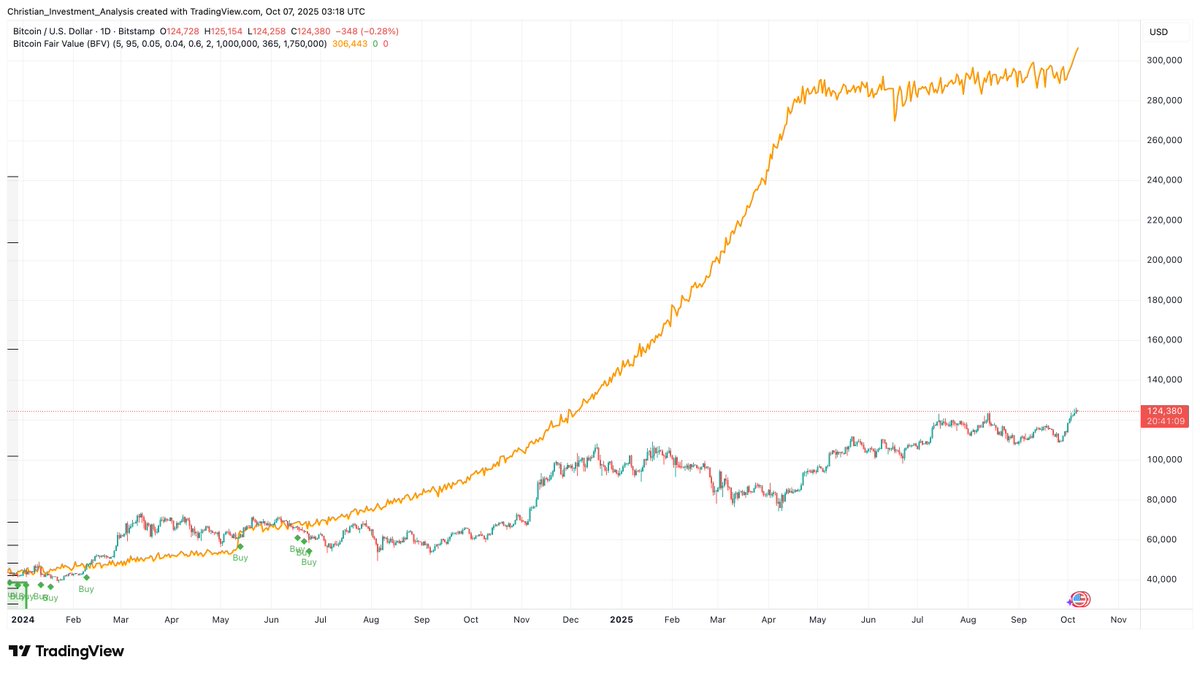
So, its not just the dilution of Dollars that increases the fair value of BTC but also the growth of the network itself that increases the AISC for bitcoin miners.
Another benefit of the difficulty adjustment is sustainability. If price goes below AISC and miners are forced to turn off hashrate, difficulty will decrease.
If difficulty decreases, AISC decreases. Thus miners can be more profitable and are incentivized to rejoin the network.
CONCLUSIONS
(1) The devaluation of Currency via inflation can increase prices by creating a new supply/demand balance (more money chasing same items).
(2) The devaluation of Currency via inflation can increase prices by raising producers' AISC. Those costs must be pushed to the consumer for producers to profit.
(3) Without profit, producers will not produce. Supply will drop and prices will increase. Supply will not increase again until prices incentivize producers with profit.
(4) Gold has been a great store of value BUT Bitcoin is the apex predator of storing value, especially via the combination of dollar dilution + difficulty adjustment raising the AISC of BTC