B Tenge

8.3K posts

B Tenge banner
B Tenge

B Tenge

@btenge89

IT Specialist; Analytical Chemist (Ph.D, ‘89, UW); Fan of Public Health; Fan of Machine Learning Methods/Chemometrics

Katılım Mart 2009
4.5K Takip Edilen246 Takipçiler
B Tenge retweetledi
Raina MacIntyre
Raina MacIntyre@Globalbiosec·
Transmission of #Ebola is being debated yet again. In the catastrophic West African epidemic in 2014, health workers were forced to work in surgical masks and many got infected. Medical journals refused to publish us, instead, publishing articles saying "less PPE is better". A nursing journal published us, because #nurses are at the frontline 1/2 sciencedirect.com/science/articl…
English
31
335
893
84.2K
B Tenge retweetledi
Dr. Angela Rasmussen
Dr. Angela Rasmussen@angie_rasmussen·
Literally no Ebola expert ever said “less PPE is better”. Workers were forced to wear surgical masks because they didn’t have access to respirators. They are forced to do so again because USAID cut funds, not because of this silly invented controversy
Raina MacIntyre@Globalbiosec

Transmission of #Ebola is being debated yet again. In the catastrophic West African epidemic in 2014, health workers were forced to work in surgical masks and many got infected. Medical journals refused to publish us, instead, publishing articles saying "less PPE is better". A nursing journal published us, because #nurses are at the frontline 1/2 sciencedirect.com/science/articl…

English
30
137
626
43.5K
B Tenge retweetledi
B Tenge retweetledi
Cai Zhou
Cai Zhou@zhuci19·
Actually the idea of generating on the continuous embedding space is not new. Our ICML'26 paper CCDD has already done so: arxiv.org/abs/2510.03206 ELF can be viewed as a special case of CCDD where the discrete schedule is set to such that all tokens are decoded at the last step.
Tanishq Mathew Abraham, Ph.D.@iScienceLuvr

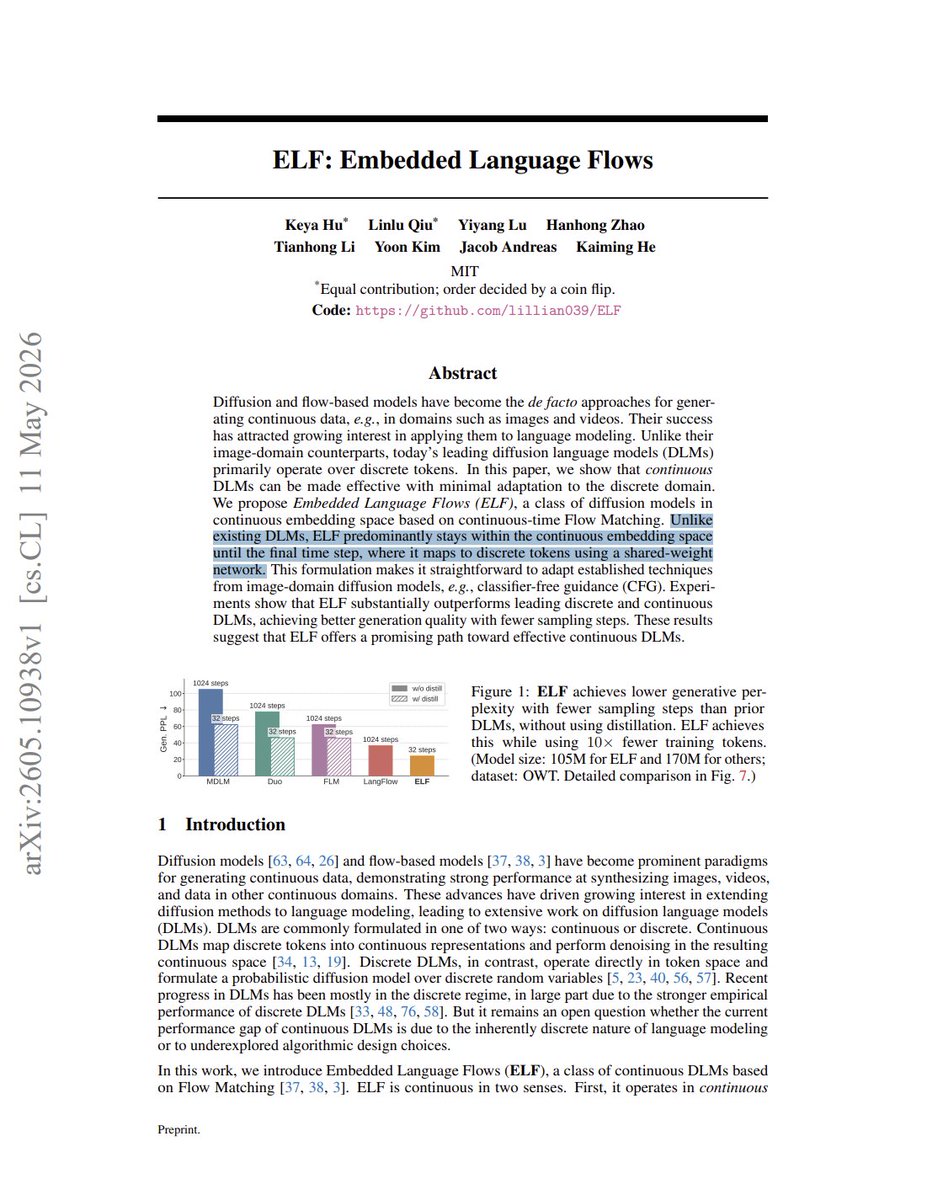
I'm a simple man, I see a Kaiming He paper, I click. ELF: Embedded Language Flows This is very interesting, getting continuous diffusion models working for text! "Unlike existing DLMs, ELF predominantly stays within the continuous embedding space until the final time step, where it maps to discrete tokens using a shared-weight network." @sedielem you might like this one!

English
4
20
149
64.5K
B Tenge retweetledi
Tanishq Mathew Abraham, Ph.D.
Tanishq Mathew Abraham, Ph.D.@iScienceLuvr·
I'm a simple man, I see a Kaiming He paper, I click. ELF: Embedded Language Flows This is very interesting, getting continuous diffusion models working for text! "Unlike existing DLMs, ELF predominantly stays within the continuous embedding space until the final time step, where it maps to discrete tokens using a shared-weight network." @sedielem you might like this one!
Tanishq Mathew Abraham, Ph.D. tweet media
English
14
96
821
153.8K
B Tenge retweetledi
B Tenge retweetledi
Judea Pearl
Judea Pearl@yudapearl·
I love this quote "Science is about understanding things that go beyond our intuition." It reminds me how probability theory was developed to counter perfectly intuitive gambler's fallacies.
Conjecture Institute@ConjectureInst

When you do any kind of science, when you get to the edge, you find things that are counterintuitive. If they had been intuitive, they would have been discovered long ago. Science is about understanding things that go beyond our intuition. ~Conjecture Institute Advisor @DavidDeutschOxf with @GadSaad

English
10
31
277
18.6K
B Tenge retweetledi
Anish Moonka
Anish Moonka@anishmoonka·
Winston Churchill fought his depression with bricks. He'd lay them for hours at his country home in Kent. He joined the bricklayers' union. And in 1921 he wrote about why it worked. It took psychology another 75 years to catch up. He called his depression the "Black Dog." It followed him for decades. His method for fighting it back was as basic as it sounds: laying brick after brick, hour after hour. Churchill spelled out his theory in a long essay for The Strand Magazine. People who think for a living, he wrote, can't fix a tired brain just by resting it. They have to use a different part of themselves. The part that moves the eyes and the hands. Woodworking, chemistry, bookbinding, bricklaying, painting. Anything that drags the body into a problem the mind can't solve by itself. Modern psychology now calls this behavioral activation. It's one of the most-studied depression treatments out there. Depression sets a behavior trap. You feel bad, so you stop doing things, and doing less means less to feel good about. Feeling worse makes you do even less. The loop tightens until you can't breathe inside it. Behavioral activation breaks the loop from the action side. You schedule the activity first, even when every part of you doesn't want to. Doing it produces small rewards: a wall gets straighter, a painting fills in, a messy room gets clean. Those small rewards slowly rewire the brain. Action comes first, and the feeling follows. Researchers at the University of Washington put this to the test in 2006. They studied 241 adults with major depression and compared three treatments: behavioral activation, regular talk therapy, and antidepressants. For the people who were most severely depressed, behavioral activation matched the drugs. It beat the talk therapy. A 2014 review of more than 1,500 patients across 26 trials backed up the result. Physical work like bricklaying does something extra on top of this. It crowds out rumination, the looping bad thoughts that grind people down during the worst stretches of depression. Bricklaying needs both hands and gives feedback brick by brick: each one is straight or crooked. After an hour you can see exactly how much wall you built. No room left for the mental chewing. The line George Mack used in his post, "depression hates a moving target," is good poetry. The science behind it is sharper. Depression hates a brain that has somewhere else to be.
George Mack@george__mack

Winston Churchill used to lay 200 bricks per day to keep his mind busy when feeling down. Depression hates a moving target.

English
856
11.6K
56.3K
6.9M
B Tenge retweetledi
Shane Ross
Shane Ross@RossDynamicsLab·
20 years ago this week, as a new PhD, I presented a talk at Caltech on how the interplay of gravity between the sun, planets, and moons create low-energy pathways for spacecraft travel throughout the solar system.
English
4
23
165
26.2K
B Tenge retweetledi
Grady Booch
Grady Booch@Grady_Booch·
I am one of those whose research points to the conclusion that the mind is computable. Sentience is an exquisite consequence of the laws of physics. I see no evidence that requires the supernatural; I find panpsychism to be a god-of-the-gaps fantasy; I see no requirement for any quantum pixie dust. What I do see is that evolution has led the cosmos through billions of years of experiments and mistakes and failures, eventually bringing forth artifacts with intelligence, with consciousness, with sentience, with life itself, by growing and combining very simple things then morphing them into extraordinarily complex ones. An underlying challenge in all this discourse, of course, is that these words represent ineffable concepts that human language strains at and fails to define crisply, and so we end up talking past one another, with emotion rather than rational and informed dialog. That notwithstanding, it is the ultimate hubris to conclude that only we humans can be conscious or sentient: a multitude of creatures living among us possess those properties to varying degrees (and we already treat multitudes of them with questionable ethical consideration). It is hubris to demand that the intelligence and consciousness and sentience we experience is its only form. It is hubris for we humans to assert that at this moment are at the cusp of building sentient artifacts. My understanding and experience suggests that while some individual elements are within our understanding, there are many others we do not know that we even know we need to know. Moreover, there exists a problem of systems architecture at extreme scale, and that we are a long way from understanding how to engineer that. But I predict that some day we shall. This is not that day, nor is it a day in the lives of any of this present generation. I expect that embodiment will be necessary (all contemporary approaches are deeply impoverished with regard to building things in and of this world, with sensing and acting now only a tiny fraction of what organics experience in all its noise and ambiguity). I posit that in this journey, we will co-evolve, compelled to reconsider what it means to be human. I know that we will find value from the things we create, but I also know that there exist fundamental and unavoidable risks that will harm us. I fear most the wealthy and privileged few who assert they alone know the way and should be trusted to bring humanity to this new digital promised land; I fear the organizations and nations who seek to use these things for greater power and control. I suspect that some strive to build artificial super intelligence (because they want to be gods) while others reject the possibility (because they cherish our uniqueness). And yet, I am hopeful, and confident in the resilience of the human sprit to endure, and in the end, be better for the journey. What an extraordinary time to be alive.
TED Talks@TEDTalks

"Many experts think that conscious AI is possible. I think they're wrong." Watch neuroscientist @anilkseth's full TED Talk here: t.ted.com/0NR6eGI

English
99
76
518
72.1K
B Tenge retweetledi
Ethan Mollick
Ethan Mollick@emollick·
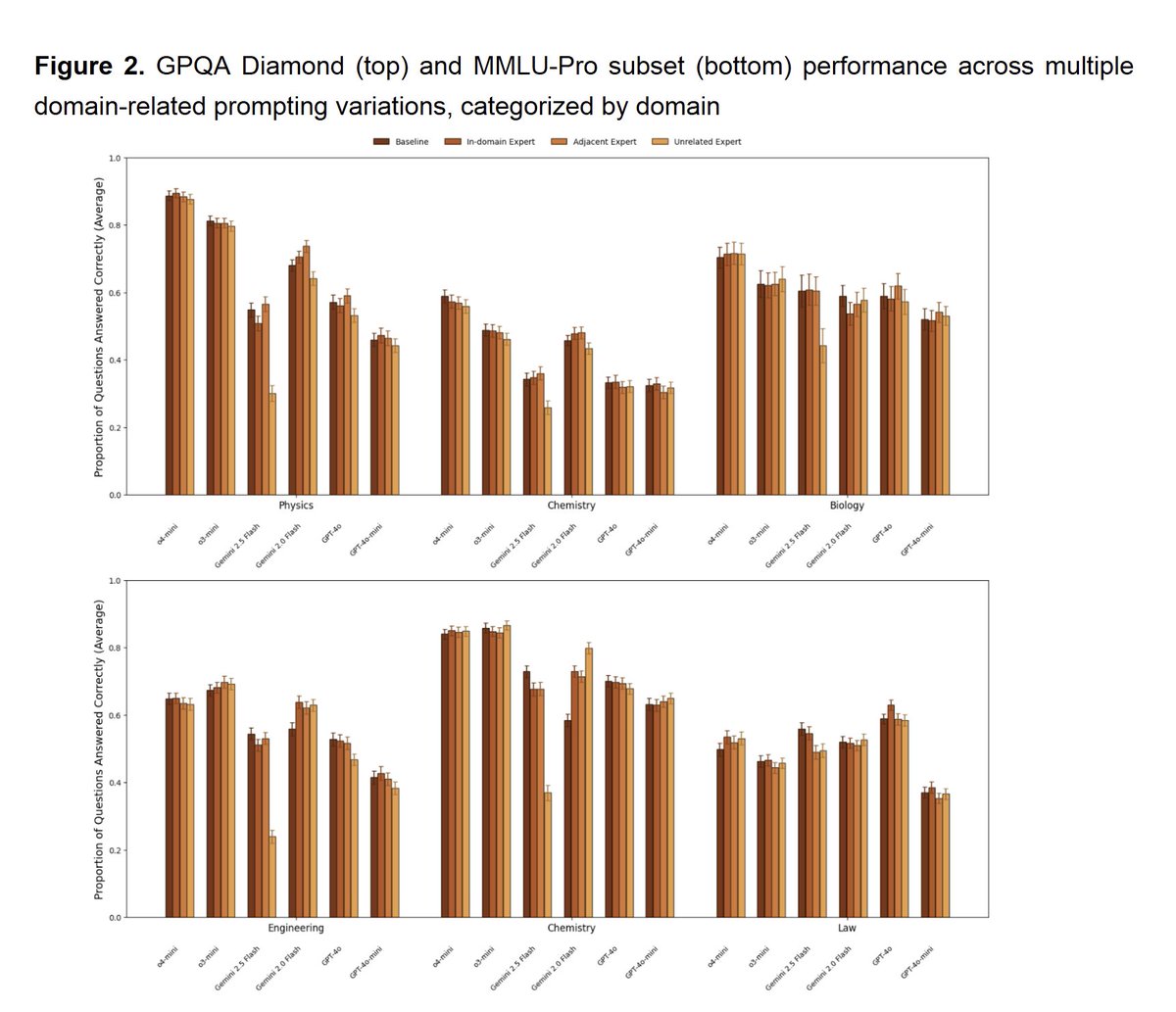
We tested one of the most common prompting techniques: giving the AI a persona to make it more accurate We found that telling the AI "you are a great physicist" doesn't make it significantly more accurate at answering physics questions, nor does "you are a lawyer" make it worse.
Ethan Mollick tweet mediaEthan Mollick tweet media
English
134
198
1.8K
531.3K
B Tenge retweetledi
Dr. Angela Rasmussen
Dr. Angela Rasmussen@angie_rasmussen·
Viruses emerge in all sorts of unpredictable ways. Could be rodents on the ship or human to human transmission enabled by cruise ship environment. Effective responses require functioning health systems that are prepared for anything. We’ve never been less prepared globally.
Jeanne Marrazzo@DrJeanneM

This would be horrific at any time, but with US CDC crippled by loss of career scientists, vaccine research under attack & US global health collaboration at a critical low, it’s even worse ⁦@IDSAInfo theguardian.com/world/2026/may…

English
5
37
245
16.1K
B Tenge retweetledi
Best of Star Wars
Best of Star Wars@bestofstarwar·
Happy Star Wars day! What does Star Wars mean to you?
Best of Star Wars tweet media
English
142
1.4K
5.2K
78.1K
B Tenge retweetledi
Being Scottish
Being Scottish@BeingScots·
May the 4th be with you 🏴󠁧󠁢󠁳󠁣󠁴󠁿✨
Being Scottish tweet media
English
31
561
2.9K
63.7K