aleks bykhun

41.2K posts

aleks bykhun banner
aleks bykhun

aleks bykhun

@caffeinum

🇺🇦 founder in SF eval your agent-readiness at https://t.co/Zsor9Lr2Kl i love emdashes —

San Francisco Katılım Temmuz 2010
1.7K Takip Edilen2.4K Takipçiler
Sabitlenmiş Tweet
aleks bykhun
aleks bykhun@caffeinum·
Alright guys I’m pivoting this account. No more shitposting. That’s over. I’m legitimate and respectable now. I’m gonna post about tech like everyone else
English
5
0
25
1.9K
aleks bykhun
aleks bykhun@caffeinum·
lol grok is not shy at all
aleks bykhun tweet media
English
0
0
3
166
Haz Hubble
Haz Hubble@hazhubble·
all the hot girls in silicon valley work for corgi or one day will i don’t make the rules
English
38
1
190
55.9K
aleks bykhun
aleks bykhun@caffeinum·
@justalexoki i watch words as they appear on the screen, equally surprising to me as surprising they arrive at you
English
0
0
3
65
taoki
taoki@justalexoki·
how the hell do you write tweets if you don't have an internal monologue
English
58
16
408
13.6K
sankalp
sankalp@dejavucoder·
pretty sure the agentmaxxers are searching on how to get better at context switching without paying the fatigue tax
English
10
1
55
2.9K
aleks bykhun retweetledi
Mika Sagindyk
Mika Sagindyk@heymikasagi·
Working with our tool now, it becomes clear that triggering workflows/getting data is best done via MCP/API/Slack bot AX isn't just a nice to have next to good UX, it's literally the new UX
English
1
1
11
590
aleks bykhun
aleks bykhun@caffeinum·
@webdevMason i’d rather buy a new couch every month than become this monster and i don’t even have kids
English
0
0
0
54
Mason
Mason@webdevMason·
I understand the reasoning behind this advice but to be blunt, I'd rather die
Mason tweet media
English
479
39
2.2K
2.1M
aleks bykhun
aleks bykhun@caffeinum·
@jaredrhizor @KentonVarda i’m referring to the fact that it’s a messy boundary, cause arguably we write code for other humans to read, too
English
0
0
0
12
Kenton Varda
Kenton Varda@KentonVarda·
I just declared a moratorium against AI-written change descriptions (e.g. PR and commit messages, also issues/tickets) from my team. AI was writing change descriptions that were worse than useless to me as I tried to review PRs: outlining details of the code that could easily be seen by looking at the code, but omitting the higher-level framing needed to understand broadly what the code is doing. I think people like having AI write these things because the output looks structured and thorough, which makes it feel professional in a way. But this isn't actually valuable. Concise, high-level descriptions are better for everyone. If I need to use my own AI to interpret what your AI wrote then something is wrong. Let AI write code, sure, but for the description, I'd rather see your prompt than your output. We could maybe have extended agents.md with guidelines on writing descriptions, but this seemed a bit pointless since a good, concise change description only takes a few minutes to write -- not a significant time savings to delegate to AI. At least, it doesn't take long if you understand the code -- and if you don't understand the code, then I'm definitely not merging it.
English
147
122
1.8K
440.2K
aleks bykhun retweetledi
Aillusory
Aillusory@aillusoryx·
GTA: San Delhi (AI Slop Gameplay Video)
English
277
977
11.7K
894.3K
aleks bykhun retweetledi
ashe
ashe@ashebytes·
@jeremiahjw once coached someone I dated on how to handle a tech team issue with "you have to make him think it was his idea" and his eyes got wide as he began to put it all together
English
9
8
900
24.5K
aleks bykhun
aleks bykhun@caffeinum·
it's becoming increasingly important how AI brains are structured, anthropic also researching in the same space a lot lately
Anastasiia Gaidashenko@avgaydashenko

Reading what AI doesn't say (this topic genuinely matters to me, and it happens to be my birthday today, so if you feel like it, a repost would be a nice gift 🎂) Something shifting in AI architecture that I don't think gets discussed enough through a safety lens. Models are starting to pass information to each other directly through internal representations, hidden states, activations, and computation vectors (still mostly research right now, but the infrastructure will follow). That matters for how we audit reasoning, since most of what we can currently check comes from what shows up in words. Right now, the main tool we have for auditing AI reasoning is reading chain-of-thought. Korbak et al. (2025) spend a whole paper arguing this window is already "fragile" for single-model reasoning. If models start reasoning through vectors passed model-to-model instead of text, understanding that latent layer becomes the only way to keep any visibility into what's actually happening. Thus I think that what seems underexplored is understanding the math of these latent spaces, and it might be the same research direction as learning how to monitor them. Models appear to converge toward similar geometric structure regardless of architecture (Huh et al. 2024). If that's right, probes for safety-relevant features might generalize: deception patterns, goal representations, misalignment signals studied once and applied across models rather than re-derived per architecture. Whether this holds for safety-critical features specifically is open, so is what adversarially robust latent decoding would even look like. Both feel more urgent than the current research investment suggests.


English
1
0
3
211
aleks bykhun
aleks bykhun@caffeinum·
claude is an ultimate B-player and you know i'm right
English
3
0
2
205
aleks bykhun
aleks bykhun@caffeinum·
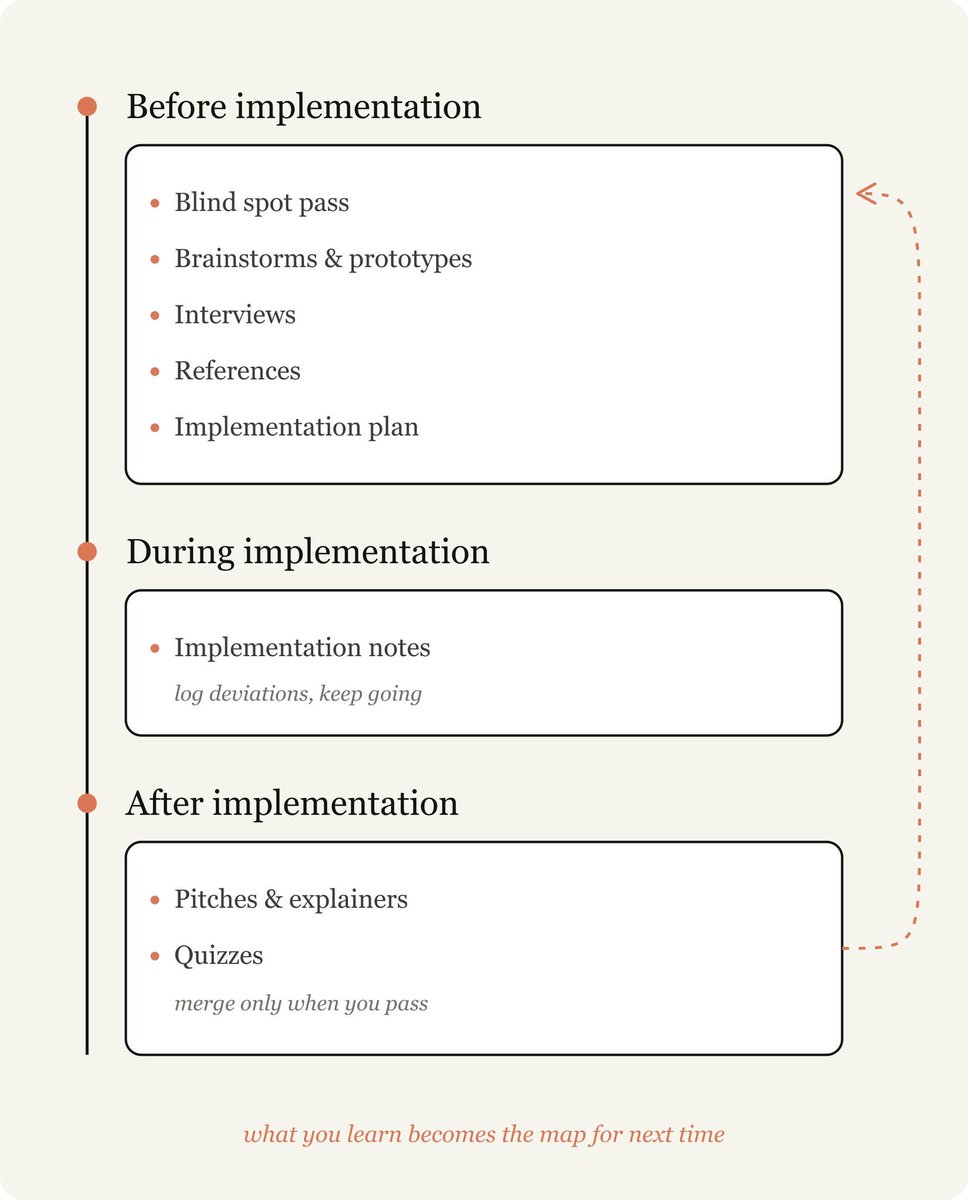
Thariq @trq212 from Claude Code team has just released a guide on how to prompt Fable to build new features In a nutshell, it's all about finding out how to put your unknowns into words. He offers 11 prompts that help you collaborate with Claude to surface these! Here's the guide implemented as a skill: github.com/team2027/claud…
aleks bykhun tweet media
Thariq@trq212

x.com/i/article/2073…

English
2
1
10
796