David Cagan

321 posts

David Cagan banner
David Cagan

David Cagan

@cagan_da

@NSF Postdoctoral Fellow in @BaranLabReads, @ScrippsResearch | PhD in Hadt Lab, @CaltechCCE | @theNASEM Ford & @NSF GRFP Fellow | Founder of Caltech Rising Tide

San Diego, CA Katılım Ocak 2020
429 Takip Edilen468 Takipçiler
Sabitlenmiş Tweet
David Cagan
David Cagan@cagan_da·
We asked ourselves, "What is the simplest way to make radicals from a diazene intermediate?" Turns out, you just need a little heat and a mild base. Radicals are seen even without a metal!
David Cagan tweet media
Baran Lab@BaranLabReads

👋DRUG HUNTERS👋 N₂ extrusion from alkyl hydrazines delivers complex, medicinally relevant alkyl S(VI)-chemical space with exceptional chemoselectivity and operational simplicity. Appearing today in @ChemRxiv: chemrxiv.org/doi/full/10.26… Alkyl hydrazines (or their sulfonyl derivatives) serve as practical radical precursors readily prepared from ketones, alcohols, amines, and complex molecules. Simple thermal activation triggers clean N₂ extrusion to generate alkyl radicals that are captured by inexpensive SO₂ sources, delivering versatile sulfinates convertible in situ to sulfonyl fluorides or sulfinamides. 70+ examples, protecting-group-free late-stage functionalization of natural products and drugs (ticagrelor, erythromycin, spiramycin), 100-g scale with trivial work-up, and stereoretentive variants round out a unified platform that directly addresses the growing need for complex alkyl S(VI) motifs in medicinal chemistry. Detailed mechanistic studies, including temperature scanning calorimetry, radical clocks, and DFT calculations help to demystify the process.

English
1
3
55
5.8K
David Cagan retweetledi
Yu Kawamata
Yu Kawamata@YuKawamata·
From glucose to gliflozins in just 2 steps. A bit of alchemy turning the cause of diabetes into a treatment.
Baran Lab@BaranLabReads

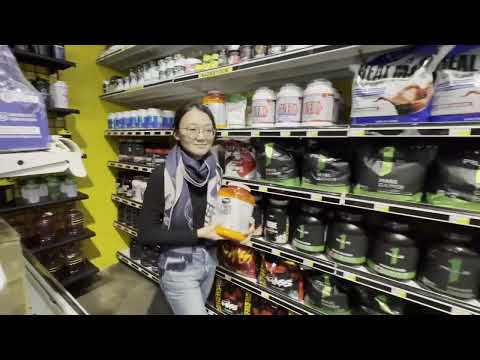
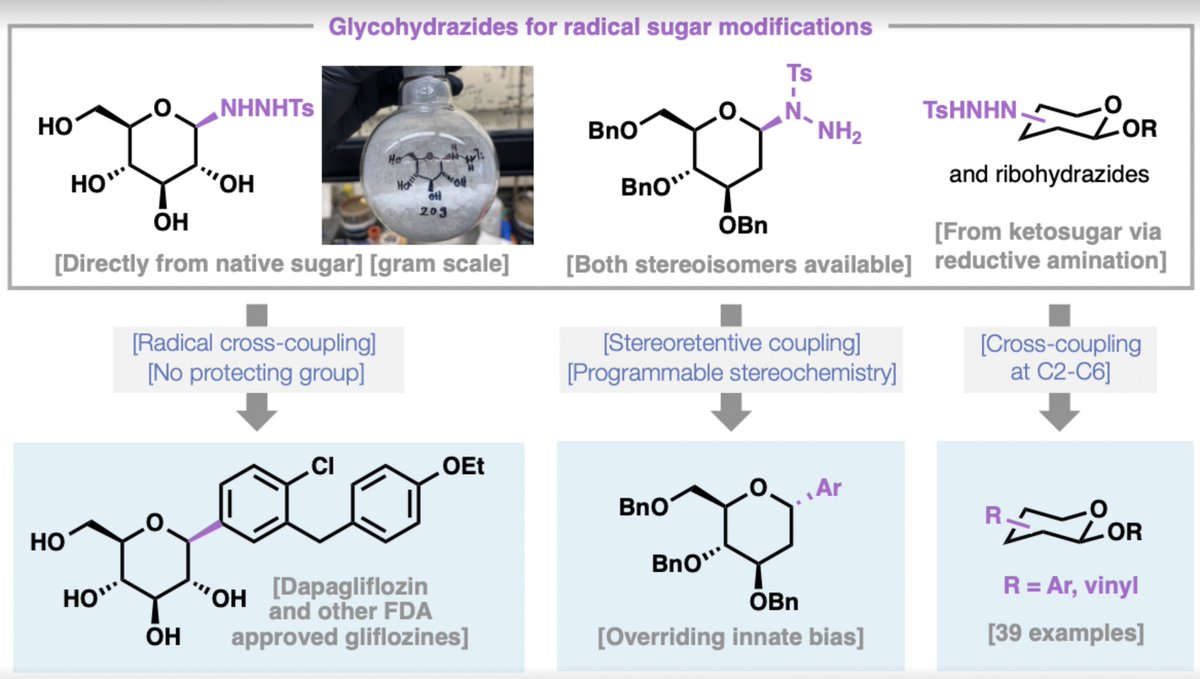
Making C-glycosides SWEET and simple! Today in @ChemRxiv we disclose (chemrxiv.org/doi/full/10.26…), in collaboration with @GroupAggarwal, an incredibly easy way to achieve radical functionalization of sugars. In this video (youtu.be/Fqdbgmx7zEI), a two-step synthesis of the billion dollar drug Dapagliflozin is achieved using household vinegar and dextrose powder from the local supplement store. High Level Summary: The work addresses a longstanding challenge in carbohydrate chemistry: the efficient, scalable, and stereocontrolled synthesis of C-aryl glycosides directly from unprotected native sugars. C-Aryl glycosides form the core pharmacophore of the SGLT2 inhibitors (dapagliflozin, canagliflozin, empagliflozin, and related agents), which are frontline therapies for type 2 diabetes and represent one of the highest-grossing classes of small-molecule drugs. Conventional synthetic routes to these molecules generally require extensive protecting-group manipulations, multi-step activation of glycosyl donors, or organometallic additions under demanding conditions. Recent advances in radical and transition-metal-catalyzed cross-couplings have improved access, yet most approaches still depend on protected precursors, specialized reagents, or protocols that are difficult to scale. We report a practical alternative based on glycosyl sulfonyl hydrazides—stable, crystalline radical precursors that are prepared in a single step from unprotected sugars by treatment with tosylhydrazine in acetic acid, followed by simple crystallization. These hydrazides undergo redox-neutral nickel-catalyzed radical cross-coupling with aryl iodides or bromides under mild conditions (70 °C, DMSO, tetramethylguanidine as base). The reaction requires no external oxidant or reductant, no photocatalyst, and no organotin species. In glucose-derived systems the coupling typically delivers high β-selectivity (>19:1 in many cases), an outcome that appears to depend on hydrogen-bonding interactions between tetramethylguanidine and the free hydroxyl groups. The main findings are as follows: All five FDA-approved SGLT2 inhibitors, as well as several clinical candidates, can be prepared in a single coupling step from the corresponding glycohydrazide. Decagram-scale synthesis of dapagliflozin was demonstrated starting from commercial dextrose; the product was isolated by aqueous workup and recrystallization (no column chromatography required at this scale). Di- and trisaccharides (lactose, cellobiose, maltose, maltotriose) couple directly to give aryl-linked oligosaccharides. Several natural products and medicinally relevant structures (salmochelin-SX, neopetrosin C, the tryptophan-mannose conjugate, and a ribose-derived IMPDH inhibitor) that previously required 9–20 steps or costly reagents are now accessible in 1–4 steps with good stereocontrol. The platform extends to non-anomeric C–C bond formation at positions C2–C6 on glucose and ribose scaffolds, providing the first systematic exploration of radical diversification across these positions. Stereoretentive radical cross-coupling, using configurationally pure hydrazides, enables programmable delivery of either α- or β-anomers, overriding inherent substrate biases and providing access to stereoisomers not previously obtainable by radical methods. The chemistry builds on our earlier development of sulfonyl hydrazide-based redox-neutral cross-coupling and stereoretentive radical arylation, here adapted and optimized for carbohydrate substrates. The method is operationally straightforward, uses inexpensive reagents and starting materials, and eliminates protecting-group strategies.

English
0
4
69
5.9K
David Cagan retweetledi
Baran Lab
Baran Lab@BaranLabReads·
Making C-glycosides SWEET and simple! Today in @ChemRxiv we disclose (chemrxiv.org/doi/full/10.26…), in collaboration with @GroupAggarwal, an incredibly easy way to achieve radical functionalization of sugars. In this video (youtu.be/Fqdbgmx7zEI), a two-step synthesis of the billion dollar drug Dapagliflozin is achieved using household vinegar and dextrose powder from the local supplement store. High Level Summary: The work addresses a longstanding challenge in carbohydrate chemistry: the efficient, scalable, and stereocontrolled synthesis of C-aryl glycosides directly from unprotected native sugars. C-Aryl glycosides form the core pharmacophore of the SGLT2 inhibitors (dapagliflozin, canagliflozin, empagliflozin, and related agents), which are frontline therapies for type 2 diabetes and represent one of the highest-grossing classes of small-molecule drugs. Conventional synthetic routes to these molecules generally require extensive protecting-group manipulations, multi-step activation of glycosyl donors, or organometallic additions under demanding conditions. Recent advances in radical and transition-metal-catalyzed cross-couplings have improved access, yet most approaches still depend on protected precursors, specialized reagents, or protocols that are difficult to scale. We report a practical alternative based on glycosyl sulfonyl hydrazides—stable, crystalline radical precursors that are prepared in a single step from unprotected sugars by treatment with tosylhydrazine in acetic acid, followed by simple crystallization. These hydrazides undergo redox-neutral nickel-catalyzed radical cross-coupling with aryl iodides or bromides under mild conditions (70 °C, DMSO, tetramethylguanidine as base). The reaction requires no external oxidant or reductant, no photocatalyst, and no organotin species. In glucose-derived systems the coupling typically delivers high β-selectivity (>19:1 in many cases), an outcome that appears to depend on hydrogen-bonding interactions between tetramethylguanidine and the free hydroxyl groups. The main findings are as follows: All five FDA-approved SGLT2 inhibitors, as well as several clinical candidates, can be prepared in a single coupling step from the corresponding glycohydrazide. Decagram-scale synthesis of dapagliflozin was demonstrated starting from commercial dextrose; the product was isolated by aqueous workup and recrystallization (no column chromatography required at this scale). Di- and trisaccharides (lactose, cellobiose, maltose, maltotriose) couple directly to give aryl-linked oligosaccharides. Several natural products and medicinally relevant structures (salmochelin-SX, neopetrosin C, the tryptophan-mannose conjugate, and a ribose-derived IMPDH inhibitor) that previously required 9–20 steps or costly reagents are now accessible in 1–4 steps with good stereocontrol. The platform extends to non-anomeric C–C bond formation at positions C2–C6 on glucose and ribose scaffolds, providing the first systematic exploration of radical diversification across these positions. Stereoretentive radical cross-coupling, using configurationally pure hydrazides, enables programmable delivery of either α- or β-anomers, overriding inherent substrate biases and providing access to stereoisomers not previously obtainable by radical methods. The chemistry builds on our earlier development of sulfonyl hydrazide-based redox-neutral cross-coupling and stereoretentive radical arylation, here adapted and optimized for carbohydrate substrates. The method is operationally straightforward, uses inexpensive reagents and starting materials, and eliminates protecting-group strategies.
YouTube video
YouTube
Baran Lab tweet media
English
3
40
227
24.9K
David Cagan retweetledi
Yu Kawamata
Yu Kawamata@YuKawamata·
One of the “hidden gems” behind this paper: huge credit to Dr. Shuanghu Wang, our first author, for spearheading the project and driving many of the most exciting applications. Congrats Shuanghu and the whole team on a fantastic piece of work!
Baran Lab@BaranLabReads

👋DRUG HUNTERS👋 N₂ extrusion from alkyl hydrazines delivers complex, medicinally relevant alkyl S(VI)-chemical space with exceptional chemoselectivity and operational simplicity. Appearing today in @ChemRxiv: chemrxiv.org/doi/full/10.26… Alkyl hydrazines (or their sulfonyl derivatives) serve as practical radical precursors readily prepared from ketones, alcohols, amines, and complex molecules. Simple thermal activation triggers clean N₂ extrusion to generate alkyl radicals that are captured by inexpensive SO₂ sources, delivering versatile sulfinates convertible in situ to sulfonyl fluorides or sulfinamides. 70+ examples, protecting-group-free late-stage functionalization of natural products and drugs (ticagrelor, erythromycin, spiramycin), 100-g scale with trivial work-up, and stereoretentive variants round out a unified platform that directly addresses the growing need for complex alkyl S(VI) motifs in medicinal chemistry. Detailed mechanistic studies, including temperature scanning calorimetry, radical clocks, and DFT calculations help to demystify the process.

English
0
5
59
4.3K
David Cagan
David Cagan@cagan_da·
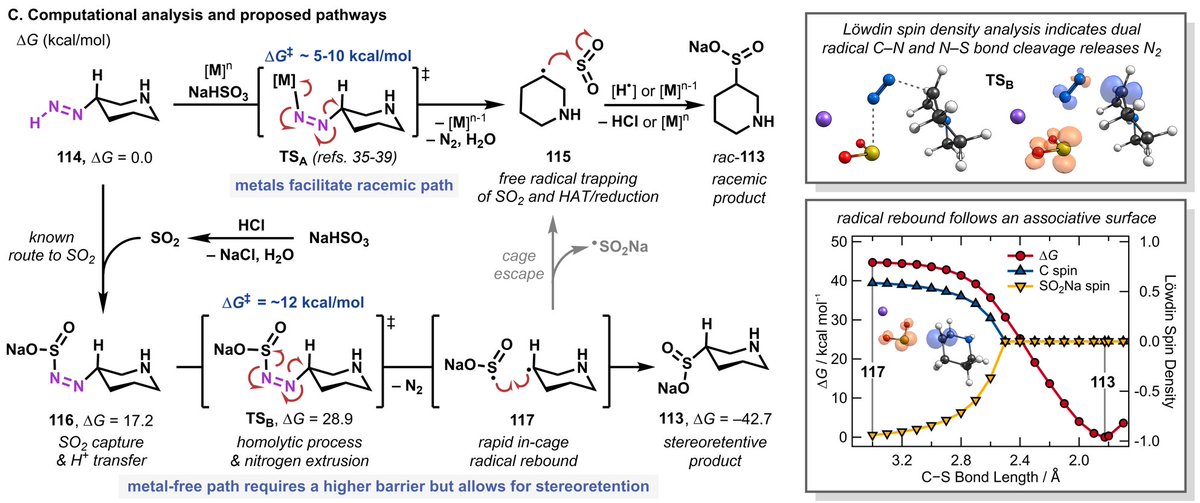
Computational analysis reveals this too. Add a metal, and you get fast reactions with higher yield, but reduced ee. If you remove the metal, the reaction slows down but the ee goes up! Geminate radical pairs are seen again; nitrogen extrusion drives it all!
David Cagan tweet media
English
0
0
3
216
David Cagan
David Cagan@cagan_da·
Metals can help, though! They turn on new reactivity pathways at lower temperatures. TSR calorimetry reveals this immediately. Add a metal, and the radicals are made in abundance, giving higher yield. The trade-off is that *free* radicals are generated, not caged ones.
David Cagan tweet media
English
1
0
3
208
David Cagan
David Cagan@cagan_da·
We asked ourselves, "What is the simplest way to make radicals from a diazene intermediate?" Turns out, you just need a little heat and a mild base. Radicals are seen even without a metal!
David Cagan tweet media
Baran Lab@BaranLabReads

👋DRUG HUNTERS👋 N₂ extrusion from alkyl hydrazines delivers complex, medicinally relevant alkyl S(VI)-chemical space with exceptional chemoselectivity and operational simplicity. Appearing today in @ChemRxiv: chemrxiv.org/doi/full/10.26… Alkyl hydrazines (or their sulfonyl derivatives) serve as practical radical precursors readily prepared from ketones, alcohols, amines, and complex molecules. Simple thermal activation triggers clean N₂ extrusion to generate alkyl radicals that are captured by inexpensive SO₂ sources, delivering versatile sulfinates convertible in situ to sulfonyl fluorides or sulfinamides. 70+ examples, protecting-group-free late-stage functionalization of natural products and drugs (ticagrelor, erythromycin, spiramycin), 100-g scale with trivial work-up, and stereoretentive variants round out a unified platform that directly addresses the growing need for complex alkyl S(VI) motifs in medicinal chemistry. Detailed mechanistic studies, including temperature scanning calorimetry, radical clocks, and DFT calculations help to demystify the process.

English
1
3
55
5.8K
David Cagan retweetledi
Jacobsen Lab
Jacobsen Lab@JacobsenLab·
Tonight, we held our annual Paper of the Year meeting, during which we celebrated the great chemistry published in 2025. This year’s winner was the Stereoretentive Radical Cross-Coupling from @BaranLabReads nature.com/articles/s4158…
English
1
12
137
7.5K
David Cagan retweetledi
Baran Lab
Baran Lab@BaranLabReads·
3D degraders, enabled by redox-neutral radical cross-coupling, appearing today in @ChemRxiv : chemrxiv.org/doi/full/10.26…. A fabulous collaboration with BMS and the Parker lab.
Baran Lab tweet media
English
1
19
162
21.1K
David Cagan
David Cagan@cagan_da·
@kaerugaippai These are done on a 10 uM scale, which makes them more accessible. You can read all about it in our SI ! HTE is fairly new to Scripps, but we now have a great facility to support it. There was a learning curve, to be sure.
English
1
0
2
180
すぱいん
すぱいん@kaerugaippai·
@cagan_da Oh, I see. So you carried out what would normally be half a year’s worth of experiments in a single run😱 Is HTE the standard approach in your lab for searching for new reactions? And is it easy to introduce HTE into a lab that has no prior experience with it?
English
1
0
0
243
David Cagan retweetledi
Jiawei Sun Lab
Jiawei Sun Lab@Jiawei1024·
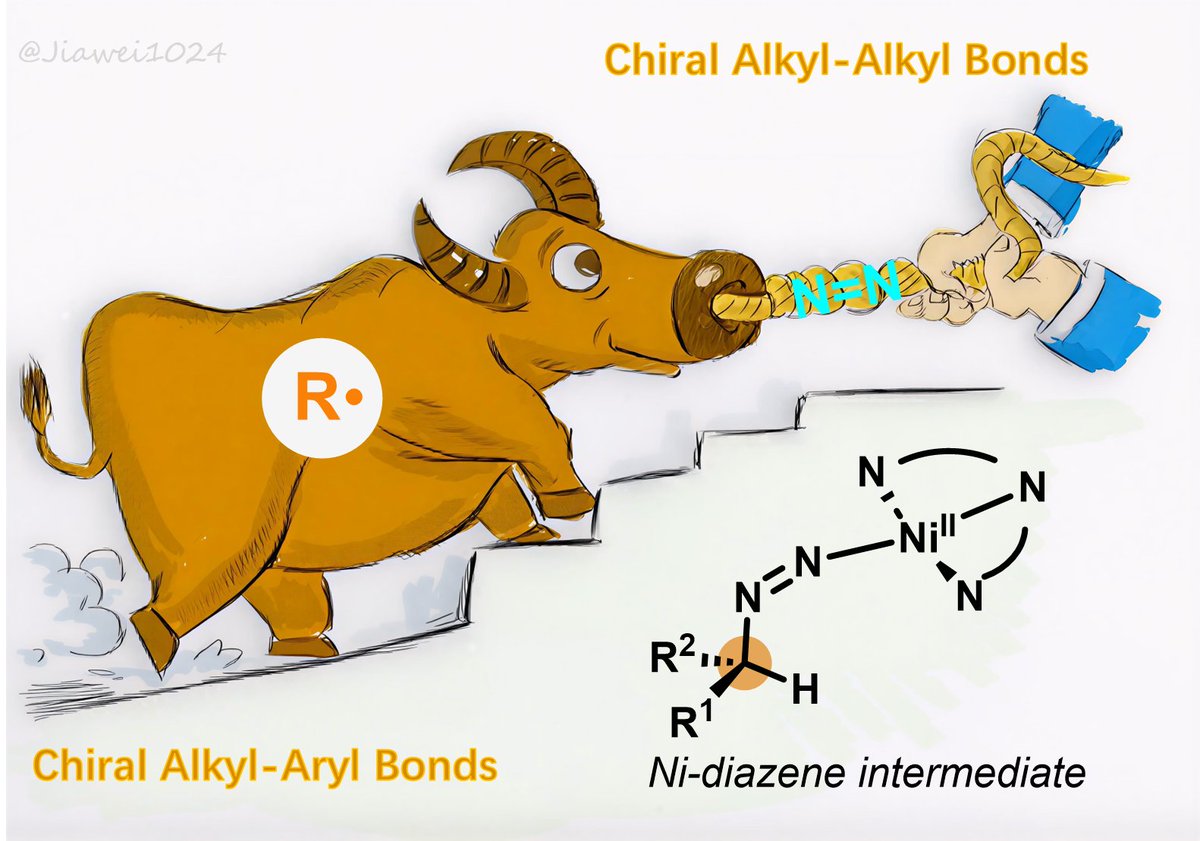
Another breakthrough!! A “Nose Ring” for a wild radical has been installed using a sulfonyl hydrazide. The Ni–diazene intermediate guides the radical to find the right partner (alkyl iodide), enabling precise control of stereochemistry. Please check out our latest RRCC reaction!!
Jiawei Sun Lab tweet media
Baran Lab@BaranLabReads

x.com/i/article/2014…

English
0
6
80
10.1K
David Cagan
David Cagan@cagan_da·
Closer inspection of the radical rebound PES predicts that the process is effectively *barrierless*. The geminate radical pair, Ni(I) + C*, recombines favorably. This happens so fast that we can even avoid cyclopropyl ring opening!
David Cagan tweet media
Baran Lab@BaranLabReads

x.com/i/article/2014…

English
1
3
51
4.8K
David Cagan retweetledi
Yu Kawamata
Yu Kawamata@YuKawamata·
Well, my favorite part is the team’s mindset: How do you convince yourself you can control a thing that loses its stereochemistry instantly and trap it fast enough with ANOTHER transient radical. Thinking this could work (and actually making it work) is kind of crazy.
Baran Lab@BaranLabReads

x.com/i/article/2014…

English
2
10
133
13.6K
David Cagan
David Cagan@cagan_da·
@BaranLabReads Rapid radical rebound ➡️⬅️ energetically driven by N2 extrusion 💥 enables alkyl radical + alkyl radical coupling without the loss of stereochemistry -- no chiral catalyst needed! Supported by experiment and DFT 🧪💻
GIF
English
0
5
40
6.1K
David Cagan retweetledi
Baran Lab
Baran Lab@BaranLabReads·
👀
Baran Lab tweet media
QME
1
13
214
17.2K