

Caracasmc
8.4K posts

Stop spending money on marketing if your funnel is broken.
I watch home service guys blow $3K-$5K/month on ads, SEO, mailers. Phone starts ringing. Leads come in.
Then what happens?
CSR doesn't pick up. Call goes to voicemail. Nobody follows up. The quote gets sent 3 days late. No one calls the customer back after they say "let me think about it."
You just paid $85 for that lead and your own team killed it before it had a chance.
You don't have a marketing problem. You have a sales problem wearing a marketing costume.
Every dollar you spend driving leads into a broken funnel is a dollar you lit on fire. And the worst part?
You'll blame the ad agency. You'll blame Google. You'll blame the market.
You'll never once look at the 40% of leads that came in and got zero follow-up.
Fix the funnel first. Answer the phone. Follow up in 5 minutes not 5 hours.
Have a system for every lead that doesn't close on the first call. THEN spend money on getting more leads.
Otherwise you're just a headless chicken with a marketing budget.
English
“For the scientist who has lived by his faith in the power of reason, the story ends like a bad dream. He has scaled the mountains of ignorance, he is about to conquer the highest peak; as he pulls himself over the final rock, he is greeted by a band of theologians who have been sitting there for centuries.”
Robert Jastrow
English

The longer I’m on X, the more I’m convinced that R. C. Sproul was correct when he stated:
“The less people know, the more certain they tend to be.”
Sproul expressed this idea frequently in his teaching, especially when warning about theological overconfidence without careful study.

English

My TOP 10 “kids movies” of the 90s
1. Heavyweights
2. 3 Ninjas
3. The Sandlot
4. TMNT (1/2)
5 Home Alone (1/2)
6. Mighty Ducks (1/2)
7. Airborne
8. Surf Ninjas
9 Little Giants
10. Blank Check
Honorable:
- Angus
- Camp Nowhere
- Hook
- Sidekicks
- Brink
- The Big Green
- ROTR
- AITO
English
The framing of your question quite literally reveals your misunderstanding of the gospel and true nature of the bride of Christ.
The mindset that sees through the lens of “your version of Christianity”, commits the exact error of those in Paul’s day claiming to be from this camp or that, all believing that their camp was the right and better one.
We have not so learned Christ.
Regardless, my original post was simply correcting your demonstrably false assertion that the “earliest” christians looked like the RCC. That’s patently absurd. If anything, the earliest expression of the churches, as clearly laid out in the NT, was quite the polar opposite of the hierarchical, top down, dominant clerical class that created the false clergy/laity divide while eventually killing doctrinal opponents.
English

@caracasmc @BibleInContext1 Where is this “true Church” that supposedly preserved your version of Christianity?
Name it. Date it. Trace it. Let's talk about history.
English

Roman Catholicism did not begin with Jesus!
The early Christian believers were not Roman Catholic!
The early church was largely made up of Jewish believers, who also taught the believing Gentiles the scriptures of the Old Testament and how Jesus the Messiah is the fulfillment of the promised redeemer!
English


You claim the “earliest Christians were clearly Catholic in belief and structure”. This is demonstrably false. The “earliest” Christians were the believers in Jerusalem and later the churches that Paul and the Apostles planted and served which are named in the NT scriptures and Epistles. There is not a single example in those early churches of the Catholic “structure” as you call it. There was no mass, no “priest” figure, no Catholic eucharist (as performed today), no veneration of Mary, no Pope, and on and on.
The believer’s gatherings were open and participatory, the Eucharist was an actual meal shared together (not a wafer and sip of wine), there isn’t a single figure resembling the “pastor” or “bishop” or “priest” that presided over the affairs of the church in the hierarchical way we see today. Mary is never mentioned even once in the context of church worship or practice. Neither is a pope.
There is literally zero similarity between what the NT scriptures reveal of the “earliest” churches and what developed later, post Apostles.
If anything, the appeal to the “church fathers” teaches us just how quickly and how early doctrinal shifts entered the church and began dividing it into different sects. But why should this surprise us? It was already happening during Paul’s lifetime!
“…. I am of Paul; and I of Apollos; and I of Cephas; and I of Christ.”
It had already started from the very beginning and became worse over time, particularly after the Apostle’s deaths. The RCC would eventually become so drunk on it’s power and doctrinal hegemony that it began persecuting and executing as heretics those who refused to agree with them, even in regards to doctrine as inconsequential as infant baptism (vs full immersion).
English
You’re obsessed and it’s honestly strange and gay. Just asserting something over and over doesn’t make it true. Where’s your evidence?
If you've actually read basic history on the early Church you'll find that the earliest Christians were clearly Catholic in belief and structure. Apostolic authority, bishops, the real presence of Christ in the Eucharist, baptismal regeneration, liturgy, Episcopal succession. That’s all there from the start.
And this isn’t complicated. That’s how real life actually works for essentially anything that's successful. Structure, authority, continuity. Not chaos and everyone doing their own thing. That’s why you immediately see authority structures in Acts, councils deciding doctrine in Acts 15, and obedience expected from the churches.
You’re Jewish, so you already understand this. That’s exactly how the Sanhedrin operated. Structured authority, binding decisions, recognized leadership. Not random individuals just asserting interpretations. Why would the New Covenant suddenly downgrade into something less ordered than the Old?
And be honest with yourself if you can...where has anything ever operated effectively without an organized body and structure? It hasn’t. That’s precisely why Christianity spread the way it did. A unified Church, teaching one faith, with real authority. Not isolated believers preaching competing doctrines and calling it unity.
What you’re describing isn’t apostolic Christianity. It’s closer to what the Gnostics were doing. Private interpretation, fragmented authority, competing claims to truth. Protestantism is essentially Gnosticism.
Your “they were just Jewish believers” line actually proves the opposite of what you think. The Church begins in Israel. Christ fulfills Israel and establishes one visible body, not a loose collection of private interpreters.
And the historical record is absolutely brutal against your claim. We all know that you're aware of the Church Fathers, but you dismiss them and ask people to trust you, a Jew on social media preaching heresy in 2026 AD. Comical.
Ignatius of Antioch, a disciple of the apostles, calls the Church “Catholic” around 107 AD and insists on unity with the bishop, the Eucharist, and the visible Church. That’s not some late Roman invention. That’s first generation Christianity after the apostles.
So nope, your idea that “Catholicism came later” only works if you ignore the actual historical records and just repeat heretical talking points as you clearly do.
If the early Church wasn’t Catholic, when exactly did it stop being what the apostles founded and become something else, and where’s the historical evidence of that shift?
Any non-Catholic answer.
But I'm mostly looking for Reformed Fundamentalist Baptists and American Evangelicals to answer this question.
English


@HeavymetalTex It isn’t days.
Yom can mean years.
It’s 1260yrs from when Jerusalem
was 1st besieged by Babylon 597BC -> Abomination of desolation being erected - Gog Roof of Dome of the Rock;
& then 1335yrs from then to the END, Yom Teruah on the Day of His SHOUT & Acceptable Year of YHVH.
English

It's worth noting there's a 75 day window between the 1,260 and 1,335 days mentioned in Daniel and Revelation. So even if we "don't know the day or the hour," it's still Biblically defensible to claim we can know when we've entered the final 3 1/2 or even 7 years before Christ's return, based on relevant sign events. This 75 day window also means that inserting a pre-trib rapture is unnecessary to maintain not knowing a specific day or hour, which is an extremely narrow window, after all.
English



I have a general rule, if Jesus celebrated it I do too.
Eric would know that if he read the Bible.

English

There's nothing more stupid in the church today than evangelicals doing a play-acting "Seder Supper."
First, we don't need to do a fake Passover. The church already has the Lord's Supper which is (among other things) the fulfillment of the old covenant Passover. Jesus gave us a meal. Why do something other than what he commanded? Why do another religious meal when Jesus already gave us one?
The reason some evangelicals get interested is the Seder is that, having eviscerated the true sacraments of their meaning and efficacy, they go looking for substitutes. They have emptied the true sacraments (baptism and the Lord's Supper) of mystery, yet, being human, they still yearn for meaningful and mysterious rituals, so they either borrow from Jewish tradition (the Seder as a substitute for the Lord's Supper) or they create their own (such as the altar call). The answer to this longing for meaningful rituals should be satisfied by reclaiming and understanding what Jesus gave us. Doing a Seder is not a way to return to the church's roots; it is the church engaging in idolatrous syncretism, no matter how well intentioned.
Second, most of the Seder is not actually rooted in Scripture. It's not the ritual described in Exodus 12 or later OT Scripture. Most of it comes from later extra-biblical traditions; indeed, most of it comes from rabbinic Judaism, and was established long after Christian faith and Judaism were clearly distinct and very different faiths. Even if those rabbinic traditions get infused with Christian symbolism, they are not "our" traditions and symbols. They comes from the Talmud, not the Bible. Christians have no more business doing a Seder than than they do keeping Ramadan or celebrating Kwanza. The church has her own meal, her own traditions, her own calendar, her own story. Why borrow from apostate Judaism? Why syncretize the Christian faith with a rival?
I have argued elsewhere that one deep-seated reason dispensational evangelicals are attracted to modern Israel is because they have rejected Christendom but still long to have an earthy, embodied cultural manifestation of the faith. The same thing is happening here - having minimized the power of the Christian sacraments, these same evangelicals look to Judaism to provide what they (wrongly) think their own religion lacks.
Third, for Christians to try to perform an old covenant Passover in any way is virtually blasphemous - and it's impossible anyway. Will the Seder meal only be for the circumcised per Exodus 12, and those who keep the cleanness laws of Leviticus? Where are are Levitical priests going to be found to administer the ritual? How does taking this pseudo-Passover meal outside of Jerusalem get justified in light of Deuteronomy 16? How will a lamb be sacrificed at the temple, per the old covenant requirement, since the temple was destroyed in 70AD? Will 2 year olds be welcome to eat the Seder since the Passover meal was for the whole household and obviously included young children? What about the shedding of blood after Jesus' death on the cross - on what basis could any Christian revert to an animal sacrifice when the final sacrifice has been offered?
The Passover was part of a system that God ended in 70AD. To turn back to it (especially in rabbinic/Talmudic form) is no better and no different from turning to paganism (cf. Gal. 4:8-11). The whole point of the Last Supper is that Jesus has transformed the old covenant Passover into something better - the new covenant meal of the Lord's Supper. Doing a Seder is participating in a religious system that rejected Jesus as Messiah.
There's more that could be said, but these reasons are fully sufficient for Christians to reject the Seder. Do the meal Jesus gave us. Do it every Lord's Day, like the apostles did. Read Calvin on the real (Spiritual) presence and embrace a theology of sacramental efficacy. Use good bread and real wine. We don't need weird non-Christian rituals to give the season meaning.
English

This brand of Christianity is most attractive to women who want zero accountability.
The lie is you can just go to god and say “sooooorey” and Jesus comes down from the earth wand waves a Harry Potter wand or something and everything is erased.
Grace doesn’t work like that. Grace is just an opportunity. It doesn’t absolve you from have to do the work to overcome consequences and make amends.
This is performative anyway down to the last tear, but people will fall for it
🌷 LIZZIE🌷@farmingandJesus
💜. @AshleySheatz 💜
English
Caracasmc retweetledi
I think it is important to separate two issues here: (1) what Justin says, and (2) how we interpret that language in light of Scripture and Christology.
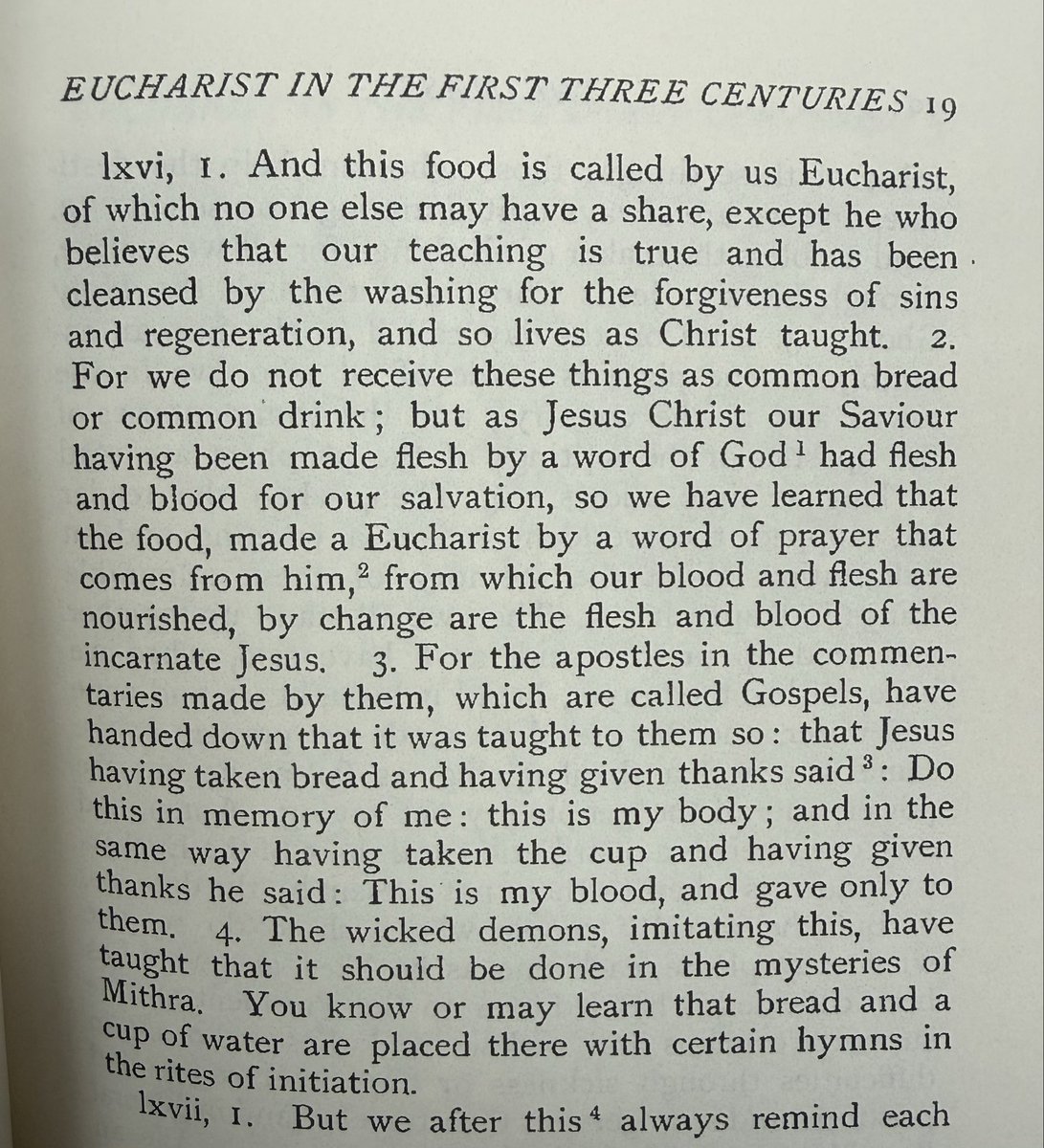
On Justin Martyr: I agree that he speaks strongly. In his First Apology, he says the Eucharistic food is not received as common bread and drink. That reflects an early, high view of the Supper.
But strong language does not, by itself, settle the mode of presence. The Fathers often speak sacramentally by using language that joins sign and reality: without offering the kind of later metaphysical explanation developed in the medieval period.
Scripture gives us the controlling categories here:
1. “This is my body…do this in remembrance of me” (Lk 22:19);
2. “The cup…is a participation (κοινωνία) in the blood of Christ” (1 Cor 10:16);
3. “Do this…in remembrance of me” (1 Cor 11:24–26).
The Supper is more than common bread, yet it remains bread (1 Cor 11:26–28). It is a real participation in Christ, but Scripture does not define that participation as a change in substance or a physical localization of his body.
Christ himself gives an important interpretive key in John 6: “The flesh is of no avail; the words that I have spoken to you are spirit and life” (Jn 6:63). Whatever “eating” means, it is not a crude physical consumption. It is a true, spiritual participation in Christ by faith.
That brings us to Christology. After the resurrection, Christ’s human body is still a true body:
1. “A spirit does not have flesh and bones as you see that I have” (Lk 24:39);
2. “This Jesus…will come in the same way as you saw him go into heaven” (Acts 1:11).
His body is real, visible, and located in the mercy seat at the right hand of the Father. Scripture never teaches that it becomes ubiquitous.
So the question is not whether Justin speaks strongly: he does. The question is how to read that language in a way that does not contradict the biblical teaching on Christ’s human nature and the once-for-all character of his sacrifice: “He offered for all time a single sacrifice for sins” (Heb 10:12).
On Vermigli, I would simply say this: arguments should stand or fall on their theological and exegetical merits, not on personal accusations. The same standard would need to be applied consistently to the Fathers themselves, many of whom lived in morally and politically complex circumstances.
The real issue remains, How do we affirm with Scripture that the Supper is a true participation in Christ, while also preserving: the integrity of his human nature, and the finality of his sacrifice?
The Reformed answer is not to deny the Real Presence, but to locate it where Scripture does: by the Spirit, through faith, in union with the risen Christ who is located bodily in heaven (Acts 3:21).
English

The Catholic Mass and the corresponding belief in the Real Presence of Jesus Christ in the Eucharist is ancient.
Below is an excerpt from Justin Martyr's Second Century account of the Mass:
English

@irentdumpsters If I sell home improvement services virtually over phone, how do I get a GBP without a physical business presence?
English
A roofing company owner told me last week he's paying $4,200 a month for Google Ads.
I asked him how many calls he got last month. He said "I don't know, maybe 20?"
I pulled up his Google Business Profile. He had 9 reviews. His last post was from November. His website had one page with a stock photo of a roof and a phone number.
He was dumping $4,200 a month into ads trying to outbid his competitors while his GBP looked like an abandoned storefront.
I told him to pause the ads for 60 days. We optimized his profile, posted weekly with real job site photos, and set up a review system that got him from 9 to 54 reviews in 8 weeks.
He now ranks #2 in the Map Pack. Gets 43 organic calls a month. His ad spend is $0.
He told me "I wish someone had shown me this 2 years ago. I wasted $100K on ads I didn't need."
Most home service businesses don't have a lead problem. They have a visibility problem. And they're paying thousands a month to cover it up instead of fixing it.
If your phone isn't ringing enough, DM me.
I'll look at your setup for free and tell you exactly what's broken.
English