Innocent Amadi

7.3K posts

Innocent Amadi banner
Innocent Amadi

Innocent Amadi

@centamadi

Christmas Messages until Dec 31. Wish me Merry Christmas, not Happy Holidays || Catholic. Igbo. Goal: Veni, vidi, vici.

United Kingdom Katılım Ocak 2011
447 Takip Edilen1.7K Takipçiler
Innocent Amadi
Innocent Amadi@centamadi·
My take: Someone's backing them to do exactly this: Keep a pulse on the food-buying habits of Nigerians. Likely a $7.3M elaborate data wrangle.
Name cannot be blank@hackSultan

This company @swoopappng raised $7.3M to build a food delivery app, and decided the primary location would be Lagos, Nigeria. One of the few places in Nigeria with the highest rate of online orders, but also the highest rate of delivery problems to match. And they decided that the strategy is to let riders keep 100% of the delivery fees. So now other platforms have to gear up, or they’ll take all the available riders. The more riders they have, the faster their delivery system will be, and the more users will want to use them. It’s tough but I believe that it can really be done. Let’s see how this strategy goes

English
0
0
0
271
Innocent Amadi
Innocent Amadi@centamadi·
This is a young person. A first-class graduate, so very educated. A designer, so she understands messaging through design. Her group produced this flyer, and she defends it with "What's the bad stuff there?" Wow.
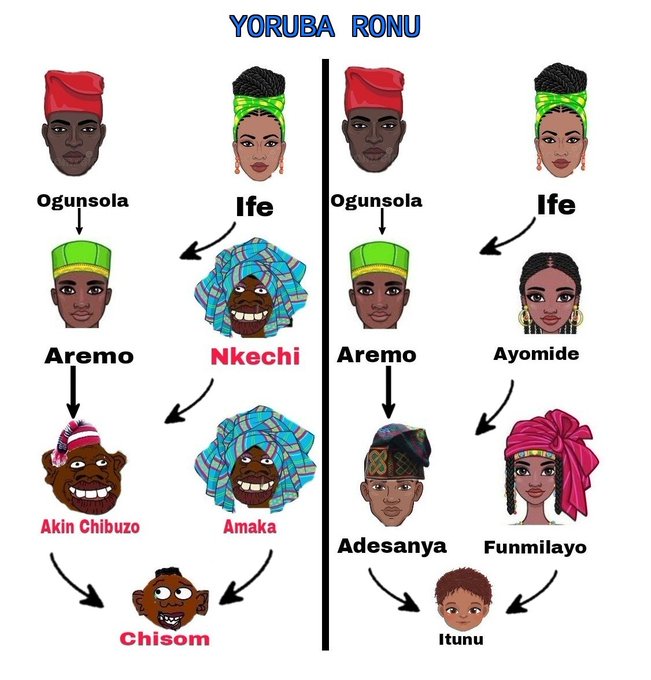
Innocent Amadi tweet media
Tomilola@shestomi

@ChinonyelumH Jesus Christ.. this means YORUBA MARRY YORUBA. IGBO MARRY IGBO. What is the bad stuff here? Will you have low self esteem if there's no inter tribal marriage? Omooo ibo, you cannot be serious ooo. Jesu Kristi, Sanu fun mi oo. 😂😭😭😭

English
0
1
2
272
Paradox 𓃶
Paradox 𓃶@Xxan_dixx·
AN OPEN LETTER IN RESPONSE TO KIO AMACHREE ON HIS OPEN LETTER TO PETER OBI On Power, Truth, and the Burden of a Generation April 2026 Mr. Kio Amachree, I read your letter not as a spectator, but as one of the many you speak for—though you do not know us by name. Men like me, born into a Nigeria already compromised, raised within systems we did not build, yet forced to suffer their consequences. Your anger is justified. Your analysis is, in many respects, accurate. But to me and many Nigerians living in Nigeria, it is incomplete. You diagnose corruption. I want to diagnose structure. Because if we misunderstand the nature of the system we are fighting, then even victory will reproduce the same disease. On this note, this open letter is just part I. ________________ I. THE ERROR OF PERSONALIZING A STRUCTURAL FAILURE You frame Bola Ahmed Tinubu as the apex of corruption. You may not be wrong sir. But here is the harder truth.....Tinubu is not the anomaly. He is the logical outcome...and I do not say this from a place tenderness. Nigeria’s political crisis did not begin with him, and it will not end with him, unless the underlying architecture of power is ruthlessly dismantled. From the First Republic through military rule, into the Fourth Republic, Nigeria has operated what political theorists would recognize as a "patrimonial state" disguised as a "constitutional democracy". Power is not institutional...it is personal...more personal than our impersonal institutional regulations (like the constitution or law) and merit-based bureaucratic processes. Loyalty is not to law...it is to networks, patronage and godfatherism! Hysterically, We do not have a republic. No. No. We have a marketplace of power and permit me, this is where your argument needs reinforcement. Because if Peter Obi...or any "reformer"—enters this system without fundamentally restructuring it, he will either be neutralized or be absorbed and consumed. There is no third option! ____________ II. THE COLLAPSE OF THE SOCIAL CONTRACT Now, let us be precise in a more pragmatic and theoretical approach rather than emotion-based. Why do a state exists in the first place? It exists to secure 3 things which are life, liberty and property. By that standard, the Nigerian state has shamefully and shamelessly defaulted. Where we have life...we have insecurity, terrorism, state failure. Where there's supposed to be liberty...there's suppressed dissent, bought judiciary and electoral manipulation just as we saw in the case of Amupitan recently. A shameful conduct by the way in the presence of substantial electronic internet evidence. Such iberiberism! And lastly, in the case of property...it is replaced with inflation, currency collapse, economic suffocation. When a government consistently fails these duties, it is clear that it loses its moral legitimacy. This is not rhetoric. It is philosophical fact and Nigerians, forgive me, manipulated and tribalistic as they may be, know this fact. What we, Nigerians are experiencing is not just bad governance but a breach of contract that comes with fatal consequences. III. YOUR ECHO ON RUTHLESSNESS You urge Peter Obi to become ruthless. And while I agree with you that it is better to be feared than loved, if you cannot be both...it is however precarious, dicey and even deeper. A ruler must not only seize power, he must secure it through stable institutions. Nigeria’s problem is not a lack of ruthless men sir. We have had many. You know this. Our problem is that they consolidate power but never institutionalize justice and this we have seen decades upon decades of institutional decay and rot. This leads to power resetting… and corruption mutating In tandem. Any blind person can see that this is the degeneration of polity into oligarchy where the rule for the common good is egregiously replaced by rule for private gain. That is exactly where Nigeria stands today. Continuation in my next post.
Kio Amachree@Ivory1957

AN OPEN LETTER TO PETER OBI — A WORD FROM A SON OF NIGERIA On Power, Courage, and the Unfinished Business of a Nation Kio Amachree | President, Worldview International · Stockholm | April 2026 Dear Mr. Peter Obi, I owe you a confession before I offer you counsel. In the last presidential election, I supported you. Not casually — I believed in you. I watched you speak in Atlanta, and what I saw was something Nigeria has rarely produced: a man who sounded like he had actually read the brief, who understood the gravity of the office he was seeking, and who spoke to Nigerians not as subjects to be managed but as citizens deserving of respect. I was moved. I was persuaded. And I trusted a process that, as I now understand more completely than ever, was never designed to be trusted. I looked across at Bola Ahmed Tinubu — a man who, in the most charitable interpretation of his observable condition, appeared to be fighting a daily battle simply to remain upright and coherent — and I made the mistake of assuming that what was obvious to my eyes would be obvious to the outcome. I did not account sufficiently for the depth of the organised criminality arrayed against the Nigerian people. I did not account for the degree to which the machinery of power in that country has been engineered not to reflect the will of the citizenry but to override it. I switched off in disgust. I am ashamed to admit it, but I did. For a moment, I despaired. What reactivated me was not optimism. It was fury — and the particular fury of a man who was raised to believe that silence in the face of injustice is its own form of complicity. My father, Chief Godfrey Kio Jaja Amachree QC — Nigeria’s first Solicitor-General, Under-Secretary-General of the United Nations, General Gowon’s personal envoy to Washington during the Civil War, one of the architects of Rivers State — was not a gentle man. He was rigorous. He was demanding. He was, at times, difficult to love. But he built into me something I could not switch off even when I wanted to: the sense that Nigeria is not merely a country one happens to have been born into. It is a responsibility. It is a debt owed to those who came before and those who will come after. My grandfather, Chief Sekin Amachree, sat at the 1958 Constitutional Conference and the Willink Commission. These men shaped Nigeria before it was even Nigeria. I am their reflection — and as any man who has stood before a mirror knows, a reflection does not always like what it sees. But it cannot look away. Now I come to you with what I hope you will receive in the spirit in which it is offered: not as flattery, not as political alignment, but as the hard, frank counsel of one educated man to another. I was educated at Eton College — not the softened, therapeutic Eton of today, but the Eton that broke you down and rebuilt you; the Eton that fed you deliberately terrible food so that you would learn to endure discomfort without complaint; the Eton that placed you among the sons of dukes and diplomats and expected you to hold your own. The school that in its long and morally complicated history produced twenty-four British Prime Ministers — including, most recently, Boris Johnson and David Cameron. I mention those two men for a reason, Peter, and I need you to listen carefully because there is a lesson in them for you. Boris Johnson — the blond, blundering, self-consciously bumbling figure that the British public came to love and loathe in equal measure — is not what he appears. That persona is a construction, polished over years at Eton, refined at Oxford, deployed with extraordinary precision. Johnson’s great-great-grandfather was a Turkish journalist named Ali Kemal, a man of dark complexion and Muslim faith who was so critical of the Atatürk revolution that he was killed by a mob and his body dragged through the streets of Istanbul. His family fled to England during the First World War — on the wrong side of the conflict, since the Ottomans had fought with the Axis against Britain — and his widow, terrified of persecution, changed the family name to Johnson. A safe, plain, English name. Over generations, the Turkish identity dissolved. The grandson of that terrified widow became the Foreign Secretary and then the Prime Minister of the United Kingdom. I am not telling you this to diminish Johnson. I am telling you this because it is the greatest lesson Eton teaches, though it never states it plainly: the surface is a weapon. The carefully constructed persona — the apparent bumbling, the Latin quotations, the self-deprecating humour — was armour and ammunition simultaneously. While his opponents were laughing at him, he was outmanoeuvring them. David Cameron, by contrast, came from genuine money and genuine breeding. He had no need to construct anything. He was charming, handsome, instinctively confident, loved his Bob Marley, smoked his weed at school, was caught — and was not expelled, because Eton looked at him and saw a future Prime Minister, which is precisely what he became. Two very different men. Both utterly ruthless. Both winners. The lesson I am drawing for you is this: you must stop campaigning like a man who is trying not to offend anyone, and start campaigning like a man who intends to win. Nigeria in 2027 is not a debating competition. It is a knife fight. And a knife fight is not won by the man who is most correct — it is won by the man who is most prepared to use what is in his hand. Let me now speak plainly about Bola Ahmed Tinubu, because plainness is what this moment demands. In my considered assessment — and I do not use such language lightly — Tinubu represents the most comprehensively corrupt political figure to have occupied the highest office in Nigeria’s troubled history. That is not rhetoric. That is a conclusion drawn from evidence that is now, in significant part, part of the public international record. There is the matter of the United States federal narcotics investigation — the case that cost him his forfeited funds in Chicago and that lies at the core of the FBI and DEA files that a United States federal court, under Judge Beryl Howell, has ordered released. Those files, due by June of this year, may well constitute the most consequential document release in the history of Nigerian political accountability. The man currently sitting in Aso Rock has a documented relationship with American federal law enforcement that has never been honestly reckoned with by the Nigerian political establishment or the Nigerian press. And then there is Gilbert Chagoury. Let us be precise: Chagoury is a man convicted in Switzerland of money laundering and reported by American intelligence as having financed Hezbollah. He is also the man to whom Tinubu’s administration has directed billions of dollars in no-tender infrastructure contracts — including the controversial Lagos-Calabar Coastal Highway — without competitive bid, without transparency, without the basic procedural safeguards that any functioning government owes its people. The relationship between Tinubu and Chagoury is not incidental. It is structural. It is the architecture of how power and money move in this administration. And then there is the son. Seyi Tinubu. A young man installed on corporate boards, positioned as a conduit for the family’s accumulation of influence, presented to the public through the cynical theatre of rice distributions to the poor while billions are being distributed to the connected. He is not a peripheral figure. He is the succession plan. He is also, for your purposes, the most humanly comprehensible point of attack — because nothing angers ordinary Nigerians more than watching a president’s son live like a king while they cannot afford to eat. Peter, here is my direct counsel to you. Stop being careful. The time for careful has passed. These are not normal political adversaries operating within a normal political system. These are people who have weaponised the state, corrupted the judiciary, terrified the press, and enriched themselves beyond any defensible measure while the Nigerian naira has collapsed and ordinary families have been reduced to desperate improvisation simply to survive. You are not going to defeat them by being measured. You are going to defeat them by being relentless. Make the Chagoury contracts the centrepiece of your campaign. Demand accountability for every naira. Make Nigerians understand not just that money has been stolen — they already know money has been stolen, they have always known — but where it has gone, into whose hands, and at whose instruction. Make the connection between the billions flowing to Chagoury’s companies and the intelligence reports linking Chagoury’s network to Hezbollah financing. Ask the question publicly and loudly: are Nigerian state funds being used to finance terrorism? Ask it until you get an answer. I write this from Stockholm. I cannot vote. I cannot march. I am a Swedish citizen of Ijaw and Niger Delta royal lineage, a diaspora voice, a man who has slept in palaces and on floors and worked on Wall Street and in the City of London and in the Nigerian National Assembly and in the boiling heart of African civic struggle. I have no party. I have no financial interest. What I have is a name, a history, and a conscience that my father — for all his severity — programmed to be incapable of looking away. I pray that the United States releases those FBI and DEA files on schedule. I pray that the Central Intelligence Agency, which has long maintained its own complex relationship with Tinubu, makes the calculation that he has become more liability than asset — particularly as the Chagoury-Hezbollah nexus moves from allegation toward documented fact in international law enforcement circles. These are not fantasies. These are live proceedings in active jurisdictions. Nigeria does not need saving — that framing is too passive, and it places too much burden on a single individual. Nigeria needs someone willing to fight for it with the same ferocity that those who have looted it have fought to keep it. My grandfather helped write the terms of this nation’s existence. My father spent his life in its service. I have spent mine trying to honour them both while finding my own voice in a world that did not always make room for it easily. I am offering you that voice. The counsel of an Old Etonian who was taught not how to be a gentleman — though that too — but how empires are built, how power actually functions, and why the most dangerous man in any room is often the one who appears least threatening. I am offering you the analytical framework of a man who has studied Nigerian politics from the inside and from the outside, who understands the diaspora, who understands the international legal architecture that can be brought to bear, and who believes, despite everything, that this fight is still winnable. Go for the jugular, Peter. Do it with evidence. Do it with precision. Do it with the controlled fury of a man who has genuinely reckoned with what is at stake. Cast away the niceties — they have cost you enough already. Nigeria is watching. The diaspora is watching. And the dead — among them the men whose names I carry — are watching too. I wish you strength, clarity, and the wisdom to know that in this particular fight, mercy extended to the wrong people is simply cruelty extended to the right ones. Go well. And go hard. Kio Amachree President, Worldview International Stockholm, Kingdom of Sweden Son of Chief Godfrey Kio Jaja Amachree QC, Nigeria’s First Solicitor-General

English
3
1
11
4.5K
Aji Bussu Onye Mpiawa azụ 🇨🇮
I don’t usually take the time to read long posts on Twitter, but I read this one from start to finish and enjoyed every word. Thank you for such a thoughtful and well-written piece.
Kio Amachree@Ivory1957

AN OPEN LETTER TO PETER OBI — A WORD FROM A SON OF NIGERIA On Power, Courage, and the Unfinished Business of a Nation Kio Amachree | President, Worldview International · Stockholm | April 2026 Dear Mr. Peter Obi, I owe you a confession before I offer you counsel. In the last presidential election, I supported you. Not casually — I believed in you. I watched you speak in Atlanta, and what I saw was something Nigeria has rarely produced: a man who sounded like he had actually read the brief, who understood the gravity of the office he was seeking, and who spoke to Nigerians not as subjects to be managed but as citizens deserving of respect. I was moved. I was persuaded. And I trusted a process that, as I now understand more completely than ever, was never designed to be trusted. I looked across at Bola Ahmed Tinubu — a man who, in the most charitable interpretation of his observable condition, appeared to be fighting a daily battle simply to remain upright and coherent — and I made the mistake of assuming that what was obvious to my eyes would be obvious to the outcome. I did not account sufficiently for the depth of the organised criminality arrayed against the Nigerian people. I did not account for the degree to which the machinery of power in that country has been engineered not to reflect the will of the citizenry but to override it. I switched off in disgust. I am ashamed to admit it, but I did. For a moment, I despaired. What reactivated me was not optimism. It was fury — and the particular fury of a man who was raised to believe that silence in the face of injustice is its own form of complicity. My father, Chief Godfrey Kio Jaja Amachree QC — Nigeria’s first Solicitor-General, Under-Secretary-General of the United Nations, General Gowon’s personal envoy to Washington during the Civil War, one of the architects of Rivers State — was not a gentle man. He was rigorous. He was demanding. He was, at times, difficult to love. But he built into me something I could not switch off even when I wanted to: the sense that Nigeria is not merely a country one happens to have been born into. It is a responsibility. It is a debt owed to those who came before and those who will come after. My grandfather, Chief Sekin Amachree, sat at the 1958 Constitutional Conference and the Willink Commission. These men shaped Nigeria before it was even Nigeria. I am their reflection — and as any man who has stood before a mirror knows, a reflection does not always like what it sees. But it cannot look away. Now I come to you with what I hope you will receive in the spirit in which it is offered: not as flattery, not as political alignment, but as the hard, frank counsel of one educated man to another. I was educated at Eton College — not the softened, therapeutic Eton of today, but the Eton that broke you down and rebuilt you; the Eton that fed you deliberately terrible food so that you would learn to endure discomfort without complaint; the Eton that placed you among the sons of dukes and diplomats and expected you to hold your own. The school that in its long and morally complicated history produced twenty-four British Prime Ministers — including, most recently, Boris Johnson and David Cameron. I mention those two men for a reason, Peter, and I need you to listen carefully because there is a lesson in them for you. Boris Johnson — the blond, blundering, self-consciously bumbling figure that the British public came to love and loathe in equal measure — is not what he appears. That persona is a construction, polished over years at Eton, refined at Oxford, deployed with extraordinary precision. Johnson’s great-great-grandfather was a Turkish journalist named Ali Kemal, a man of dark complexion and Muslim faith who was so critical of the Atatürk revolution that he was killed by a mob and his body dragged through the streets of Istanbul. His family fled to England during the First World War — on the wrong side of the conflict, since the Ottomans had fought with the Axis against Britain — and his widow, terrified of persecution, changed the family name to Johnson. A safe, plain, English name. Over generations, the Turkish identity dissolved. The grandson of that terrified widow became the Foreign Secretary and then the Prime Minister of the United Kingdom. I am not telling you this to diminish Johnson. I am telling you this because it is the greatest lesson Eton teaches, though it never states it plainly: the surface is a weapon. The carefully constructed persona — the apparent bumbling, the Latin quotations, the self-deprecating humour — was armour and ammunition simultaneously. While his opponents were laughing at him, he was outmanoeuvring them. David Cameron, by contrast, came from genuine money and genuine breeding. He had no need to construct anything. He was charming, handsome, instinctively confident, loved his Bob Marley, smoked his weed at school, was caught — and was not expelled, because Eton looked at him and saw a future Prime Minister, which is precisely what he became. Two very different men. Both utterly ruthless. Both winners. The lesson I am drawing for you is this: you must stop campaigning like a man who is trying not to offend anyone, and start campaigning like a man who intends to win. Nigeria in 2027 is not a debating competition. It is a knife fight. And a knife fight is not won by the man who is most correct — it is won by the man who is most prepared to use what is in his hand. Let me now speak plainly about Bola Ahmed Tinubu, because plainness is what this moment demands. In my considered assessment — and I do not use such language lightly — Tinubu represents the most comprehensively corrupt political figure to have occupied the highest office in Nigeria’s troubled history. That is not rhetoric. That is a conclusion drawn from evidence that is now, in significant part, part of the public international record. There is the matter of the United States federal narcotics investigation — the case that cost him his forfeited funds in Chicago and that lies at the core of the FBI and DEA files that a United States federal court, under Judge Beryl Howell, has ordered released. Those files, due by June of this year, may well constitute the most consequential document release in the history of Nigerian political accountability. The man currently sitting in Aso Rock has a documented relationship with American federal law enforcement that has never been honestly reckoned with by the Nigerian political establishment or the Nigerian press. And then there is Gilbert Chagoury. Let us be precise: Chagoury is a man convicted in Switzerland of money laundering and reported by American intelligence as having financed Hezbollah. He is also the man to whom Tinubu’s administration has directed billions of dollars in no-tender infrastructure contracts — including the controversial Lagos-Calabar Coastal Highway — without competitive bid, without transparency, without the basic procedural safeguards that any functioning government owes its people. The relationship between Tinubu and Chagoury is not incidental. It is structural. It is the architecture of how power and money move in this administration. And then there is the son. Seyi Tinubu. A young man installed on corporate boards, positioned as a conduit for the family’s accumulation of influence, presented to the public through the cynical theatre of rice distributions to the poor while billions are being distributed to the connected. He is not a peripheral figure. He is the succession plan. He is also, for your purposes, the most humanly comprehensible point of attack — because nothing angers ordinary Nigerians more than watching a president’s son live like a king while they cannot afford to eat. Peter, here is my direct counsel to you. Stop being careful. The time for careful has passed. These are not normal political adversaries operating within a normal political system. These are people who have weaponised the state, corrupted the judiciary, terrified the press, and enriched themselves beyond any defensible measure while the Nigerian naira has collapsed and ordinary families have been reduced to desperate improvisation simply to survive. You are not going to defeat them by being measured. You are going to defeat them by being relentless. Make the Chagoury contracts the centrepiece of your campaign. Demand accountability for every naira. Make Nigerians understand not just that money has been stolen — they already know money has been stolen, they have always known — but where it has gone, into whose hands, and at whose instruction. Make the connection between the billions flowing to Chagoury’s companies and the intelligence reports linking Chagoury’s network to Hezbollah financing. Ask the question publicly and loudly: are Nigerian state funds being used to finance terrorism? Ask it until you get an answer. I write this from Stockholm. I cannot vote. I cannot march. I am a Swedish citizen of Ijaw and Niger Delta royal lineage, a diaspora voice, a man who has slept in palaces and on floors and worked on Wall Street and in the City of London and in the Nigerian National Assembly and in the boiling heart of African civic struggle. I have no party. I have no financial interest. What I have is a name, a history, and a conscience that my father — for all his severity — programmed to be incapable of looking away. I pray that the United States releases those FBI and DEA files on schedule. I pray that the Central Intelligence Agency, which has long maintained its own complex relationship with Tinubu, makes the calculation that he has become more liability than asset — particularly as the Chagoury-Hezbollah nexus moves from allegation toward documented fact in international law enforcement circles. These are not fantasies. These are live proceedings in active jurisdictions. Nigeria does not need saving — that framing is too passive, and it places too much burden on a single individual. Nigeria needs someone willing to fight for it with the same ferocity that those who have looted it have fought to keep it. My grandfather helped write the terms of this nation’s existence. My father spent his life in its service. I have spent mine trying to honour them both while finding my own voice in a world that did not always make room for it easily. I am offering you that voice. The counsel of an Old Etonian who was taught not how to be a gentleman — though that too — but how empires are built, how power actually functions, and why the most dangerous man in any room is often the one who appears least threatening. I am offering you the analytical framework of a man who has studied Nigerian politics from the inside and from the outside, who understands the diaspora, who understands the international legal architecture that can be brought to bear, and who believes, despite everything, that this fight is still winnable. Go for the jugular, Peter. Do it with evidence. Do it with precision. Do it with the controlled fury of a man who has genuinely reckoned with what is at stake. Cast away the niceties — they have cost you enough already. Nigeria is watching. The diaspora is watching. And the dead — among them the men whose names I carry — are watching too. I wish you strength, clarity, and the wisdom to know that in this particular fight, mercy extended to the wrong people is simply cruelty extended to the right ones. Go well. And go hard. Kio Amachree President, Worldview International Stockholm, Kingdom of Sweden Son of Chief Godfrey Kio Jaja Amachree QC, Nigeria’s First Solicitor-General

English
1
19
89
5.9K
Innocent Amadi
Innocent Amadi@centamadi·
I read this to the end. And I disagree. There is a reason the most dangerous man in the room is the less obvious. You don’t fight wolves by baring your fangs. And if you must strike at the devil, you better not miss. This isn’t the right time for Peter to escalate. He has neither citizens protection nor state might. Peter is doing exactly what he should. On the opposition chess board, he is the king. And you don’t launch an attack with your king in front. It’s time for a castle. We need rooks, bishops, knights, queens and pawns to move into the center. Asking anything from Obi is, at this time, a grave miscalculation. Power is power. Those that wield it are frantically praying for him to misstep, or mis-speak. We need more players on the chess board. Not a call to expose the king.
Kio Amachree@Ivory1957

AN OPEN LETTER TO PETER OBI — A WORD FROM A SON OF NIGERIA On Power, Courage, and the Unfinished Business of a Nation Kio Amachree | President, Worldview International · Stockholm | April 2026 Dear Mr. Peter Obi, I owe you a confession before I offer you counsel. In the last presidential election, I supported you. Not casually — I believed in you. I watched you speak in Atlanta, and what I saw was something Nigeria has rarely produced: a man who sounded like he had actually read the brief, who understood the gravity of the office he was seeking, and who spoke to Nigerians not as subjects to be managed but as citizens deserving of respect. I was moved. I was persuaded. And I trusted a process that, as I now understand more completely than ever, was never designed to be trusted. I looked across at Bola Ahmed Tinubu — a man who, in the most charitable interpretation of his observable condition, appeared to be fighting a daily battle simply to remain upright and coherent — and I made the mistake of assuming that what was obvious to my eyes would be obvious to the outcome. I did not account sufficiently for the depth of the organised criminality arrayed against the Nigerian people. I did not account for the degree to which the machinery of power in that country has been engineered not to reflect the will of the citizenry but to override it. I switched off in disgust. I am ashamed to admit it, but I did. For a moment, I despaired. What reactivated me was not optimism. It was fury — and the particular fury of a man who was raised to believe that silence in the face of injustice is its own form of complicity. My father, Chief Godfrey Kio Jaja Amachree QC — Nigeria’s first Solicitor-General, Under-Secretary-General of the United Nations, General Gowon’s personal envoy to Washington during the Civil War, one of the architects of Rivers State — was not a gentle man. He was rigorous. He was demanding. He was, at times, difficult to love. But he built into me something I could not switch off even when I wanted to: the sense that Nigeria is not merely a country one happens to have been born into. It is a responsibility. It is a debt owed to those who came before and those who will come after. My grandfather, Chief Sekin Amachree, sat at the 1958 Constitutional Conference and the Willink Commission. These men shaped Nigeria before it was even Nigeria. I am their reflection — and as any man who has stood before a mirror knows, a reflection does not always like what it sees. But it cannot look away. Now I come to you with what I hope you will receive in the spirit in which it is offered: not as flattery, not as political alignment, but as the hard, frank counsel of one educated man to another. I was educated at Eton College — not the softened, therapeutic Eton of today, but the Eton that broke you down and rebuilt you; the Eton that fed you deliberately terrible food so that you would learn to endure discomfort without complaint; the Eton that placed you among the sons of dukes and diplomats and expected you to hold your own. The school that in its long and morally complicated history produced twenty-four British Prime Ministers — including, most recently, Boris Johnson and David Cameron. I mention those two men for a reason, Peter, and I need you to listen carefully because there is a lesson in them for you. Boris Johnson — the blond, blundering, self-consciously bumbling figure that the British public came to love and loathe in equal measure — is not what he appears. That persona is a construction, polished over years at Eton, refined at Oxford, deployed with extraordinary precision. Johnson’s great-great-grandfather was a Turkish journalist named Ali Kemal, a man of dark complexion and Muslim faith who was so critical of the Atatürk revolution that he was killed by a mob and his body dragged through the streets of Istanbul. His family fled to England during the First World War — on the wrong side of the conflict, since the Ottomans had fought with the Axis against Britain — and his widow, terrified of persecution, changed the family name to Johnson. A safe, plain, English name. Over generations, the Turkish identity dissolved. The grandson of that terrified widow became the Foreign Secretary and then the Prime Minister of the United Kingdom. I am not telling you this to diminish Johnson. I am telling you this because it is the greatest lesson Eton teaches, though it never states it plainly: the surface is a weapon. The carefully constructed persona — the apparent bumbling, the Latin quotations, the self-deprecating humour — was armour and ammunition simultaneously. While his opponents were laughing at him, he was outmanoeuvring them. David Cameron, by contrast, came from genuine money and genuine breeding. He had no need to construct anything. He was charming, handsome, instinctively confident, loved his Bob Marley, smoked his weed at school, was caught — and was not expelled, because Eton looked at him and saw a future Prime Minister, which is precisely what he became. Two very different men. Both utterly ruthless. Both winners. The lesson I am drawing for you is this: you must stop campaigning like a man who is trying not to offend anyone, and start campaigning like a man who intends to win. Nigeria in 2027 is not a debating competition. It is a knife fight. And a knife fight is not won by the man who is most correct — it is won by the man who is most prepared to use what is in his hand. Let me now speak plainly about Bola Ahmed Tinubu, because plainness is what this moment demands. In my considered assessment — and I do not use such language lightly — Tinubu represents the most comprehensively corrupt political figure to have occupied the highest office in Nigeria’s troubled history. That is not rhetoric. That is a conclusion drawn from evidence that is now, in significant part, part of the public international record. There is the matter of the United States federal narcotics investigation — the case that cost him his forfeited funds in Chicago and that lies at the core of the FBI and DEA files that a United States federal court, under Judge Beryl Howell, has ordered released. Those files, due by June of this year, may well constitute the most consequential document release in the history of Nigerian political accountability. The man currently sitting in Aso Rock has a documented relationship with American federal law enforcement that has never been honestly reckoned with by the Nigerian political establishment or the Nigerian press. And then there is Gilbert Chagoury. Let us be precise: Chagoury is a man convicted in Switzerland of money laundering and reported by American intelligence as having financed Hezbollah. He is also the man to whom Tinubu’s administration has directed billions of dollars in no-tender infrastructure contracts — including the controversial Lagos-Calabar Coastal Highway — without competitive bid, without transparency, without the basic procedural safeguards that any functioning government owes its people. The relationship between Tinubu and Chagoury is not incidental. It is structural. It is the architecture of how power and money move in this administration. And then there is the son. Seyi Tinubu. A young man installed on corporate boards, positioned as a conduit for the family’s accumulation of influence, presented to the public through the cynical theatre of rice distributions to the poor while billions are being distributed to the connected. He is not a peripheral figure. He is the succession plan. He is also, for your purposes, the most humanly comprehensible point of attack — because nothing angers ordinary Nigerians more than watching a president’s son live like a king while they cannot afford to eat. Peter, here is my direct counsel to you. Stop being careful. The time for careful has passed. These are not normal political adversaries operating within a normal political system. These are people who have weaponised the state, corrupted the judiciary, terrified the press, and enriched themselves beyond any defensible measure while the Nigerian naira has collapsed and ordinary families have been reduced to desperate improvisation simply to survive. You are not going to defeat them by being measured. You are going to defeat them by being relentless. Make the Chagoury contracts the centrepiece of your campaign. Demand accountability for every naira. Make Nigerians understand not just that money has been stolen — they already know money has been stolen, they have always known — but where it has gone, into whose hands, and at whose instruction. Make the connection between the billions flowing to Chagoury’s companies and the intelligence reports linking Chagoury’s network to Hezbollah financing. Ask the question publicly and loudly: are Nigerian state funds being used to finance terrorism? Ask it until you get an answer. I write this from Stockholm. I cannot vote. I cannot march. I am a Swedish citizen of Ijaw and Niger Delta royal lineage, a diaspora voice, a man who has slept in palaces and on floors and worked on Wall Street and in the City of London and in the Nigerian National Assembly and in the boiling heart of African civic struggle. I have no party. I have no financial interest. What I have is a name, a history, and a conscience that my father — for all his severity — programmed to be incapable of looking away. I pray that the United States releases those FBI and DEA files on schedule. I pray that the Central Intelligence Agency, which has long maintained its own complex relationship with Tinubu, makes the calculation that he has become more liability than asset — particularly as the Chagoury-Hezbollah nexus moves from allegation toward documented fact in international law enforcement circles. These are not fantasies. These are live proceedings in active jurisdictions. Nigeria does not need saving — that framing is too passive, and it places too much burden on a single individual. Nigeria needs someone willing to fight for it with the same ferocity that those who have looted it have fought to keep it. My grandfather helped write the terms of this nation’s existence. My father spent his life in its service. I have spent mine trying to honour them both while finding my own voice in a world that did not always make room for it easily. I am offering you that voice. The counsel of an Old Etonian who was taught not how to be a gentleman — though that too — but how empires are built, how power actually functions, and why the most dangerous man in any room is often the one who appears least threatening. I am offering you the analytical framework of a man who has studied Nigerian politics from the inside and from the outside, who understands the diaspora, who understands the international legal architecture that can be brought to bear, and who believes, despite everything, that this fight is still winnable. Go for the jugular, Peter. Do it with evidence. Do it with precision. Do it with the controlled fury of a man who has genuinely reckoned with what is at stake. Cast away the niceties — they have cost you enough already. Nigeria is watching. The diaspora is watching. And the dead — among them the men whose names I carry — are watching too. I wish you strength, clarity, and the wisdom to know that in this particular fight, mercy extended to the wrong people is simply cruelty extended to the right ones. Go well. And go hard. Kio Amachree President, Worldview International Stockholm, Kingdom of Sweden Son of Chief Godfrey Kio Jaja Amachree QC, Nigeria’s First Solicitor-General

English
3
2
5
227
Innocent Amadi
Innocent Amadi@centamadi·
Had to believe he has a hand in this.
English
0
0
0
32
Innocent Amadi
Innocent Amadi@centamadi·
@Ghost_girl_Mew Good to know! That's a pretty exclusive order, purely merit-based. Your dad must be awesome.
English
2
0
14
2.5K
Cee_ntia
Cee_ntia@Ghost_girl_Mew·
@centamadi knights of st sylvester, same order with my dad.
English
2
0
16
2.4K
Innocent Amadi retweetledi
Pope Leo XIV
Pope Leo XIV@Pontifex·
This is a Vigil filled with light, the oldest in the Christian tradition, known as the “mother of all vigils.” In it we relive the victory of the Lord of life over death and the underworld. #Easter
English
242
1.8K
11.1K
236.6K