Chuck Cooper

10 posts

Chuck Cooper

Chuck Cooper

@chascooper23

Chairman of Cooper & Kirk PLLC and “one of Washington’s best known lawyers” (NYT). Former head of DOJ Office of Legal Counsel (Reagan)

United States Katılım Şubat 2016
59 Takip Edilen109 Takipçiler
Chuck Cooper
Chuck Cooper@chascooper23·
And in two years and 17 days, Justice Thomas will surpass Justice William O. Douglas as the Court’s longest serving Justice. It will be most fitting that the record set by Justice Douglas, one of the worst Justices in American history and a contemptible human being, will be eclipsed by Justice Thomas, one of the greatest Justices ever to serve on the Court and a genuinely good and decent man.
English
6
40
315
32.4K
Mark Paoletta
Mark Paoletta@MarkPaoletta·
BREAKING NEWS: Justice Clarence Thomas is now our third longest serving Justice in American history! 34 years and 192 days. He is quite simply our greatest Justice. Justice Thomas recently delivered one of the most important speeches in American history, celebrating the 250th anniversary of the signing of the Declaration of Independence. It’s a must read, and link to speech and youtube video are below. Learn more about Justice Thomas’s inspiring life by watching the superb documentary, Created Equal: Clarence Thomas in His Own Words or reading his exceptional memoirs, My Grandfather’s Son. (links below) And in three days, Justice Thomas will be our 2nd longest serving Justice in history!
English
640
7K
39.1K
727.2K
AAGHarmeetDhillon
AAGHarmeetDhillon@AAGDhillon·
Today, @CivilRights & @DOJCivil intervened in a lawsuit to prevent Colorado from requiring AI companies to alter their algorithms & advance CO’s woke DEI goals. It’s illegal under the 14th Amendment to discriminate based on race, sex, & other protected classes—see you in court!
English
1.1K
6.1K
27.6K
504.9K
Chuck Cooper
Chuck Cooper@chascooper23·
@HarmeetKDhillon Great article. As a former Deputy Assistant AG in the Civil Rights Division in the Reagan Admin. (1981-1985), I salute AAG Dhillon’s courage and unflinching commitment to enforcing the EQUAL civil rights of ALL Americans.
English
0
0
3
67
Chuck Cooper
Chuck Cooper@chascooper23·
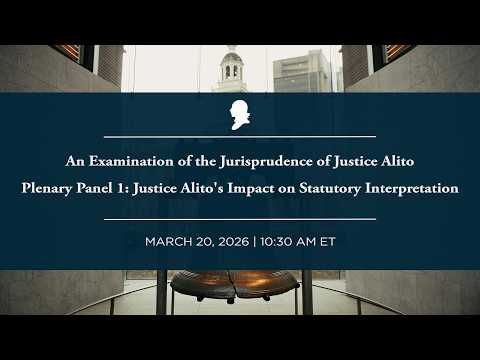
I was honored to participate yesterday on a Federalist Society panel discussing Justice Alito’s impact on statutory interpretation, along with Professor Robby George, Judge Greg Katsas, and Eric Palmer. Many thanks to FedSoc for celebrating Justice Alito’s 20 years on the Court and inviting me to participate. youtube.com/live/uaqwrn24c…
YouTube video
YouTube
English
1
15
77
41.1K
Chuck Cooper
Chuck Cooper@chascooper23·
@kurtlash1 Agree. It briskly demolishes the desperate arguments advanced by the throngs of academics advocating for the Court to amend the 14th Amendment to provide universal birthright citizenship.
English
0
0
1
53
Chuck Cooper
Chuck Cooper@chascooper23·
I was honored to testify yesterday before the Subcommittee of the Constitution of the Senate Judiciary Committee in support of President Trump’s Executive Order on birthright citizenship. Many thanks to Chairman Schmitt for inviting me. c-span.org/clip/senate-co…
English
1
5
22
2.8K
Chuck Cooper
Chuck Cooper@chascooper23·
Bravo to AAG Dhillon and team for their tireless efforts to protect the civil rights of ALL Americans, regardless of race, sex, religion, etc. As a former PDAAG in CRT(Reagan), I believe there has never been an AAG more committed to the rule of law and fearless in fighting for it.
English
0
1
5
381
Jesus A. Osete
Jesus A. Osete@JesusOseteDOJ·
This past week alone, the @CivilRights team, under the leadership of @AAGDhillon: 1. Sued six States that have refused to provide their voter rolls; 2. Opposed race predominant districting at the U.S. Supreme Court; 3. Opposed California’s effort to keep boys in girls’ sports; and 4. Defended the 2A rights of law abiding citizens in the Seventh Circuit. Stay tuned for next week. 👀
English
270
1.2K
5.4K
258.4K
Chuck Cooper
Chuck Cooper@chascooper23·
@BurnhamDC Yes, a testament to Sauer and the SC majority. But these lower courts, whose lawless rulings seek to frustrate the Admin’s policies at every turn, are leaving Sauer little choice about what he brings to the SC.
English
0
2
9
841
Chuck Cooper
Chuck Cooper@chascooper23·
James Burnham is right in every particular. But there is also a constitutional argument that the Plaintiffs (and others, including the Government Accounting Office) have made against the President’s exercise of his so-called “pocket rescission” authority under the Impoundment Control Act. The ICA authorizes the President to request Congress to rescind appropriated funds, and it gives Congress a 45-day period to enact a rescission bill, thus effectively repealing the appropriation. The Plaintiffs say that a Presidential request for rescission of spending authority is unconstitutional if the request is made within 45 days of the date on which the spending authority expires and if the spending authority then lapses due to congressional inaction on the President’s request. They argue that the lapse of spending authority in this scenario is tantamount to a unilateral Presidential cancellation of the spending authority in violation of the Supreme Court's decision in Clinton v. City of New York, 524 U.S. 417 (1998). Not so. The Court in Clinton struck down the Line Item Veto Act, which gave the President the power to “cancel” budget items “that have been signed into law.” The Court held that this provision violated the Constitution because it authorized the President unilaterally to “repeal properly enacted statutes,” without conforming to Article I’s “finely wrought” process for enacting, or repealing, a law—bicameral passage by Congress and presentment to the President for approval. The Court specifically rejected the notion that the power to cancel an item of appropriation was indistinguishable from the President's “traditional authority to decline to spend appropriated funds,” emphasizing that the problem with the Line Item Veto Act was that it gave the President “the unilateral power to change the text of duly enacted statutes.” But here, the presidential act of requesting congressional rescission of spending authority obviously does not change the text of an appropriation act. Nor is any lapse of spending authority the result of the President's unilateral action; it is the result of the joint action of the President’s request for rescission and the Congress's failure to act on the request within the time limit that Congress has set by law for itself. Pocket rescissions under the ICA are constitutional, and the Court should grant Solicitor General Sauer’s request for an emergency stay of the district court’s injunction.
James Burnham@BurnhamDC

Have now had a chance to review @TheJusticeDept's emergency filing in this important case at the crossroads of USAID, wasteful foreign spending, and the vital issue of impoundment. The filing is very well done and @TheJusticeDept should win, as we will see. 1/

English
2
2
16
4.4K
Chuck Cooper
Chuck Cooper@chascooper23·
@MarkPaoletta @USGAO Devastating take down of GAO’s 2018 reversal of its 43-year, consistent position that pocket rescissions are authorized and valid under the ICA. Well done Mark.
English
0
5
30
60.6K
Mark Paoletta
Mark Paoletta@MarkPaoletta·
.@USGAO’s Trump Derangement Syndrome is on full display with this pocket rescission post. GAO is wrong on pocket rescissions (the Impoundment Control Act text specifically allows for them) AND GAO previously agreed with this view for 43 years – until 2018 (during Trump 45 Administration) when it abruptly reversed its position. Congress is well aware that the ICA permits pocket rescissions. In fact, GAO told Congress this in a December 15, 1975 opinion, and despite amending various provisions of the ICA over the years, Congress has never amended the language that permits pocket rescissions. Contrary to GAO’s recent absurd claim, no Supreme Court case affects GAO’s 1975 opinion. GAO reversed its 40-year view solely for political anti-Trump reasons. In 1975, GAO told Congress to fix this provision, writing that it’s “a major deficiency in the Impoundment Control Act. We believe Congress should have the affirmative means within the Act to handle rescissions” including “changing the Act to prevent funds from lapsing where the 45-day period has not expired.” The ICA allows the President to propose to Congress rescinding funds and allows him to withhold these funds for 45 days, while Congress considers the proposal. There is no time limit on when POTUS can send up proposal. Thus, the President is permitted to send up a rescission package under the ICA, and funds may lapse during the 45 days withholding period. Here is more background on why pocket rescissions are permitted by the TEXT of the ICA and the history of GAO’s and Congress’ conduct, amounting to a ratification of this view. In 1975, just after the ICA was enacted, GAO released an opinion that the ICA allows for pocket rescissions, calling it a “major deficiency” in the ICA text and recommended Congress amend the ICA to prevent pocket rescissions. In 1983, in an unrelated case, the Supreme Court held that legislative veto provisions are unconstitutional. In 1987, the D.C. Circuit held that the ICA’s legislative veto provision on deferrals was unconstitutional and the ICA’s entire deferral section was unconstitutional. Later in 1987, Congress enacted a comprehensive amendment to the ICA, including by restoring the deferral provision without the unconstitutional legislative veto. Congress also amended the rescission provision by prohibiting the same funds from being proposed for rescission twice. Importantly, Congress did NOT amend the ICA to prohibit pocket rescissions despite GAO specifically recommending it in 1975. Congress rejected this and left in place the exact language that permits pocket rescissions, knowing full well its implications. Thus, Congress ratified that pocket rescissions are permissible. In 2020, 2021, and 2023, legislation was proposed to prohibit pocket rescissions. The legislation failed each time. In its blog post, GAO says its views on the ICA pocket rescission have “evolved,” but nowhere admits that it had issued an opinion in 1975 finding that the ICA permits pocket rescissions and that it recommended that Congress should change the ICA to prevent them. GAO also does not mention that Congress amended the ICA, including the rescissions sections, but never changed the language permitting pocket rescissions Finally, GAO’s claim that a Supreme Court decision made them change its position is just flat out false. GAO reversed its position of 43 years simply out of a desire to thwart President Trump’s agenda. It’s driven by Trump Derangement Syndrome. Shame on GAO.
U.S. GAO@USGAO

You may have heard of a “pocket veto,” but maybe not a “pocket rescission.” For both, timing is key. But unlike a pocket veto, a pocket rescission is illegal. Today’s WatchBlog post looks at why: gao.gov/blog/what-pock…

English
25
110
261
65.3K