chiknstitute
771 posts

chiknstitute
@chiknstitute
research & development in guerrilla marketing


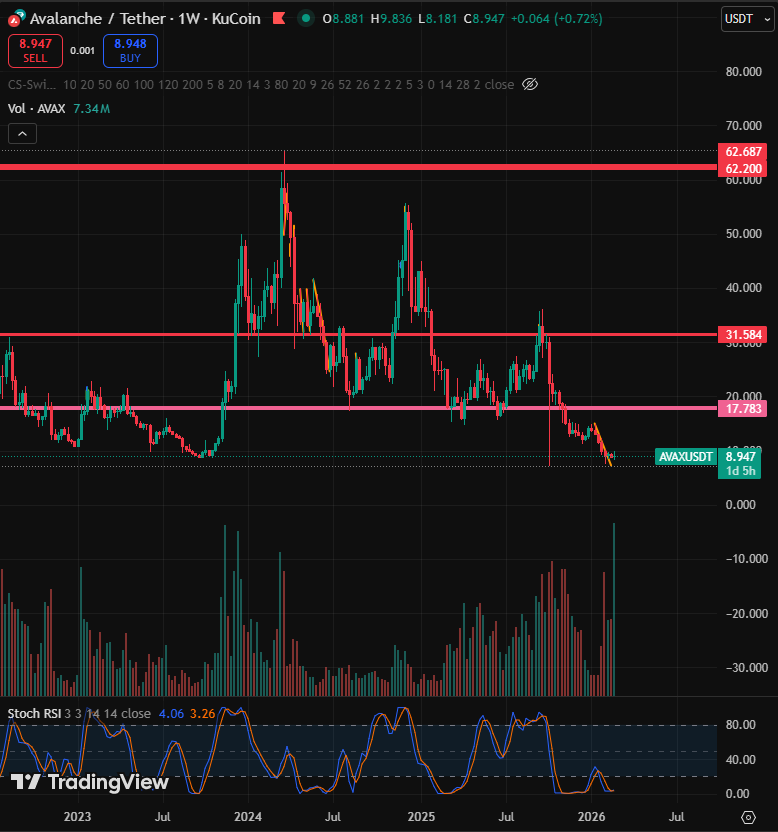
THE LARGEST ASSET MANAGER ON EARTH IS ACCUMULATING DECENTRALIZED YIELD. BlackRock officially expanded its massive institutional suite directly to the Avalanche network. Their dedicated staking fund actively extracts native yield for massive traditional capital. What specific smart contract network do you think they aggressively target next?

My net worth peaked at $1.2 million. None of it was real. I don't mean that philosophically. I mean it was located on servers that have since been turned off. I own eleven properties in the metaverse. Three in Decentraland. Four in The Sandbox. Two in Voxels. One in Otherside. And a beachfront villa in Horizon Worlds that I bought for $214,000 because Mark Zuckerberg called it "the next frontier." The frontier closed last week. It's a mobile app now. Last year I mass DM'd 340 people the phrase "you don't understand how early we are." I have since stopped doing that. Not because I was wrong. Because most of them blocked me. I got into metaverse real estate in November 2021. Everyone was buying. Someone paid $450,000 to be Snoop Dogg's neighbor. In a video game. With no legs. The avatars didn't have legs. I thought that was bullish. "The legs are coming," I told my Discord. "Legs are a roadmap item." Three hundred people reacted with rocket emojis. I called myself a "digital land baron." I put it in my Twitter bio. I put it in my LinkedIn headline. I said it on a podcast that had eleven listeners. Three of them were bots. The rest were my alts. My virtual property has more square footage than my actual apartment. My actual apartment has furniture. Location, location, location. My most valuable asset was a plot next to a virtual Gucci store. Gucci left in 2023. The store is still there. Nobody's in it. It's like a mall in Ohio but with worse graphics and no food court. I held. Diamond hands. That's what we said. "Diamond hands." It means refusing to sell while your investment loses 94% of its value. We turned financial paralysis into a personality trait. A guy in my Discord paid $2.4 million for a 618-parcel estate in Decentraland. Prime district. High foot traffic. I asked him what "foot traffic" meant when the platform had 38 daily active users. He said I didn't understand the technology. I didn't. I still bought more. We had a DAO. A decentralized autonomous organization. That means we voted on decisions. There were nine of us. Three never showed up. Two voted on everything without reading it. The other four were me and my alts. We voted to "acquire strategic parcels." The vote passed unanimously. I voted four times. My portfolio peaked at $1.2 million. I told everyone. I made a spreadsheet. I projected 40x returns by 2025. I made a pitch deck. The pitch deck had a slide that said "WE ARE BUILDING THE DIGITAL ECONOMY." The slide had a rocket emoji. That was my entire financial model. In 2023 I bought a Bored Ape for $189,000. It's worth $14,000 now. I don't talk about the Ape. I still use it as my profile picture. People ask me about it. I say "I'm long-term bullish." Long-term bullish means I can't sell it without crying in a Panera. My mom asked me what a Bored Ape was. I said "digital art on the blockchain." She asked why it cost more than her car. I said "you don't understand Web3." She said "I understand you live in a studio apartment." She's not in my Discord. Justin Bieber bought one for $1.3 million. It's worth about $90,000 now. I felt better about mine after I heard that. That's community. WAGMI. We're All Gonna Make It. We said that every day. In the group chat. While the floor dropped. While the volume dried up. While 95% of all NFT collections went to zero. We're all gonna make it. None of us made it. But we said it with conviction and a laser-eye profile picture. That counts for something. It doesn't. But we said it did. That's decentralized consensus. Meta spent $84 billion on the metaverse. I need to say that again. $84 billion. More than the GDP of Luxembourg. More than the GDP of Iceland, Luxembourg, and Malta combined. They spent it on a platform where the avatars had no legs, the graphics looked like a 2006 Wii game, and the peak user count was lower than the lunch rush at a Chipotle in Des Moines. They just pulled Horizon Worlds from VR headsets. It lives on as a mobile app. My beachfront villa is now a mobile app. Location, location, location. Zuckerberg renamed the entire company for this. Facebook became Meta. A $900 billion company changed its legal name because the CEO watched Ready Player One and said "I want that." Reality Labs lost $10 billion in 2021. $14 billion in 2022. $16 billion in 2023. $18 billion in 2024. $19 billion in 2025. That's not a strategy. That's a speedrun. They laid off 1,500 Reality Labs employees this year. Shut down three VR studios. Killed Supernatural. Put the entire VR social vision in a casket and said "we're pivoting to AI and wearables." The pivot took four years and $84 billion. I pivoted too. I'm an AI real estate investor now. I bought a virtual plot in an AI-generated world that doesn't exist yet. The founder said it was "the intersection of spatial computing and large language models." I don't know what that means. I gave him $40,000. He has a whitepaper. It's 47 pages. I read the title and the tokenomics section. The tokenomics section is a pie chart. I love pie charts. They make everything look like a plan. The project has a roadmap. Q1: "Build community." Q2: "Launch beta." Q3: "Scale ecosystem." Q4 is blank. Q4 is always blank. That's where the exit scam goes. My accountant asked me to value my metaverse portfolio for tax purposes. I said $1.2 million. He said "current market value." I said $6,400. He stared at me for eleven seconds. I know because I counted. He asked if I had any other investments. I showed him my NFTs. He stared for longer. I told him they were "cultural artifacts with long-term provenance." He asked if I'd considered a 401k. I told him a 401k was "legacy finance." He told me to leave his office. The metaverse is dead. I don't accept that. I am a digital land baron. I own eleven properties across four platforms. I have a beachfront villa in a mobile app, a plot next to an empty Gucci store, and a cartoon monkey that cost me more than my actual car. Location, location, location. The location is nowhere. But I'm early. I'm always early. That's the same as being wrong except you get to say it with confidence.


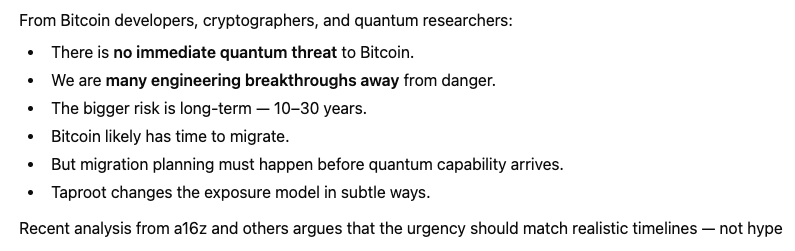
Michael @Saylor explains the quantum computing debate, the actual risks to Bitcoin, and what protocol upgrades could look like. Watch this clip from our full show👇🏼


Now, the quantum resistance roadmap. Today, four things in Ethereum are quantum-vulnerable: * consensus-layer BLS signatures * data availability (KZG commitments+proofs) * EOA signatures (ECDSA) * Application-layer ZK proofs (KZG or groth16) We can tackle these step by step: ## Consensus-layer signatures Lean consensus includes fully replacing BLS signatures with hash-based signatures (some variant of Winternitz), and using STARKs to do aggregation. Before lean finality, we stand a good chance of getting the Lean available chain. This also involves hash-based signatures, but there are much fewer signatures (eg. 256-1024 per slot), so we do not need STARKs for aggregation. One important thing upstream of this is choosing the hash function. This may be "Ethereum's last hash function", so it's important to choose wisely. Conventional hashes are too slow, and the most aggressive forms of Poseidon have taken hits on their security analysis recently. Likely options are: * Poseidon2 plus extra rounds, potentially non-arithmetic layers (eg. Monolith) mixed in * Poseidon1 (the older version of Poseidon, not vulnerable to any of the recent attacks on Poseidon2, but 2x slower) * BLAKE3 or similar (take the most efficient conventional hash we know) ## Data availability Today, we rely pretty heavily on KZG for erasure coding. We could move to STARKs, but this has two problems: 1. If we want to do 2D DAS, then our current setup for this relies on the "linearity" property of KZG commitments; with STARKs we don't have that. However, our current thinking is that it should be sufficient given our scale targets to just max out 1D DAS (ie. PeerDAS). Ethereum is taking a more conservative posture, it's not trying to be a high-scale data layer for the world. 2. We need proofs that erasure coded blobs are correctly constructed. KZG does this "for free". STARKs can substitute, but a STARK is ... bigger than a blob. So you need recursive starks (though there's also alternative techniques, that have their own tradeoffs). This is okay, but the logistics of this get harder if you want to support distributed blob selection. Summary: it's manageable, but there's a lot of engineering work to do. ## EOA signatures Here, the answer is clear: we add native AA (see eips.ethereum.org/EIPS/eip-8141 ), so that we get first-class accounts that can use any signature algorithm. However, to make this work, we also need quantum-resistant signature algorithms to actually be viable. ECDSA signature verification costs 3000 gas. Quantum-resistant signatures are ... much much larger and heavier to verify. We know of quantum-resistant hash-based signatures that are in the ~200k gas range to verify. We also know of lattice-based quantum-resistant signatures. Today, these are extremely inefficient to verify. However, there is work on vectorized math precompiles, that let you perform operations (+, *, %, dot product, also NTT / butterfly permutations) that are at the core of lattice math, and also STARKs. This could greatly reduce the gas cost of lattice-based signatures to a similar range, and potentially go even lower. The long-term fix is protocol-layer recursive signature and proof aggregation, which could reduce these gas overheads to near-zero. ## Proofs Today, a ZK-SNARK costs ~300-500k gas. A quantum-resistant STARK is more like 10m gas. The latter is unacceptable for privacy protocols, L2s, and other users of proofs. The solution again is protocol-layer recursive signature and proof aggregation. So let's talk about what this is. In EIP-8141, transactions have the ability to include a "validation frame", during which signature verifications and similar operations are supposed to happen. Validation frames cannot access the outside world, they can only look at their calldata and return a value, and nothing else can look at their calldata. This is designed so that it's possible to replace any validation frame (and its calldata) with a STARK that verifies it (potentially a single STARK for all the validation frames in a block). This way, a block could "contain" a thousand validation frames, each of which contains either a 3 kB signature or even a 256 kB proof, but that 3-256 MB (and the computation needed to verify it) would never come onchain. Instead, it would all get replaced by a proof verifying that the computation is correct. Potentially, this proving does not even need to be done by the block builder. Instead, I envision that it happens at mempool layer: every 500ms, each node could pass along the new valid transactions that it has seen, along with a proof verifying that they are all valid (including having validation frames that match their stated effects). The overhead is static: only one proof per 500ms. Here's a post where I talk about this: ethresear.ch/t/recursive-st… firefly.social/post/farcaster…


Vitalik admitting PQ signatures will jump from 3k to ~200k gas exposes the nightmare of retrofitting a live L1. ⛽️💥 $ETH has massive technical debt. Why wait a decade to patch a leaky ship when $QRL + Zond offers a natively Quantum-Secure EVM TODAY? ⚛️