Sir John Chipman IISS
7.3K posts

Sir John Chipman IISS
@chipmanj
Executive Chairman of The International Institute for Strategic Studies (IISS)
London/Global Katılım Nisan 2010
674 Takip Edilen16.1K Takipçiler
Sabitlenmiş Tweet

If it is agreed that the so-called ‘rules based order’ is dead, is it logical to have that dead order govern our decisions in disorder?
During the Cold War there was no ‘rules based order’; there was balance of power, regulated by arms control.
Now we have neither; and rules cannot be enforced.
International law is no longer ‘fit for purpose’. It is out-dated, not least because it does not account for non-state actors or so-called grey area threats.
A period of harsh realpolitik will inevitably re-shape international law.
In the meantime, as international law is honoured more in the breach than in the observance, it cannot be the decisive factor in determining national security policy.
That pains the liberal conscience, but is consistent with the liberal lament that the ‘rules-based order’ is dead.
English
Sir John Chipman IISS retweetledi

I don't offer a rosy assessment in my new piece in the Financial Times today about the US-Israel war with Iran:
ft.com/content/587cd0…
What will phase two of the war look like? For Israel, the focus will be on the continued destruction of Iran’s military infrastructure and greater targeting of its coercive apparatus to weaken the Revolutionary Guards and its associated militia, the Basij force. For the US, the goal will be to restore maritime traffic, defend its Arab partners better than to date and adapt to Iran’s own adaptations. For Iran, it could involve weapons we have not seen deployed much. One of the mysteries of the war is why it has not fired more of its cruise missiles. The optimistic answer is that they have been largely destroyed; the likelier one is that Iran has held many back as they are a particularly useful capability for close combat in the Strait of Hormuz.
After the beating it has taken, the Iranian regime is unlikely to back down because it retains several advantages: geography, time and asymmetry. Iran can target more countries and areas from more positions. The longer the war goes on, the greater the cost to everyone else — and the Iranian regime has superior pain tolerance. When survival is the goal, anything goes.
English
Sir John Chipman IISS retweetledi

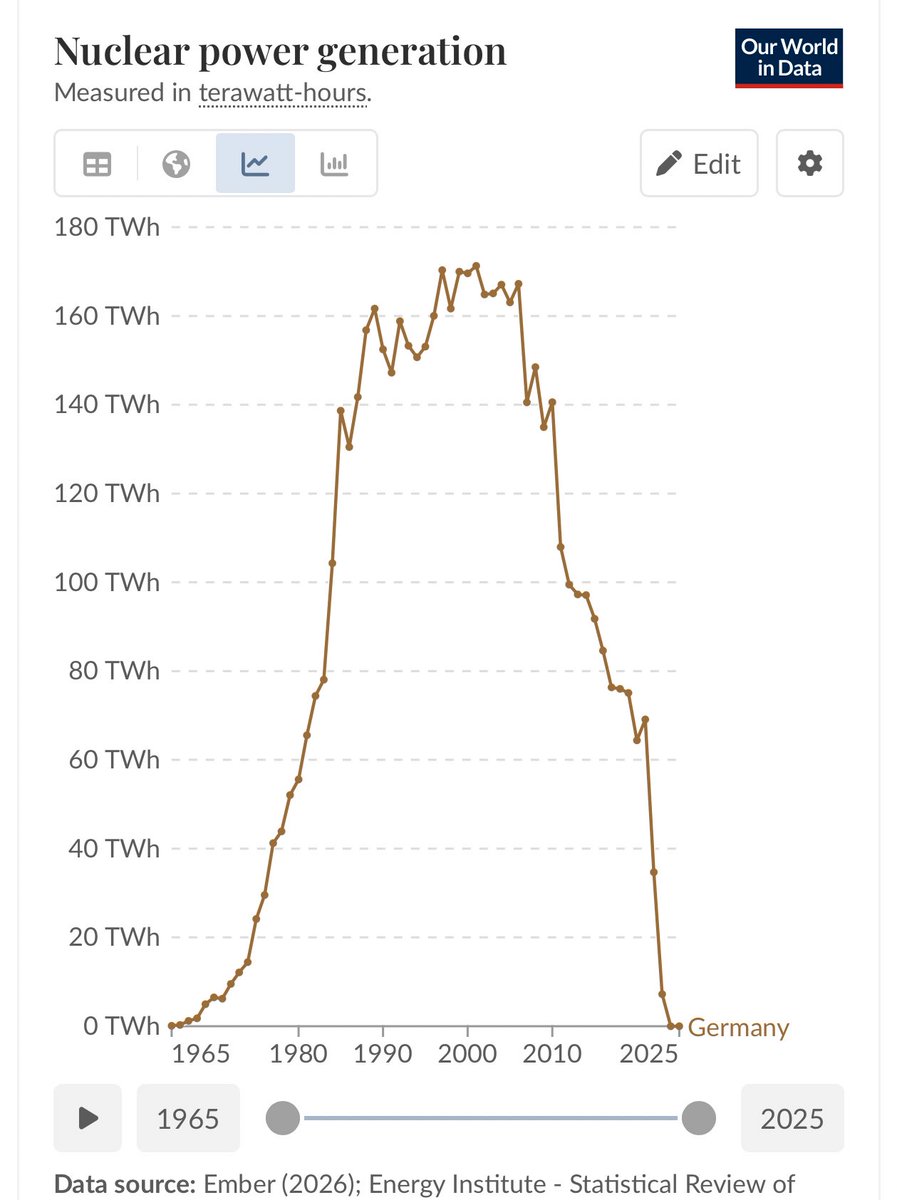
Unreal numbers 👀⚡️
"JPMorgan estimates that, had Germany not phased out nuclear power, the country would have generated 50% less electricity from fossil fuels and 84% less electricity from natural gas in 2024. Electricity prices in Germany would have been around 25% lower, and the country would have imported half as much electricity.."

English
Sir John Chipman IISS retweetledi

Britain has made electricity so expensive and scarce that it cannot compete in the defining race of this century: the deployment of AI at scale.
This is Sovereign Suicide.
1/ Britain now has the highest industrial electricity prices in the developed world. At 25p per kilowatt-hour, its power costs stand at double the EU average and quadruple those of the US (6p) and China (7p).
2/ Energy-intensive output has collapsed by 33% since 2021. In 1970, manufacturing accounted for 30% of UK GDP; today, it is just 8% — a lower share than Thailand (26%).
3/ But this isn’t just about the death of old industry. Just as cheap electricity determined the industrial powers of the past, it will now determine the AI superpowers of the future.
4/ The real competition is not about who builds the best AI models, but who can afford to run them. Sovereignty in this century isn’t found in “green ledgers” or offshore wind farms; it is found in the physical ability to process Intelligence at an industrial scale.
4/ Britain’s current path is a dead end. There are 140 data centers in the UK’s grid connection queue, representing 50 GW of demand — more than the entire country’s current peak usage (45 GW). For many, the quoted connection date is 2040.
5/ As Intelligence proliferates, productivity will no longer be measured in man-hours, but in Tokens-per-Watt: how many units of ‘Intelligence’ a kilowatt-hour of electricity can buy. With its 25p rate, it is already 400% more expensive to buy Intelligence in Britain than in China or the US.
6/ This is a direct hit to the UK services sector, which accounts for 82% of the economy. As AI automates knowledge work, British firms must 'rent' intelligence from foreign clouds at predatory rates just to stay competitive.
7/ Even if Britain builds domestic AI infrastructure, the 25p barrier means it would be structurally uncompetitive from day one. This leaves only the path of outsourcing national productivity to foreign clouds, a permanent transfer of British wealth.
8/ True sovereignty requires a radical shift to dedicated, low-cost power for compute. Without cheap energy, Britain won’t just lose its factories — it may lose its offices, too.
English
Sir John Chipman IISS retweetledi

People should never feel pressured to take a position on war.
But if you do, you can do so at two points:
- during the build-up when you struggle with the arguments;
- and on Day 0.
After that, you can't go from saying 'I support this war' to 'I no longer do because I don't agree with how it is conducted, about the objectives, about the cost, about the human catastrophe etc.'
What sticks is your opinion on Day 0.
PS: this does not apply to people in the midst of it all.
English
Sir John Chipman IISS retweetledi

Merz: We discussed Russian oil and gas deliveries with the US President in the G7 this week. Six members clearly said this sends the wrong signal.
This morning we learned the US government apparently decided otherwise.
We think this is wrong — there’s a price issue, not a supply shortage. I’d like to know what other motives are behind this temporary decision.
English
Sir John Chipman IISS retweetledi

In Poland, Prime Minister Donald Tusk has said the government will pursue a “Plan B” after the country’s president vetoed legislation allowing it to tap nearly €44 billion in EU defense loans.
3/3
tvpworld.com/92068972/polis…
English
Sir John Chipman IISS retweetledi

In Poland, a decision by the country’s president Nawrocki to veto a key bill paving the way for tens of billions of euros in EU defense funding has been slammed by the government, as "treason, cowardice and deceit".
2/3
tvpworld.com/92071869/nawro…
English
Sir John Chipman IISS retweetledi

In Poland, President Karol Nawrocki vetoed legislation allowing Poland to tap nearly €44 billion in EU defence loans, arguing that while the country must strengthen its military, it must do so “on its own terms.”
1/3
tvpworld.com/92060333/nawro…
English
Sir John Chipman IISS retweetledi

The ferocious intensity and widening scope of the full-scale war pitting the United States and Israel against Iran is radiating across the Middle East.
This webinar will examine the military dimensions of the war and how to think about the respective strategies of the warring sides; the political effects of the war; the regional fallout both in the Gulf region and in the Levant; and the prospects for further escalation or a diplomatic off-ramp.
🌐 Online
📅 Monday 9 March
⏰ 14:00–15:00 GMT
💬 Dr Hasan Alhasan (@HTAlhasan), Emile Hokayem (@emile_hokayem), Air Marshal (Retd) Martin ‘Sammy’ Sampson, Sir John Chipman (@chipmanj)
Register now: go.iiss.org/4ucK27Q

English
Sir John Chipman IISS retweetledi

There are many parts to the Iranian ‘ government machinery’ — often the gears don’t mesh; all the more so when the leadership is in disarray. The admission is remarkable nevertheless.
Gregg Carlstrom@glcarlstrom
Remarkable clip here in which Araghchi says the regime no longer has effective command and control over the IRGC
English

Talent, energy, commitment on full display here! 👇
Mark Sedwill@marksedwill
St Andrews transformed my life. Here’s why I’m now standing to be its next Chancellor 👇
English

Impressive statement. 👇
Mark Sedwill@marksedwill
St Andrews transformed my life. Here’s why I’m now standing to be its next Chancellor 👇
English

This passage in Kagan’s essay:
‘To mount a plausible defense against further Russian territorial aggression while also deterring American aggression will require not just marginal increases in defense spending but a full-scale strategic and economic reorientation toward self-reliance—a restructuring of European industries, economies, and societies. But if Germany, Britain, France, and Poland all armed themselves to the full extent of their capacity, including with nuclear weapons, and decided to forcefully defend their economic independence, they would collectively wield sufficient power to both deter Russia and cause an American president to think twice before bullying them. If the alternative is subjugation, Europeans could well rise to such a challenge.’
toomas hendrik ilves@IlvesToomas
The pre-eminent historian of US foreign policy today, Robert Kagan weighs in on the historical moment: theatlantic.com/magazine/2026/…
English
Sir John Chipman IISS retweetledi

Listen to Sir Alex Younger, the former head of MI6. He is one of the most astute establishment figures we have right now when it comes to grand strategy. His warning that America’s defence shield has “infantilised” Britain and Europe needs to be taken really seriously.
Creation of hard power is absolutely central to grand strategy. But decades of security dependence have trained European leaders to treat it as someone else’s job.
Politicians like Starmer, Miliband and Ed Davey do not seem to grasp that hard power has to be built, funded, and maintained. It is fundamentally incompatible with many of their cherished agendas.
The same criticism applies to every single Conservative leader since Thatcher. They talked a good game about defence, but too often governed as if the strategic environment would remain benign forever. This was unforgivable post-2014.
To be fair to Kemi Badenoch, she seems to understand this better than her predecessors. And Nigel Farage, whatever people think of him, has a much sharper instinct for the reality that power ultimately rests on productive force.
For me, the clearest example of Westminster’s complacency and recklessness is Net Zero, renewables, the war on domestic fossil fuels and the steady march of deindustrialisation. We have treated our industrial base as expendable, as if our national prosperity and security can survive without cheap, reliable energy and carbon-intensive industry.
I am hoping Trump’s behaviour over Greenland finally forces a fundamental rethink of the national security assumptions that have dominated British politics, the media, and boardrooms for far too long.
This complacency has to stop, and quickly. We need late 1930s levels of urgency, determination and seriousness.
English
Sir John Chipman IISS retweetledi

Sir John Chipman IISS retweetledi