chrxh

288 posts

chrxh banner
chrxh

chrxh

@chrx_h

Creator of https://t.co/4GaCJ5FLrw - https://t.co/ErjTT8Yj7v | PhD | Ex-researcher in Applied Analysis | https://t.co/usuvPxCdAi

Berlin, Germany Katılım Ekim 2020
506 Takip Edilen7.4K Takipçiler
chrxh retweetledi
erwan plantec
erwan plantec@eplantec·
Synthetic ecosystems that autonomously and continuously evolve in silico 👾 An Alifer dream we pursue with Flow-Lenia ! If you are interested in complex systems with (1) emergent creatures and (2) intrinsic evolutionary dynamics, go check our new paper ! A 🧵
English
25
269
1.5K
190.7K
chrxh retweetledi
Spectral Compute
Spectral Compute@SpectralCom·
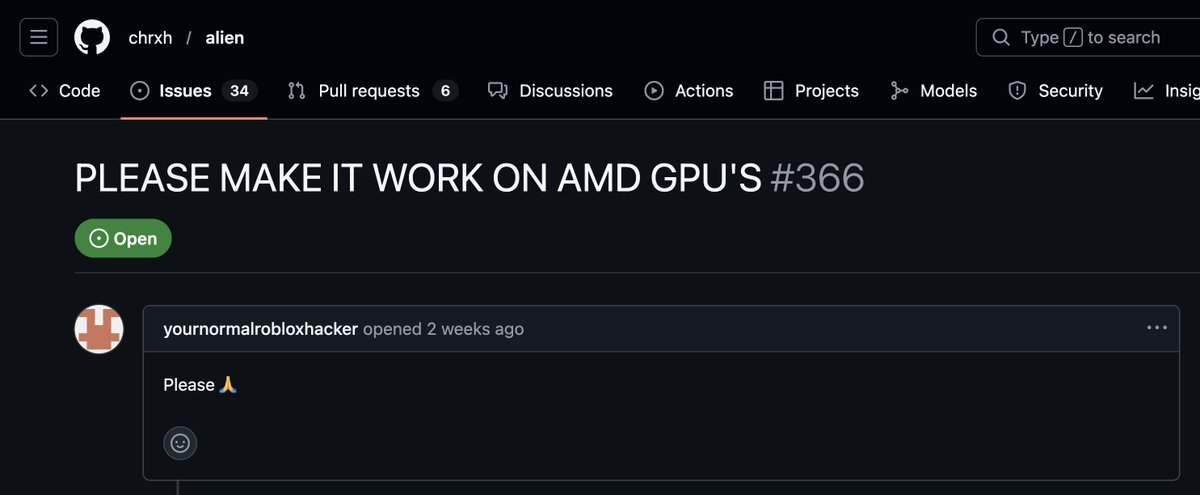
Great software shouldn't be limited by hardware. Projects like ALIEN by @chrx_h are built on highly optimized CUDA code, but users are clamoring for AMD support (see below 👇).
Spectral Compute tweet media
English
1
1
4
708
chrxh
chrxh@chrx_h·
I can't express how amazing the team at @SpectralCom is! Thanks to their compilers, the CUDA-native artificial life simulator github.com/chrxh/alien can now run on AMD GPUs: scale-lang.com 🔥🔥🔥 Honestly, I never thought I'd see this happen in my lifetime 😀
English
1
2
22
1.1K
hazelnut
hazelnut@hazelnut0x·
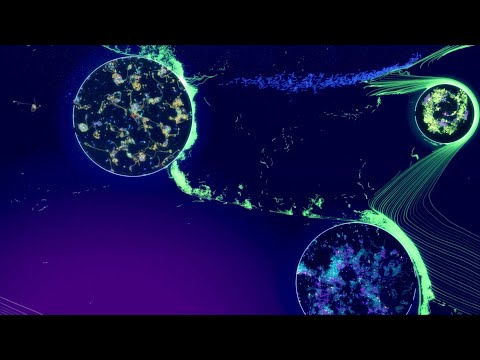
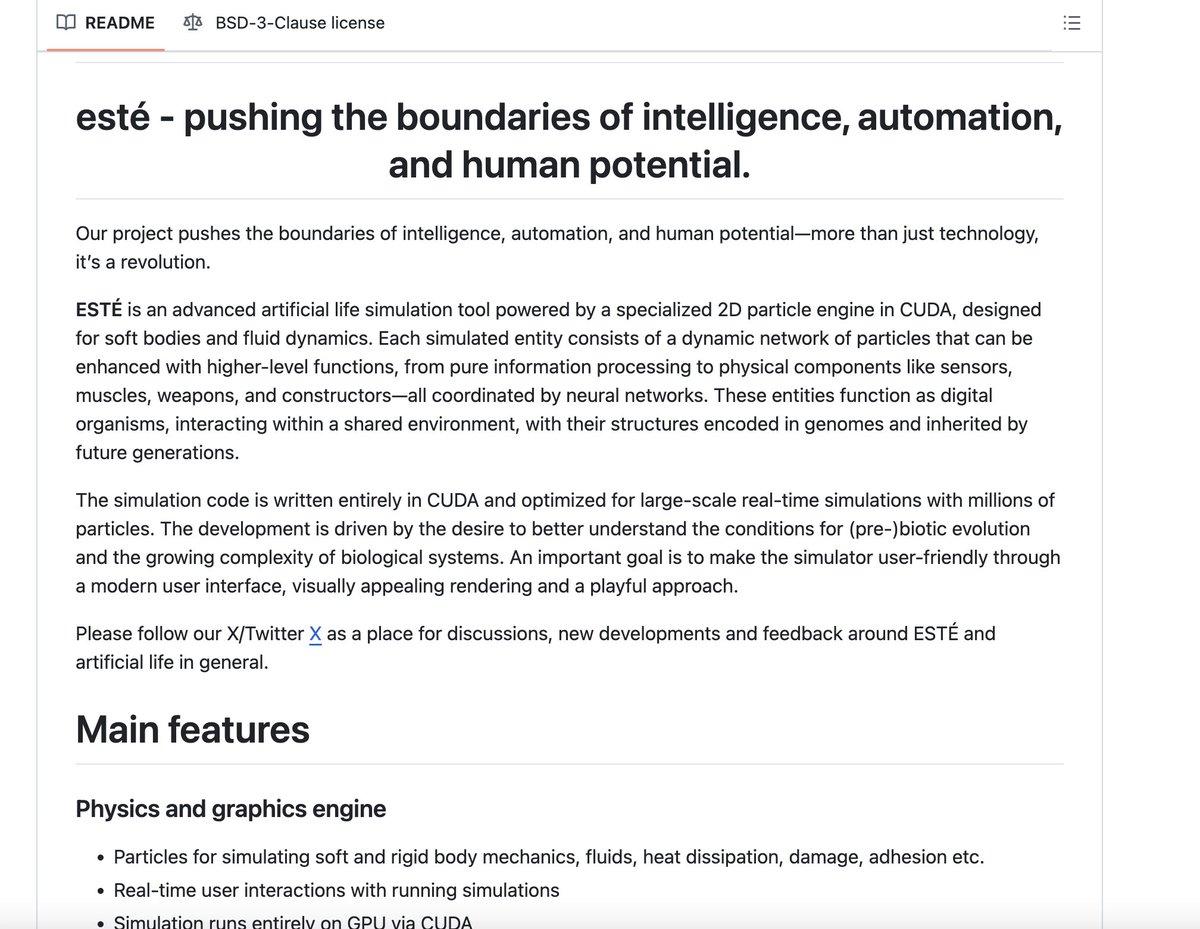
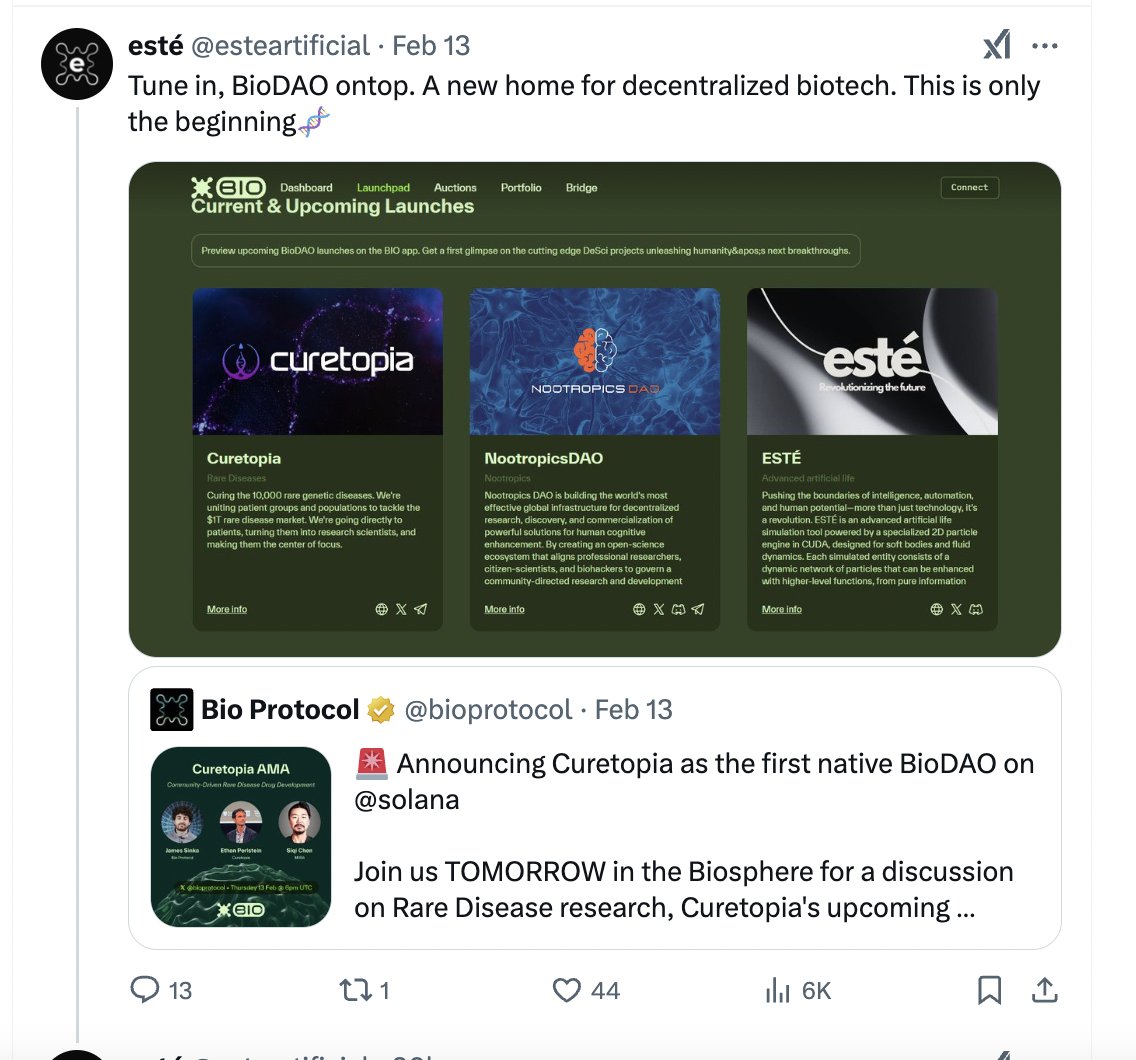
larp alert: @esteartificial $ESTE - The real dev's account is here (despite inactivity) @JoeClinton02 - Github is forked/ripped from @chrx_h's Alien project - They faked that they are on the @bioprotocol launchpad (which is actually so dumb when they're launching on pf)
hazelnut tweet mediahazelnut tweet mediahazelnut tweet mediahazelnut tweet media
English
4
0
7
1.2K
chrxh
chrxh@chrx_h·
Happy New Year to everyone! The development of ALIEN in 2024 was focused on lots of incremental improvements and smaller extensions. Next year, however, there could be major changes to the core model that can no longer be addressed with successive minor updates. Sometimes one has to step off the beaten track and also be prepared to let promising ideas fail in simulations. I've worked out new concepts that will need to be tested in prototypes. I don't know where this journey is going! ... and that's the fun part!
chrxh tweet media
English
2
0
25
2.1K
chrxh
chrxh@chrx_h·
The simulation parameter window is the heart of ALIEN. It has now been replaced by a much more potent version, enabling features such as naming, reordering, opening in a separate window, and cloning of parameter zones and radiation sources. To handle the growing number of parameters, a quick filter has also been added for easier navigation. In addition, several smaller improvements and bug fixes have been implemented, including revised neuron mutations, minimum genome size constraints for deletion mutation, optional energy costs for muscle cells, and much more. Special thanks goes to Enitoni and tilsk (both @ Discord) for their excellent suggestions and bug reports!
chrxh tweet media
English
0
1
14
1.8K
chrxh retweetledi
Kenneth Stanley
Kenneth Stanley@kenneth0stanley·
Very proud to have collaborated with @akarshkumar0101. @SakanaAILabs & others in a significant step forward for artificial life: guiding the search for artificial life with foundation models! Time for the AI revolution to pump some energy back into alife too!
Sakana AI@SakanaAILabs

Introducing ASAL: Automating the Search for Artificial Life with Foundation Models sakana.ai/asal/ Artificial Life (ALife) research holds key insights that can transform and accelerate progress in AI. By speeding up ALife discovery with AI, we accelerate our understanding of emergence, evolution, and intelligence–core principles that can inspire the next generation of AI systems! We proudly collaborated with MIT, OpenAI, Swiss AI Lab IDSIA, and Ken Stanley on this exciting project. Full Paper (Website): pub.sakana.ai/asal/ Full Paper (arxiv): asal.sakana.ai/paper/ Code: github.com/SakanaAI/asal/ In this work, we propose a new algorithm called Automated Search for Artificial Life (“ASAL”) to automate the discovery of artificial life using vision-language foundation models. Instead of tediously hand-designing every tiny rule of an Alife simulation, simply describe the space of simulations to search over, and ASAL will automatically discover the most interesting and open-ended artificial lifeforms! Because of the generality of foundation models, ASAL can discover new lifeforms across a diverse range of seminal ALife simulations, including Boids, Particle Life, Game of Life, Lenia, and Neural Cellular Automata. ASAL even discovered novel cellular automata rules that are more open-ended and expressive than the original Conway’s Game of Life. We believe this new paradigm may reignite ALife research by overcoming the bottleneck of manually designed simulations, thus advancing beyond the limits of human ingenuity.

English
5
28
191
24.7K
chrxh retweetledi
Sakana AI
Sakana AI@SakanaAILabs·
Introducing ASAL: Automating the Search for Artificial Life with Foundation Models sakana.ai/asal/ Artificial Life (ALife) research holds key insights that can transform and accelerate progress in AI. By speeding up ALife discovery with AI, we accelerate our understanding of emergence, evolution, and intelligence–core principles that can inspire the next generation of AI systems! We proudly collaborated with MIT, OpenAI, Swiss AI Lab IDSIA, and Ken Stanley on this exciting project. Full Paper (Website): pub.sakana.ai/asal/ Full Paper (arxiv): asal.sakana.ai/paper/ Code: github.com/SakanaAI/asal/ In this work, we propose a new algorithm called Automated Search for Artificial Life (“ASAL”) to automate the discovery of artificial life using vision-language foundation models. Instead of tediously hand-designing every tiny rule of an Alife simulation, simply describe the space of simulations to search over, and ASAL will automatically discover the most interesting and open-ended artificial lifeforms! Because of the generality of foundation models, ASAL can discover new lifeforms across a diverse range of seminal ALife simulations, including Boids, Particle Life, Game of Life, Lenia, and Neural Cellular Automata. ASAL even discovered novel cellular automata rules that are more open-ended and expressive than the original Conway’s Game of Life. We believe this new paradigm may reignite ALife research by overcoming the bottleneck of manually designed simulations, thus advancing beyond the limits of human ingenuity.
English
76
632
2.8K
748.5K
chrxh retweetledi
PHD Comics
PHD Comics@PHDcomics·
Expectations
PHD Comics tweet media
English
2
62
512
38.7K
chrxh
chrxh@chrx_h·
@julia34663 Thanks! Yes, it's open source (github.com/chrxh/alien). The software features an in-game simulation browser, where you can find the stuff I've posted here. A CUDA capable card is required.
English
1
1
4
342
Dr. Julia Muller
Dr. Julia Muller@julia34663·
@chrx_h This is just about the coolest thing I’ve ever seen. Is it open source? I’d love to play around with this if that’s okay.
English
1
0
2
375
chrxh
chrxh@chrx_h·
The next plot twist: The once highly aggressive beasts have split into different lineages and have become noticeably more passive. Most now resemble plant-like creatures, forming an endless forest of biomass that sustains an entire ecosystem around them. The spiky creatures (shown in the video at 0:54) are particularly interesting. Their spikes help them to fend off attacks quite effectively. ...and yes, I'm already working on plans to scale up ALIEN simulations for users who are willing to dedicate their GPU time.
English
20
60
627
68K
chrxh
chrxh@chrx_h·
@BasedEpicUltra just run the latest installer. it will update your version.
English
1
0
0
13
WilstonLind
WilstonLind@BasedEpicUltra·
@chrx_h how do i update the alien project? do i have to reinstall the entire thing again or is there a system that lets me do it without that?
English
1
0
0
14
chrxh retweetledi
Zolden
Zolden@ZoldenGames·
Remember this scene in Terminator 2?
English
108
408
8K
935.6K
chrxh
chrxh@chrx_h·
... 2 days later, without much having happened, new type of organisms suddenly appear everywhere. Most of them are kind of asleep and others act extremely fast and attack their opponents with full broadside. I don't know exactly how they function. Everything on these organisms seems strange, but they are powerful, successful and scary!
English
31
99
938
125.8K
chrxh
chrxh@chrx_h·
The creatures consist of networks of nodes (the body parts), each of which can be equipped with specific functionalities. These functionalities might include small neural networks, sensors, muscles or other stuff. Adjacent nodes can exchange activity signals, allowing multiple nodes with neural networks (currently 8 neurons) to interconnect into arbitrary larger networks or link them to input (e.g. sensors) or output nodes (e.g. muscles). A genome here contains the construction sequences for all body parts of a creature in hierarchical order (for instance, first build the body, then the legs, ...), along with the properties for each node. If a node is equipped with a small neural network, the genome encodes their weights, biases, and activation types. This design offers modularity, but reusability is currently very limited in this implementation. Construction sequences can specify repetitions. This is convenient for iterative structures, where descriptions of nodes are reused multiple times. In the long term, I'm considering transitioning from the hierarchical model to a 'pointer-based' genome model, where shared (sub-)sequences could be referenced from different places.
English
2
2
2
424
Dan Brickley
Dan Brickley@danbri·
@chrx_h @Antpan42 What does the genome to neural net mapping look like? Is there scope for modularity/reuse amongst its evolved components?
English
1
0
1
108
chrxh
chrxh@chrx_h·
The organisms can consist of multiple body parts. Each part is a network of nodes, encoded in the genome as a construction sequence. These sequences are hierarchically organized in the genome (e.g., first build the corpus, then the legs, etc.). Some time ago, I transitioned from syntactic to semantic mutations. This has the advantage that the mutations can be very finely tuned. For example, one can only mutate the cells of the neuronal network if no morphological changes are desired.
English
0
0
2
32
thomas "noio" vandenberg
thomas "noio" vandenberg@noio_games·
@chrx_h how do you store 'DNA' ? And how do you apply mutations to it? Do you mutate 'semantically' (e.g. add/remove 1 leg) or 'syntactically' (change ACTG => ACGG, see what happens) if that makes sense?
English
1
0
1
149
chrxh
chrxh@chrx_h·
@honeykjoule You can find it under the “Deep Down Below” folder. I have uploaded all the states I posted on X.
English
0
1
10
1.4K