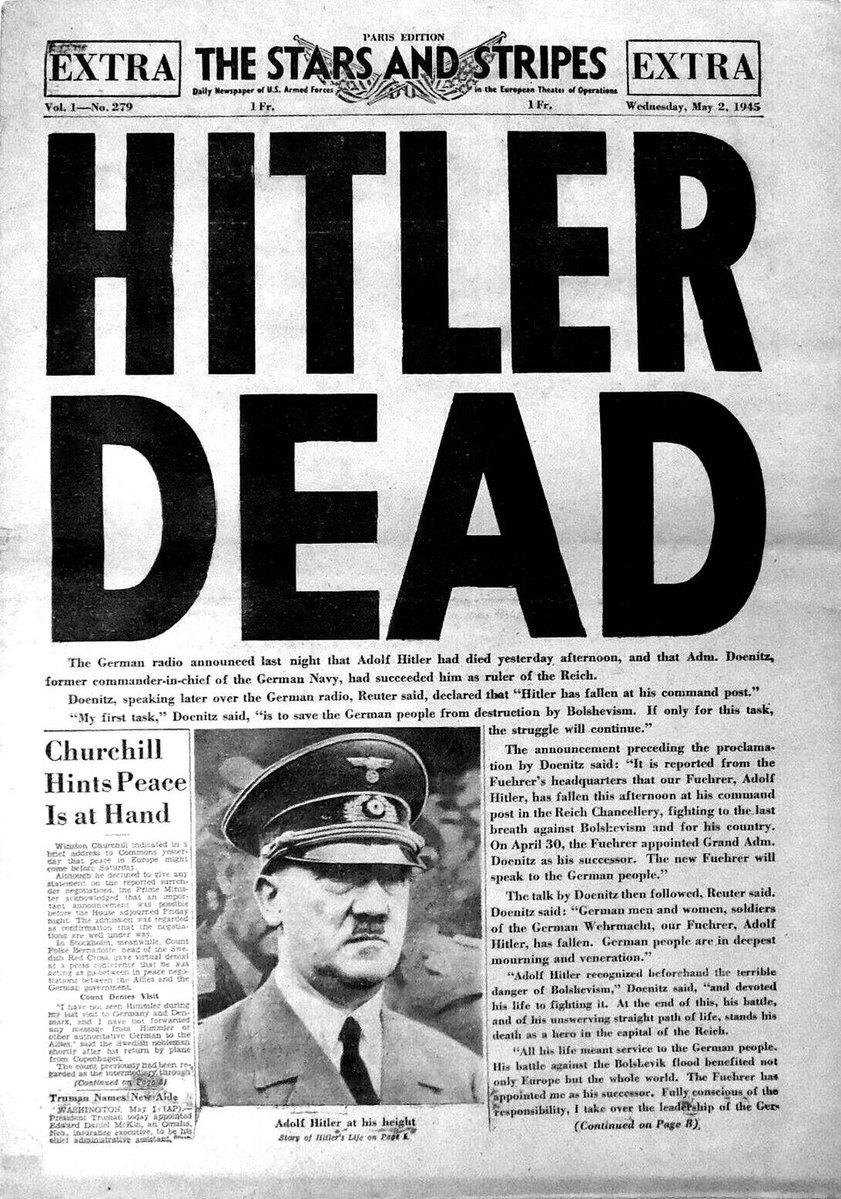
On this day in 1945, Adolf Hitler commits suicide in his bunker deep beneath the streets of Berlin. The German Führer escapes justice, but not the judgement of history.
سجيس مالك فرص تزاوج ولا حظ مع الفحول السويين ولا ادنى قابلية للتلقيح من رجل فحل اكتفي بالإباحيين الزانيين عندك أنت في اسفل الهرم كما أثبتت الإحصائيات خاصة مع كسك الناشف اليابس المفحم شفراته مهترية مترهلة ولبرا مشهد مقزز كافي يخلي أعتى الفحول يفقد قدرته على الانتصاب يا عاهره
سجيس المومس المثقوبة والمطية والمركب الذليل الرخيص لذكور الاقليم ما اكتفت بإنبطاحها للمهندس الفحل كسَبية ومحضية لمُبايعته على السمع والطاعة حتى بعد رفضه لها استمرت تتهمه وتلفق وتسقط سلوكياتها العاهره عليه ما تتقبل رفض كسها الزنجمفحم وتبقى سجيس مكب للمني والفضلات ومرحاض القارة
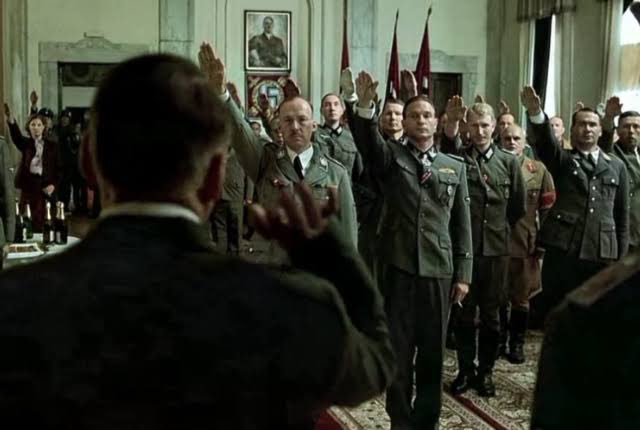
Kluge, Himmler, Dönitz, and Keitel at the funeral service of Colonel General Hans Hube, 26 Apr 1944
Hans-Valentin Hube (1890-1944) was one of the more capable German armored commanders of the Second World War, known for his cool tactical judgment and his ability to extract forces from seemingly impossible situations. He rose to the rank of Generaloberst (Colonel General) shortly before his death.
Hube was born in Naumburg in October 1890 and entered the Imperial German Army as a young officer before the First World War. He served in the infantry on the Western Front, where he was severely wounded in 1914 and lost his left arm. Despite the amputation, he was retained in the Reichswehr after the war, an unusual distinction that reflected the army's high opinion of him. Throughout his career he wore an artificial arm, and his troops nicknamed him "Der Mensch" ("The Man") out of respect.
In the Second World War he commanded the 16th Infantry Division (Motorized), which was later reorganized as the 16th Panzer Division. He led it during the invasion of the Soviet Union in 1941, fighting at Uman and Kiev, and then south toward the Caucasus and Stalingrad in 1942. At Stalingrad his division was destroyed inside the pocket along with the rest of the Sixth Army, but Hitler personally ordered Hube flown out shortly before the surrender in January 1943 because he was considered too valuable to lose.
After Stalingrad he was given command of XIV Panzer Corps, which he led during the defense of Sicily in the summer of 1943. He is generally credited with conducting one of the more successful German operational achievements of the war there: the orderly evacuation of roughly 40,000 German troops, along with much of their equipment, across the Strait of Messina to the Italian mainland in August 1943, despite Allied air and naval superiority.
He then took command of the 1st Panzer Army on the Eastern Front in late 1943. His best-known feat in that role was breaking out of the Kamenets-Podolsky pocket in the spring of 1944, when his army of roughly 200,000 men was encircled by Zhukov's forces during the Soviet Dnieper-Carpathian offensive. Rather than the expected breakout to the south, Hube, working with Manstein, who pressed Hitler hard for permission, drove west, kept his force largely intact, linked up with relief forces, and saved the bulk of the army. It was a rare bright spot for the Wehrmacht in that period of the war.
Hitler promoted him to Generaloberst and decorated him with the Diamonds to his Knight's Cross with Oak Leaves and Swords, one of only 27 recipients of that grade. The day after the award ceremony, on 21 April 1944, Hube was killed when the aircraft flying him back from the Berghof crashed near Salzburg.
Assessments of Hube tend to be relatively consistent: he is generally regarded as among the most professionally competent German armored commanders of the war, alongside figures like Balck and Manstein, particularly skilled at defensive and withdrawal operations. As with all senior Wehrmacht commanders on the Eastern Front, his career is also bound up with the broader conduct of that campaign, including operations in areas where war crimes were committed by German forces, though Hube himself is not typically singled out in the literature for direct involvement in such acts in the way some other commanders are.
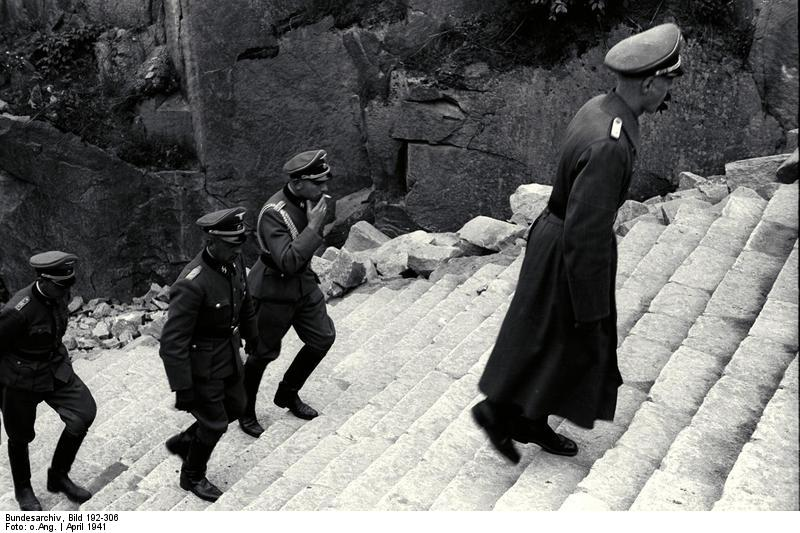
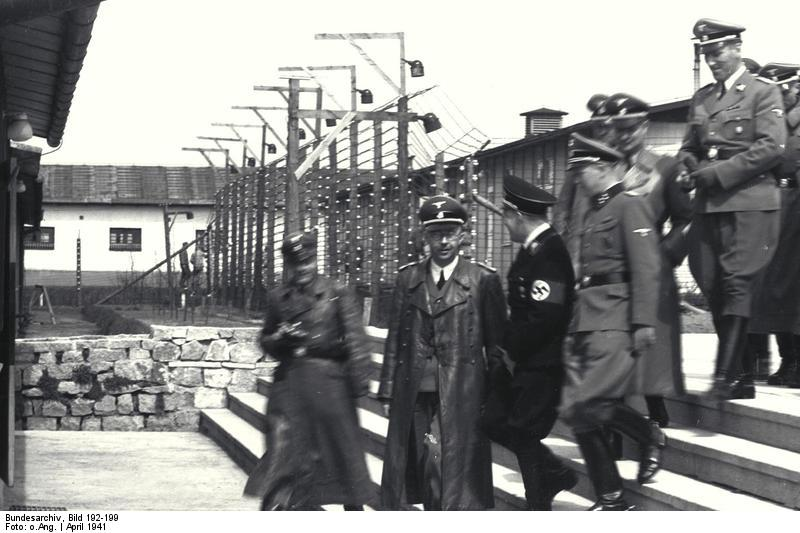
Heinrich Himmler visiting the Mauthausen Concentration Camp in Austria, 27 Apr 1941
Heinrich Himmler's visit to Mauthausen on 27 April 1941 was one of several inspection tours he made to the camp complex during its operational years. Mauthausen, located about 20 kilometers east of Linz in Upper Austria, had been established in August 1938 following the Anschluss, and by 1941 it was the central camp of a growing network of subcamps, with Gusen (about 5 km away) being the largest and most important satellite.
The April 1941 visit is well documented through a series of photographs taken by SS photographers, which survived the war and are now held in archives including the Bundesarchiv and the Mauthausen Memorial archives. The images show Himmler touring the Wiener Graben granite quarry, the camp's economic centerpiece, accompanied by camp commandant Franz Ziereis, Gauleiter of Upper Austria August Eigruber, SS-Obergruppenführer Ernst Kaltenbrunner (then the senior SS and police leader in Vienna), and various officers from the Inspectorate of Concentration Camps and the SS economic administration. Some of the photographs show Himmler standing at the top of the quarry looking down at prisoners working below, and others show him inspecting the infamous "Stairs of Death," the 186 stone steps up which prisoners were forced to carry granite blocks weighing as much as 50 kilograms.
The visit took place during a significant moment in the camp's development. Mauthausen had been formally classified by Reinhard Heydrich's RSHA in January 1941 as the only Stufe III (Category III) camp in the entire concentration camp system, the harshest classification, reserved for prisoners considered "incorrigible" enemies of the Reich, and explicitly designed for "Vernichtung durch Arbeit," or extermination through labor. Himmler's tour appears to have been partly an inspection of the quarry operations run by the SS-owned company DEStG (Deutsche Erd- und Steinwerke GmbH), which sold stone to Albert Speer's building projects, and partly a review of the camp's expansion plans. New construction at Gusen and at the main camp was under way, and the prisoner population was growing rapidly with the arrival of large numbers of Spanish Republicans, Polish political prisoners, and others.
The visit preceded several major escalations. Within months, Mauthausen would begin receiving Soviet prisoners of war (mass executions of Soviet POWs began at the camp in autumn 1941), and the gas chamber at the main camp would be constructed in 1941 to 1942. By the time the camp was liberated by U.S. forces on 5 May 1945, at least 90,000 people had died at Mauthausen and its subcamps, with some estimates placing the figure considerably higher.
The 1941 photographs are among the most widely reproduced images of Himmler in a camp setting and are frequently used in Holocaust education to illustrate the direct, personal involvement of senior Nazi leadership in the operation of the camp system. Himmler is shown calmly observing conditions that he and his subordinates had deliberately engineered to be lethal.
Полицейские и банкиры ненавидели его, а печать прославила как Робин Гуда. В эпоху Великой депрессии Диллинджер стал одним из самых знаменитых бандитов США.
diletant.media/articles/45336…
This day in 1942, the Großdeutsche Reichstag convened for the last time.
It unanimously passed a decree proclaiming Hitler "Supreme Judge of the German People", officially allowing him to override the judiciary and administration in all matters. #WW2
This day in 1944, Sgt Norman Jackson crawled onto the wing of his burning Lancaster bomber at 20,000 ft, attempting to extinguish a fire and save his crew.
He fell (with damaged parachute) after a German night fighter attacked. Survived, captured, and earned the Victoria Cross in 1945. #WW2
Столетие со дня образования Государственного совета отмечали со вкусом. Император заказал Илье Репину колоссальное полотно.
diletant.media/articles/34613…
This day in 1945, Benito Mussolini and his mistress Clara Petacci were captured near Dongo by Italian communist partisans while trying to flee to Switzerland.
Instead of handing him over to Allied forces, the partisans took matters into their own hands. #WW2
Поддержать авторов «Дилетанта» можно по ссылке: pay.cloudtips.ru/p/50920e30 👈🏻
Сбор организован от имени ответственного лица, которое в дальнейшем будет распределять пожертвования в пользу людей, работающих над вашим любимым проектом.
♥️Мы работаем для вас!