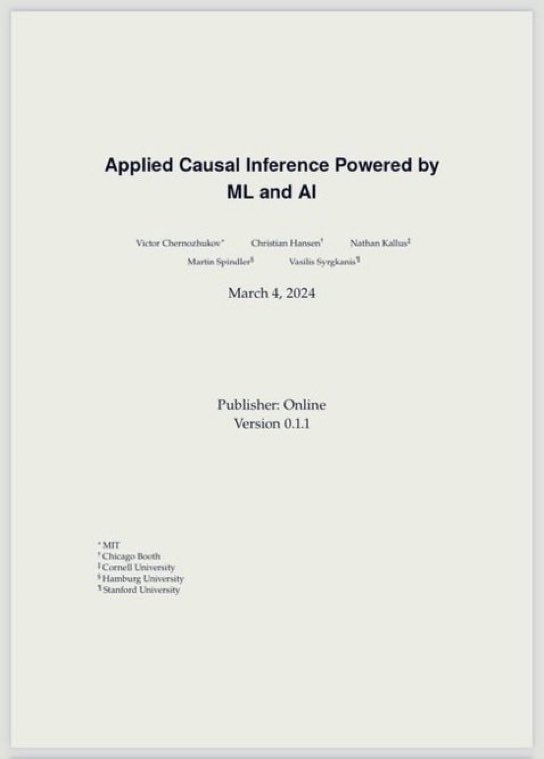
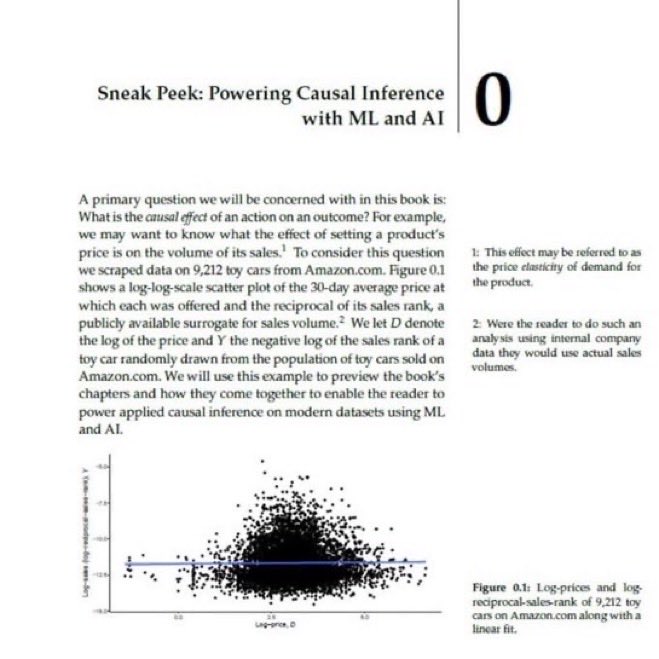
Updated 2204-page PDF Mathematics ebook:
"Algebra, Topology, Differential Calculus, and Optimization Theory For Computer Science and Machine Learning"
Find it here: cis.upenn.edu/~jean/gbooks/g…
140K GITHUB STARS. THREE MONTHS.
While most people are still copy-pasting into ChatGPT every single morning, this stack stopped needing that entirely.
Hermes plus Obsidian plus NotebookLM. It writes its own skills the moment it catches a repeated pattern. It maps your knowledge into a real graph. It remembers what you taught it last week without you saying a word.
One local setup. Zero re-briefing, ever.
Bookmark this now.
China open-sourced a peanut-sized OCR that parses entire 100-page PDFs in one shot..
It's called Unlimited-OCR. Only 3B params. Runs locally.
Every other OCR tool chops your doc into pages and loses the thread. this one reads the whole thing in a single pass.
→ One-shot "long-horizon" parsing (32K context window)
→ Multilingual, out of the box
→ 93% on the standard parsing benchmark (+6 over baseline)
→ <0.11 error rate past 40 pages
→ Runs 100% locally on your own hardware
→ Works with Transformers, vLLM, SGLang, Docker, Ollama, llama.cpp
Traditional cloud OCR (Textract, Google Vision, Azure Doc Intelligence) costs $1.50–$15 per 1,000 pages.
This runs on your machine. For free. Forever.
Baidu built it explicitly to push DeepSeek-OCR one step further. Already at 1.9M downloads on Hugging Face and most people have no idea it exists yet.
100% open source.
Connections between individuals scale nonlinearly in fully linked groups.
A sequence of complete graphs starts with 3 people and 3 lines, then 4 people and 6 lines, building up to 14 people and 91 lines.
The line totals follow the formula n(n-1)/2 exactly.
Total handshakes in a room full of people or the connection requirements in a complete social or computer network can be determined by it.
"Solving Mathematical Problems: A Personal Perspective," by Terence Tao
╰┈➤amzn.to/4fDBK4e
Amazon summary: "Authored by the leading name in mathematics, this engaging and clearly presented text leads the reader through the various tactics involved in solving mathematical problems at the Mathematical Olympiad level. Covering number theory, algebra, analysis, Euclidean geometry, and analytic geometry, Solving Mathematical Problems includes numerous exercises and model solutions throughout. Assuming only a basic level of mathematics, the text is ideal for students of 14 years and above in pure mathematics."
Quantum mechanics uses specialized symbols to describe the behavior of matter and energy at microscopic scales.
An alphabetical guide highlights core concepts like angular momentum, bound states, the fine structure constant 1/137, photon energy hν, the Schrödinger equation EΨ=ĤΨ, reduced mass mM/(M+m), Laplacian ∇², and uncertainty ΔxΔp.
These ideas are used to build the transistors in every computer chip and the lasers in fiber optic networks that connect the world.
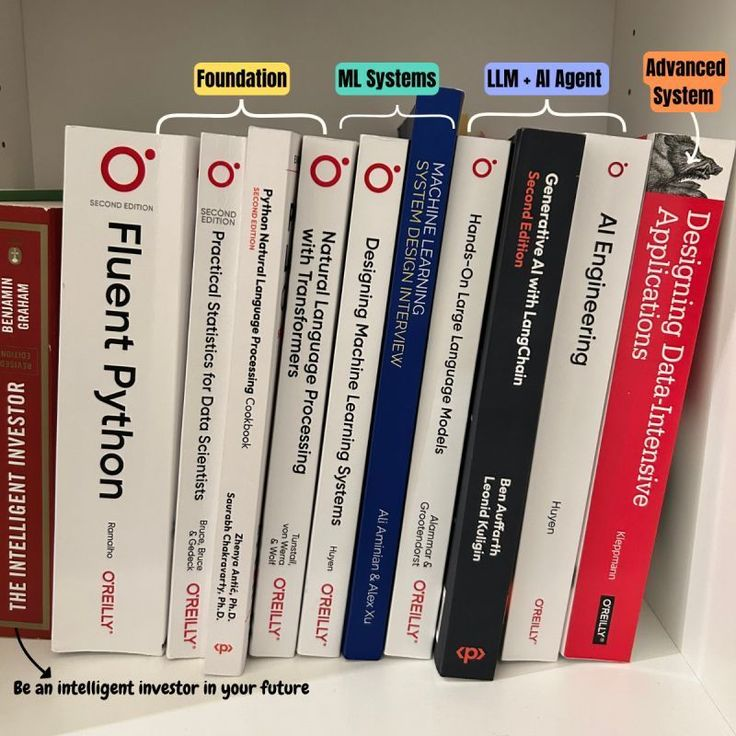
You only need to read four books to truly get what’s going on in data science and AI:
• Designing Machine Learning Systems by Chip Huyen
• AI Engineering by Chip Huyen
• Practical Statistics for Data Scientists by Peter Bruce, Andrew Bruce, and Peter Gedeck
• Hands-On Machine Learning with Scikit-Learn, Keras, and TensorFlow by Aurélien Géron
If you read these four technical books and then read these four books on business value and leadership, you’ll be well on your way to career success:
• The Lean Startup
• Good Strategy Bad Strategy
• The First 90 Days
• The Hard Thing About Hard Things
Any more you'd add?
The circular diagram presents the C major scale, its seven diatonic triads (I–vii°), and the corresponding relative modes in a single, integrated view. At its center lies C, from which the primary triads radiate outward:
CM (I), Dm (ii), Em (iii), FM (IV), GM (V), Am (vi), and Bdim (vii°),
each formed by stacking every other note of the C–D–E–F–G–A–B scale. Encircling these are the seven modes:
Ionian, Dorian, Phrygian, Lydian, Mixolydian, Aeolian, and Locrian
aligned with their respective parent roots and annotated with their characteristic scale degrees and interval patterns.
This unified layout enables musicians to quickly visualize harmonic relationships, making it a practical reference for composition, improvisation, modulation, and transposition across keys.
Marvin Minsky, MIT professor and father of artificial intelligence:
"Anthropic pays engineers $900K to build multi-agent AI systems. The blueprint is 40 years old, from an MIT professor who proved intelligence is just a swarm of dumb specialists."
the thread above shows you how to turn one AI into a team of specialized agents, each with its own job and memory, all managed by a boss. brilliant. it is also marvin minsky's 1986 theory of how your own mind works.
minsky's whole idea was that intelligence is not one smart thing. it is a society of tiny, mindless agents, each doing a single dumb job, none of them intelligent alone. put enough of them together under a few managers and intelligence emerges. that is not a metaphor for the claude trick. it is the claude trick.
so when you spin up specialized sub-agents and delegate, you are not inventing a new hack. you are rebuilding the architecture minsky described forty years ago, the same one your brain has run your entire life. he co-founded the field, taught it at MIT, and left it all in this free lecture. same story i keep telling: the "new" AI trick is usually an old idea in a new wrapper.
here is the part the thread skips, and minsky knew it. a society of agents is only as good as how you organize it. one dumb specialist is useless. a thousand, badly managed, is chaos. the edge was never spawning the agents. it is the orchestration, knowing which specialist to call, when, and how to combine their answers. the tool is free. the judgment is the whole game.
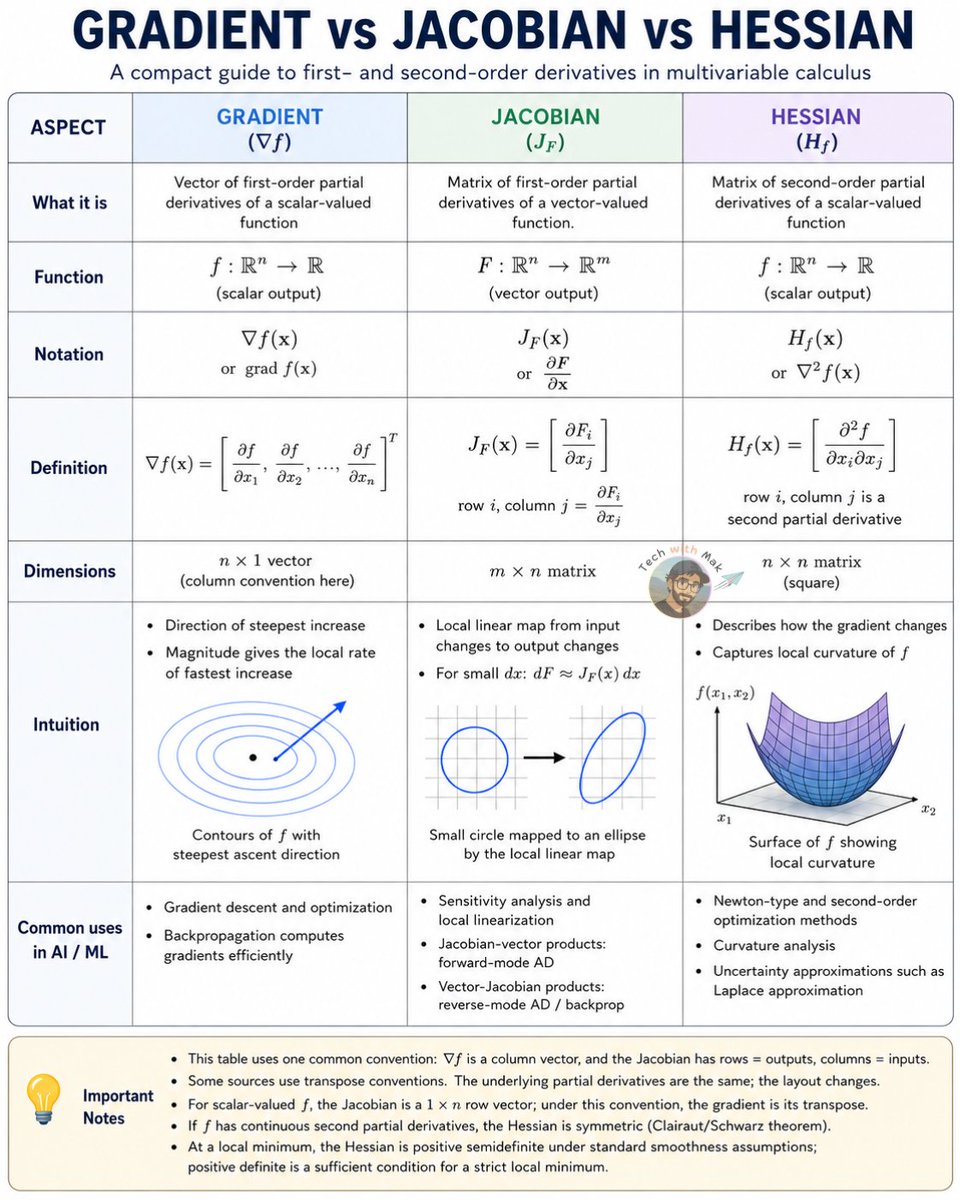
This math sits underneath every AI model being trained right now.
Gradient. Jacobian. Hessian.
Three words that look intimidating at first.
But they are really just three ways of measuring change.
𝟭. 𝗚𝗿𝗮𝗱𝗶𝗲𝗻𝘁 ∇f
Takes a scalar function:
f : ℝⁿ → ℝ
Returns a vector of first-order partial derivatives.
It answers:
"Which direction makes f increase fastest?"
That is why gradients are central to optimization.
Gradient descent moves in the opposite direction because the gradient points uphill.
Backpropagation efficiently computes gradients during training.
𝟮. 𝗝𝗮𝗰𝗼𝗯𝗶𝗮𝗻 J_F
Takes a vector-valued function:
F : ℝⁿ → ℝᵐ
Returns an m × n matrix of first-order partial derivatives.
It answers:
"How does each output change with each input?"
The Jacobian is the local linear map of a vector-valued function.
It shows up in:
→ sensitivity analysis
→ change of variables
→ automatic differentiation
→ forward-mode AD
→ reverse-mode AD / backpropagation
In simple terms:
forward-mode AD uses Jacobian-vector products.
reverse-mode AD uses vector-Jacobian products.
𝟯. 𝗛𝗲𝘀𝘀𝗶𝗮𝗻 H_f
Takes a scalar function:
f : ℝⁿ → ℝ
Returns an n × n matrix of second-order partial derivatives.
It answers:
"How does the gradient itself change?"
That means the Hessian measures curvature.
When the second partial derivatives are continuous, the Hessian is symmetric.
At a critical point:
→ positive definite Hessian → strict local minimum
→ negative definite Hessian → strict local maximum
→ indefinite Hessian → saddle point
The clean mental model
Gradient = first derivatives of one output
→ tells you direction
Jacobian = first derivatives of many outputs
→ tells you sensitivity
Hessian = second derivatives of one output
→ tells you curvature
And the relationship between them is simple:
The Hessian is the Jacobian of the gradient.
For a scalar output, the Jacobian contains the same partial derivatives as the gradient, up to row/column convention.
Same idea:
measure change.
Different object:
direction, sensitivity, curvature.
Once this clicks, optimization stops looking like a pile of formulas.
It starts looking like a map of the problem.
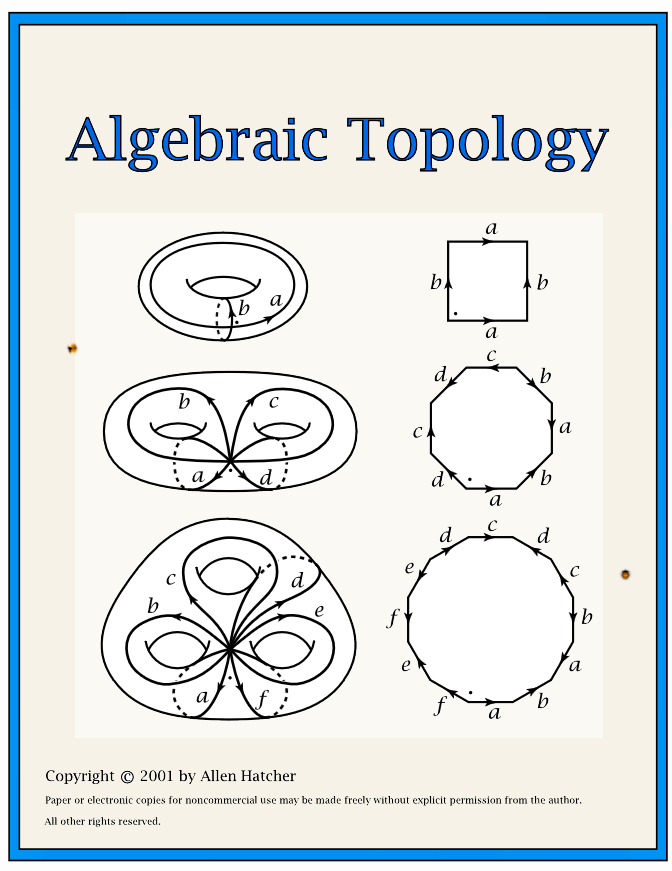
FREE Math Book. 560 pages.
"Algebraic Topology" by Hatcher.
"A readable introduction to algebraic topology with rather broad coverage of the subject.... The geometry of algebraic topology is so pretty, it would seem a pity to slight it and to miss all the intuition it provides." This classic resource is used in academic settings around the world.
**Chapter 0. Some Underlying Geometric Notions**
Homotopy and Homotopy Type
Cell Complexes
Operations on Spaces
Two Criteria for Homotopy Equivalence
The Homotopy Extension Property
**Chapter 1. The Fundamental Group**
1.1. Basic Constructions
Paths and Homotopy
The Fundamental Group of the Circle
Induced Homomorphisms
1.2. Van Kampen’s Theorem
Free Products of Groups
The van Kampen Theorem
Applications to Cell Complexes
1.3. Covering Spaces
Lifting Properties
The Classification of Covering Spaces
Deck Transformations and Group Actions
**Additional Topics**
1.A. Graphs and Free Groups
1.B. K(G,1) Spaces and Graphs of Groups
**Chapter 2. Homology**
2.1. Simplicial and Singular Homology
∆ Complexes
Simplicial Homology
Singular Homology
Homotopy Invariance
Exact Sequences and Excision
The Equivalence of Simplicial and Singular Homology
2.2. Computations and Applications
Degree
Cellular Homology
Mayer-Vietoris Sequences
Homology with Coefficients
2.3. The Formal Viewpoint
Axioms for Homology
Categories and Functors
**Additional Topics**
2.A. Homology and Fundamental Group
2.B. Classical Applications
2.C. Simplicial Approximation
**Chapter 3. Cohomology**
3.1. Cohomology Groups
The Universal Coefficient Theorem
Cohomology of Spaces
3.2. Cup Product
The Cohomology Ring
A Künneth Formula
Spaces with Polynomial Cohomology
3.3. Poincaré Duality
Orientations and Homology
The Duality Theorem
Connection with Cup Product
Other Forms of Duality
**Additional Topics**
3.A. Universal Coefficients for Homology
3.B. The General Künneth Formula
3.C. H–Spaces and Hopf Algebras
3.D. The Cohomology of SO(n)
3.E. Bockstein Homomorphisms
3.F. Limits and Ext
3.G. Transfer Homomorphisms
3.H. Local Coefficients
**Chapter 4. Homotopy Theory**
4.1. Homotopy Groups
Definitions and Basic Constructions
Whitehead’s Theorem
Cellular Approximation
CW Approximation
4.2. Elementary Methods of Calculation
Excision for Homotopy Groups
The Hurewicz Theorem
Fiber Bundles
Stable Homotopy Groups
4.3. Connections with Cohomology
The Homotopy Construction of Cohomology
Fibrations
Postnikov Towers
Obstruction Theory
**Additional Topics**
4.A. Basepoints and Homotopy
4.B. The Hopf Invariant
4.C. Minimal Cell Structures
4.D. Cohomology of Fiber Bundles
4.E. The Brown Representability Theorem
4.F. Spectra and Homology Theories
4.G. Gluing Constructions
4.H. Eckmann-Hilton Duality
4.I. Stable Splittings of Spaces
4.J. The Loopspace of a Suspension
4.K. The Dold-Thom Theorem
4.L. Steenrod Squares and Powers
**Appendix**
Topology of Cell Complexes
The Compact-Open Topology
The Homotopy Extension Property
Simplicial CW Structures
Link: pi.math.cornell.edu/~hatcher/AT/AT…
Download 698-page PDF eBook…
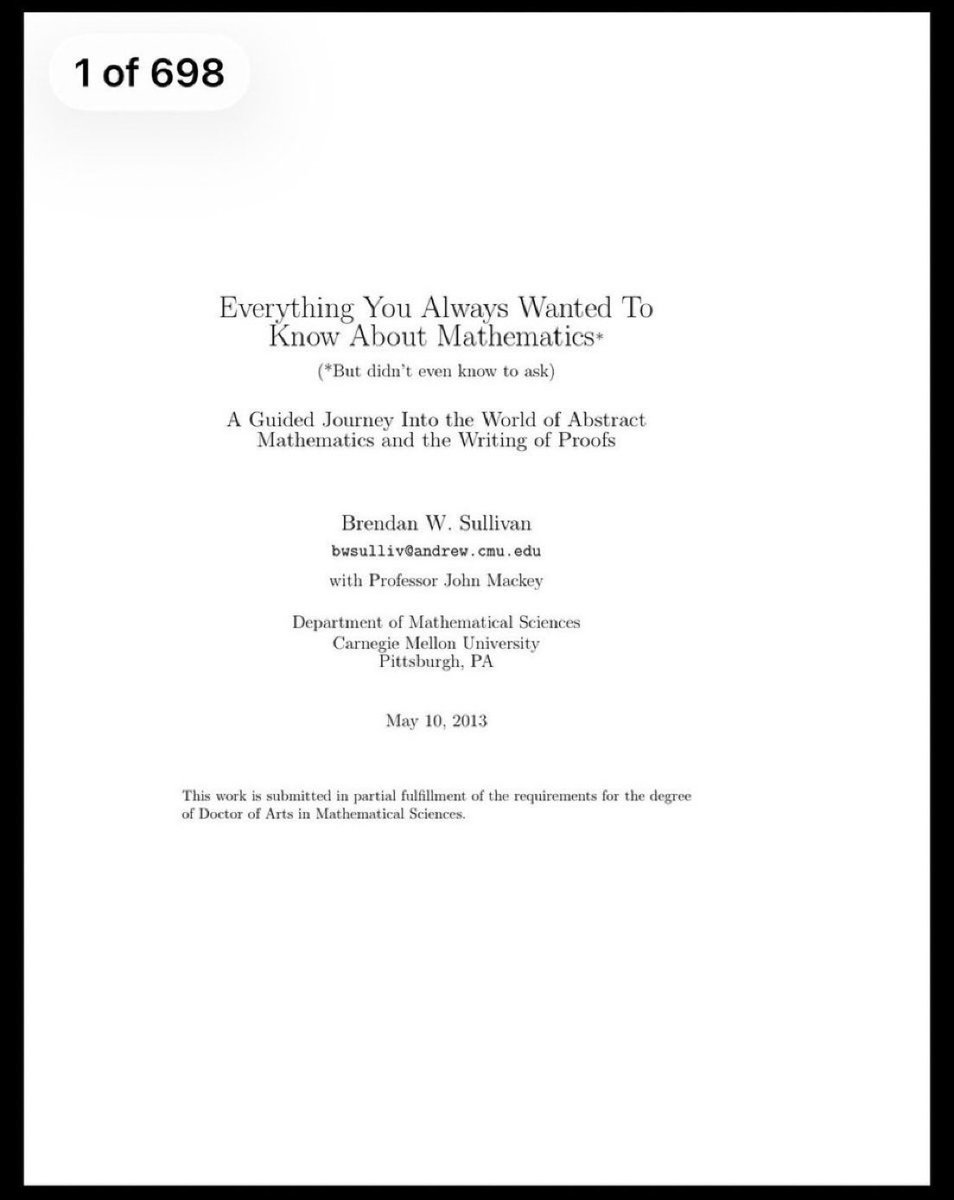
Everything You Always Wanted To Know About Mathematics* (*But didn’t even know to ask)
A Guided Journey Into the World of Abstract Mathematics, Theorems, and the Writing of Proofs: math.cmu.edu/~jmackey/151_1…
YOU CAN BUILD AN AI SECOND BRAIN IN 15 MINUTES.
No coding experience. No $1000 course.
Here is the entire setup.
Step 1: Download Claude Desktop.
Step 2: Download Obsidian.
Step 3: Create a new vault and start dropping .MD files into it.
Step 4: Tell Claude Code to connect to your vault using Karpathy's prompt: gist.github.com/karpathy/442a6…
That is it.
Your entire knowledge base becomes searchable, connectable, and queryable by the most powerful AI model on earth.
Every note you have ever written.
Every idea you have ever captured.
Every resource you have ever saved.
Claude reads all of it, finds connections you missed, and surfaces insights from your own thinking that you FORGOT you had.
Most people use Claude as a search engine.
The people building second brains use it as an INTELLIGENCE LAYER on top of everything they know.
That gap is the gap between asking Google a question and having a research partner who has read everything you have ever written.
Bookmark this.
Build it tonight. Follow @cyrilXBT
Google just dropped a 1-hour course on agentic engineering from scratch:
00:00 - Build your first AI agent
08:24 - Give your agent real memory (short, persistent, long)
28:34 - Agentic loops that run for hours on their own
40:04 - Build your own MCP (MCP VS API)
1:00:22 - Wire up multi-agent systems
72 minutes and you'll understand agents better than most people building them.
Watch it today, then read the step by step guide for beginners on building loops below.