Desi Walter White

1.9K posts

Desi Walter White banner
Desi Walter White

Desi Walter White

@codetheworld909

Antarctica Katılım Mart 2023
379 Takip Edilen25 Takipçiler
Desi Walter White retweetledi

Akshay 🚀
Akshay 🚀@akshay_pachaar·
Claude Code isn't a coding tool. (It's a programmable dev environment) Engineers open it, type a prompt, and let it write code. But the real leverage is in the system around the prompt. Here are 12 features that make Claude Code programmable: 𝟭) 𝗖𝗟𝗔𝗨𝗗𝗘.𝗺𝗱: The project's persistent memory. Stack details, conventions, and constraints load automatically at every session start. 𝟮) 𝗥𝘂𝗹𝗲𝘀: Behavioral guardrails beyond 𝗖𝗟𝗔𝗨𝗗𝗘.𝗺𝗱. Project-wide do's and don'ts that apply across sessions and contributors. 𝟯) 𝗦𝗸𝗶𝗹𝗹𝘀: Reusable instruction files stored in .claude/skills/. Write once, and Claude follows them automatically every time the task matches. 𝟰) 𝗛𝗼𝗼𝗸𝘀: Shell scripts that fire on events like PreToolUse and PostToolUse. Auto-lint, run tests, or validate output without manual intervention. 𝟱) 𝗦𝗹𝗮𝘀𝗵 𝗖𝗼𝗺𝗺𝗮𝗻𝗱𝘀: Workflow shortcuts stored in .claude/commands/. Multi-step flows triggered with a single keystroke. 𝟲) 𝗣𝗹𝘂𝗴𝗶𝗻𝘀: Bundles of skills, hooks, commands, and MCP servers packaged into one installable unit. Over 100 official plugins are in the marketplace today. 𝟳) 𝗠𝗖𝗣: Connects Claude to databases, APIs, and external services. This is how it gets real-world access beyond the codebase. 𝟴) 𝗣𝗹𝗮𝗻 𝗠𝗼𝗱𝗲: Claude drafts a step-by-step plan before touching any code. Approve or reject before anything runs. 𝟵) 𝗣𝗲𝗿𝗺𝗶𝘀𝘀𝗶𝗼𝗻𝘀: Whitelist or block specific tools on a per-session basis. Non-negotiable for anything production-facing. 𝟭𝟬) 𝗦𝘂𝗯𝗮𝗴𝗲𝗻𝘁𝘀: Spawn parallel Claude instances that divide and conquer multi-step workflows simultaneously. 𝟭𝟭) 𝗩𝗼𝗶𝗰𝗲 𝗠𝗼𝗱𝗲: Talk to Claude hands-free via /voice. Push-to-talk with the spacebar, and the command goes straight to the input field. 𝟭𝟮) 𝗥𝗲𝘄𝗶𝗻𝗱: Step back to any checkpoint in the session and restart cleanly from that point. Features 1-5 define the environment. 6-7 extend it. 8-9 control it. 10-12 change how it runs. That framing matters because the gap between using Claude Code as a chatbot and using it as a programmable system is enormous. 𝗖𝗟𝗔𝗨𝗗𝗘.𝗺𝗱 + Skills + Hooks alone can automate half the repetitive decisions in a codebase. If you want to go deeper, I wrote a detailed article covering the anatomy of the .claude/ folder, a complete guide to 𝗖𝗟𝗔𝗨𝗗𝗘.𝗺𝗱, hooks, skills, subagents, and permissions, and how to set them all up properly. The article is quoted below.
Akshay 🚀 tweet media
Akshay 🚀@akshay_pachaar

x.com/i/article/2034…

English
26
51
303
31K
Desi Walter White retweetledi
Anuj
Anuj@anujcodes_21·
🚨 Anthropic just showed a 27-minute workshop on how to actually do prompts for Claude. Taught by the people who built it. Free. No registration. No paywall. I've seen $300 courses that don't cover what they teach in the first 8 minutes. Watch it and bookmark it now.
English
84
1.5K
10.2K
1.4M
Desi Walter White retweetledi
Brij Pandey
Brij Pandey@LearnWithBrij·
Most people use Claude Code like autocomplete. But Claude Code is actually a full agent operating system. And most engineers are only using Layer 1. Here’s the architecture nobody explains properly: 🧠 Layer 1 — CLAUDE.md This is the agent’s constitution. Your: → architecture rules → coding standards → repo structure → naming conventions → workflows All live here. Always loaded. Always active. This is what turns Claude from “generic AI” into “your engineering team’s AI.” 📚 Layer 2 — Skills Reusable expertise modules. Claude dynamically loads the right SKILL.md only when needed. That means: → cleaner context → lower token usage → specialized execution → less hallucination The important part most people miss: Skills can fork into isolated subagents. So your main context stays clean while deep tasks execute separately. This is where Claude starts feeling agentic instead of conversational. 🛡️ Layer 3 — Hooks The most underrated layer in the stack. Hooks are deterministic infrastructure triggers: → PreToolUse → PostToolUse → SessionStart → Stop This is NOT AI reasoning. It’s programmable guardrails. Examples: → auto-run linting → block dangerous bash commands → enforce repo policies → send Slack notifications → auto-format outputs → inject runtime context Production reliability happens here. Most teams skip this layer completely. Huge mistake. 🤝 Layer 4 — Subagents This is where Claude Code becomes a true multi-agent system. Delegate tasks downward. Receive results upward. Each subagent gets: → isolated context → separate tools → different permissions → independent models No context bleed. No recursive chaos. Hard boundaries by design. You stop thinking: “One AI assistant” And start thinking: “Distributed cognitive workers.” 📦 Layer 5 — Plugins The distribution layer. Bundle: → skills → hooks → commands → agents → workflows into one installable package. One command: Entire team inherits the same behavior instantly. This is how organizations operationalize agentic engineering. Not prompts. Infrastructure. The gap between: “AI demo” and “Production-grade agent system” is usually one of these five layers. Most people are still prompting. A few are engineering cognition. That’s the real shift happening right now. Follow for deep dives on Claude Code, MCP, Hooks, multi-agent systems, and agentic AI architecture.
Brij Pandey tweet media
English
15
107
482
14K
Desi Walter White retweetledi
Shraddha Bharuka
Shraddha Bharuka@BharukaShraddha·
AI AGENTS MASTER TREE AI AGENTS + AUTOMATION + AGENTIC AI MASTER TREE │ ├── 1. Agent Foundations │ ├── What is an AI Agent │ ├── Agent vs Workflow │ ├── Single-Agent Systems │ ├── Multi-Agent Systems │ └── Agentic AI Concepts │ ├── 2. LLM Fundamentals │ ├── Transformer Architecture │ ├── Context Windows │ ├── Tokenization │ ├── Inference & Sampling │ └── Fine-Tuning Basics │ ├── 3. Prompt Engineering │ ├── Zero-shot Prompting │ ├── Few-shot Prompting │ ├── Chain of Thought │ ├── Structured Output │ └── Prompt Optimization │ ├── 4. Memory Systems │ ├── Short-Term Memory │ ├── Long-Term Memory │ ├── Vector Memory │ ├── Semantic Retrieval │ └── Persistent Context │ ├── 5. RAG (Retrieval-Augmented Generation) │ ├── Embeddings │ ├── Chunking Strategies │ ├── Vector Databases │ ├── Hybrid Search │ └── Retrieval Pipelines │ ├── 6. AI Agent Frameworks │ ├── LangChain │ ├── LangGraph │ ├── CrewAI │ ├── AutoGen │ └── OpenAI Agents SDK │ ├── 7. Tool Calling & MCP │ ├── Function Calling │ ├── APIs & Integrations │ ├── MCP Servers │ ├── Browser Automation │ └── External Tool Execution │ ├── 8. Autonomous Workflows │ ├── Planning Agents │ ├── Task Decomposition │ ├── Reflection Loops │ ├── Self-Correction │ └── Workflow Orchestration │ ├── 9. AI Coding Agents │ ├── Claude Code │ ├── Cursor │ ├── Codex │ ├── Windsurf │ └── Repo-Aware Agents │ ├── 10. Agent Memory Architecture │ ├── CLAUDE.md │ ├── Skills System │ ├── Hooks & Guardrails │ ├── Subagents │ └── Session Persistence │ ├── 11. Voice & Multimodal Agents │ ├── Speech-to-Text │ ├── Text-to-Speech │ ├── Vision Models │ ├── Realtime AI │ └── Multimodal Reasoning │ ├── 12. AI Agent Deployment │ ├── FastAPI │ ├── Docker │ ├── Cloud Deployment │ ├── Serverless Agents │ └── Scalable Infrastructure │ ├── 13. Observability & Evaluation │ ├── Agent Monitoring │ ├── Logging & Tracing │ ├── Hallucination Detection │ ├── Eval Frameworks │ └── Performance Optimization │ ├── 14. Real-World AI Agents │ ├── Research Agents │ ├── Coding Copilots │ ├── Customer Support Agents │ ├── AI SDRs │ └── Autonomous Browsing Agents │ └── 15. Career Path ├── AI Automation Engineer ├── AI Agent Developer ├── Prompt Engineer ├── GenAI Engineer └── Agentic AI Architect
Shraddha Bharuka tweet media
English
14
22
137
3.5K
Desi Walter White retweetledi
Black Hat
Black Hat@BlackHatEvents·
Discover what's next in cybersecurity. Debate what's claimed. Deploy what works. Black Hat USA, August 1–6. Super Early Bird pricing ends May 22nd — largest savings available. One Step Ahead.
English
0
21
206
144.2K
Desi Walter White retweetledi
R𝛼m🦅
R𝛼m🦅@rambuilds_·
15 AI related accounts you should follow on Twitter: 1. @karpathy His tweets already create LLMs narratives that you later see on linkedin in 2 months. 2. @fchollet posts thoughtful research on intelligence, benchmarks, and AI limitations. Keras creator + ARC-AGI 3. @ylecun Yann LeCun is Deep learning pioneer & Meta Chief AI Scientist; big-picture research takes and critiques (and drama). 4. @AndrewYNg Andrew Ng is AI education legend; practical ML advice, courses, and real-world implementation. creator of deeplearning ai 5 @rasbt Sebastian Raschka posts on Practical ML/LLM implementations, "build from scratch" tutorials, and books. 6. @dair_ai Weekly ML/AI paper threads and accessible research explainers (high-signal for staying current). 7. @lilianweng Lilian Weng is ex-OpenAI and her Lil'Log-style threads are good. has In-depth LLM research breakdowns 8. @jeremyphoward posts interesting takes on AI/crypto news, and works on democratizing practical deep learning and accessible education. 9. @simonw Simon post Practical LLM tools, takes, experiments, prompting, and engineering breakdowns. django co-founder 10. @_akhaliq Curates the latest arXiv papers, model releases, and open-source AI drops. 11. @ID_AA_Carmack AGI/low-level optimization takes that makes you think about the problem. 12. @gwern Really high-quality long-form AI research notes and essays. 13. @goodside LLM evaluation, prompting research, and real capabilities testing 14 @drfeifei Computer vision pioneer; human-centered AI and spatial intelligence research 15 @demishassabis Been following his work for 9 years. Demmis is my hope against google usurpating their power with AI. Demmis is google DeepMind's CEO Let me know who I missed guys and save it for future
English
72
254
2.2K
233.2K
Desi Walter White retweetledi
Akshay 🚀
Akshay 🚀@akshay_pachaar·
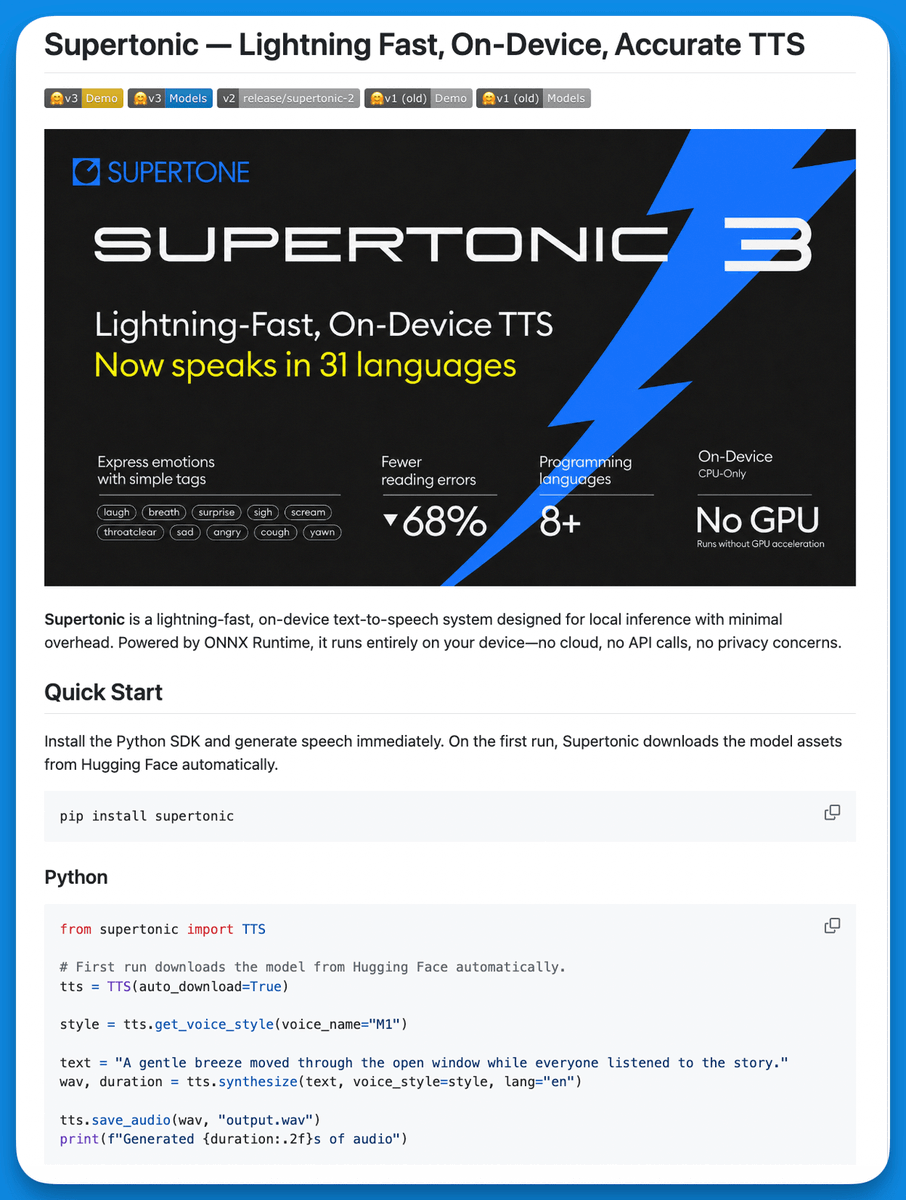
this TTS model generates speech 167x faster than you can hear it. Supertonic is an on-device TTS engine that runs via ONNX for cross-platform inference. - no GPU - 31 languages - captures every emotion - beats ElevenLabs on speed - runs even on a Raspberry Pi 100% open-source.
Akshay 🚀 tweet media
English
22
104
716
43.3K
Desi Walter White retweetledi
Vivek | Cybersecurity
Vivek | Cybersecurity@VivekIntel·
🐧 Linux Kernel is C 🌐 Nginx is C 🚀 Redis is C 🗄️ PostgreSQL core is C 🧠 SQLite is C 🔒 OpenSSL is C 📦 Git is C ⚡ Memcached is C 🧵 libuv is C 📡 TCP/IP stack is C 🖥️ X11 Window System is C 🧰 GNU Coreutils are C 🛠️ GCC is C 🧬 CPython runtime is C 📁 ext4 / NTFS file systems are C 🎮 Game engine foundations are C 🚗 Embedded firmware is C 📟 Networking drivers are C 🛰️ Aerospace & real-time systems are C 💳 Payment terminals run C The foundation of operating systems, databases, networking, crypto, and embedded systems is written in C. Trends come and go. C stays.
English
1
5
51
2.4K
Desi Walter White retweetledi
Vivek | Cybersecurity
Vivek | Cybersecurity@VivekIntel·
🔥 Red Team & Ethical Hacking PDF Collection — From Exploitation to Offensive Security (Red Teaming • API Hacking • Kali Linux • Privilege Escalation • Phishing • SSH Hardening • Password Cracking • Cyber Warfare) This collection includes practical Red Team and Offensive Security resources: • Hacking: The Art of Exploitation • Hands-On Hacking • Red Team Guides & RTFM Manuals • API Hacking & Web Exploitation • Kali Linux & Penetration Testing • Privilege Escalation (Windows/Linux) • SSH Hardening & Offensive Mastery • Password Cracking Techniques • MFA & Authentication Attacks • Phishing & Social Engineering • Cloud Attack Vectors • Cyber Warfare & Red Team Operations If you actually want Red Team skills, focus on: • Linux + Networking fundamentals • Bash/Python scripting • Web security basics • Active Directory fundamentals • Enumeration methodology • CTFs + Labs + HTB/TryHackMe • Writing reports and documenting findings Otherwise you become another “tool-only hacker” who freezes in real assessments. 📥 Free Red Team PDF Collection: drive.google.com/drive/mobile/f… #RedTeam #EthicalHacking #CyberSecurity #KaliLinux #Pentesting #BugBounty #PrivilegeEscalation #APIHacking
Vivek | Cybersecurity tweet mediaVivek | Cybersecurity tweet mediaVivek | Cybersecurity tweet mediaVivek | Cybersecurity tweet media
English
2
35
142
4.5K
Desi Walter White retweetledi
Avid
Avid@Av1dlive·
Cursor pays engineers $1,100,000 a year to run teams of AI agents that ship code while they sleep. [The CEO of Cursor explained in 9 minutes how they ship at 100x speed using team of agents] ↓ Save this before everyone copies the playbook 1. Engineers no longer babysit one assistant. They manage dozens of agent colleagues working in parallel, each on its own remote machine 2. Validation contract before code, not after. Humans only at scoping and review. 3. The agent team handles the full loop : planning, coding, testing, shipping PRs with each agent specialised for a role. Watch the guide. Then read the guide below by @eng_khairallah1
Khairallah AL-Awady@eng_khairallah1

x.com/i/article/2054…

English
96
213
2.4K
621.4K
Desi Walter White retweetledi
Anish Moonka
Anish Moonka@anishmoonka·
A software engineer at Atlassian got laid off in March after 8 years. His response: a 38-minute YouTube video showing how the company's entire tech works, free for anyone to copy. That same quarter, Atlassian's revenue hit $1.79 billion, a record. His name is Vasilios Syrakis. He worked in Sydney on Atlassian's digital plumbing: the system that handles the company's web traffic, made up of about 2,000 programs running across 13 regions of the world. Every time someone clicks on Atlassian's software, the system Syrakis worked on decides which of those servers answers. Atlassian's own engineering blog wrote about his team's work in February 2025. On Sunday, Syrakis walked through the whole architecture on YouTube, every box on the diagram. The financial picture doesn't fit the layoff story. Atlassian's cloud business grew 29% year over year last quarter. The company has 350,000 customers, including 80% of the Fortune 500. None of that looks like a company that needs to cut a tenth of its staff to "self-fund AI investment," as the CEO put it in March. In the six months before the layoffs, CEO Mike Cannon-Brookes sold 866,145 of his own shares for roughly $134 million. Co-founder Scott Farquhar sold exactly the same number on the same schedule. The board also approved spending $2.5 billion to buy back Atlassian stock from the market, a move that props up the share price. The shares still fell 56% this year. Investors think AI lets companies do more work with fewer employees, and Atlassian charges its customers per employee. Sam Altman called this practice "AI washing" in February. Of the 1.2 million American jobs cut in 2025, only 55,000 blamed AI. The rest had different reasons, or none at all. The engineer who helped build Atlassian's plumbing is now teaching the internet how it works, for free, because he no longer has a paycheck to protect.
Ed Andersen@edandersen

Incredible video by randomly sacked Atlassian engineer telling all about the entire company Love this genre, like LinkedIn green banner with zero fcks given

English
68
805
8.6K
1.8M
Desi Walter White retweetledi
Alex Xu
Alex Xu@alexxubyte·
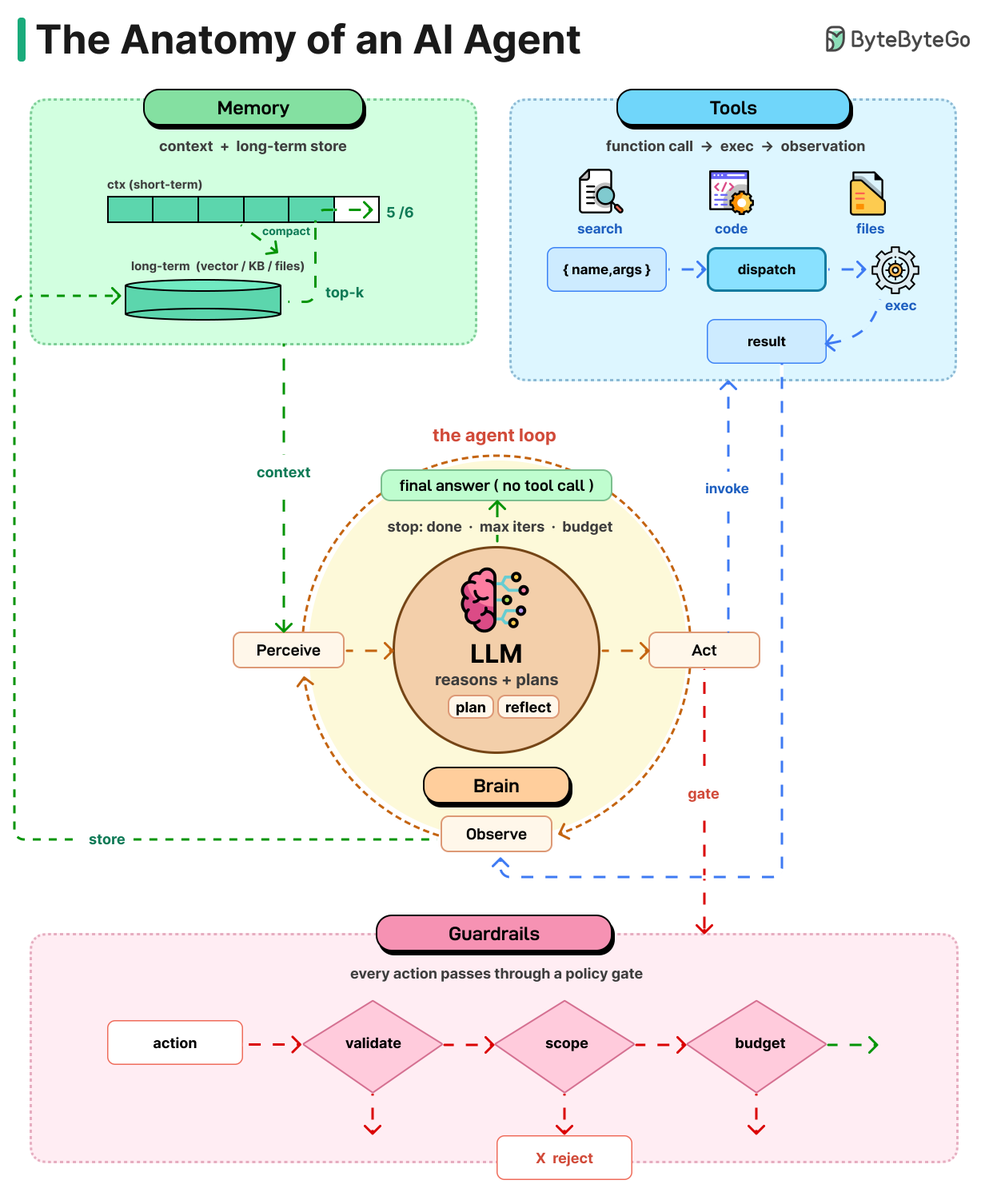
An AI agent can be thought of as a simple While-loop. It uses an LLM to select an action, executes that action, evaluates the result, and repeats the process until the task is complete. Let’s take a closer look at each of these components: Brain: The LLM is the core. It reads the situation, thinks, and decides what to do next. The big shift from chatbot to agent: the model isn't writing text anymore, it's making choices. Planning: Hard tasks need more than one step. Agents break them down using methods like Chain of Thought (think step by step), Tree of Thoughts (try options, pick the best), or Reflexion (learn from mistakes and retry). Planning turns a fuzzy goal into clear actions. Tools: An LLM without tools is a brain in a jar. Tools are functions the model can call, like web search, code execution, APIs, files, or browsers (often using the MCP standard). The model requests a tool, the system runs it, and the result comes back. Memory: Without memory, every turn starts from zero. Short-term memory is the context window. Long-term memory lives in vector stores, files, and knowledge bases. When the window fills up, agents summarize old turns and carry the summary forward. Loop: All four pieces work together in a cycle. The agent looks at the current state, decides what to do, uses a tool, sees the result, and repeats. It keeps going until it gives a final answer. Guardrails: Not strictly anatomy, but important. Sandboxing, human checks, token limits, output validation, and scope limits keep autonomy from turning into expensive chaos. The more autonomy you give, the more these matter. Over to you: when you build an agent, which of these five takes the most work to get right?
Alex Xu tweet media
English
29
139
712
101.6K
Desi Walter White retweetledi
Akshay 🚀
Akshay 🚀@akshay_pachaar·
Claude Code's architecture, mapped. Calude Code is one of the most powerful agent harnessed out there, it's a lot more than "a CLI that calls claude." the actual system has six layers, and the model is just one node inside the loop. the diagram breaks down every component: 𝗜𝗻𝗽𝘂𝘁 𝗟𝗮𝘆𝗲𝗿 handles session management, permission gating, and YAML-based trust tiers before anything reaches the model. 𝗞𝗻𝗼𝘄𝗹𝗲𝗱𝗴𝗲 𝗟𝗮𝘆𝗲𝗿 holds the skill registry, context compressor (3-layer, 92% threshold), task graph, and cross-session memory store. this is where harness intelligence lives outside the weights. 𝗘𝘅𝗲𝗰𝘂𝘁𝗶𝗼𝗻 𝗟𝗮𝘆𝗲𝗿 runs tool dispatch through a typed registry with one handler per tool. bash, read, write, grep, glob, revert. streaming runtime handles parallel execution. prompt cache reuses stable prefixes at 10% cost. 𝗜𝗻𝘁𝗲𝗴𝗿𝗮𝘁𝗶𝗼𝗻 𝗟𝗮𝘆𝗲𝗿 connects the MCP runtime to external servers. filesystem, git, custom. tools register inward, memory writes outward to agent_memory. md. 𝗠𝘂𝗹𝘁𝗶-𝗔𝗴𝗲𝗻𝘁 𝗟𝗮𝘆𝗲𝗿 is the most underappreciated piece. subagent spawner, teammate mailboxes over redis pub/sub, FSM protocol (IDLE→REQUEST→WAIT→RESPOND), autonomous board with atomic locks, and worktree isolation with per-task branches and conflict detection on merge. 𝗢𝗯𝘀𝗲𝗿𝘃𝗮𝗯𝗶𝗹𝗶𝘁𝘆 𝗟𝗮𝘆𝗲𝗿 wraps everything. event bus with lifecycle hooks, background executor running daemon threads non-blocking. the master agent loop sits at the center. perception → action → observation. it's deliberately simple. a "dumb loop" where the model reasons and the harness mediates. this is the architecture behind what feels like magic when you use claude code. it's not magic. it's harness engineering. the article below is a deep-dive covering how Anthropic, OpenAI, LangChain, and others build this pattern from the ground up.
Akshay 🚀 tweet media
Akshay 🚀@akshay_pachaar

x.com/i/article/2040…

English
30
150
706
90.9K
Desi Walter White retweetledi
Rishabh
Rishabh@Rixhabh__·
INSTEAD OF WATCHING NETFLIX TONIGHT. Spend 2 hour with this. Claude AI FULL COURSE that teaches you how to BUILD and AUTOMATE anything. Watch it and Bookmark it now.
English
17
142
835
137K