@nicolasmelo @samsantosb Zero alucinação é o novo zero downtime. Praticamente impossível
Português
Marcão
1.1K posts

@codewriterr
Escrevendo bugs para garantir o pão de cada dia desde 2010

“design a RAG pipeline for 10M docs with zero hallucination” apparently this was asked in a Google L5 interview round. came across it somewhere on the internet and honestly it’s a way more interesting system design problem than most classic distributed systems questions 1. ingest + normalize docs - remove duplicates, standardize formats, extract metadata, maintain version history 2. hybrid retrieval (BM25 + embeddings) - BM25 handles exact keyword matching while embeddings capture semantic meaning - semantic search alone usually struggles with precision at massive scale 3. ANN retrieval + reranking - ANN (Approximate nearest neighbor ) quickly pulls top candidate chunks from millions of docs - then a reranker rescoring step improves relevance by deeply comparing query vs retrieved chunks 4. source confidence scoring - every retrieved chunk gets scored based on freshness, trust level, overlap and retrieval consistency - low-confidence context should never heavily influence generation 5. constrained generation - the model is only allowed to answer using retrieved context (nothing new to be invented outside of the retrieved context) 6. citation-backed responses - every major claim links back to exact chunks, documents or timestamps 7. hallucination fallback layer - if retrieval confidence drops below a threshold: “insufficient evidence found” 8. continuous evals - run adversarial queries, retrieval recall benchmarks and hallucination tests continuously 9. caching + memory layer - cache high-frequency enterprise queries and retrieval paths (improves latency and output) 10. observability everywhere - trace retrieval paths, chunk rankings, token attribution and failure points Also at 10M docs, retrieval quality matters more than the frontier model itself.


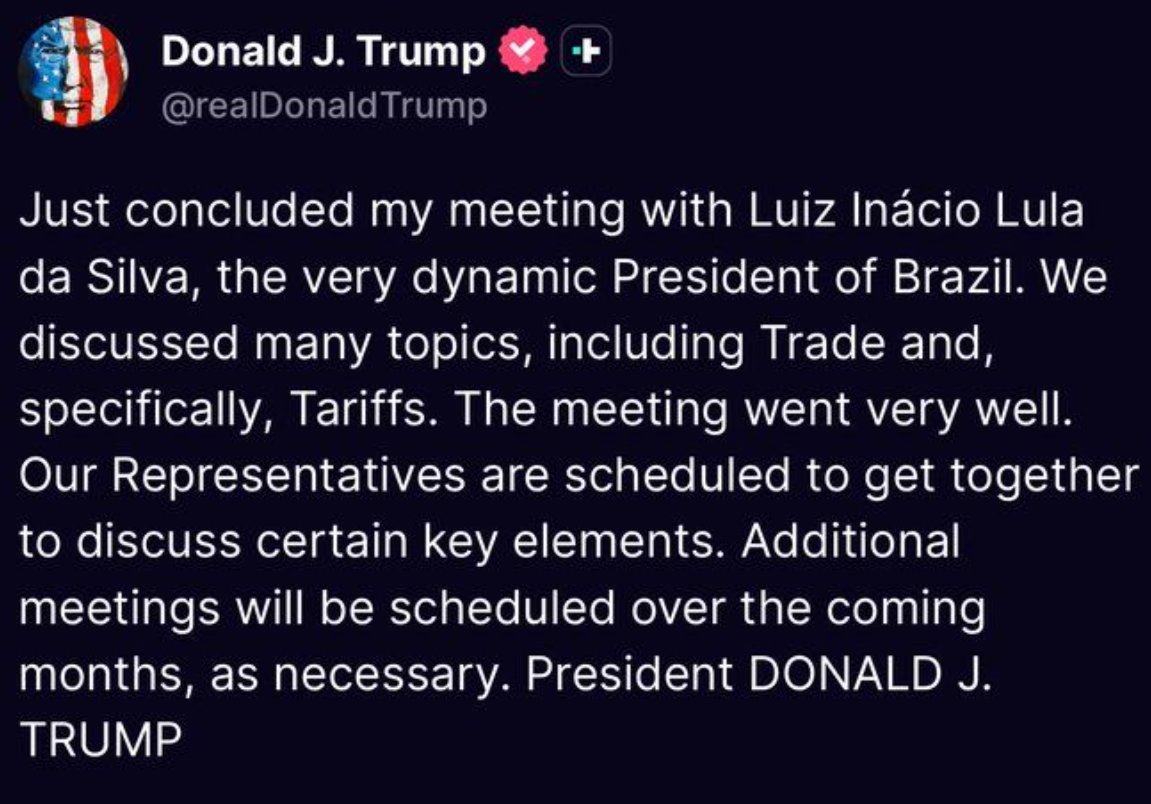
No day after: reunião entre Trump e Lula não rendeu capa nos jornais daqui. Destaque para o encontro entre Rubio e o Papa






Let us think more deeply about what is being said. Marc Andreessen: “Software isn’t precious anymore… high quality software is infinitely available.” (From a recent @pmarca interview) “We’ve always lived in a world in which software is this precious thing… Those days are just over. If you need new software… you’re just going to wave your hand and get it.” Andreessen is the man I like to quote: “software is eating the world.” Is Andreessen’s new model correct? I suspect reality today is closer to this: AI makes low-quality software nearly free. Your HR director can prompt an app and get something that works, somewhat. It may be as good as what Joe the intern produced ten years ago. It won’t be perfect, but it will look good from a distance. In many cases, it will be good enough. As a professor, I could always find a student to help with a project. It usually went like this: 1.I would prompt the student (“What if we did…”). 2.The student would produce something close to what I wanted. 3.I would prompt the student again… and so on. Eventually, if the student was good, the final code would mostly do what I wanted. In many cases, I would just throw it away or forget about it. Almost always, I ended up rewriting parts myself. I once met an entrepreneur who was jealous: “You professors get all this free labor while I have to hire and pay people.” Ah. How often did professors produce great software? Not often. As quality requirements increase, I believe the benefits of AI coding diminish. So I think Andreessen is incorrect. We are getting low-quality software for free, but not much more of the high-quality software we actually need. If you want to make a living writing software, you had better up your game. As for getting high-quality software for free? Color me skeptical.


This is big... Anthropic just announced a model so powerful they won't release it to the public out of fear over the damage it will cause 😨 Claude Mythos Preview found thousands of zero-day exploits in every major operating system and web browser... The numbers are hard to believe: > $50 to find a 27-year-old bug in OpenBSD, one of the most security-hardened operating systems ever built > Under $1,000 to find AND build a fully working remote code execution exploit on FreeBSD that grants unauthenticated root access from anywhere on the internet > Under $2,000 to chain together multiple Linux kernel vulnerabilities into a complete privilege escalation exploit For context: these are the kinds of findings that previously required elite security researchers working for weeks. Anthropic engineers with no formal security training asked Mythos to find exploits overnight. They woke up to working code the next morning. The results were so impressive Anthropic assembled Apple, Google, Microsoft, Amazon, NVIDIA, and seven other organizations into Project Glasswing: A $100M defensive coalition. They're not releasing this model publicly. Instead, they're racing to patch the world's infrastructure before models like this proliferate.


33 years 😮 Damn #OracleLayoffs

33 years 😮 Damn #OracleLayoffs

GENTE? Jonas fez uma publicação no Instagram distorcendo uma fala de Ana Paula Renault enquanto ela conversava com ele sobre Deus na casa do #BBB26. O post foi removido do perfil do ex-BBB horas depois, após receber diversas denúncias da torcida da jornalista.