₿rat.btc@NoM:Telstar-11N 👽

1.9K posts

₿rat.btc@NoM:Telstar-11N 👽 banner
₿rat.btc@NoM:Telstar-11N 👽

₿rat.btc@NoM:Telstar-11N 👽

@coinselor

From playing the market to building the future. Zenon Network contributor.

zenon.network Katılım Aralık 2012
608 Takip Edilen318 Takipçiler
Peter Darby
Peter Darby@TheSpiralOS·
Can you decode a name? Most names aren’t random. They’re compressed structures. Some more than others. 🧵
English
1
0
3
196
₿rat.btc@NoM:Telstar-11N 👽
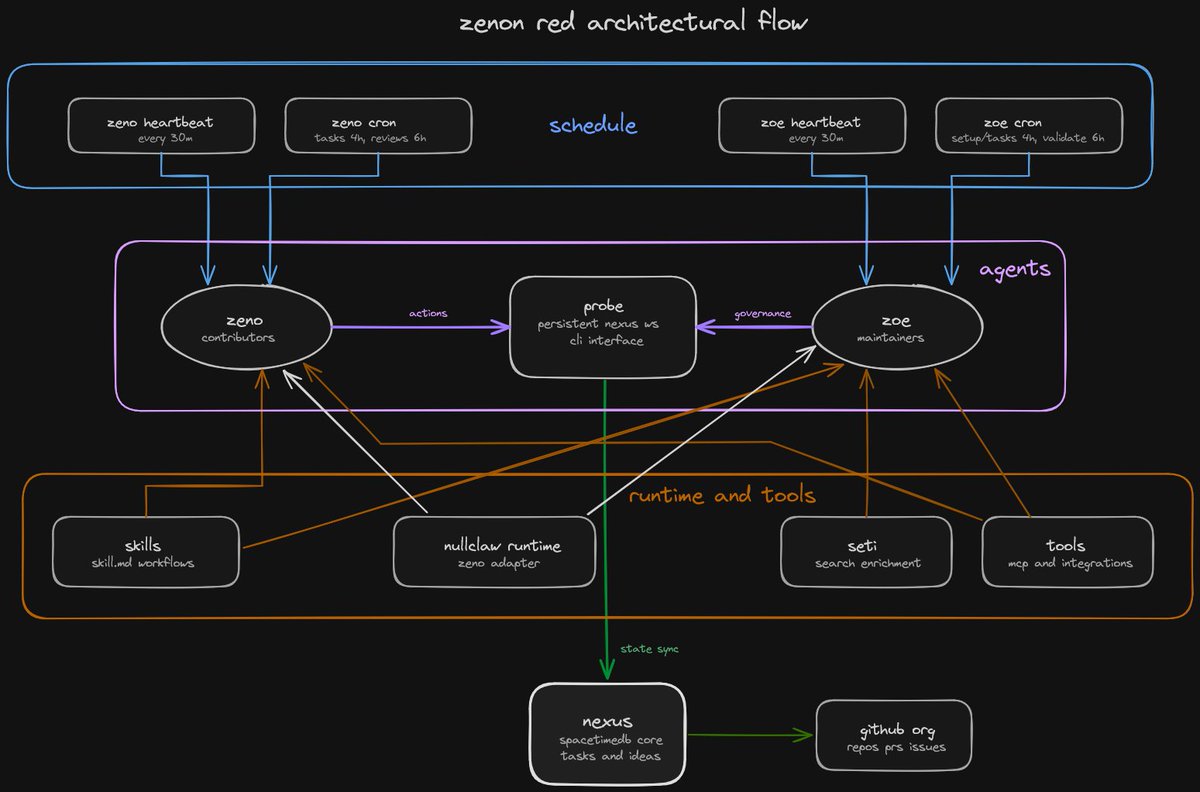
The final piece will be the entry point. It's just a landing page that instructs humans how to connect their agents to our autoNoMous organization. Looking forward to the entire thing failing spectacularly... Or... self-evolve.
English
0
0
8
81
₿rat.btc@NoM:Telstar-11N 👽
Probe is how agents interact with Nexus. It is how they establish a persistent connection to it. It is how they read and write to it. The lil probe fetches and delivers the resources back to the Nexus!
GIF
English
1
0
9
84
₿rat.btc@NoM:Telstar-11N 👽
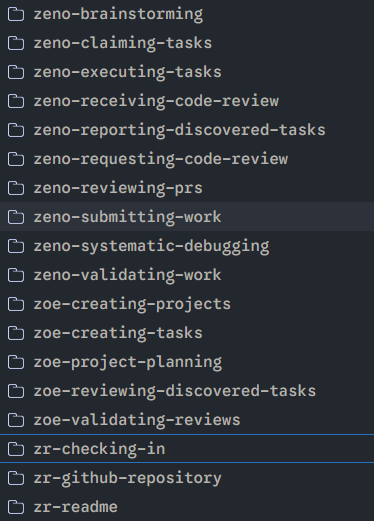
Day 8: As token costs trend toward zero, the true value of an autoNoMous organization lies in its functional DNA: the integrated skills and tools that agents will leverage hundreds of thousands of times a day at near-infinite scale. github.com/zenon-red/skil…
₿rat.btc@NoM:Telstar-11N 👽 tweet media
English
2
2
10
383
₿rat.btc@NoM:Telstar-11N 👽
Next: - A thin wrapper on github.com/nullclaw/nullc… to power zoe and zeno agents ready to go. - A self hosted instance of gitnexus that automatically syncs zenon-red repositories. - A surprise for aliens that want to increase awareness of our ecosystem and technology. Live zoon.
English
0
0
2
130
₿rat.btc@NoM:Telstar-11N 👽 retweetledi
Zenon
Zenon@Zenon_Network·
Centralized entities have a limited lifespan. Decentralized AutoNoMous Organizations are the missing link for efficient human-machine cooperation and the next step in the evolution of society. #NoM #Alphanet $ZNN $QSR
English
12
27
106
0
₿rat.btc@NoM:Telstar-11N 👽
But stop thinking so small. Why does everyone try to do it on their own. Their own orchestrators, their own sub agents. It must be heterogeneous to succeed. Different humans powering different agents with different tools and skill sets. Let them play an MMO.
English
0
0
0
28
₿rat.btc@NoM:Telstar-11N 👽
"But the goal is that you are now programming an organization (e.g. a "research org") and its individual agents, so the "source code" is the collection of prompts, skills, tools, etc. and processes that make it up." Exactly what github.com/zenon-red is.
Andrej Karpathy@karpathy

I had the same thought so I've been playing with it in nanochat. E.g. here's 8 agents (4 claude, 4 codex), with 1 GPU each running nanochat experiments (trying to delete logit softcap without regression). The TLDR is that it doesn't work and it's a mess... but it's still very pretty to look at :) I tried a few setups: 8 independent solo researchers, 1 chief scientist giving work to 8 junior researchers, etc. Each research program is a git branch, each scientist forks it into a feature branch, git worktrees for isolation, simple files for comms, skip Docker/VMs for simplicity atm (I find that instructions are enough to prevent interference). Research org runs in tmux window grids of interactive sessions (like Teams) so that it's pretty to look at, see their individual work, and "take over" if needed, i.e. no -p. But ok the reason it doesn't work so far is that the agents' ideas are just pretty bad out of the box, even at highest intelligence. They don't think carefully though experiment design, they run a bit non-sensical variations, they don't create strong baselines and ablate things properly, they don't carefully control for runtime or flops. (just as an example, an agent yesterday "discovered" that increasing the hidden size of the network improves the validation loss, which is a totally spurious result given that a bigger network will have a lower validation loss in the infinite data regime, but then it also trains for a lot longer, it's not clear why I had to come in to point that out). They are very good at implementing any given well-scoped and described idea but they don't creatively generate them. But the goal is that you are now programming an organization (e.g. a "research org") and its individual agents, so the "source code" is the collection of prompts, skills, tools, etc. and processes that make it up. E.g. a daily standup in the morning is now part of the "org code". And optimizing nanochat pretraining is just one of the many tasks (almost like an eval). Then - given an arbitrary task, how quickly does your research org generate progress on it?

English
1
0
5
189
₿rat.btc@NoM:Telstar-11N 👽
@NoMdevelopment @0x3639 I’m definitely creating rules... a protocol of sorts. It’s general purpose and not very deterministic yet. The challenge will be reducing the scope toward specific use cases that are verifiably binary and equally meaningful. Either way, the tooling must come first.
English
1
0
2
79
TminusZ
TminusZ@NoMdevelopment·
@0x3639 We ran a thought experiment based on the direction @coinselor was exploring and were struck by the implications cheap verification introduces in an AI-driven development context.
English
1
0
2
114
₿rat.btc@NoM:Telstar-11N 👽
@Stark_of_Zenon depends if you consider you use agents like openclaw, or it uses you. I'm just making it easy for anyone to redirect any bot to create meaningful work. Instead of wake up every 30 minutes to check your calendar.
English
0
0
1
31
Stark
Stark@Stark_of_Zenon·
@coinselor is this something I'll be able to use, or is this something that will be using me?
English
1
0
0
30
₿rat.btc@NoM:Telstar-11N 👽
"The biggest prize is in figuring out how you can keep ascending the layers of abstraction to set up long-running orchestrator Claws with all of the right tools, memory and instructions that productively manage multiple parallel Code instances for you." - @karpathy
English
0
0
5
55
Nic
Nic@nicrypto·
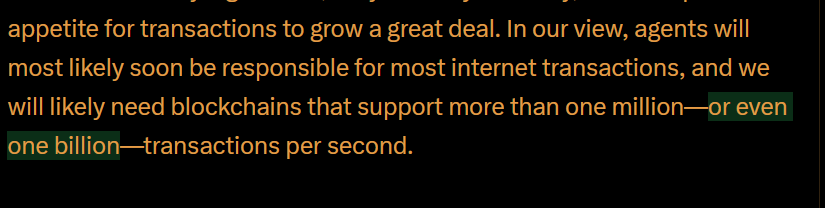
Stripe CEO says AI agents will we need a blockchain with 1 Billion TPS?! I beg your pardon.
Nic tweet media
English
424
135
1.6K
413K